Monthly Archives: April 2013

HMS Affray submarine memorial to be unveiled in Gosport

HMS Affray

HMS Affray sank off the coast of Alderney in an area known as the Hurd Deep

One of three surviving widows of 75 sailors who died in a submarine tragedy will unveil a new memorial later.

HMS Affray was on a training exercise off Alderney in the Channel Islands when it went missing in April 1951.

It was the last Royal Navy submarine to be lost at sea. It was found two months later 7.5 miles off the north west of Alderney at a depth of 280ft (85.3m).

Mary Henry, from Emsworth, whose husband Derek Foster died, is expected to attend a ceremony in Gosport later.

Another memorial to the tragedy was unveiled at Braye Harbour in Alderney last year.

HMS Affray left Portsmouth on 16 April, 1951 and submerged about 30 miles south of the Isle of Wight at 21:15 BST. It failed to resurface when it was due to at 08:30.

A search and rescue operation was launched, involving 26 ships and submarines along with available aircraft.

The Royal Navy’s official inquiry concluded HMS Affray sank because the snort mast, the tube through which the diesel engine “breathed” while the submarine was at periscope depth, snapped because of metal fatigue.

Source – BBC News

Submarines ready to enter Royal Canadian Navy fleet

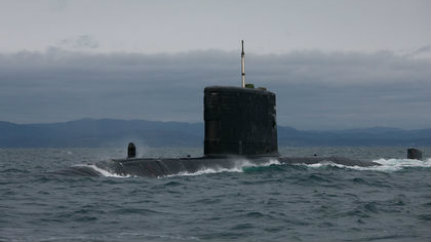
RIMPAC 2012 off Hawaii marks the first overseas deployment of the submarine HMCS Victoria

RIMPAC 2012 off Hawaii marks the first overseas deployment of the submarine HMCS Victoria

TORONTO – Run silent, run deep.

In a matter of weeks the Royal Canadian Navy will have three submarines ready to do just that.

The fourth will be in dry dock and not released until 2015.

These conventional diesel-electric boats were all purchased second  hand from Britain in 1998 and transferred to the RCN at an initial cost  of  $750 million.

Years of controversy and refit followed before last year’s historic  visit by HMCS Victoria to the RIMPAC exercises off Hawaii. That passage  culminated in its firing an MK 48 heavyweight torpedo and sinking the  decommissioned transport USNS Concord.

News that HMCS Victoria is to be joined by its sisters is welcome for  the defence establishment. For critics — of which there are many — it  is just another chapter in a convoluted tale of mismatched procurement  meeting ill-defined strategic needs.

The Canadian taxpayer has been left to pick up the now estimated $3  billion (and rising) tab prompting the question: does the RCN even need  to stay in the submarine business?

It’s in good company if it does.

Across the Pacific Rim, alone, countries as far apart as South Korea  and Australia, Indonesia and Japan, China, Vietnam, Malaysia and  Singapore operate conventional submarines.

Further afield Bangladesh is acquiring its first submarines to boost  its naval power in the Bay of Bengal while India operates 14 boats,  including a nuclear-powered attack submarine leased from Russia.

All are used for sea-lane security in a variety of scenarios  including clandestine work delivering special forces operators in  shallow coastal waters.

Still, those tasks should be viewed through an entirely different  geo/strategic setting to that of Canada’s, cautions Steven Staples,  president of the Rideau Institute, a defence and foreign policy  think-tank in Ottawa.

He acknowledges the growing submarine capabilities in other parts of  the globe but maintains Canada is historically not in the trade of  long-range power projection.

“We live in a self-evidently different neighbourhood to Asia,”  Staples said, “and our submarines are more coastal. They were designed  to sit on the sea floor during the Cold War to watch and listen for  Soviet fleet activity.

“There is a strong argument against whether we need them at all. The  three Oberon class boats that preceded the current subs were mostly used  to provide opposition training for the U.S. Navy.

“We may well find the new boats doing that as well. That’s a pretty expensive way to stay friends with an ally.”

Sitting, watching and listening. Three things non-nuclear submarines excel at.

Surely with increased shipping activity in the Arctic thanks to  receding pack ice and more and bigger ships transiting the route for a  short-cut to Europe, doesn’t it make sense for Canada to have eyes and  ears monitoring a potentially ice free Northwest Passage?

“Well, it would help if they were ever fully operational, put it that  way” Staples said. “If they could dive without hitting the ocean floor  or even remember to close hatches before submerging.

“Look, I just don’t think this project has been worth the money and  the time spent to deliver a marginal capability. I wouldn’t call it a  textbook case of how Canada should NOT go about procuring extremely  complicated defence equipment because, sadly, there are other contenders  for that title.”

If Canada eventually embraces the “use ‘em if you’ve got ‘em”  doctrine, they might want to look at what Australia did with its six  Oberon-class diesel-electric boats during the last decades of the Cold  War.

The Royal Australian Navy conducted perilous intelligence-gathering  operations off the coasts of Vietnam, Indonesia, China and India as part  of an American-led effort to check the Soviet Navy’s formidable fleet.

Between 1978 and 1992 Australian submarines would secretly track Soviet ships as they transited the South China Sea.

There were 16 patrols in all.

In one case an Australian boat famously trailed a new Soviet frigate  all the way to the entrance of Vietnam’s Cam Ranh Bay naval base and  photographed its hull shape, propellers, weapons systems and sonar. All  undetected despite being just being 1.8-metres from the frigate’s hull  at one stage.

Difficult but not impossible to replicate in Arctic waters if RCN  submariners ever get the call to covertly see just who is using the  trans-polar shipping route. And why.

Source – Sun News Network


US – Submarine commander who faked his own death to end an affair is discharged from Navy

A former submarine commander who faked his death to end an extramarital affair should be honorably discharged from the Navy, a panel of officers recommended Friday after a daylong hearing in which the officer said he accepted ‘full and total accountability’ for his behavior.

Cmdr. Michael P. Ward II, a married 43-year-old, sent his mistress in Virginia an email in July posing as a fictitious co-worker named Bob and saying Ward had died unexpectedly.

Ward was relieved of his duties aboard the USS Pittsburgh in August a week after he’d taken command and has received a letter of reprimand for adultery and other military violations.

Ward Cmdr. Michael P. Ward II, a married 43-year-old, sent his mistress in Virginia an email in July posing as a fictitious co-worker named Bob and saying Ward had died unexpectedly

After testimony from Ward’s former superior officers, colleagues and shipmates, Ward, in his dress blues, acknowledged to the panel that he had had an affair and sent the bogus email to the woman in an effort to end it.

‘The reason I did it was to sever the relationship,’ he said, ‘but the choice was ridiculous.’

He apologized to the Navy and the sailors who served under him.

The three-officer board of inquiry recommended Ward retain his rank upon being discharged. Its decision goes to the secretary of the Navy for approval within 90 days.

During the hearing, at Naval Submarine Base New London, the government countered that Ward discredited the Navy and that his removal put a strain on the fleet because officers had to be shuffled around to cover his removal.

‘Commander Ward’s actions show a complete lack of honesty, character and integrity,’ said Navy Lt. Griffin Farris, acting as prosecutor at the hearing.

Ward said he accepted responsibility for his actions and would regret them all his life, adding that he was grateful to his wife for standing by him.

‘I want to apologize directly to my wife for the hurt and harm and humiliation I have caused her,’ he said as she sat in the front row, her eyes red. ‘I accept full and total accountability for my actions.’

Still, the Navy shouldn’t throw away Ward’s talent and training, said high-ranking officers with whom he has served.

They said he made an awful mistake and was a fast-rising, hardworking officer.

Ward Ward said he took ‘full responsibility’ for his actions

Before moving to Connecticut, Ward served on the Joint Chiefs of Staff, where he used his nuclear expertise to provide daily briefings to the chairman as the Fukushima disaster unfolded following the earthquake in Japan.

Navy Capt. Lawrence Vincent, who worked with Ward in Washington, said he would serve with again and the handling of the affair struck him as out of character.

‘With Mike Ward, it was a true shock,’ Vincent said.

Ward was honest with his chain of command from the beginning, his lawyer said.

‘This man probably would have been an admiral someday, and he’s brought shame on himself, and he knows that,’ said Navy Cmdr. Daniel Cimmino, representing Ward.

But a senior enlisted sailor from the USS Pittsburgh told the panel that Ward at first denied the accusations.

The sailor, Master Chief Chris Beauprez, said he received a call on the submarine from a sister of Ward’s girlfriend, who told him what Ward had done.

Beauprez said he told Ward about the call and Ward denied the woman’s allegations, then said he’d address the situation himself.

Beauprez testified that he had an implicit trust in what his commander said so he didn’t take the matter any further.

Days later, he said, he heard Ward was being dismissed.

A fellow Navy officer who had gone through training with Ward, Cmdr. Anthony Moore, testified that he heard about the affair, including the detail that Ward had used the name Tony Moore in an online dating profile that he used to meet the woman, when news of it first surfaced.

‘I was very surprised,’ Moore, who’s based on a submarine squadron in Washington state, told the board by telephone. ‘And frankly, I was a little concerned for my reputation.’

Source – Mail on-line


India – State gets ‘retired’ Navy submarine

INS Vagli, the oldest operational submarine of the Indian Navy, was handed over to the State government on Wednesday to be converted into a maritime museum that will be established at Mamallapuram.

Vagli, decommissioned in Visakhapatnam on December 2010, arrived here on March 25. It was handed over to State Finance Minister O Paneerselvam and Tourism Minister P Chendur Pandian by Vice-Admiral Anil K Chopra, Flag Officer Commanding-in-Chief, Eastern Naval Command.

The submarine is likely to be stationed in harbour till September before being transferred for installation on about 30 acres of land abutting the beach near the Shore Temple, a UNESCO world heritage site. Chopra said that the submarine was towed to Chennai port free of cost. Paneerselvam thanked the vice admiral and sought his help in installing the submarine on at the selected site.

The ship, which will be converted into a museum,  will have food courts, audio-visual studio, souvenir shops and an aquarium. It will be planned and executed in a phased manner using the ‘build-own-operate-transfer’ model.

The Vagli, a Type 641B Foxtrot-class submarine, was commissioned by then Lieutenant Commander Lalit Talwar on August 10, 1974 at Riga, Latvia, in the erstwhile Soviet Union. It had completed 36 years of dedicated service under 23 commanding officers.

INS Vagli, the oldest operational submarine of the Indian Navy undertook her last dive. The submarine is scheduled to be decommissioned in December after 36 glorious years of service. Vice Admiral Anup Singh, Flag Officer Commanding-in-Chief, Eastern Command along with other senior officers sailed on the submarine to mark the historic occasion. In his message on the occasion, the Flag Officer commended the crew for their professionalism and enthusiasm and said that the submarine had sailed into history with pride and honour.
The submarine, presently commanded by Cdr AA Kapre, is the last of the Foxtrot class of submarines which were built in the erstwhile USSR. She was commissioned  on August 10, 1974 at Riga and since then has operated extensively on both the coasts. The submarine has participated in large number of exercises with ships and aircraft including recently concluded bilateral exercise with the Singapore Navy.
-Cdr TLP Babu from Visakhapatnam
Source – Vagli Last Dive

The Global Submarine Market 2013-2023 – Report

Reportlinker.com announces that a new market research report is available in its catalogue:
The Global Submarine Market 2013-2023

http://www.reportlinker.com/p01158672/The-Global-Submarine-Market-2013-2023.html#utm_source=prnewswire&utm_medium=pr&utm_campaign=Aerospace_and_Defense

Product Synopsis This report is the result of SDI’s extensive market and company research covering the global Submarine industry. It provides detailed analysis of both historic and forecast global industry values, factors influencing demand, the challenges faced by industry participants, analysis of the leading companies in the industry, and key news.
Introduction and Landscape Why was the report written? “The Global Submarine Market 2013-2023” offers the reader detailed analysis of the global Submarine market over the next ten years, alongside potential market opportunities to enter the industry, using detailed market size forecasts.
What are the key drivers behind recent market changes? In 2013 the global submarine market is estimated to value US$14.4 billion and is expected to grow to US$21.7 billion by 2023, representing a CAGR of 4.2% during the forecast period. The market consists of three categories: SSN, SSBN and SSK. The global expenditure on SSNs is expected to account for a major share of approximately 41% during the forecast period. The remaining expenditure is accounted for by SSBN and SSK with shares of 33% and 26% respectively.
What makes this report unique and essential to read? “The Global Submarine Market 2013-2023” provides detailed analysis of the current industry size and growth expectations from 2013 to 2023, including highlights of key growth stimulators. It also benchmarks the industry against key global markets and provides a detailed understanding of emerging opportunities in specific areas.
Key Features and Benefits The report provides detailed analysis of the market for submarines during 2013-2023, including the factors that influence why countries are investing or cutting defense expenditure. It provides detailed expectations of growth rates and projected total expenditure.
Navantia, Fincantieri, DCNS, Kockums, BAE Systems, Mazagon Docks, Hyundai Heavy Industries, Daewoo Shipbuilding and Marine Engineering, PO Sevmash, Huntington Ingalls Industries, General Dynamics Electric Boat Limited, Admiralty Shipyards, ThyssenkKrupp Marine Systems, ASC, Golcuk Naval Shipyard, Mitsubishi Heavy Industries, Kawasaki Shipbuilding Corporation, SaaB, Thales, Lockheed Martin
A significant number of countries such as the US, the UK, Germany, France, and India are currently in the process of replacing their existing fleet of submarines. Most of these submarines are being retired as they have reached the end of their operational cycle. Additionally, Soviet era submarines currently in use by countries such as Russia, India, and China need to be replaced. The demand for modern submarines creates a lucrative opportunity for suppliers across the world.
Key Market Issues The market for submarines in the Western world drastically reduced after the end of the Cold War and those possessing substantial submarine building capabilities are virtually self-sufficient in this regard. However BRIC countries and the developing economies of Southeast Asia are becoming financially able to fund a cost consuming submarine capability. China, with its anti-access strategy and its claim to the South China Sea, and North Korea, with its belligerent attitude, have triggered the demand for submarines in the Far East. Regional rivalries among countries such as India and Pakistan, and Greece and Turkey, and the push for general modernization are seen as drivers for the submarine market worldwide.
The global submarine industry requires skilled labor to design submarines and provide maintenance and upgrades throughout its operational life. However, budget cuts have led to a shortage of skilled professionals such as reactor engineers and scientists, causing a resource crunch within the industry. The UK’s submarine industry is currently facing a 14% shortage of civilian safety experts and a 7% shortage of submarine reactor engineers, largely due to a lack of defense budget allocation.
Key Highlights A submarine that draws power by onboard nuclear reactors has a nearly boundless range and advanced maneuverability. The submarine can be positioned in distant waters across the globe with no need to surface except for crew provisions every three months or so. Therefore, the innovation of the nuclear reactor is serving at least six international navies: the US, Russia, the UK, France, China, and India, all of which possess nuclear submarines.
The decreased demand for submarines in the West and the increasing number of technologically advanced sub-systems included in these vessels means that no single industry would be able to develop and sustain a submarine manufacturing base. This has gradually resulted in consolidation in the industry. There is also increasing collaboration on joint development and production activities amongst firms. For example American firms Huntington Ingalls Shipbuilding and General Dynamics Electric Boat jointly produce the Virginia-class submarines.

Table of Contents
1 Introduction 1.1 What is this Report About? 1.2 Definitions 1.3 Summary Methodology 1.4 Continue reading

Ex-Barrow submariner Craig launches charity night for naval fund

A FORMER submariner is working hard in a bid to create a  night to support a naval charity.

Craig Palmer with a football signed by Manchester City players which is among the items to be auctioned at the charity night to raise money for the Royal Navy and Royal Marines Charity. Craig was inspired to help the fund after seeing its work supporting the family of Ian Molyneux, inset, who was killed onboard HMS Astute

Craig Palmer with a football signed by Manchester City players which is among the items to be auctioned at the charity night to raise money for the Royal Navy and Royal Marines Charity. Craig was inspired to help the fund after seeing its work supporting the family of Ian Molyneux, inset, who was killed onboard HMS Astute

Craig Palmer, 24, is organising a fundraising night in aid of the Royal Navy and Royal Marines Charity.

Mr Palmer, who served onboard HMS Vigilant, said he was inspired to organise the event after his experiences serving in the forces and after seeing the support the charity provided to the family of Ian Molyneux, who died after being shot onboard HMS Astute in 2011.

Mr Palmer has already secured an array of donations set to be auctioned off at the charity night due to be held at the Nines, in Barrow, on June 20, including a signed Manchester City football, a signed Barrow AFC shirt and a bottle of House of Commons whisky.

He said: “I had friends who were onboard HMS Ambush and were injured in the shootings in 2011.

“This is my way of giving a bit back to the forces. I’ve seen firsthand how this charity can help people.

“A friend of mine died and his kids don’t have a dad. This charity helps his family but this family gives it away to so many people – it’s unbelievable.”

Craig Palmer served aboard HMS Vigilant

Craig Palmer served aboard HMS Vigilant

Mr Palmer is also hoping to put a new Mini Cooper up for grabs via a reverse auction which is due to launch at the fundraiser evening and end on December 20 with the winner named in time for some festive fun behind the wheel.

Along with the charity auction and launch of the reverse auction Mr Palmer said there will be performances from Take That tribute act Rule The World and local bands Paper Cranes and Jumbo Jamz.

Mr Palmer also said he is set to give away 50 tickets to current forces personnel.

More details about tickets are set to be released in the coming weeks

Source – North West Evening Mail


US – Women eager to join ‘brotherhood’ on Navy’s fast-attack submarines

Concerns arise about need for costly onboard changes

Navy Lt. j.g. Marquette Leveque, 25, found a “professional working environment” as one of the first female officers to train on guided- and ballistic-missile subs. (U.S. Navy photograph)

Life aboard a fast-attack submarine can be rough: Quarters are cramped,  operations are hectic and privacy is just a memory, veteran submariners say.

But as the Navy prepares to assign women to  fast-attack subs, one of its first female submariners is relishing the challenge  of serving in the “dolphin brotherhood.”

Lt. j.g. Marquette Leveque, 25, said  that serving with two other women and 150 men undersea for six months was  basically a “nonevent.”

“The biggest change I think was [the men] just getting used to female voices  around, and I mean that in a very positive way,” said Lt.  Leveque, a native of Fort Collins, Colo.

Still, other big changes — and challenges — lie on the horizon.

Women have been permitted to serve on guided-missile submarines such as the USS Ohio since 2009. Now they will be able to serve on smaller submarines used for surveillance, reconnaissance and intelligence-gathering. (U.S. Navy photograph)

The Navy, which decided to allow women to serve  on guided- and ballistic-missile submarines in 2009, announced in January that  female sailors would be permitted to deploy on fast-attack submarines, as the Pentagon lifted its ban on women in direct ground  combat jobs.

Lt. Leveque is one of the first 24  female officers selected to train on guided- and ballistic-missile submarines,  which generally avoid contact with other ships and are tasked with conducting  nuclear counterattacks.

Fast-attack subs carry out intelligence, surveillance and reconnaissance  missions; insert special operations forces into sensitive areas; lay mines; and  attack enemy ships and ground targets. From 350 feet to 370 feet long and 33  feet to 40 feet wide, they are about 200 feet shorter and 10 feet narrower than  their missile-laden cousins and carry crews of 140 — about 20 fewer personnel  than guided- and ballistic-missile subs.

‘No room to expand’

The Navy has four guided-missile and 14  ballistic-missile subs, and 54 fast-attack subs.

One reason for the Navy’s ban was the “prohibitive” cost of retrofitting sleeping and bathroom facilities on such  small vessels. No retrofitting was needed for guided- and ballistic-missile  subs, which provide staterooms that female officers share and bathrooms with  changeable signs indicating which sex is inside. Enlisted female sailors, whose  bunks provide little privacy, eventually will be assigned to fast-attack subs,  officials say.

Facilities on fast-attack subs are less spacious, and there is “virtually no  room to expand anything on these tightly packed boats,” said retired Rear Adm. Edward S. “Skip” McGinley II,  who has served on the smaller, stealthier vessels. He said part of the subs’ bunk spaces probably would have to be cordoned off to accommodate enlisted  women.

Navy Lt. j.g. Marquette Leveque, 25, found a "professional working environment" as one of the first female officers to train on guided- and ballistic-missile subs. (U.S. Navy photograph)

“That involves not just moving around [walls] and doors in quarters which are  already extremely cramped, but also doing some significant plumbing  rearrangements to establish separate sanitary facilities in a ship that is  already a plumbing nightmare,” Adm. McGinley said. “This, in my humble  opinion, may be the most expensive and difficult engineering problem to solve in  this project.”

Rob Fisher, another veteran submariner, said: “Separate areas will be very  difficult to do. Segregation of the area could be arranged, but travel-through  areas for the opposite sex will be necessary.

“I believe that women can be great submariners, but the older subs were not  built with privacy in mind.”

During a recent news conference, a senior Navy  official speaking on background said that assigning women to fast-attack subs  would incur costs, but he did not elaborate.

“Lots of plans are being discussed and [it’s] too early to tell,” said Cmdr.  Monica Rousselow, a Navy spokeswoman.

Fraternization

Other concerns include fraternization and pregnancy, especially when a  submarine might be unable to surface.

“The fraternization potential, in my opinion, would be very high.  The  fast-attack lifestyle is extremely cramped and would really need mature  personnel and leadership to enable female members to serve successfully,” former  submariner Brian Penders said, adding that fraternization on a fast-attack  vessel probably would not exceed that on larger subs or surface ships.

The Navy said it does not track data on  male-female fraternization.

According to a January report in Stars and Stripes, a recent Navy  survey found that nearly three-quarters of sailor pregnancies are unplanned. Of  those, only 31 percent were using birth control at the time of conception.

Traces of carbon monoxide, carbon dioxide and other gases in a submarine  could harm a developing child in the earliest weeks of pregnancy, when a sailor  might not know she is pregnant, said Elaine Donnelly, president of the Center  for Military Readiness and a staunch critic of women in combat roles.

Dr. Hugh Scott, a retired Navy  rear admiral, said the levels of carbon dioxide in a submerged submarine are 10  times higher that those in the open atmosphere and could damage the brain of a  fetus. He said he has called for Navy studies on the  impact of prolonged exposure on women’s fertility, bone health and developing  fetuses, but none has been conducted. Dr.  Scott served in the Office of the Chief of Naval Operations from 1992 to  1994 as director of the Medical Resources and Plans and Policy divisions.

Lt. Leveque, who is married to a  fellow submariner, said fraternization will not be a problem.

“Honestly, it’s a very professional working environment, and that doesn’t  change when we go [from port] to sea at all,” said Lt.  Leveque, one of the first three women to earn the submarine warfare officer “dolphins” pin, after nearly two years of training and a deployment aboard the  ballistic-missile sub USS Wyoming, based in Kings Bay, Ga.

She is backed by at least two other female Navy  pioneers — retired Capt. Lory Manning, who was one of the first women to serve  on a surface ship, and Capt. Joellen Oslund, one of the first six women accepted  into Navy flight school in 1972 and the Navy’s  first female helicopter pilot.

“I think [the military] threw up a lot of artificial barriers that have  finally come down, and I expect the women will do fine in submarines,” Capt.  Oslund said.

“It’s where every submariner wants to go,” Capt. Manning said. “The other  [submarines] just sort of sit out there and wait for the balloon to go up.  [A  fast-attack sub is] where every submarine admiral has to spend time.”

Source – Washinigton Post

Russia boosts its submarine exports to Asia

Two Malaysian Air Force Lady officials take a look at the two submarines from France "La Praya" and Pakistan "Hurmat" at the Langkawi International Maritime and Aerospace (LIMA '97) Exhibition 03 December in Malaysia's resort island Langkawi.
Two Malaysian Air Force Lady officials take a look at the two submarines from France “La Praya” and Pakistan “Hurmat” at the Langkawi International Maritime and Aerospace Exhibition in Malaysia’s resort island Langkawi.


During the Langkawi International Maritime and Aerospace exhibition taking place in Malaysia, Igor Vilnit, the CEO of the Russian developer of submarines Rubin, reported on the progress of a number of development projects aimed at exporting Russian submarines to Asian countries. Vasily Kashin, an expert at the Center for Analysis of Strategies and Technologies, analyzes the situation.

This year Vietnam will receive the first of six Project 636 submarines it has ordered. At present, the first Vietnamese submarine, which was named “Hanoi”, is already undergoing testing. At the beginning of this year the Vietnamese team of the future vessel started its training in Russia. Simultaneously, Russian specialists are building in Vietnam the entire necessary infrastructure for using the submarines and training the submarine personnel.

One cannot exclude the possibility that the transfer to Vietnam of the Project 636 submarines will go more quickly than what was stated by Rubin’s CEO, – suggests expert Vasily Kashin. It is known for a fact that the second submarine of the Vietnamese order has already been launched, while the third one is expected to be launched in August. It is quite possible that this year Vietnam will get two submarines and another one in 2014. All six submarines have to be transferred to Vietnam by the end of 2016.

Thus, 2013 will be used to develop the Vietnamese fleet’s submarine forces. Prior to this Vietnam tried to set up its submarine forces by purchasing two superlight submarines from North Korea, but it failed. North Korea’s light submarines turned out to be too weak in their combat capabilities.

According to Vasily Kashin, an expert at the Center for Analysis of Strategies and Technologies, the acquisition of the Project 636 submarines from Russia satisfies Vietnam’s need to defend its sovereignty at sea and in reality poses no threat to the interests of Russia’s strategic partner China. The limited submarine forces would not give Vietnam any chance of winning the battle against the Chinese fleet, which supersedes it by several times, but would allow it to preserve the status-quo with its own resources. The lack of its own effective naval forces could push Vietnam towards a closer partnership with powers from outside the region, like it happened in the Philippines’ case. Taking all this into account, the real conflict between Vietnam and China has a very low probability as China’s policy towards Vietnam is based on the maximum engagement of the Vietnamese in trade and economic cooperation.

Another promising direction for the export of Russian submarines to Asia is India. The India’s navy is getting ready to announce a tender for the purchasing of 6 non-nuclear submarines. According to Rubin’s CEO Igor Vilnit, Russia is planning to offer the Indians its submarines of the Amur-950 project. Amur-950 is a reduced version of the Amur-1650 submarines, the acquisition of which China is currently negotiating to purchase. Compared to Amur-1650 they have a lower displacement and a lower range, while their armament is just slightly inferior to that of the Amur-1650 submarines.

The specific qualities of the Amur-950 submarines include the vertical launch for 10 ballistic missiles, which if needed could be launched within 2 minutes.

The offer to the Indian Navy includes the vessels equipped with ultrasound ballistic missiles “Brahmos” jointly produced by Russia and India. Russia’s participation in the Brahmos project is considered to give a serious advantage to the Russian proposal for this tender, in which the French submarine producers are participating as well. Obviously, these submarines of a low displacement are meant to be used in the Indian Ocean only.

 At the same time, the negotiations with China are still underway to supply four larger Amur-1650 submarines, of which two are likely to be equipped with the new Russian engines which work without air supply. Due to the extended range of action, the Amur-1650 submarines can be used in the Pacific Ocean at far distances from the bases. Compared to the Project 636 submarines supplied to China earlier, Amur-1650 boats have lower level of perceptibility, which increases their chances of overcoming Japan’s system of submarine defense.

The modern diesel-electric submarines are an effective and relatively inexpensive weapon, which gives the naval forces of Asia’s developing countries a chance to stand up to the large fleets of the developed countries, believes Vasily Kashin, a Russian expert on defense issues. The experience of the Falklands war of 1982 and the subsequent naval military exercises of the NATO countries revealed that with proper management such boats can successfully overcome the anti-submarine defense of aircraft carrier combat groups.

Source – The Voice of Russia

UK must defend against North Korea’s nuclear threat, says PM – video

http://www.guardian.co.uk/politics/video/2013/apr/04/uk-defend-north-korea-pm-video

The prime minister has stressed the need for the UK to retain its Trident nuclear deterrent, saying it would be “foolish to leave Britain defenceless” in the face of the growing threat posed by North Korea andIran.

David Cameron’s insistence on the need for an independent nuclear deterrent came as the US said it was moving a missile defence battery to the Pacific island of Guam as Pyongyang continued to ratchet up the rhetoric against South Korea and its American ally.

What did Cameron say?

Writing in Thursday’s Daily Telegraph, the prime minister said such “evolving threats” underlined the need for the UK to maintain the ultimate deterrent.

“We need our nuclear deterrent as much today as we did when a previous British government embarked on it over six decades ago,” he said. “Of course, the world has changed dramatically. The Soviet Union no longer exists. But the nuclear threat has not gone away. In terms of uncertainty and potential risk it has, if anything, increased.”

Cameron said Iran was continuing to defy the will of the international community over its nuclear programme while North Korea may already be building a nuclear arsenal.

“The highly unpredictable and aggressive regime in North Korea recently conducted its third nuclear test and could already have enough fissile material to produce more than a dozen nuclear weapons,” he said.

“Last year North Korea unveiled a long-range ballistic missile which it claims can reach the whole of the United States.”

Were such a weapon to exist, he said, the whole of Europe – including the UK – would be affected.

The prime minister added: “Does anyone seriously argue that it would be wise for Britain, faced with this evolving threat today, to surrender our deterrent?

“Only the retention of our independent deterrent makes clear to any adversary that the devastating cost of an attack on the UK or its allies will always be far greater than anything it might hope to gain.”

What do the PM’s comments mean for the future of Trident?

Cameron’s comments underline the Conservatives’ commitment to a like-for-like replacement for the ageing Trident submarine fleet, although their Liberal Democrat coalition partners are seeking a cheaper alternative.

The shadow defence minister, Kevan Jones, said that while it was “absolutely right and necessary” for the UK to retain an independent nuclear deterrent, the costs involved needed to be taken into account.

“World events demonstrate that in an unpredictable era our country needs the ultimate security guarantee,” he said. “The precise nature of the deterrent must be judged on meeting military capability requirements and cost.”

The prime minister attempted to head off such questions in his Telegraph article, arguing that national security was worth the price of the deterrent.

“Our current nuclear weapons capability costs on average around 5%-6% of the current defence budget,” he said. “That is less than 1.5% of our annual benefits bill. And the successor submarines are, on average, expected to cost the same once they have entered service. It is a price which I, and all my predecessors since Clement Attlee, have felt is worth paying to keep this country safe.”

How much would renewing Trident cost?

According to conservative estimates, renewing Trident would cost £100bn. The key choice on a Trident replacement will arise in 2016, when the government will need to decide whether to spend between £25bn and £30bn on replacing the four Vanguard-class submarines, which are due to be taken out of service in the mid-2020s, with a Successor class. If the government commits to replacing the Trident nuclear deterrent fleet, the cost could swallow 35% of the military equipment budget over the coming years at a time when the MoD is facing deep cuts.

Where do the political parties stand on Trident?

The Conservatives are committed to replacing Trident with a “continuous at-sea deterrent” in which, similar to current practice, nuclear warheads on intercontinental ballistic missiles are carried on four Vanguard-class submarines.

The Lib Dems have raised the possibility of a land or air-based system or carrying smaller nuclear warheads on cruise missiles on board Astute-class submarines.

Labour has a long standing commitment to a like-for-like replacement to Trident but is believed to be rethinking it and is yet to state a firm policy.

The future of Trident is also likely to feature in next year’s looming Scottish independence referendum campaign, with the SNP insisting that it would not allow nuclear missiles to be based in an independent Scotland.

The timing of the Trident decision means it could be a major issue in the 2015 general election.

David Cameron says North Korea’s nuclear possibilities are a ‘real concern’ for the UK, after visiting a British Naval nuclear submarine in Scotland on Thursday. The PM took a tour of the submarine following the printing of an article he wrote in the Daily Telegraph, stressing the need for strong nuclear defences. At a question and answer session after the tour, Cameron says of North Korea’s weapons: ‘They can reach Europe. They can reach us too’

Source – The Guardian

UK – Annual Diesel Boat Reunion (Plymouth)

Mr MW PITKEATHY (Pitt.k)
N193 (THE COURAGEOUS EXHIBIT OFFICE)
HM NAVAL BASE DEVONPORT
PLYMOUTH
PL2 2BG
dieselboatreunion@hotmail.co.uk

DIESEL BOAT REUNION

Dear Gentlemen
I can confirm that the next Diesel Boat Reunion will be held as usual at the Weston Mill Oakvilla Social Club, Ferndale Road on Saturday 3th August 2013.
The Catering Staff at the Oakvilla have managed to keep the price at £5.00 per head for the buffet, so if you want food please make a cheque out to Mr M.W PITKEATHLY and post to the above address; I will action it for you. I would ask that if you want food that you do not leave it till the last moment to get your cheques in as I will NOT accept any cheques after the 27th July.

Please do not arrive before 1130.

1130                                       Start CHECK IN and Bar Open
1400                                       Welcome Speech.
1415                                       Buffet available.
1900                                       Start staggering out as the locals are wanting to use their bar.

As per last year there will be £2.00 door fee please which will go to the Alliance Appeal after keeping a small amount back for any expenses. Last year we returned a cheque for £1007.00 to help with Alliance Appeal which was absolutely brilliant and greatly appreciated by the RN Submarine Museum and another nice letter received from Vice Admiral Tim McClement.  So thank you one and all for your great generosity.
Concerning the email system, please do not forward funnies, round robins or support this or that campaign, E-petitions. I just delete them without reading and will certainly not forward them on to others.  Concerning emails, every time I send out a general email, I get at least 50 that bounce back for whatever reason, so please, on entry check that your email address is correct. Last reunion at the door there were at least 10 chits that the email address was illegible!
I have warned everyone that we would be going email and web only and that no letters would be sent out. Please if you know anyone that is not on email or computer literate can you please contact them and feed them the info about the next DBR thank you.
If any of you took photos at the last reunion and are willing to share them on the website can you please forward on.
Short bit from Ken Woods.
The Hoe Conservative Club (just up from the Registry Office) welcomed us two years ago and all the lads who are down for the weekend had a great time in there.  It’s somewhere to meet on the Friday night before the reunion but unfortunately last year it was closed for refurbishment and the lads were really disappointed. Now it has reopened and the Steward says we are more than welcome to use the club during our reunion weekend, frankly like all clubs they could do with the business.  Quite a few stay in B&B’s in the Hoe area so it gives them a meeting place especially the ones who travel on their own for the weekend for the DBR on Saturday at the Oak Villa.  I would appreciate it if you can mention it in your newsletter. I’ll be there on the Friday night anyway as I’m an associate member of the club.
I look forward to meeting many of you again on the 3rd August 2013.
Yours Aye
MW Pitkeathly (usually known as Pitt.k)

Advertised here as well – http://www.dieselsubmariners.co.uk/info.html