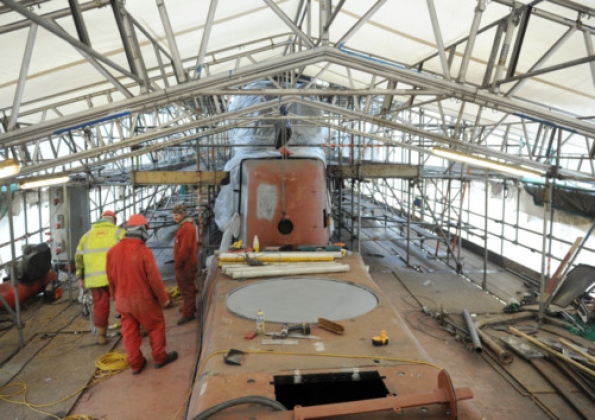
Author Archives: jasonlockley

Canada’s submarine fleet needs to start from scratch


By the time Canada's submarines are ready for duty, they'll be due for retirement.

By the time Canada’s submarines are ready for duty, they’ll be due for retirement.

Defence Minister Peter MacKay blames the Liberals for Canada’s troubled fleet of second-hand Victoria-class submarines. It was the Liberals who purchased the four British-made vessels for the suspiciously low price of $750-million in 1998. Yet it was none other than MacKay himself who, 10 years later, persuaded his Conservative colleagues not to scrap them. It was MacKay who signed taxpayers up for another $1.5-billion worth of refits and repairs, thereby throwing good money after bad.

It was apparent long before 2008 that the submarines were deeply flawed. The diesel engines were designed for railroad locomotives and not the rapid stops and starts required of submarines. There were defects in the torpedo tubes, making it possible for both the inner and outer doors to be open at the same time, even while the subs were submerged. The subs were mothballed in saltwater for four years before Canada bought them, and years more before we took possession. They suffered serious corrosion — the diving depth of HMCS Windsor is now restricted due to rust damage on the hull.

Shortly after Canada took possession, 1,500 litres of saltwater spilled into HMCS Corner Brook because of a malfunctioning Submerged Signal Ejector — a device that is used to deploy decoys while submerged. HMCS Victoria experienced serious problems with its cooling system. And a deadly fire broke out on HMCS Chicoutimi when seawater entering through an open hatch caused an electrical short in wiring that had just one layer of waterproof sealant, instead of the three layers the construction specifications had required. In 2004, the electrical system on Victoria was destroyed when the submarine was hooked up to an on-shore electric supply. The Halifax Chronicle Herald reported that the Navy spent about $200,000 after the accident “to buy old technology that mirrors what the sub’s British builders used” – equipment that one of the Navy’s own “electrical technologists” said “probably goes back to the ‘60s.”

In 2007, Windsor entered a refit that was supposed to take three years but ended up taking six. Documents obtained by the CBC later explained that every system had major problems. Spare parts are also difficult to obtain.

It was in this context that MacKay pushed for the $1.5-billion refit and repair contract, a move rendered all the more perplexing by the fact that, by 2008, the submarines were already between 15-19 years old. This meant that the most one could hope for from the vessels, after their refits, was a single decade of service.

Chicoutimi has been out of the water since the fire in 2004, and will remain in dry dock until at least the end of this year

Which is not very long when you consider that, for the same amount of money, Canada could have procured between 3-4 brand new diesel-electric submarines based on proven designs from France or Germany.

Today, five years after the $1.5-billion contract, MacKay insists the situation is improving. Which is true, if going from horrendous to bad counts as an improvement. Corner Brook was damaged in an accident in 2011 and put out of action until 2012. It is scheduled to return to dry dock for three years in 2014. In December 2012, a defect was discovered in one of Windsor’s two diesel engines, which resulted in the submarine having to operate on just one engine. This put the sub on limited duty. She will be taken out of service later this year so that the engine can be replaced. Chicoutimi has been out of the water since the fire in 2004, and will remain in dry dock until at least the end of this year. Victoria, which emerged from six years in dry dock in 2011, is scheduled to return there for three years in 2016.

According to the Department of National Defence, Canada’s four Victoria-class submarines have accumulated a total of just 1,131 days at sea in the decade since 2003 — about 30 days per submarine per year. It’s time to stop throwing good money after bad. If Canada wants to maintain this capability, we need to start from scratch.

Source – National Post

DECISION ON NEW BARROW BUILT SUBMARINES ‘MUST NOT BE DELAYED’

EXTENDING the life of Barrow-built nuclear submarines would not be safe, a top politician has claimed.

P886100.jpgds
 

Defence secretary Phillip Hammond made the admission in response to a parliamentary question asked by Barrow and Furness MP John Woodcock.

There have been fears that the government’s Trident Alternative Review could recommend a further delay in bringing in new submarines, a move that would risk leaving a gap in the order book at Barrow shipyard.

The coalition government has already ordered a four-year delay to the in-service date of the successor deterrent boats, meaning that the existing Vanguard class vessels will have served for a record 35 years before they retire.

Following a question from Mr Woodcock in the House of Com mons, Mr Hammond confirmed the life of the hulls of the Vanguard submarine fleet cannot safely be extended beyond their latest retirement date, which for Vanguard – the oldest of the boats – is 2028.

Mr Hammond said: “We have already extended the life of the Vanguard class once and it is not judged possible or safe to extend it further.”

Speaking after receiving the response, Mr Woodcock said: “This clear view from the MoD that it would be unsafe to further extend the life of Vanguard should knock on the head any idea the government could put yet another delay into the build programme at Barrow.

“Aside from the extra cost and disruption that another delay would cause, we cannot countenance asking the sailors who bravely provide Britain’s nuclear deterrent to serve in life-expired, potentially unsafe hulls.

“By 2028, the Vanguards will have done good service, but the time will have come to provide the country’s vital deterrent with new submarines rather than spend huge amounts of money to extend the life of Vanguard still further, simply so we can again postpone the urgent decision on new boats.”

Source – North West Evening Mail

US – Two submarines on deck at Electic Boat

Submitted photo courtesy of General Dynamics Electric Boat
The first module for the future USS Illinois, the 13th member of the Virginia class, arrives at Electric Boat in Groton by barge from EB’s Quonset Point facility Tuesday, June 18, 2013.
For first time in decade, shipyard builds two boats at once


Groton — For the first time in a decade, Electric Boat is simultaneously working on two submarines in its main building shed.

The first module for the future USS Illinois, the 13th member of the Virginia class, arrived by barge from EB’s Quonset Point facility Tuesday. It was placed next to the North Dakota, the 11th of the class.

Two submarines have not been side by side in Building 260 since 2003, when EB was building the USS Jimmy Carter and the USS Virginia, the first of the class.

“This is our first step to ramping up in Groton to two boats a year,” said Todd Beardsley, the ship’s manager at EB for the Illinois (SSN 786).

The first module for the follow-on submarine at EB normally arrives after its predecessor is put into the water for the first time. The “float off” for the North Dakota (SSN 784) will not happen until September or October. That submarine is on track for the fastest delivery of the class yet.

“Everything keeps getting earlier and earlier, so we’re ready to go to two boats a year,” Beardsley added.

The Navy began buying two submarines per year in 2011 but the Groton waterfront is where the final assembly and testing of submarines is done, so it is not projected to have a steady workload until 2015. EB is under contract to build the 11th through the 18th ships of the class, with Newport News Shipbuilding in Virginia.

About 600 people in Groton and Quonset Point are working on the Illinois. Next year, once all four modules are in Groton, nearly 1,000 people will be working in the yard on the submarine.

The arrival of the first module, in this case, the forward half of the engine room, is a milestone, Beardsley said, because major work on the submarine can now begin in Groton. The next task is to attach the reactor compartment to the 50-foot-long cylindrical module, he said.

Cmdr. Jess Porter, the submarine’s commanding officer, arrived in Groton on Monday to begin assembling the crew. The first group, about 35 people, will spend the next few weeks in school in Schenectady, N.Y., learning how to operate the propulsion plant, Porter said.

Porter said being in command of a new Virginia-class submarine is “a phenomenal opportunity” because the culture for the ship is set in the early stages of construction.

“That culture, in large measure, goes a long way toward building that ship to a viable and powerful platform,” he said.

First Lady Michelle Obama was named sponsor for the submarine last year.

Construction on the Illinois began in March 2011. The submarine is contracted to be delivered to the Navy in 66 months, on Aug. 31, 2016. Beardsley said his goal is to finish earlier in 2016 and to beat whatever record the North Dakota sets when it is delivered in early 2014.

Female officers will begin reporting aboard Virginia-class submarines in January 2015. Porter said that if women are assigned to the Illinois, “my ship will be ready to support that.”

Porter, 46, who is from Pocatello, Idaho, took the USS Missouri through the delivery and commissioning process as that submarine’s executive officer. He spent 12 years as an enlisted nuclear electrician’s mate in the surface fleet before being commissioned as an officer and joining the submarine force. He served on the USS Michigan and the USS Connecticut.

The shipyard is a challenging environment, Porter said, but the crew will come away from it knowing “that ship inside and out.” Porter and Beardsley met for the first time on Wednesday so Porter could see the hull section.

Outside of the bustling building shed, EB’s three graving docks are currently filled with three submarines undergoing repairs. Beardsley, who has worked at EB for 14 years, remembers when the Jimmy Carter and the Virginia were there.

“This is by far the busiest we’ve been since then,” he said.

Source – The Day

ROYAL NAVY SUBMARINER EARNS DOLPHINS THE AMERICAN WAY

Royal Navy Submariner earns dolphins - the American way

A Royal Navy submariner recently received US Navy Submarine Service “dolphins”, making him just the second UK officer to qualify on a US Navy submarine.

It has been a tough process, but getting my US Navy dolphins is one of the highlights of my career and I have enjoyed every minute of it.

Lieutenant Matt Main RN

Lieutenant Matt Main has already earned his Royal Navy dolphins – the unique badge which signifies a qualified submariner – but on June 10 he was presented with the US equivalent after a gruelling 27 month training and qualification process.

Matt, a Marine Engineer (Submarines) in the Royal Navy, was presented with the US dolphins by Commander George Perez, Commanding Officer of the USS New Mexico, after his success as part of the US-UK Personnel Exchange Programme.

Fully integrated into the crew of USS New Mexico, Matt is currently the Damage Control Assistant and will become the Assistant Engineer in due course before returning to the Royal Navy.

US Navy submarine officers must qualify both forward and aft to earn their dolphins and so, for Matt, learning to drive the submarine both surfaced and submerged has been a unique experience.

“It is a real privilege to serve on this fine submarine with such a professional, motivated crew,”

said Matt.

“It has been a tough process, but getting my US Navy dolphins is one of the highlights of my career and I have enjoyed every minute of it.

“The welcome I received when I reported on board a year ago was incredibly warm and I am proud to call these men my brothers.”

Commander Perez said:

“After a fast-paced, demanding year of intense operations, Lieutenant Main has earned his gold US dolphins.

“He is fully qualified to stand Officer of the Deck on USS New Mexico and will do so repeatedly over the next year as he assumes an even larger role in the day-to-day operations of the ship.

“When an officer earns his dolphins in the US Navy, it signifies that they have demonstrated, through performance as the Officer of the Deck, a thorough understanding of all aspects of submarine operations.”

Lieutenant Main was presented his dolphins during a ceremony alongside HM Naval Base Clyde. Witnessing events were the crew of USS New Mexico as well as Royal Navy colleagues.

Matt is the second Royal Navy officer to earn US Navy submarine dolphins, with the first, Lieutenant Commander Ralph Coffey, receiving his after serving with USS Providence from 2010-12.

Source – Royal Navy Website

HMS Alliance – Submarine close to surfacing again

Alliance

The HMS Alliance refurbishment at the Royal Navy Submarine Museum in Gosport. Standing on top of the submarine

In less than three weeks the refurbished hull of a Second World War era submarine will be revealed for all to see.

Piece by piece the scaffolding surrounding HMS Alliance at the Royal Navy Submarine Museum, in Gosport, is being taken down.

The final section is due to be removed early next month.

It will be a major milestone in a project that has already seen many.

Sitting atop her home on a concrete cofferdam, she will, for the first time in decades, be looking her best.

A gleaming black finish – itself painted on top of anti-corrosive paint and a holding coat – will mask the major work embarked upon in October 2011 to restore her.

Alliance had suffered such corrosion that huge parts of her were damaged so badly they had to be replaced, rather than repaired.

Bob Mealings is the curator at the museum and calls sections of the submarine, which is not yet finished, ‘a real work of art.’

But he added if this project had not been started, the ‘irreplaceable’ submarine would have been lost to the public.

‘Eventually I think she would have been in such a poor state you couldn’t have opened her to the public,’ he says.

‘She would have become a health and safety hazard to people surrounding the submarine because bits were dropping off.

‘And also she would have been an environmental hazard because the rust and the paint coatings, all of which are not supposed to be in the water, gradually dropping off and contaminating the sea around us.

‘And she is the only surviving Second World War submarine – she’s irreplaceable.

‘It would have been a major loss for UK maritime heritage, for naval heritage and indeed for Gosport, as the town that is essentially the historical home of the British submarine service.’

She is also a memorial to the 5,300 British submariners who have lost their lives in service.

At the end of £6.7m project in March 2014, Alliance will have been bought another 60 years.

To get to that stage, the restoration so far has been nothing if not extensive.

Around 40 tonnes of new steel has been put into the boat to replace parts that were beyond repair.

Bob adds: ‘The restoration itself has included absolutely everything.

‘Down at the bow, by the bow’s keel, we’ve had to restore from the bottom of the keel all the way up and all the way down.

‘All of that has been blasted back and repainted and a lot of welding repair work carried out.

‘The bow is a very good example of the challenge of producing a really good restoration in terms of the quality of workmanship.

‘To actually roll steel plate and weld it in that [compound curve] shape is a real work of art, it’s real craftsmanship.’

The work has been guided by the 1945 original build drawings, supplied to the museum by BAE Systems at Barrow-in-Furness.

But that has not made it plain sailing for Portsmouth-based firm ML UK which has carried out the work.

Getting access to certain parts has been difficult.

That included the ballast tanks, which could only be accessed by cutting through the hull.

‘There are dozens of ballast tanks aboard Alliance,’ says Bob.

‘Every one of them has had to be opened up, blasted and repainted in order to preserve the interior.

‘The shot blasters have had to go in there and blast all the rust away, the painters have had to go in there and paint.

‘Some of the work in the confined spaces has been challenging.

‘It’s in the nature of the way submarines are constructed, they’re not the easiest thing to work on and maintain.

‘There’s so much machinery crammed into confined spaces.

‘Simply obtaining access to various parts of the submarine has been one of the challenges of the project.’

A major consideration during the restoration work has been safeguarding against any future corrosion.

And that has meant protecting the boat, which is on the historic ship’s register, against birds.

The A-Class’s casing has more than 100 distinctive free-flood holes.

But each one of them is now covered with mesh to stop it becoming an aviary.

Bob said: ‘A lot of the superstructure of a submarine is free-flood, so when it dives, water floods into these spaces, which is obviously meant to happen.

‘The problem with a preserved historic submarines is that birds like to go in there and nest.

‘Every one of these free-flood holes, and they’re all over the hull of the submarine, has to be meshed over.

‘It’s a shame because it’s a very distinctive feature of a Second World War submarine to have all these holes but a bit fatal when you’re trying to protect it.’

‘Birds contaminate the boat with their guano but they also make it unhygienic to work on.

‘At the height of the problem there were probably 200 birds nesting or associated with the boat.

‘Now we’re down to a handful of stragglers.’

Instead, regular groups of visitors can be found aboard, being shown around by one of the museum’s many volunteers.

When the programme of work is completed, visitors can see what it was like for 65 crew and six officers that used to be on board.

A state-of-the-art sound and lighting system will bring the boat to life.

She is open for visitors now and museum staff are keen to share their enthusiasm for her with others.

Volunteering

JUST as museum staff want the submarine to be open to the public, so is the restoration work itself.

An army – or crew – of volunteers has been taken on to help with the work.

Roy Furse, a former member of the Fleet Air Arm, is a conservation volunteer.

The 67-year-old, from Seafield Road, in Portchester, will be working on bringing some of the electronic equipment back to life.

He was busy in a workshop at the museum when he spoke to The News.

He said: ‘I’ve been working on the submarine.

‘I’ll be working on the electronics, which is quite exciting, trying to get some of it working again for lights and visual effects.

‘I worked at IBM for 28 years in project management and needed something really different and this is it.

‘It’s keeping the past alive, and people not involved with the sea can come and

see what it was all about years and years ago.’

Mr Furse has been volunteering on the project for three months.

Volunteers are given initial training but are given space to fit into the project.

Curator Bob Mealings added that the museum hopes the volunteers involved will stay for the long term to help with the upkeep of the fully-restored vessel.

He said: ‘We’d like people around to help us maintain the submarine in the long term.

‘There are all sorts of projects on board the boat, which we won’t get a chance to sort out before March next year when we relaunch.’

To volunteer on the project, call (023) 9251 0354, extension 231.

Fundraising events

EVEN after getting £3.4m from the Heritage Lottery Fund, refurbishing a submarine is a costly business.

Bosses need around a further £200,000 to hit the project’s target.

Those behind the £6.7m project run fundraising events to bring in more cash to pay for the work.

And this week a travelling speaker, with the stage name of Eric, will be talking at the museum to help bring in the cash.

Fresh from a world tour, which included Australia, London and Leicester, the former submariner will talk about the secret world of submarines.

Tickets cost £10 for the show on Thursday at the museum.

Then on Thursday, July 18 from 7pm to 9pm, the museum’s own archivist will give a talk.

George Malcolmson will give his talk, Donald’s Navy 1900 – 1945, about the seaside artist Donald McGill.

And on Thursday, September 12 a dinner aboard HMS Victory will raise cash for the ongoing restoration.

Diners are invited to enjoy fine dining and fine wines on Admiral Lord Nelson’s Lower Gun Deck in aid of the restoration appeal.

The night will be in full naval tradition style and will end with a prize auction.

All tickets can be bought online at supportusalliance.co.uk or by calling (023) 9254 5036.

To support the cause further, become a friend of the museum on rnsubmusfriends.org.uk

Source – The News

Barrow submarine heritage dream hits rocks after news HMS Onyx to be scrapped

DREAMS of a submarine heritage centre in Barrow have suffered a blow as the proposed centre piece is due to depart for the wreckers’ yard.

HMS Onyx has been sitting in Barrow since May 2006 when a group of submariners, led by Terry Spurling, helped bring the boat back to Barrow.

The group had hoped the boat would become an interactive centre piece at a submarine heritage centre but the plans ran into trouble after the group could not secure funding from the Heritage Lottery Fund without the backing of Barrow Borough Council or Cumbria County Council.

As the boat is prepared to be towed to Hull, where it will be dismantled, Mr Spurling said the dream of using a submarine is no longer possible.

He said: “It’s sad for Barrow that it’s going but there’s now no chance of getting a submarine.

“It was the last O-class (Oberon) class submarine available and it’s about to be made into razor blades.

“It’s the end of the dream based around a submarine but I still believe there’s a heritage story to tell.”

Mr Spurling said the decision had been taken after HMS Onyx had been sitting in Buccleuch Dock for the best part of seven years – which has led to rusting and corrosion.

He added: “When the climate is right and when there is money available I think there will be some-thing.

“We have a paintings collection at Barrow Town Hall, a large book collection and a lot of hardware and materials that have been loaned to Faslane.”

Mr Spurling said he understands the reasons Onyx is to be scrapped but added he is sad the heritage centre has lost its centre piece.

Source – North West Evening Mail

Vietnam acquires 2 submarines from Russia

 The much-awaited arrival in August of the Philippines’ second warship BRP Ramon Alcaraz from the United States has been matched by Vietnam with its acquisition of two submarines from Russia.

On the other hand, a US lawmaker has been reportedly calling on Washington to sell conventional submarines to Taiwan.

“We are not girding to go to war with any country. Our capability upgrade program is only aimed at building a credible territorial defense for the country,” a senior security official said over the weekend, referring to an apparent arms race in the Asia-Pacific region.

Defense and security monitoring showed that two diesel-electric Kilo-Class submarines are to be turned over to the Vietnamese Navy this September by Russia’s Admiralty Shipyard under Vietnam’s $2-billion Project 635.

Meanwhile, Taiwan-based Central News Agency reported last Thursday that New Jersey Rep. Robert Andrews wrote US Defense Secretary Chuck Hagel, asking him to find ways to support Taiwan’s acquisition of diesel electric submarines.

“Yes, we are lagging behind in terms of military capability but on the positive note, our Navy will get another ship with the scheduled arrival of BRP Alcaraz to guard and defend the country’s maritime sovereignty” the official stressed.

BRP Alcaraz lifted anchor at South Carolina last week on her voyage to the Philippines after undergoing almost a year of refurbishment and retrofitting of its weapons.

The high endurance cutter was acquired by the Philippine Navy last year under the Excess Defense Article Military Assistance Program of the US.

Formerly called USS Dallas, the second Hamilton-class cutter is expected to be deployed in areas in the West Philippine Sea where China had been building up its presence.

The US delivered its first Hamilton-class cutter to the Philippines in December. Renamed BRP Gregorio del Pilar, the vessel – the Philippine Navy’s biggest – is now patrolling the West Philippine Sea, particularly near Recto Bank.

The Philippines, Brunei, China, Malaysia, Vietnam and Taiwan have territorial claims in the Spratly archipelago.

To date, 18 Chinese surveillance vessels have been monitored in the Philippines’ exclusive economic zone. Three of these ships have taken up position near Ayungin Shoal.

Source – ABS/CBN

Canadian submarine fleet’s future could be at risk

No mention of sub replacements in $33B National Shipbuilding Procurement Strategy, report says

The HMCS Chicoutimi sits aboard the heavy lift ship Tern in Halifax harbour on April 6, 2009. The vessel was transported to Victoria for a refit.The HMCS Chicoutimi sits aboard the heavy lift ship Tern in Halifax harbour on April 6, 2009. The vessel was transported to Victoria for a refit. (CBC)

Stealth and silence are hallmarks of the Royal Canadian Navy’s submarine fleet but those qualities may also apply to the federal government’s vision for the beleaguered force, says a new report released Tuesday on the future of the navy’s sub squadron.

The report, titled “That Sinking Feeling” said there are indications that the future of submarines in the navy may be as shaky as the spotty service record of the second-hand Royal Canadian Navy subs.

A hint of looming doom for the submarine fleet could be that there is no mention of replacements in the much-touted National Shipbuilding Procurement Strategy (NSPS), said the report, which is produced by the Rideau Institute and the Canadian Centre for Policy Alternatives.

“Nowhere in the plan is there any mention of one particular, significant, readily identifiable and probably imminent procurement — namely, the replacement of Canada’s troubled Victoria-class submarines,” the report said.

The report is co-authored by Stewart Webb, a researcher with the Rideau Institute, and Professor Michael Byers, a University of British Columbia defence expert.

Byers has been critical of both the Harper government and Canada’s military procurement strategy in the past. In 2008, Byers sought the New Democratic Party nomination for the federal riding of Vancouver Centre but lost to Liberal incumbent Hedy Fry.

The government plans on spending $33 billion over the next three decades replacing the ships of Canada’s navy.

New supply and logistics ships, a fleet of Arctic patrol vessels and up to 15 replacements for the navy’s front-line frigates and destroyers are planned. But submarines, which the navy claims are vital to Canada’s defence, do not surface in the ambitious warship construction program.

“Canada’s Victoria-class submarines may have as little as one decade of remaining service-life, and too many mistakes have been made with submarine procurement in the past,” the report said.

Victoria-class fiasco

The report chronicles the history of Canada’s dabbling with submarines — from the failed attempt to build up to a dozen powerful nuclear submarines in the late 1980s to the decision to buy four mothballed British submarines that had to be retro-fitted around an American-supplied torpedo.

By the time Canada decided to buy the four bargain-priced submarines, the oldest had spent a total of nine years languishing in salt water without a crew.

“Unfortunately, the apparent bargain quickly became a costly fiasco,” states the report.

The report provides a scathing account of the “inferior vessels” since the first sub, HMCS Victoria, entered service in the Canadian navy in 2000.

The time all the submarines have spent at sea is a telling number.

While in service with the British navy for four years, the subs spent 1,077 days at sea. But after 13 years in service with the Canadian navy, the boats have spent only 783 days patrolling, the report said.

One sailor was killed and several others injured because of a fire aboard the submarine HMCS Chicoutimi and there have been constant, and later confirmed, reports of cracked valves, a dented hull, shoddy electrical systems, rusted parts and cost overruns.

CBC reported last month that HMCS Windsor’s planned two-year refit actually lasted five years and cost $209 million.

After the submarine was relaunched in Halifax in the fall of 2012 it was discovered that one of the vessel’s two generators didn’t work, resulting in the submarine being restricted to near-home waters until the multi-million generator can be replaced. That replacement might not happen for years, confirmed the navy.

The federal government signed a controversial $1.5 billion contract in 2008 with the Canadian subsidiary of a British-based company to provide “in-service support” for the submarines.

But Tuesday’s report said that money could have funded a new fleet of state-of-the art submarines.

“The Harper government could have procured three to four brand new diesel-electric submarines, based on proven designs from France, Germany, or Sweden,” states the report.

Future plans sketchy

The report challenges Canadians to decide whether the navy needs submarines or not but it also ponders whether the Harper government is quietly planning to procure new submarines.

Military brass have made it clear that submarines are front and centre in its plans for Atlantic, Pacific and Arctic defence. But the government has not been so forthright.

“There is clearly a desire within [the Department of National Defence] and the Canadian Armed Forces for the procurement of new submarines. But the absence of submarines from the NSPS remains unexplained,” write the authors.

The report suggests there may be three possible scenarios for Canada’s submarine future: a possible secret plan for the Victoria class replacement; a possible secret plan to terminate Canada’s sub capability; or there is no plan to either keep or replace the current fleet.

“Condemning Canada’s submarine program to death through neglect and obsolescence rather than design,” the report said.

Other countries have decided to scrap submarine capabilities altogether.

The Danish navy pulled the plug on its sub fleet, and the possibility of new submarines in 2004 after a national debate.

Instead of subs, the Danes opted to build a small but mighty fleet of surface ships to patrol in both home and international waters.

But many other countries have decided to invest in submarines as the ideal way to deny other nations access to their waters.

China, India, Iran, Chile, Malaysia and Israel are all building or buying new fleets of advanced submarines.

The report said there are several submarine designs Canada might consider to replace the aging but low mileage Victoria class submarines.

The German-built U-214 class has the ability to remain underwater for weeks at time because of new air-independent technology.

Canada’s submarines must surface, or send mast to the surface, several times a day in order to charge batteries.

New submarines like the French Scorpene or Swedish Gotland would allow Canada to patrol under the ice in the Arctic and do so with just 25 sailors — half the crew needed for the Victoria class.

But if history is any guide, it takes Canada 15 to 20 years to design and build a new class of complex warships.

“The best-before date of Canada’s Victoria-class is approaching, perhaps as soon as 2023,” warns the report.

Cmdr. Hubert Genest, with the navy’s public affairs office, told CBC News that the navy plans to operate the Victoria-class submarines until the late 2020s, saying that the navy has “always said that the Victoria-class submarines was the bridge to the next generation of submarines for Canada.”

Source – CBC News

UK – Forgotten logbook reveals bid to raise WWI submarine

The forgotten logbook of a former Royal Navy diver has revealed a fascinating  insight into attempts to raise a unique First World War submarine that sank more  than 80 years ago as the result of a tragic accident.

The faded and yellowing diary was rediscovered by the family of Plymouth-born  Albert “Bob” Smale who, as a 23-year-old recently-qualified navy diver took part  in a year-long salvage operation to raise the world’s very first underwater  aircraft carrier, HMS M2.

  1. Lee Smale, 62, pictured with his father's logbook

    Lee Smale, 62, pictured with his father’s  logbook

  2. The world's first underwater aircraft carrier HMS M2 in action with her two-man Parnell Peto biplane – the ship sank while on a routine training exercise off West Bay, Dorset, in 1932

    The world’s first underwater aircraft carrier HMS  M2 in action with her two-man Parnell Peto biplane – the ship sank while on a  routine training exercise off West Bay, Dorset, in 1932

  3. Lieutenant Commander Lionel 'Buster' Crabbe disappeared in the murky waters of Portsmouth Harbour

    Lieutenant Commander Lionel ‘Buster’ Crabbe  disappeared in the murky waters of Portsmouth Harbour

  4. Albert 'Bob' Smale during his Royal Navy career, in which he served as a diver

    Albert ‘Bob’ Smale during his Royal Navy career,  in which he served as a diver

Lee Smale, 62, of Plymouth,  the youngest son of four children born to Bob  and Gladys Smale, remembers his father’s logbook from childhood.

He said: “The logbook had always been in the family but we’d never really  given it much thought. He died in 1968 but it was only when we began sorting  through my mother’s things when she moved into sheltered accommodation that it  resurfaced.

“But looking through all his belongings and coming across the logbook again,  the family recognised its significance.”

The M2 was one of four “M” class submarines put into service during the First  World War and following the cessation of hostilities was modified to carry a  small two-seater Parnell Peto biplane.

Intended for aerial reconnaissance during advance scouting missions, the aircraft had hinged wings to allow it to fit within a specially designed watertight hangar. Launched by hydraulic “catapult”, the Peto was recovered via a deck-mounted crane on its return.

On January 26, 1932, during a routine training exercise off West Bay, Dorset,  after advising her support vessel of her intention to dive, all contact with the  M2 was lost and the submarine disappeared without trace.

A major search ensued but with her position unknown it was eight days before  the M2’s location was eventually discovered.  All of the vessel’s   60-strong  crew lost their lives in the tragedy – believed to be a direct consequence of a  failure to secure the submarine’s hangar doors before diving.

Lying upright on the seabed at a depth in excess of 30 metres, the Royal Navy  salvage team, hindered by the strong tidal currents that swirled around the M2,  worked around the clock for   11 months to seal the hull before filling the  vessel with air to refloat the stricken submarine.

However, as the salvage attempt reached its final stage, and only six metres  from the surface, a heavy gale resulted in the operation being aborted and the  M2 dropped back down to the seabed.

The neat handwritten pages of the logbook initially record Mr Smale’s diver  training, but further examination  revealed a passage dedicated to the M2  salvage work carried out by himself and his colleagues.

Under a heading entitled “M2 Salvage,” Mr Smale describes the “method of  sealing hatches with cement”.

“Hatch is closed down and then a layer of small bags filled with cement is  placed on top, and then a few buckets of loose cement is put on to fill in the  spaces between bags,” he wrote.

The logbook also contains a detailed hand-drawn illustration of the submarine  showing its position, features and amendments before the failed lifting  operation.

The difficulties of working at such a depth, contending with strong tides,  poor visibility and bad weather while dressed in the heavy brass helmets of the  era are also conveyed in detail in a collection of newspaper cuttings pasted  among the book’s pages.

The Dorset Echo newspaper reported: “He has an electric torch swung around  his neck. The feeble illumination of this helps him when the torch is held  close, but his principal asset is a sense of direction acquired by experience  and that astonishing sensitiveness of touch which utter darkness gives to a  diver as to a man who is blind.”

“My dad had quite a varied and distinguished career,” said Lee, who also has  a certificate in recognition of his father’s Mention in Dispatches during the  Wanhsien Incident on the Yangtze River, China in 1926.

Going on to achieve the rank of Petty Officer, Bob Smale was a contemporary  and close friend of Lionel “Buster” Crabb, the Royal Navy frogman who  disappeared in mysterious circumstances at the height of the Cold War.

Lieutenant Commander Crabb, came to prominence for his pioneering work in  underwater bomb disposal during the Second World War and while he had all but  retired by 1955, just a year later he was recruited by MI6 to investigate an  advanced propulsion system used by the Soviet cruiser Ordzhonikidze during the  vessel’s visit to the United Kingdom.

On the evening of  April 19, 1956, Crabb descended into the murky waters of  Portsmouth Harbour on what was to be his final mission and was never seen  again.

Several months later the headless and handless corpse of a diver was  discovered floating in a nearby harbour, but this was not the end of Commander  Crabb’s story.

At the inquest into Crabb’s disappearance, the coroner’s report suggested the  body was in all probability that of the missing 47-year-old OBE and George Medal  holder – despite the lack of firm evidence which could have been provided by  fingerprints or dental records.

Unsurprisingly, various theories abounded as to Crabb’s fate: he was killed  by a Soviet sniper; eliminated by MI5 or even defected to the USSR to head their  military diving team.

However, Lee Smale is adamant that his father’s friend did not die on that  fateful night.

“He and my father were apparently very close and he told members of the  family at the time that he didn’t believe for one minute that Crabb was dead,”  he said.

With her protected status as a War Grave, the wreck of HMS M2 has now become  popular dive site with recreational scuba divers.

Allowed to dive her remains on a “look-but-don’t-touch” basis, the modern-day  diver can observe the M2’s final resting place, just as Bob Smale did more than  80 years ago.

Source – This is Cornwall

Tangled in red tape, India’s submarine fleet sinking

 
Tangled in red tape, India's submarine fleet sinking
The Indian Navy is making do with just 14 aging conventional diesel-electric submarines.
NEW DELHI: The navy’s desperate attempts to rescue its sinking underwater combat arm have been dealt a double whammy. First, the ongoing project to construct six Scorpene submarines has been delayed by another 14-18 months, with the first vessel now slated to roll out of Mazagon Dock Limited(MDL) by November 2016 at the earliest.More worryingly, the new project to construct six advanced stealth submarines, armed with both land-attack missile capabilities and air-independent propulsion for greater underwater endurance, is still stuck in political apathy and bureaucratic red-tape. It has already been examined by three committees after being granted “acceptance of necessity” in November 2007.

The finance ministry has now again returned the file for the over Rs 50,000-crore project, code-named Project-75India, to the defence ministry for clarifications.

“The draft Cabinet Committee on Security (CCS) note for P-75I is simply being tossed around with no resolution in sight. The global tender or RFP (request for proposal) for it can be issued only after the CCS approves the file,” said a source.

Even if the P-75I tender is floated today, it will take at least three years to ink the contract with the selected foreign collaborator, and another seven to eight years after that for the first submarine to be built.

With the over Rs 23,000 crore Scorpene (P-75) project already running four years behind the original 2012-17 induction schedule, alarms bells are now ringing. The navy is making do with just 14 aging conventional diesel-electric submarines — 10 Russian Kilo-class and four German HDW ones — which are to be progressively retired in the coming years despite life-extension refits. China and Pakistan, meanwhile, are adding muscle to their underwater combat fleets.

Way back in 1999, the CCS approved a 30-year submarine-building plan, which envisaged induction of 12 new submarines by 2012, followed by another dozen by 2030. But the government’s inability to plan and take decisions means the navy is yet to get a single submarine 14 years later.

P-75I is embroiled in a debate over the “selection of Indian shipyards” and the “indigenization level to be achieved”. While two submarines are to be imported, four will be constructed in India.

The navy wants private shipyards to be involved in the project to save time since MDL is overburdened with orders. But the MoD’s defence production department has insisted that three will be built at MDL in Mumbai and one at Hindustan Shipyard in Visakhapatnam.

The Scorpene project, with contracts being inked with French firms in October 2005 has been grossly mismanaged, with huge time and cost overruns. The deal for the ‘MDL procured material packages’, including sensors, propulsion and the likes, with the French firms was signed only last December. The order for heavy-weight torpedoes to arm the submarines is also yet to be placed.

Projections show only five to six of the present 14 Indian submarines will be fully operational by 2020. Even with a few Scorpenes by then, India will remain far short of the minimum 18 conventional submarines required to deter Pakistan and China.

Source – Times of India