Author Archives: jasonlockley

U36: Another Fuel Cell Submarine for the German Navy

HDW Class 212A submarine

One of the most modern non-nuclear submarines in the world has been named during a ceremony at the shipyard of ThyssenKrupp Marine Systems GmbH, a company of ThyssenKrupp Industrial Solutions AG. This marks another important milestone in the ongoing shipbuilding programme for the German Navy: U36 is the second boat of the second batch of HDW Class 212A submarines destined for operation in the Navy. The German town of Plauen has assumed sponsorship for U36. The ultra-modern submarine was named by Silke Elsner, companion to the Mayor.

The contract to deliver a second batch of two HDW Class 212A submarines was signed on 22nd September 2006 in Koblenz with the German Office for Military Technology and Procurement/BWB (now the German Office for Equipment, Information Technology and Employment of the Bundeswehr/BAAINBW). The submarine building activities are taking place at the shipyards of ThyssenKrupp Marine Systems in Kiel and Emder Werft- und Dockbetriebe in Emden.

The two additional units will be largely identical to their sister ships from the first batch. They are also equipped with the HDW air-independent fuel cell propulsion system which has already given excellent results in operations with the boats of the first batch. The German Navy submarine U32 gave renewed proof of this in April 2013. On the way to participate in naval exercises in the USA the boat produced a new record for non-nuclear submarines with 18 days in submerged transit without snorkelling.

To meet changes in operational scenarios and to take constant technological advances into account, a number of modifications have been made in the second batch:

  • Integration of a communications system for Network Centric Warfare
  • Installation of an integrated Sonar and Command and Weapon Control System
  • Installation of a superficial lateral antenna sonar
  • Replacement of one periscope by an optronics mast
  • Installation of a hoistable mast with towable antenna-bearing buoy to enable communication from the deep submerged submarine
  • Integration of a lock system for Special Operation Forces
  • Tropicalisation to enable world-wide operations.

The Italian Navy has also decided in favour of a second batch of two HDW Class 212A submarines, which are being built under licence by the Italian shipyard Fincantieri. That means that the Italian Navy will soon also have four boats of this class available for operations.


U36 – Technical Data:

General boat data:
Length over all: approx. 57 m
Height including sail: approx. 11.5 m
Maximum hull diameter: approx. 7 m
Displacement: approx. 1,500 t
Crew: 28
Pressure hull built of non-magnetic steel

Propulsion system:
Diesel generator
SIEMENS Permasyn® motor
HDW fuel cell system [SIEMENS PEM fuel cell]
Low-noise skew-back propeller

Source – Fuel Cell Today

Mystery of French submarine disasters can never be unveiled


Mystery of French submarine disasters can never be unveiled. 50107.jpeg


The death, or rather, sudden disappearance of Eridis submarine of the French fleet stirred heated debate in the world. The tragedy occurred early in the morning on March 4, 1970. Despite the fact that the site of the tragedy was found almost immediately, it took specialists almost two months to find the submarine itself. This is not the only mysterious detail about the disaster.

Generally, there is very little information about French submarine Eridis. In contrast, dozens of books have been written and several documentaries have been made about the death of Russia’s Kursk submarine. A well-known documentary on the Kursk disaster was filmed by famous French journalist Jean-Michel Carre. The reason and basis for the film, as the author of the film admits, was the article published on the Pravda.Ru website three years after the death of the Kursk.

During the International Film Festival of marine and adventure films “The Sea is Calling,” which takes place in St. Petersburg, the author of this article had a chance to talk to the former commander of France’s third nuclear submarine, Rear Admiral Jean-Marie Mate. The admiral did not reveal any special secrets about the Eridis other than those that can be found in the open press, albeit in limited quantities. Jean-Marie Mate pointed out that submariners, whatever their nationality might be, always remain heroes. Figuratively speaking, they have only one nationality that is directly connected with their profession that is equally difficult and dangerous in all navies of the world.

But still, why did the death of Eridis submarine receive so little attention in the press, books and movies? The disappearance and death of this submarine in the Mediterranean Sea used to be a worldwide sensation … The secret of secrets. However, we managed to find some information on the subject. We had to resort to the help of translators from French and dig into into the archives of the Russian, or more precisely, Soviet Navy (the Russian military also investigated the disaster). Here’s what we found out.

The Eridis submarine belonged to the Daphne class of diesel-electric submarines. There were eleven submarines of this type built for the French Navy, and all of them were named after mythical goddesses, nymphs and dryads. Submarines of this class were built for the navies as Spain, Portugal, South Africa and Pakistan. The full water displacement of the submarine made up a little more than a thousand tons. It was about 58 meters long and was outfitted with 12 torpedo tubes (which was a bit more than any Russian submarine of the class had).

According to historical information that can be found in Russian sources, the construction of submarine S-644 Eurydice began in July 1958 at Direction des Constructions et Armes Navales shipyard in Cherbourg. The sub was launched on June 19, 1960, and on September 26, 1964 the submarine was passed into service. Its service was common for French submarines: combat training of the crew, patrolling the southern coast of France and North Africa and escorting civilian vessels with important goods. The Eridis has never traveled outside the waters of the Mediterranean Sea.

Early in the morning of March 4, 1970, the Eridis left the base of Saint-Tropez. There were 57 people on board. At sea, the submarine, in cooperation with aviation, was supposed to exercise the search and conventional attack against a submarine of a potential enemy. For this purpose, the Eridis was in touch with the basic patrol plane Atlantic that took off from Nimes-Garon naval air base. The sea seemed to be calm at first. Interestingly, pilots saw the periscope breaker of the Eridis when the sub was about seven miles to the south-east off Cape Camara. Communication was normal. Suddenly, early in the morning, at 7.13 a.m. local time, messages from the Eridis ceased to arrive. The Atlantic aircraft lost the radar contact with the submarine …

In his last radio message, the submarine commander said that he was taking the course in the area of ​​the exercise and was preparing to submerge. Very quickly, almost immediately after the break of connection, naval aircraft and anti-submarine vessels began to look for the lost vessel. The French navy sent everything that was available into the sea: surface ships Surcouf, Dyuper, Picard, Vendée, Alert, Arago, Jean Charcot, six minesweepers, Daphne and Doris submarines, as well as airplanes and helicopters. The Italians and Americans also took part in the search: they sent four minesweepers and the Skylark rescue boat.

The approximate area of ​​the death of Eridis was found quickly. The place, where patrol aircraft Atlantic saw the submarine during the last session, was found as well. A large spot of diesel fuel, pieces of plywood and a punch card with the name “Eridis” were found some time later. The remains of the submarine proved that the submarine had sunk. Experts began to investigate the disappearance of the submarine. They analyzed samples of the diesel fuel that was found on the water surface. The analysis showed that the fuel had a high content of sulfur, which was characteristic of the fuel of the lost submarine.

Four days after the start of the search, the administration of the French Navy announced the Eridis and 57 members of its crew perished. Officers on rescue ships removed their caps, and all ships of the French fleet blared their horns in memory of the victims.

Some time later, after analyzing the data of seismographs of coastal surveying laboratories, it was found that there was an explosion recorded on March 4th, at 7.28 a.m.. The place, where the tragedy occurred, was found quickly. However, it took specialists quite a while to find the submarine itself.

The relatives of the dead sailors demanded the submarine be found at all costs and the cause of its death be established. The French government asked the United States to assist in the search for Eridis. American rescue ship Mizar arrived in Toulon: the vessel successfully demonstrated her abilities during the search for the Thresher submarine. It was only on April 22, more than 1.5 months after the death of the submarine, when the Americans detected and identified several large fragments of Eridis scattered at depths from 600 to 1,100 meters …

It was later found that a large fragment of the stern of the Eridis was resting in the center of a strange crater that was 30 meters in diameter. All metal fragments of the sub were strangely twisted and deformed. European newspapers started guessing. Design flaws? Crew error? The version about alien intervention was especially popular during that time. Some suggested that the Eridis collided with a merchant vessel. Indeed, Tunisian, Argentine and Greek cargo ships traveled across the area, where the accident occurred.

The results of the investigation have never been exposed to the general public. The death of the Eridis caused national shock in France. A few years before, three French submarines sank with their crews near Toulon, one after another. On December 6, 1946, U-2326 submarine tragically sank (France received the submarine after the defeat of Nazi Germany). On September 23, 1952, submarine Sibylle was lost (former British R.229 Sportsman). January 27, 1968 became the day when France lost Minerve sub (of the same type with Eridis).

The reasons of those disasters remain a mystery. Is there a Bermuda Triangle in the Mediterranean Sea?

In Toulon, at one of the main bases of the French Navy, a monument to the dead submariners was erected. The French still go there to honor the memory of the dead submariners.

Source – English Pravda

Singapore and Australia sign submarine rescue arrangement

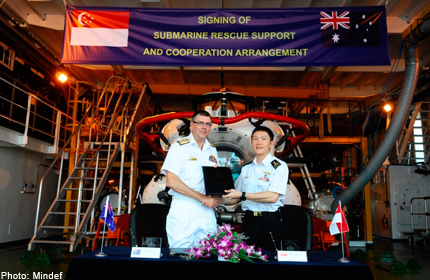
RAN's Chief of Navy Vice-Admiral Ray Griggs (left) and RSN's Chief of Navy Rear-Admiral Ng Chee Peng (right) at the signing the Submarine Rescue Arrangement on board the RSN’s submarine rescue and support vessel, MV Swift Rescue.

RAN’s Chief of Navy Vice-Admiral Ray Griggs (left) and RSN’s Chief of Navy Rear-Admiral Ng Chee Peng (right) at the signing the Submarine Rescue Arrangement on board the RSN’s submarine rescue and support vessel, MV Swift Rescue.

SINGAPORE – The Republic of Singapore Navy (RSN)’s Chief of Navy Rear-Admiral Ng Chee Peng signed the Submarine Rescue Arrangement with Royal Australian Navy (RAN)’s Chief of Navy Vice-Admiral Ray Griggs earlier today.

The agreement was signed on board the RSN’s submarine rescue and support vessel, MV Swift Rescue.

The Submarine Rescue Arrangement establishes a framework between the RSN and RAN in the area of submarine rescue support and cooperation. Under the arrangement, the RSN will make available to the RAN MV Swift Rescue and other resources to render support and assistance in the event of an RAN submarine incident.

The Ministry of Defence said that the Submarine Rescue Arrangement reaffirms the close and long-standing bilateral defence relationship between Singapore and Australia, where both armed forces interact frequently through exercises, visits, professional exchanges and military courses.

Source – Asia One

Japan – Military to respond to submarines entering territorial waters, PM Abe warns

Military to respond to submarines entering territorial waters, PM Abe warns

Prime Minister Shinzo Abe has once again issued a warning against any intrusion into Japan’s territorial waters, this time referring to foreign submarines that will attempt to pass through underwater. This is in response to the Defense Ministry’s report that a foreign submarine was spotted just outside the contiguous zone, south of Kumejima Island in Okinawa Prefecture on Tuesday.

The contiguous zone is a 12 nautical mile strip outside territorial waters so the submarine still did not violate any international laws. Rules state that vessels can pass freely through the waters given that their intentions are peaceful. Submarines are required to surface and display their national flags if they are already navigating in territorial waters. There is still no indication from what country the spotted vessel was but Ministry officials have said that they probably belong to the Chinese Navy.

Abe told the parliament that submarines entering territorial waters is a “serious issue” and would require maritime security action. This indicates that the Ministry could direct Japan’s Self Defense Forces to move if there would be any confirmed intrusion. This incident, while not violating any laws, is too close to reports of three Chinese government ships that were near the disputed Senkaku/Diaoyu islands last Monday. The Japanese Coast Guard says that this is the 43rd incident of Chinese ships entering Japanese waters since September 2012.

While observers do not believe that China would mount any actual attack or military move on the waters, it is just further proof of them boasting their naval and military capabilities. They have been criticized for showing off an aggressive stance against countries that have a territorial dispute with them, particularly Vietnam, the Philippines and Japan.

Foreign submarine  spotted near Japanese territorial waters

Foreign submarine spotted near Japanese territorial watersA foreign submarine was detected in a contiguous zone just outside Japanese territorial waters south of Kumejima Island in Okinawa Prefecture, Japan’s Defense Ministry revealed on Tuesday. Ministry officials did not elaborate on the submarine vessel’s country of origin, but a government source revealed that the sub likely belonged to the Chinese Navy.

“I was prepared to order ‘maritime security operations’ immediately upon getting approval from the Prime Minister (Shinzo Abe), if the submarine entered Japan’s territorial waters,” Defense Minister Itsunori Onodera told reporters on May 13. Under the current Self-Defense Forces Law, Onodera has the authority to order Japan’s Self-Defense Forces (SDF) units to conduct whatever was necessary to protect Japanese lives and property at risk, and to maintain the nation’s security at sea. These circumstances, often termed as “maritime security operations,” allow the SDF to use weapons in lawful self-defense and emergency evacuation of citizens. The last time such an order was made was in November 2004, when a Chinese submarine entered Japan’s territorial waters – the area around the Sakishima island chain in Okinawa Prefecture. The latest case did not involve any incursion into Japanese territorial waters, but Onodera is believed to have mentioned such information as a stern warning to any country that may have been involved.

It is known that international law does not prohibit submarines from entering contiguous zones such as in this incident. It is a calculated tact by Japan’s Defense Ministry to make the latest incident public because of the fact that the passage through the contiguous zone was over a prolonged period of time, which made it very unusual. Tense maritime situations have been par for the course with China and Japan as the territorial dispute over the Senkaku/Diaoyu island chain continues to drag on. On Monday, three Chinese maritime surface ships broke the 12-nautical-mile rule and approached one of the islands, which according to the Japanese Coast Guard was the 43rd incident where Chinese ships in the area entered Japanese territorial waters since September 2012. This incident, including the submarine issue, is causing further tension in an already escalating situation.

Source – JDP

UK – Periscopes Are Returned To WW2 Submarine In Gosport

Periscopes

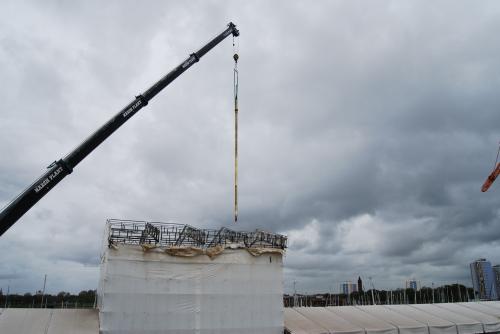
The periscopes of the historic HMS Alliance were returned by a giant crane today as part of a £7m conservation project to restore the only surviving WW2 era A-class submarine sited at the Royal Navy Submarine Museum in Gosport, Hampshire.  The periscopes have been conserved by the Babcock International Group at the submarine base Faslane in Scotland.

HMS Alliance was equipped with two 40ft periscopes, one for general use and one for attack. The Attack scope is made of bronze and dates from the submarine’s construction in 1945. Both periscopes were removed last year for restoration. The returned periscopes will be fully functional and allow visitors to HMS Alliance, the opportunity to view Portsmouth Harbour where the historic submarine is based.

Bob Mealings, Curator at the Royal Navy Submarine Museum said, “Before the restoration visitors on-board HMS Alliance could not use either periscope. Now they will for be able to look through the scopes for the first time in thirty years. The views will be amazing.”

The Museum’s restoration contractor ML UK Ltd, based in Portsmouth, will be using two large cranes to re position the historic periscopes. The periscopes will then be set for the best view in elevation and power.

The conservation project to restore HMS Alliance will be completed in Spring 2014, meanwhile the Submarine Museum is open to visitors, however HMS Alliance will be temporarily closed while the periscopes are refitted.  HMS Alliance will reopen Tuesday 21 May.

For more information on the Saving HMS Alliance Project, visit www.submarine-museum.co.uk

Source – About My Area

Crew of first Vietnamese submarine to make five 10-days sea voyages

The sea part of the training of the crew of the first Project 636 submarine built for the Vietnamese Navy has begun in the village of Svetly near Kaliningrad, a source in the Russian shipbuilding industry told Interfax-AVN.

“The theoretical, coastal part was followed by the sea part of the training, which includes five 10-days sea voyages,” the source said.

“Since the beginning of the factory trials, which included tests by the customer’s representatives, the first export series submarine has successfully conducted 23 dives,” he said.

In 2013, the shipbuilding enterprise Admiralteiskiye Verfi will provide to the Vietnamese Navy the first two diesel electric Project 6363 Varshanyanka submarines  of the six submarines envisioned by the contract, a source in the Russian defense industry told Interfax earlier.

The contract for the supply of six diesel electric Project 6363 submarines was signed in 2009 during a visit to Moscow by Vietnamese Prime Minister Nguyen Tan Dung.

Besides, submarine construction, the contract envisions the training of Vietnamese crews and the supply of the needed equipment and technical property.

Project 6363 diesel electric submarines are third-generation submarines. These submarines have a good modernization potential that makes it possible to integrate new weapons, including the anti-ship missile system Club, which considerably expands the target area.

A training center is created to train the crews of the Vietnamese submarines in Kamran with assistance from  the ST. Petersburg OAO Concern NPO Avrora.

The enterprise developed and created five systems for these submarines, specifically, the computerized information system Lama and the submarine management system Palladiy.

Source – Russia Beyond the Headlines

Malaysia needs more submarines – former RMN chief

Malaysian Scopene – KD Tunku Abdul Rahman

KUALA LUMPUR: Malaysia needs more submarines to be able effectively safeguard the country’s sovereignty, especially in the South China Sea, former Royal Malaysian Navy (RMN) Chief, Admiral (Rtd) Tan Sri Mohd Anwar Mohd Nor said.

He said the RMN would need six, or at least three, submarines.

Currently, Malaysia has two submarines, the Scorpene, which are based at Teluk Sepanggar, Sabah.

“Come the time when the submarines have to be sent for repair or service which is going to take months. Having only two submarines can disrupt operations by the navy,” he said when met by Bernama recently.

He said this when asked on the setting up of submarine fleets by several countries in the region, like Malaysia, Vietnam and Indonesia.

Recently, Singapore commissioned the Archer-class submarine to operate alongside four Challenger-class submarines.

Mohd Anwar said the best way for RMN to address the problem was by acquiring six Gowind class vessels.

Gowind 950 – Offshore Patrol Vessel

On a posting by  a blogger, known as Shahpaskal on militaryofmalaysia.net, that the use of submarines was not suitable in the Straits of Malacca, he said:

“No submarines dare sail in the Straits of Malacca. If there is any conflict,   with the aim of closing the strait as a passage for vessels, it will happen in the South China Sea or the Bay of Bengal and the Andaman Sea,” he added.

He said the submarines served as the most effective weapon.

The submarines can be used for signal and electronic intelligence operations, he added.

Source – New Straits Times


Coalition vows to build new Collins-class submarines in Adelaide

HMAS Dechaineux and HMAS Waller

Collins-class submarines HMAS Dechaineux and HMAS Waller on exercise off the Western Australia coast. Picture:

THE man most likely to be Australia’s defence minister in less than six months time has promised 12 new submarines will be built in Adelaide and indicated they will be designed here too.

Federal Opposition defence spokesman David Johnston today said the subs strategy unveiled in a defence white paper released last week by Prime Minister Julia Gillard is “what the Coalition accepts and will deliver”.

The Federal Government’s announcement contains no timelines, but says the new subs fleet will be built in Adelaide from a new design or as an updated version of the ageing Collins-class vessels.

Senator Johnston last week was highly critical of the idea of an evolved Collins.

However, in Adelaide today, he had softened his position.

Stephen Smith

Defence Minister Stephen Smith, visiting a shipbuilding yard in Adelaide, says the Collins-class submarines could keep operating until 2038.

“We will deliver those submarines from right here at ASC in South Australia,” he said.

“Right across Australia, there is only one place that has all of the expertise that’s necessary to complete one of the most complex, difficult and costly capital works projects that Australian can undertake.

“It’s ASC here in Adelaide. We believe that all of the expertise that is necessary for that project is here.”

SA Opposition Leader Steven Marshall said the announcement was “fantastic news”.

Julia Gillard on Collins-class submarine

Prime Minister Julia Gillard talks to Vice-Admiral Chris Richie and other official on the deck of a Collins-class submarine as she visits Australian Submarine Corp at North Osborne in South Australia. Picture:

Current polls show the Federal Opposition is likely to claim power on September 14.

Senator Johnston said he accepted the Federal Government was “taking the best available professional and technical advice” and that he would “be picking up … the cudgels for this project as fast as we possibly can”.

“We will have a plan that you can pick over, you can point to, you can see dates, times and money,” he said.

“I accepted the Minister’s down-selected to those two options, the evolved Collins and a new design.

“He’s said that … the military off-the-shelf option and a modified military off the shelf option will be, and he’s used a bit of a weasel word, he said they will be suspended. Now I don’t know what suspended really means.

“If everything that the Minister has said is based on fantasy, we’ll tell you and we’ll revisit this. But at the moment I believe he has accepted the best advice technically and professionally that he can.”

Source – Adelaide Now

Russian prosecutors want retrial in submarine deaths

Navy prosecutors in Russia appealed the acquittal of two men blamed for the deaths of 20 people aboard the nuclear submarine Nerpa in a deadly 2008 accident.

The accident, in which a fire safety system was activated without permission, released poisonous freon gas, suffocating to death 20 men, including 17 civilian shipyard workers.

There were 208 people on board the vessel at the time conducting sea trials in the Sea of Japan.

Capt. Dmitry Lavrentyev was charged with abuse of authority in the accident, and engineer Dmitry Grobov was accused of causing death by negligence.

Lavrentyev and Grobov were acquitted of the charges April 26 on grounds the investigation into the accident had not been properly conducted. This was their second acquittal. A jury cleared the two men in September 2011, but the Supreme Court’s military board overturned the verdict in May 2012.

The Pacific Fleet navy prosecutors said Wednesday they think Lavrentyev and Grobov should be tried again, RIA Novosti reported.

 “In our opinion, Lavrentyev and Grobov are the only ones guilty of the accident. They are the ones who should be held responsible. We regret that the jury failed to understand this,” a spokesman said.

Other men on board the Nerpa at the time of the accident have written an open letter defending the actions of Lavrentyev and Grobov and instead blamed the defense industry for creating a fire-suppression system contaminated with a poisonous chemical, RIA Novosti reported.

Source – UPI .Com

Submarine ‘Minnesota’ successfully completes sea trials – Video clip

The U.S. Navy’s newest attack submarine “Minnesota” successfully completes first sea trials Monday.

Submarine ‘Minnesota’ successfully completes sea trials

Huntington Ingalls Industries announced the newest Virginia-class submarine, Minnesota (SSN 783), successfully completed alpha sea trials Monday.

Alpha trials are the boat’s first round of at-sea tests and evaluations. Minnesota is being built at HII’s Newport News Shipbuilding division, the Globe Newswire reported.

All systems, components and compartments were tested during the trials. The submarine submerged for the first time and operated at high speeds on the surface and under water. The Minnesota will undergo two more rounds of sea trials, including one with the Navy’s Board of Inspection and Survey, before delivery later this month. Minnesota is anticipated to deliver approximately 11 months ahead of its contracted delivery date.

“This submarine is the result of a lot of hard work by the shipbuilders here at Newport News, our teammates at Electric Boat, and the overall Navy organizational structure, including NAVSEA, SUPSHIP and ship’s force personnel,” said Jim Hughes, NNS’ vice president of submarines and fleet support, in a news release. “It is incredibly gratifying for all of us to see this magnificent vessel operate so well during her first at-sea period.

Minnesota clearly carries on the Virginia-class tradition of continuous cost and schedule improvement while also raising the bar on operational readiness and capability.”

Minnesota, named to honor the state’s residents and their continued support of the U.S. military, is the last of the block II Virginia-class submarines and is in the final stages of construction and testing at Newport News Shipbuilding division. Construction began in February 2008, and the keel was authenticated in May 2011. The boat was christened Oct. 27, 2012.

Minnesota is the 10th ship of the Virginia class of nuclear-powered fast-attack submarines. It’s the third ship to bear the state name, the Associated Press reported. The first USS Minnesota was a sailing steam frigate commissioned in 1857 that served during the Civil War. The second Minnesota was commissioned in 1907. The 7,800-ton Minnesota will have a crew of about 134 officers and enlisted personnel.

Huntington Ingalls Industries (HII) designs, builds and maintains nuclear and non-nuclear ships for the U.S. Navy and Coast Guard and provides after-market services for military ships around the globe. For more than a century, HII has built more ships in more ship classes than any other U.S. naval shipbuilder at its Newport News Shipbuilding and Ingalls Shipbuilding divisions employing about 37,000 in Virginia, Mississippi, Louisiana and California.

Source – Dispatch