Author Archives: jasonlockley

Submariner’s sea stories revealed the silent service

<b>Edward L. Beach Jr.</b>

Edward L. Beach Jr.

Sometimes the acorn does not fall far from the tree.

On April 20, 1918, Edward L. Beach Jr. was born in New York City. His father, Edward Sr., was commanding the Navy Torpedo Station in Newport, R.I., waiting for his next sea command, as the United States was entering World War I.

Beach Sr. graduated from the U.S. Naval Academy in 1888, and rose to become Captain in 1914. He took command of the armored cruiser USS Tennessee in 1915, the ship was renamed USS Memphis when the Navy decided that battleships would be named for states. On Aug. 29, 1916, the Memphis was anchored in Santo Domingo, Dominican Republic, harbor when the ship was swamped and wrecked by tidal waves; 43 crew were killed and over 200 injured. A court-martial found Beach guilty of “not having enough steam available to get under way on short notice,” the court considered the tidal waves a predictable effect of weather. The court’s punishment was to reduce Beach’s seniority by 20 places, a sentence reduced by Secretary of the Navy Josephus Daniels when it was determined the tidal waves were produced by an underwater earthquake, not weather.

Not long after the disaster, Beach married Alice Fouché, a Dominican of French ancestry, they had three children, Edward Jr., John and Alice. Six months after the birth of his son, Captain Beach was given command of the battleship New York (BB-34), flagship of the US battleship squadron attached to the British Home Fleet. He retired in 1921 and become a professor of military and naval history at Stanford University.

From 1907 to 1922, Beach published 13 novels for young adults, emphasizing hard work, honesty and honor. They were apparently inspirational to a generation of boys who later joined the Navy. Beach also wrote an autobiography, “From Annapolis to Scapa Flow,” that his son edited after his father’s death; it was not published until 2003, 60 years after his death.

Beach Jr. graduated second in his class from the Naval Academy in 1939. He was initially assigned to the surface navy, serving on a heavy cruiser and a destroyer, before being sent to the Submarine Training School in Connecticut; an assignment he resisted. He graduated first in his class there in December 1941, just days before the attack on Pearl Harbor. He reported to the USS Trigger (SS-237) on Jan. 1, 1942. “ ‘There’s my new home,’ I thought, ‘wonder if I’m looking at my coffin.’ To me, she certainly wasn’t impressive, beautiful, or anything at all but an ugly chunk of steel. ‘No life, no spirit, no character,’ I thought.” Beach wrote in his first book, “Submarine!,” published in 1946.

He served on the Trigger and the USS Tirante (SS-420) before taking command of the USS Piper (SS-409) in 1945. He made 12 war patrols. The first patrol of the Tirante, in the Yellow Sea, was especially notable, sinking at least six Japanese ships and capturing two downed airmen. Beach, the executive officer, received the Navy Cross, captain George L. Street was awarded the Congressional Medal of Honor, and the ship’s crew received a Presidential Unit Citation. The action inspired Beach’s first novel, the bestselling “Run Silent, Run Deep,” published in 1955. He published two more submariner novels.

Beach received many other decorations for his war performance.

In August 1951, Beach was relieved of command to become the Naval Aide to General Omar Bradley when he was named the first Chairman of the Joint Chiefs of Staff. His performance was rewarded with command of the USS Trigger, named for the earlier submarine, which was the first post-war submarine class. He was tapped to serve as President Dwight Eisenhower’s Naval Aide.

In 1958, he received command of the USS Triton (SSRN-586) the Navy’s fifth nuclear-powered submarine. Its shakedown cruise in February 1960 was the first non-stop submerged circumnavigation; it took 84 days and roughly followed the route of Ferdinand Magellan’s three-year course (1519-1522).

He retired in 1966, and wrote several histories, including the story of the USS Memphis disaster.

He died on Dec. 1, 2002.

Source – The Tennessean

South Korea, U.S. hold submarine drill in Yellow Sea

South Korea and the United States on Monday began an anti-submarine drill in the tensely guarded western sea as part of regular exercises amid high tensions with North Korea, military officials said.
The anti-submarine warfare exercise, which lasts until Friday, is the second in a planned series of this year’s combined military maneuvers following the last one in February.

The joint naval drill mobilizes a nuclear-powered Los Angeles-class submarine, Aegis destroyers, P-3C maritime surveillance aircrafts deployed from U.S. bases as well as South Korean destroyers, submarines and maritime aircrafts, military officials said.

“It is part of an annual routine drill held to prepare against an adversary’s submarine infiltration,” a military official said, requesting anonymity.

The latest military training comes after the two allies completed their two-month-long Foal Eagle exercise last week, amid high inter-Korean tensions due to Pyongyang’s warlike threats against Seoul and Washington.

On Sunday, the North’s official Korean Central News Agency condemned the upcoming naval drill, saying the fate of a joint industrial zone in the North hinges on Seoul.

Claiming a 97,000-ton Nimitz-class nuclear powered super carrier is expected to join the training, a spokesman for the Policy Department of the National Defense Commission called on Seoul to stop “hostile acts and military provocations” if it wants to normalize the suspended Kaesong Industrial Zone.

In response to Pyongyang’s call to stop military training to resume inter-Korean talks, Seoul’s defense ministry on Monday vowed not to give in to Pyongyang’s demands.

“It is inappropriate that the North is demanding the cancellation of South Korea-U.S. joint drills by linking it with the Kaesong Industrial Complex,” defense ministry spokesman Kim Min-seok said in a briefing. “As the drills are designed to defend against North Korean provocations, they cannot be stopped.”

“As long as the North maintains its hostile stance, the joint drills will continue,” Kim said.

Although Pyongyang has routinely called the annual training a rehearsal for a northward invasion, its rhetoric turned more hostile this year under young leader Kim Jong-un, even threatening nuclear strikes against the South and the U.S.

According to the U.S. Navy’s website, the Nimitz Strike Group, consisting of the aircraft carrier USS Nimitz (CVN 68) and guided-missile destroyers and cruisers, arrived in the U.S. 7th Fleet on May 3.

The Nimitz Strike Group will conduct exercises and port visits to enhance maritime partnerships and promote peace and stability in the Indo-Asia-Pacific region along with its allies, the U.S. Navy said.

Seoul’s defense ministry didn’t confirm the participation of the U.S. carrier, noting consultations are currently underway between the two sides.

North Korea has a large fleet of submarines, and one of them is blamed for torpedoing the South Korean warship Cheonan in the Yellow Sea in March 2010, killing 46 sailors.

About 28,500 American troops are stationed in South Korea as the 1950-53 Korean War ended in an armistice agreement, not a peace treaty.

India – Nuclear submarine INS Arihant nuke reactor to be activated in 2-3 weeks

India’s first home-built nuclear submarine, capable of firing ballistic missiles, will soon activate its nuke reactor

Moving towards completing its nuclear triad, India will activate the atomic reactor on-board the indigenous nuclear submarine INS Arihant in the “next two to three weeks” paving way for its operational deployment by the Navy soon.

“The nuclear reactor on-board the INS Arihant would be made critical (activated) in next two to three weeks,” DRDO chief V K Saraswat said.

Nuclear triad is the ability to fire nuclear-tipped missiles from land, air and sea. He said after the nuclear reactor is activated, the agencies concerned can work towards readying the warship for operational deployments soon. INS Arihant has been undergoing trials at Navy’s key submarine base in Vishakhapatnam and would be launched for sea trials after the nuclear reactor goes critical.

The DRDO has also readied a medium-range nuclear missile BO-5 for being deployed on the Arihant and its last developmental trial was held on January 27 off the coast of Vishakhapatnam. The nuclear submarine will help India achieve the capability of going into high seas without the need to surface the vessel for long durations. Conventional diesel-electric submarines have to come up on surface at regular intervals for charging the cells of the vessel.

Source – India.Com

USS Nautilus lets visitors experience life down below

USS Nautilus

If you’ve ever wondered what it would be like to be a submariner and dive deep below the ocean surface you can do just that at the Submarine Force Museum in Groton. There you can see the history of the submarine service and climb aboard the USS Nautilus, the world’s first nuclear powered vessel.

The Nautilus, named after the ship depicted in Jules Verne’s novel, “20,000 Leagues Under the Sea” was first launched Jan. 21, 1954, after 18 months of construction. First lady Mamie Eisenhower broke the traditional bottle of champagne across Nautilus’ bow during the ceremony. On Sept. 30, 1954, Nautilus became the first commissioned nuclear powered ship in the U.S. Navy.

Nautilus made naval history on July 23, 1958, when it departed Pearl Harbor, Hawaii, under top secret orders to conduct “Operation Sunshine,” the first crossing of the North Pole by a ship. It was at 11:15 p.m. Aug. 3, 1958, that Commander William R. Anderson announced to his crew, “For the world, our country and the Navy … the North Pole.” With 116 men on board, Nautilus had accomplished the seemingly impossible task of reaching 90 degrees north, the geographic North Pole.

The museum with more than 33,000 artifacts is dedicated to saving the history of the submarine. The museum can trace its roots back to 1955 when the Electric Boat Division of General Dynamics founded the Submarine Library with a huge collection of books and documents relating to the history of the submarine. In 1965 the facility was donated to the U.S. Navy and moved to its current location. The name was changed to the Submarine Force Museum in 1969 and efforts began to convince the Navy to donate Nautilus to the museum. A new 14,000-square-foot museum was built in 1986 and was expanded in 1997 and again in 2000.

On display in the is a replica of the Turtle, the world’s first combat submarine built in 1775. The Turtle was designed to attach a mine to the hull of an enemy ship. It was used against the British during the Revolutionary War but was not successful.

Also on display are models of several different classes of submarines and a control room where visitors can sit and operate the controls of a sub. A 50 foot-long 1/6th scale cutaway model of the submarine USS Gato is suspended from the ceiling in the main exhibit area. The Gato was the primary class of submarine used by the United States during World War II. Other displays include midget submarines from WWII, working periscopes and the Explorer, an early U.S. research submarine.

The museum library has a collection of more than 20,000 documents and 30,000 photographs related to the history of the submarine. The collection has 6,000 books including an original 1870 copy of Jules Verne’s “20,000 Leagues Under the Sea.”

The centerpiece for the museum is the Nautilus which was designated a National Historic Landmark by the Secretary of the Interior on May 20, 1982. The historic ship then underwent an extensive conversion at Mare Island Naval Shipyard in Vallejo, Calif., to make it more accessible to visitors. When the conversion was complete it was towed to Groton and on April 11, 1986, the museum and Nautilus opened to the public.

Tours aboard the Nautilus are self guided and visitors get an audio wand that describes each numbered stop on the tour. The first stop after entering the forward part of the ship through a specially constructed glass house added during the conversion to a museum is the torpedo room. The Nautilus has six tubes for its 24 torpedoes. Plexiglas partitions have been installed throughout Nautilus so visitors can see but not touch the historic vessel.

As the tour continues visitors pass by berthing areas for the crew and the wardroom for the 11 officers on board. On the wall behind the wardroom table are instruments showing the ship’s speed, course and depth. Also on display in the wardroom is an original copy of Jules Vernes’ “20,000 Leagues Under the Sea.”

Next on the tour is the Attack Center where the periscopes are located as well as the firing panel to launch the torpedoes. The Control Room is located directly below the Attack Center and has all the instruments and controls for diving, surfacing and steering the ship. To the right of the Control Room is the Radio Room where all the ship’s communication equipment is located.

The final stop on the tour is the Crew’s Mess where the enlisted men ate. Food was served every six hours and because living conditions were stressful, submarines had the best food in the military.

———————————————————————————-

Coalition torpedoes Collins submarine plan in Labor’s defence white paper _ Video Clip

White paper a ‘disaster’ for defence

Click on Picture for Video Clip

White paper a ‘disaster’ for defence

Greg Sheridan believes the government’s defence white paper lacks both operational and strategic sense.

BIPARTISANSHIP on defence policy has been fractured after the Coalition today ruled out a “Son of Collins” submarine, which Labor is keeping on the table in its latest defence white paper.

The white  paper released today rules out an off-the-shelf design for 12 new  submarines, which would be either a more highly-evolved version of the  existing Collins Class boats, or an entirely new, tailor-made, design.

The  paper also commits Australia to the purchase of 12 new “Growler”  electronic warfare fighter jets at a cost of $1.5 billion, while taking a  more conciliatory position on the rise of China than the previous  strategic blueprint in 2009, which warned against China’s growing  military might in the Asia Pacific region.

The document, released  today, rules out an off-the-shelf design for the new submarine fleet to  replace the trouble-plagued Collins Class boats.

“We’ve come to  the conclusion, as reflected by the white paper, that an off-the-shelf  submarine does not give us the strategic or the operational reach that  we need for Australia’s interests as a maritime country and continent,”  Defence Minister Stephen Smith said.

He said Australia had gained  intellectual rights to the Collins Class design, “so we’ll progress  that”, while the alternative was a wholly new design.

Whatever the design, the fleet would be built in South Australia and be installed with US combat systems.

Opposition defence spokesman David Johnston said a new design could present problems, but the Collins Class design should be avoided at all costs.

“You know, I wouldn’t want to go back near Collins if it was the last thing on earth that we had to do” he said.

“I think Collins has been a very expensive disaster.”

Minister Smith and Julia Gillard said the upcoming May budget would include a modest rise in defence spending, after last year’s cut.

Mr Smith confirmed the government aspired to lift defence spending to 2 per cent of GDP, subject to economic circumstances.

“What we have discovered over the time since then is it is very difficult, if not impossible, to map out precise funding for defence or any other area of government when you are facing changing economic and fiscal circumstances,” Mr Smith said.

“In this case, it is called the global financial crisis … the adverse consequences of which are ongoing,” he said.

Senator Johnston said the Coalition had a similar target, but it also had a plan to get there by lifting defence spending by 3 per cent a year.

He attacked the white paper for its lack of financial detail, saying the Coalition would redo the white paper in office, including the full cost of hardware procurement.

“What sort of a plan is this when the department cannot or is not permitted to put a dollar figure on any of these acquisitions?” he said.

“We have the biggest capital works program, not just in defence’s history but in commonwealth history, (and) there is no plan, no schedule, no money. So where does that leave 12 submarines?”

Defence Force Chief General David Hurley said he believed there had been a good budget process given the reality of the government’s fiscal position, which preserved defence capability into the future.

“I think this has been a good outcome for all,” he said.

The purchase of the 12 new Growler aircraft is a change of plan for the government, which had intended to refit 12 of its fleet of 24 Super Hornets as Growlers.

The government says that will not affect plans to buy around 100 fifth generation Joint Strike Fighters.

The government will also bring forward replacement of the navy’s Armidale Class patrol boats, which have been heavily used on border protection operations across Northern Australia.

Replacement supply ships may be built in Australia to replace HMAS Sirius and HMAS Success.

The white paper makes no commitment to acquiring a fourth air warfare destroyer.

Neither does it make a firm decision on long-running proposals to acquire long-range surveillance drones to watch over Australia’s northwest.

Opposition Leader Tony Abbott said the white paper was a “long list of acquisitions without the money to pay for it”.

“The reality is this government talks a good game on defence, but defence spending as a proportion of GDP is at the lowest level since 1938,” Mr Abbott said.

But a leading defence analyst says the new white paper fixes some of the errors of the 2009 document and does a far better job of matching capability with available resources.

Australian Strategic Policy Institute defence capability expert Dr Andrew Davies said some unnecessary capabilities, such as offshore patrol combatant vessels, had gone, while the number of Joint Strike Fighters had been scaled back from 100 to 72, with future governments able to opt for more.

“Resources and aspiration have come back closer. It remains to be seen whether they will match but it’s certainly closer than it was four years ago. Let’s give credit where it’s due. This fixes some of the errors of the last one.”

Source – The Australian

Three Russian nuclear submarines to be recommissioned

27_big

Three nuclear submarines of the Russian Navy currently under maintenance will be recommissioned by 2014, a Navy spokesman said.

The K-410 Smolensk cruise missile submarine, which is undergoing repairs since 2011, will resume its service in the Northern Fleet, the spokesman said Tuesday.

The Pacific Fleet will be rejoined by the K-150 Tomsk cruise missile submarine, which was docked in 2010 due to problems with the cooling engine of its nuclear reactor; and the K-419 Kuzbass attack submarine, under repairs since 2010.

The Kuzbass belongs to the same Akula II class as the ill-fated K-152 Nerpa, on which 20 people were killed during sea trials in 2008 due to malfunction of the fire suppression system.

The Russian Navy has 48 nuclear submarines, 20 of which are currently undergoing repairs or upgrade, according to Russian-ships.info database.

Source – DESI

One of Singapore’s most advanced submarines declared battle-ready

The last of Singapore’s most advanced submarines was declared battle-ready on Tuesday, April 30, 2013, sharpening the capabilities of the Republic of Singapore Navy (RSN) in underwater warfare.

The last of Singapore’s most advanced submarines was declared battle-ready on Tuesday, sharpening the capabilities of the Republic of Singapore Navy (RSN) in underwater warfare.

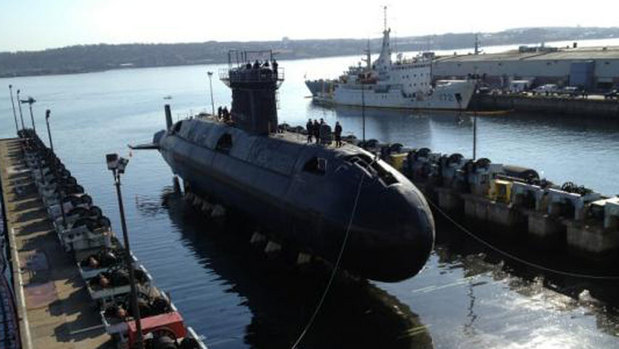
The RSS Swordsman was commissioned, following more than two years of tests and torpedo-firing exercises in Sweden and in the warmer and more corrosive waters here. The 60.5m diesel-electric vessel arrived in Singapore in last December. This is the second Archer-class vessel to be added to the RSN’s 171 Squadron, after the first, RSS Archer, was declared operational in 2011. The submarine squadron also comprises four ageing Challenger-class submarines.

Deputy Prime Minister Tharman Shanmugaratnam, who was at the ceremony in Changi Naval Base, said the new vessel will strengthen the navy’s ability to safeguard Singapore’s “continued and unimpeded access to the maritime routes”.

He noted that Tuesday’s ceremony also marked the end of the RSN’s eight year journey to replace some of the Challenger-class submarines, which were built in the 1960s.

Source – Straits Times

Canada – Submarine HMCS Windsor hobbled after $209M refit

HMCS Windsor

HMCS Windsor is on restricted duties because it has a broken generator.

Setback leaves Royal Canadian Navy with just one fully operational sub

CBC News has learned there is more trouble for Canada’s fleet of used British submarines.

The Royal Canadian Navy has confirmed that HMCS Windsor – fresh from a $209 million refit – is unable to perform as expected because of a broken mission-critical diesel generator.

“We have restricted her in range of operations and her endurance,” Captain Luc Cassivi, director of Canada’s submarine force told CBC in an interview.

That means that the Windsor will only be able to operate in Canadian coastal waters until the diesel generator – a huge 16 cylinder engine – is removed from the submarine and replaced.

The Windsor has a second diesel generator which is still working. The diesel generators are used to charge the batteries that allow the submarine to operate under water.

Restrictions in place

A source has told CBC that the submarine’s diving depth is severely restricted and the navy has been forced to withdraw the sub from planned exercises off the southern U.S. coast.

Capt. Cassivi said he is unable to provide exact details of the restrictions because they are “classified and linked to operational capabilities,” but he denies that any exercises have been cancelled.

“It’s an unexpected defect, and that is why we are going through the investigative process,” said Capt. Cassivi.

The Halifax–based Windsor went back in the water in April, 2012 after a five-year refit designed to bring the submarine up to Canadian standards. The refit was three years behind schedule and until now, the navy has refused to say exactly how much it cost.

Capt. Cassivi confirmed to CBC that the Windsor’s five-year refit totalled $209 million. The cost of removing and replacing the diesel generator is not included in the refit price.

“We have a plan for rectification as soon as the parts are available,” said Capt. Cassivi.

The submarine should be hauled out of the water in Halifax in late summer and it could take a “few months” to replace the engine, he said.

One operational submarine

Canada purchased the four Victoria-class submarines in 1998 after the British navy declared them surplus. At $750 million, the deal was hailed as a bargain, and at a price far less than buying new submarines.

HMCS Victoria completed its refit last year at about the same $209 million cost as the Windsor, said Capt. Cassivi.

HMCS Chicoutimi’s refit is more complicated and expensive because of damage done to the submarine by a fire that killed one sailor on the boat’s first voyage under a Canadian flag. The Chicoutimi has been sidelined ever since the 2004 fire but may become operational by the end of the year.

Also, the refit to HMCS Corner Brook is expected to exceed the $200 million-plus price tag because of damage done to the sub’s bow when it slammed into the seafloor off British Columbia. The Corner Brook has not gone to sea since its grounding in June 2011.

The unexpected repairs to the Windsor and the resulting restrictions means that the navy has only one fully operational submarine in service. The west coast-based HMCS Victoria – which was discovered to have a large dent in its hull after delivery – is the only submarine capable of firing torpedoes, unrestricted diving and movement.

Source – CBS News

Discovered WW1 British And German Submariners Solidarity In Gosport

sbbbbbb

The personal photographs from a WW1 Royal Navy submarine commander have revealed the mutual respect he shared with his German adversary. Curators at the Royal Navy Submarine Museum in Gosport, Hampshire discovered this story after recently taking possession of a remarkable personal photograph album from Lt Cdr Samuel Gravener, Commanding Officer of HMS E2 which included photographs of a German submariner and his family.

Ninety – eight years ago, on 29th April 1917, HMS E2 was on patrol in the Mediterranean when she sighted German U-boat UC37, who herself was about to destroy an Italian sailing ship off Marsala, Sicily.  Gravener, E2’s Commanding Officer, fired a torpedo at UC37 which hit but failed to detonate. The Officer of the Watch onboard UC37 that day was Fritz Boie.  Fourteen years later, the German submariner, Boie tracked down Gravener and sent him a letter which concluded “So I send you now my kindest regards, hoping you are still alive and well off”. That was the start of an exchange of letters and family photographs by the two former adversaries.

Bob Mealings, Curator at the Royal Navy Submarine Museum said, “This is a wonderful discovery of opposing sides uniting through their submariner experiences.”

The Royal Navy Submarine Museum recently purchased Samuel Gravener’s photograph album which included copies of the original letter and original photographs of Boie and his family, along with three contemporary crew photographs.

The photo album will be on temporary display in the Submarine Museum which is open every day to visitors and includes a visit to the historic WW2 era HMS Alliance, X24 and the Royal Navy’s very first submarine Holland1.

For more information please visit http://www.submarine-museum.co.uk or call 023 92510354.

Source – About My Area

BAE Systems to Aid U.S. Navy in Maintaining Submarine Torpedoes

BAE Systems supports the Naval Undersea Warfare Center Keyport Division in Washington State with a range of services, helping to maintain the operational readiness of submarine torpedoes and other weapon systems. (Photo: BAE Systems)

BAE Systems supports the Naval Undersea Warfare Center Keyport Division in Washington State with a range of services, helping to maintain the operational readiness of submarine torpedoes and other weapon systems. (Photo: BAE Systems)


The U.S. Navy has awarded BAE Systems an $80 million contract to continue providing systems engineering and other technical services to support the Naval Undersea Warfare Center (NUWC) Keyport Division in Washington State. BAE Systems, along with six local subcontractors, will assist the Navy in maintaining the operational readiness of submarine torpedoes and other weapon systems.

The three-year contract, managed by Naval Sea Systems Command, builds on BAE Systems’ ongoing support of the Navy’s submarine weapons programs. For more than 30 years, the company has provided a range of services to NUWC in Keyport, Washington; Newport, Rhode Island; and Groton, Connecticut. In addition, for more than 40 years, BAE Systems has provided systems engineering and integration to the Navy’s submarine-based Strategic Systems Programs. That workforce, based in Rockville, Maryland, ensures the readiness of the Trident II fleet ballistic missile and the SSGN Attack Weapons System.

“All of these systems are critical to national defense and security,” said Kris Busch, vice president and general manager of Maritime & Defense Solutions at BAE Systems. “Our team has the experience and the expertise to continue supporting these Navy programs for many years to come.”

At the Keyport site, the BAE Systems team provides life-cycle systems support services for the Heavyweight and Lightweight Torpedo, and for information assurance and submarine towed systems. These services include engineering and technical support, performance analysis and monitoring, training, logistics, troubleshooting and problem resolution, and project management.

The team also supports tactical software systems development at Keyport, in addition to administrative, training and ammunition operations at the Strategic Weapons Facility Pacific in nearby Bangor, Washington.

Source – Market Watch

Source – Business Wire