Category Archives: The world’s submarines

News, views and stories about the rest of the world’s submarines

WWI submarine graveyard discovered by underwater archaeologists

german u-boat (whatsthatpicture flickr)

A short way off England’s south and east coasts, under less than 50 feet of water, archaeologists have discovered the remains of 41 German and 3 UK submarines sunk during World War I. Der Spiegel reports that the watery graveyard is home to several U-boats that the German Imperial Navy still lists as missing. Now that the vessels have been discovered, the race is on to explore them before they disintegrate entirely.


Nearly half of Germany’s 380 U-boats were lost during the war

The German vessels were an integral part of Germany’s naval strategy at the time, inflicting heavy damages on the British fleet. But when discovered, their slow speed and undeveloped torpedo technology ultimately left them easy prey for warships, and nearly half of Germany’s 380 U-boats were lost during the war.

Since many of the subs were sunk during active duty, the bodies of the crew are expected to still be inside — what are called “disaster samples.” But further examination and preservation of the sites presents some tricky legal hurdles. Firstly, under UK law, the sunken subs are considered “inviolable gravesites.” And secondly, UNESCO doesn’t consider the wrecks to be archaeological artifacts worth protecting since they’re still less than 100 years old.

Source – The Verge

German Submarines for Poland?

ORP Bielik

At the end of May 2013, the German and Polish defense ministers signed a Letter of Intent on naval cooperation. What does that mean for Polish submarine plans?

Poland’s current submarine fleet includes 1 Russian Kilo Class boat, ORP Orzel , which was commissioned in 1986. Another 4 modernized U207 Kobben Class  pocket submarines of German design were given to Poland by Norway, who added 1 Type 207 used for spares/ training. The tiny 435t Type 207s were commissioned in Norway from 1964 – 1967, which doesn’t leave them much of a safe lifespan.

Poland’s 2013 – 2022 defense modernization plan expects to finalize specifications for new submarines by the end of 2013. Two would be bought in 2022, and a 3rd in 2030. Poland’s shipyards had been expecting to participate, and to receive technology transfer benefits.

A copy of the LoI received by Defense Industry Daily sets out 28 named cooperation domains. They include joint exercises and services, exchange of knowledge and personnel, operational activities together, and the acquisition and maintenance of new equipment.

Procurement projects include include common procurement and operation of Joint Support Ships, and of mission modules for Germany’s 6 forthcoming MKS180/ K131 special mission ships. New oilers and tankers are listed as a common development and operation case: Poland operates only ORP Baltyk, and Germany’s 2 remaining Walchensee Class coastal tankers were commissioned in 1966.

U-212A Cutaway

Submarines are mentioned twice, via generic “cooperation in the field of submarines” (#1), and “Establishment of a DEU-POL submarine operating authority” (#8). The first is normal, but the second is an important step, especially in light of recent events in both Poland and Germany.

Germany’s budget has seen steady pressure, leading to planned reductions and sell-offs within a number of major orders. Poland’s defense budget, which had defied European trends, is headed for imminent cuts as 2013 government revenues come in below expectations. The MON has stated that it will protect land systems modernization as a top priority, and recent orders for more wheeled Rosomak IFVs seem to reinforce that trend. On the modern battlefield, airpower is the dominant asset, and Poland’s planning acknowledges that they need to improve both their aerial fleet and their air & missile defense capabilities. The Polish Navy has generally been the lowest priority for Polish military modernization, and current imperatives show no signs of changing that status.

In that environment, new submarines look to face funding challenges, unless the budgetary environment improves.

ORP Orzel

Those circumstances are adding plausibility to an unconfirmed report we’ve received that that the German BWB has proposed leasing 2 of the Deutsche Marine’s U212A submarines to Poland, a move that would keep the German fleet at 4 despite planned deliveries. A common operating authority is certainly a good way to tie that kind of arrangement together, and each government has reasons to like the idea. Not only would Germany save on operating expenses by remaining at 4 boats, they would be able to make money doing it, instead of paying for basic maintenance of mothballed boats. Meanwhile, Poland would avoid the huge up-front cost of buying new boats, and might be able to save money by decommissioning the old, maintenance-intensive U207/Kobben Class boats soon after any U212A lease.

Our source says that a deal could be done by the end of 2013.

If true, the EU can be expected to stick its nose in – as they did in 2010 when the Czech Republic bought/ bartered for 4 C-295M light transports from EADS, without opening the deal to EU-wide competition.

Poland’s shipyards like Stocznia Remontowa Nauta and Stocznia Marynarki Wojennej, whose owners were hoping to use the submarine deal to modernize their aging infrastructure, would also be out in the cold. The Polish shipbuilding industry is a shadow of what it was in the 1980s, when the Gdansk-centered Solidarity movement began bringing down the Soviet Empire. Then again, neither are they easily dismissed.

Source – Defence Industry Daily

Canada – Navy submarine damage severe, internal report says

HMCS Corner Brook hit seafloor off British Columbia in 2011

Slamming into the seafloor at 11 km/h damaged one of Canada’s submarines more severely than the navy originally admitted to the public, new documents obtained by CBC show.

The Royal Canadian Navy’s Damage Assessment and Options Analysis report for HMCS Corner Brook tells a story of a submarine suffering “extensive damage” from “tearing and dents” that left a gaping, two-metre hole in the submarine’s bow.

Seawater was “roiling” in the parts of the submarine and two of its torpedo tube doors had been torn off when it rammed the ocean floor off British Columbia two years ago.

The submarine had 60 people aboard, including some of the most experienced and senior submariners in the navy, when it rammed the rocky seafloor while cruising 45 metres below the surface.

Two sailors were slightly injured during the June 4, 2011 collision.The navy’s official board of inquiry blamed Lt.-Cmdr. Paul Sutherland, the sub’s captain, for the collision.

The inquiry was closed to the public and the navy only released a one-page summary of the hearing.

The navy has publicly called the accident a “fender bender” which resulted in no structural damage. But the navy’s internal report tells a much different story.

The damage report obtained by CBC under Access to Information was completed three days after the grounding and contains photographs detailing the damage to the Corner Brook.

While Vice-Admiral Mark Norman, now commander of the Royal Canadian Navy, assured Canadians the damage was not as bad as it looked, the report says “structural state of sub unk.” Unk is navy shorthand for unknown.

“Location of strike likely to have caused shock stress transmission within forward structure,” states the navy’s early damage report.

Norman had denied the damaged extended beyond what could be seen in several photographs obtained by CBC in February 2012.

The photos showed the submarine after it was hauled from the water with a hole in it the size of a ping-pong table.

Safety questioned

“The navy has not been upfront with Canadians about the degree of damage and just how close we came to a truly serious accident. I think the Canadian navy has to come clean across the board with respect to Canada’s Victoria class submarines,” said Michael Byers, a University of British Columbia defence expert who has been critical of the submarine program in the past.

The report said that there are “strong indications” of damage to the main ballast tank that may extend to the pressure hull of the submarine. The pressure hull is a thick, rolled-steel area of the submarine where sailors live and work.

“This accident came very close to claiming the lives of the entire crew,” said Byers, who co-authored a recent report on Canada’s fleet of four second-hand British-built submarines.

The damage to the HMCS Corner Brook was in the area in which sailors are quartered.

The damage to the HMCS Corner Brook was in the area in which sailors are quartered. 

Byers said if the pressure hull is twisted or damaged, it may be impossible for the navy to fix.

“Please bear in mind that the documents you have from the ATI request were created very soon after HMCS Corner Brook ran aground in 2011,” wrote Department of National Defence spokeswoman Tracy Poirier in an email to CBC.

“While I can say that more work has been done since then to look into what damage the submarine incurred, I have not been able to find out any details as to what was learned during these subsequent surveys.”

The navy has said it intends to repair the 2,400-tonne submarine during its scheduled refit period, which is to begin this year and run until 2016. The navy will replace the British torpedo system and other sensors and communications equipment that came with the four Victoria-class submarines Canada bought in 1998.

A similar refit process was just completed on another submarine from the class — HMCS Windsor — and it took five years instead of the planned two.

The cost of the work on the Windsor totalled $209 million and still only one of the sub’s two generators is operational, limiting the distance the sub can go away from land.

The navy has not said how much more it will cost to attempt to repair the collision damage to the 70-metre-long Corner Brook.

“If it turns out not to have worked after an attempt at repairing the vessel then Canadian taxpayers will have poured close a billion dollars into a bottomless pit trying to recover this submarine,” said Byers.

Source – CBC News

Canada – New $531-million submarine contract protects 200 jobs at Esquimalt

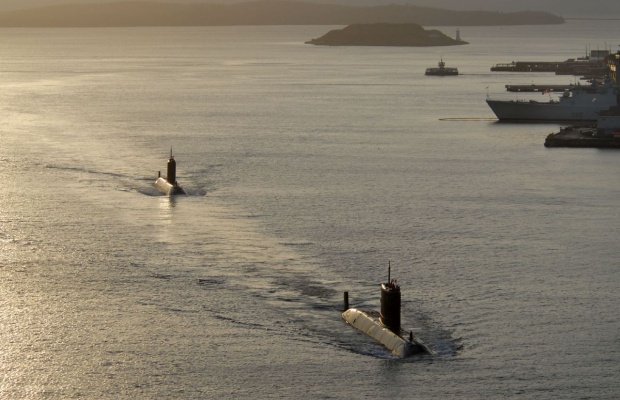
A rare site of two Canadian subs sailing together into homeport for the Christmas holidays. Seen leading the pack is the HMCS Cornerbrook with the HMCS Windsor following. The HMCS Cornerbrook and the HMCS Windsor arrived in the early dawn coming along side in Halifax today in Nova Scotia on the 21st of December 2006

Canada

The Harper government is set to announce a five-year, $531-million contract  extension to repair and upgrade Canada’s fleet of four diesel-electric  submarines

OTTAWA — B.C.’s shipbuilding and repair industry will get a shot of good news  Thursday when the Harper government announces a five-year, $531-million contract  extension to repair and upgrade Canada’s fleet of four diesel-electric  submarines, The Vancouver Sun has learned.

The contract, following a similar agreement struck in 2008, will protect  roughly 200 jobs at the department of national defence’s Fleet Maintenance  Facility in Esquimalt, according to a federal official.

Another 200 jobs will be protected at locations elsewhere in Canada, he  said.

“This significant federal investment will support more than 400 high-quality  jobs, improve the long-term sustainability of B.C.’s shipbuilding industry and  provide the best tools for Canada’s sailors,” he said in a prepared  statement.

The contract was won in a competitive bid by Babcock Canada Inc., a  subsidiary of the British multinational firm Babcock International Group  PLC.

Babcock International won the original contract in 2008 after it teamed up  with Weir Canada Inc. of Mississauga, Ont., to create a consortium called the  Canadian Submarine Management Group.

However, Babcock announced in 2011 that CSMG would be renamed Babcock Canada  Inc. after Weir’s share of the joint venture was transferred to Babcock.

The original contract award caused a political flap because Babcock beat out  Irving Shipbuilding, which wanted to keep the repair work in Halifax.

One of the critics was Green party leader Elizabeth May, who at the time was  planning her run against Defence Minister Peter MacKay in his Nova Scotia  riding.

May, who accused the government of an “anti-Atlantic bias,” is now the MP for  the Vancouver Island riding of Saanich-Gulf Islands.

The original five-year contract in 2008 was worth $370 million over five  years, but if CSMG met performance targets the contract was to be extended over  15 years, for a total value of up to $1.5 billion.

Thursday’s announcement gives a clear indication that Babcock has met those  targets.

The fleet of four Victoria-class diesel-electric submarines has had a rocky  history after the Liberal government made what appeared to be the  bargain-basement purchase of the mothballed subs from the Royal Navy for $750  million in 1998.

It took far longer and was costlier than expected to make the vessels  seaworthy, and in 2004 the HMCS suffered a fire that left one officer dead. In  2011, HMCS Corner Brook ran aground near Vancouver Island during manoeuvres.

There are now two subs, HMCS Victoria and HMCS Windsor, that are fully  operational.

HMCS Chicoutimi is currently being serviced at Esquimalt but is expected to  be ready for sea trials later this year.

The HMCS Corner Brook is also in Esquimalt for both repairs and a refit.

The fleet is “at the highest state of readiness that they’ve ever been,” the  source said.

Source – The Vancouver Sun

Russian submarines heading to NZ waters

The Russians are coming, again, in submarines to waters near New Zealand.

The state-run Itar-Tass agency says Russia will send submarines armed with nuclear ballistic missiles to the South Pacific and the Southern Ocean.

“The revival of nuclear-submarine patrols will allow us to fulfil the tasks of strategic deterrence not only across the North Pole but also the South Pole,” an unnamed official in the military General Staff was quoted as saying.

Given that the South Pole is 1500 kilometres from the sea, it suggests the new Borei-class submarines, with 16 long-range nuclear missiles, might end up in the Ross Sea.

“As the Russian Navy receive the Borei-class missile submarines, they will not only continue to patrol the Arctic, Atlantic and Pacific Oceans, but will resume execution of combat missions in those regions of the world’s ocean, where in the late 90s of the last century used to be the Soviet Navy, and where they have ceased to appear following the collapse of the Soviet Union,” the report said.

It echoes the Soviet days and in 1982, when a Russian submarine was photographed by the Royal New Zealand Air Force east of New Zealand.

The air force still has submarine-hunting capacity in the form of its six P3 Orions, but it seldom practises finding them now.

In 1972, the navy was ordered to sea as intelligence suggested a Soviet submarine was near New Zealand.

Several ships and the air force were well out to sea when they heard, on what was then the NZBC, that a Soviet hydrographic submarine had docked in Suva that morning.

Just before Christmas in 1982, the diesel-powered Soviet Foxtrot submarine Regul was spotted on the surface near Tahiti sailing with a research vessel.

It continued towards the South Island and was last seen near the Chatham Islands. The Soviets said they were doing oceanographic work.

Three years later, there were headlines and claims that the French submarine Rubis was in the Waitemata Harbour, supporting the agents bombing the Rainbow Warrior. It was never proved.

German and Japanese submarines operated near New Zealand during World War II.

U862 captain Heinrich Timm claimed later that while they were off Hawke’s Bay, crew landed to get fresh milk from the dairy herd they saw.

In the 1870s, New Zealand built 17 harbour forts around the country, fearing that Tsarist Russia, in the wake of the Crimean War, might invade. It was never clear why it wanted Auckland.

Source – Stuff.co.nz

Canada’s submarine fleet needs to start from scratch


By the time Canada's submarines are ready for duty, they'll be due for retirement.

By the time Canada’s submarines are ready for duty, they’ll be due for retirement.

Defence Minister Peter MacKay blames the Liberals for Canada’s troubled fleet of second-hand Victoria-class submarines. It was the Liberals who purchased the four British-made vessels for the suspiciously low price of $750-million in 1998. Yet it was none other than MacKay himself who, 10 years later, persuaded his Conservative colleagues not to scrap them. It was MacKay who signed taxpayers up for another $1.5-billion worth of refits and repairs, thereby throwing good money after bad.

It was apparent long before 2008 that the submarines were deeply flawed. The diesel engines were designed for railroad locomotives and not the rapid stops and starts required of submarines. There were defects in the torpedo tubes, making it possible for both the inner and outer doors to be open at the same time, even while the subs were submerged. The subs were mothballed in saltwater for four years before Canada bought them, and years more before we took possession. They suffered serious corrosion — the diving depth of HMCS Windsor is now restricted due to rust damage on the hull.

Shortly after Canada took possession, 1,500 litres of saltwater spilled into HMCS Corner Brook because of a malfunctioning Submerged Signal Ejector — a device that is used to deploy decoys while submerged. HMCS Victoria experienced serious problems with its cooling system. And a deadly fire broke out on HMCS Chicoutimi when seawater entering through an open hatch caused an electrical short in wiring that had just one layer of waterproof sealant, instead of the three layers the construction specifications had required. In 2004, the electrical system on Victoria was destroyed when the submarine was hooked up to an on-shore electric supply. The Halifax Chronicle Herald reported that the Navy spent about $200,000 after the accident “to buy old technology that mirrors what the sub’s British builders used” – equipment that one of the Navy’s own “electrical technologists” said “probably goes back to the ‘60s.”

In 2007, Windsor entered a refit that was supposed to take three years but ended up taking six. Documents obtained by the CBC later explained that every system had major problems. Spare parts are also difficult to obtain.

It was in this context that MacKay pushed for the $1.5-billion refit and repair contract, a move rendered all the more perplexing by the fact that, by 2008, the submarines were already between 15-19 years old. This meant that the most one could hope for from the vessels, after their refits, was a single decade of service.

Chicoutimi has been out of the water since the fire in 2004, and will remain in dry dock until at least the end of this year

Which is not very long when you consider that, for the same amount of money, Canada could have procured between 3-4 brand new diesel-electric submarines based on proven designs from France or Germany.

Today, five years after the $1.5-billion contract, MacKay insists the situation is improving. Which is true, if going from horrendous to bad counts as an improvement. Corner Brook was damaged in an accident in 2011 and put out of action until 2012. It is scheduled to return to dry dock for three years in 2014. In December 2012, a defect was discovered in one of Windsor’s two diesel engines, which resulted in the submarine having to operate on just one engine. This put the sub on limited duty. She will be taken out of service later this year so that the engine can be replaced. Chicoutimi has been out of the water since the fire in 2004, and will remain in dry dock until at least the end of this year. Victoria, which emerged from six years in dry dock in 2011, is scheduled to return there for three years in 2016.

According to the Department of National Defence, Canada’s four Victoria-class submarines have accumulated a total of just 1,131 days at sea in the decade since 2003 — about 30 days per submarine per year. It’s time to stop throwing good money after bad. If Canada wants to maintain this capability, we need to start from scratch.

Source – National Post

Vietnam acquires 2 submarines from Russia

 The much-awaited arrival in August of the Philippines’ second warship BRP Ramon Alcaraz from the United States has been matched by Vietnam with its acquisition of two submarines from Russia.

On the other hand, a US lawmaker has been reportedly calling on Washington to sell conventional submarines to Taiwan.

“We are not girding to go to war with any country. Our capability upgrade program is only aimed at building a credible territorial defense for the country,” a senior security official said over the weekend, referring to an apparent arms race in the Asia-Pacific region.

Defense and security monitoring showed that two diesel-electric Kilo-Class submarines are to be turned over to the Vietnamese Navy this September by Russia’s Admiralty Shipyard under Vietnam’s $2-billion Project 635.

Meanwhile, Taiwan-based Central News Agency reported last Thursday that New Jersey Rep. Robert Andrews wrote US Defense Secretary Chuck Hagel, asking him to find ways to support Taiwan’s acquisition of diesel electric submarines.

“Yes, we are lagging behind in terms of military capability but on the positive note, our Navy will get another ship with the scheduled arrival of BRP Alcaraz to guard and defend the country’s maritime sovereignty” the official stressed.

BRP Alcaraz lifted anchor at South Carolina last week on her voyage to the Philippines after undergoing almost a year of refurbishment and retrofitting of its weapons.

The high endurance cutter was acquired by the Philippine Navy last year under the Excess Defense Article Military Assistance Program of the US.

Formerly called USS Dallas, the second Hamilton-class cutter is expected to be deployed in areas in the West Philippine Sea where China had been building up its presence.

The US delivered its first Hamilton-class cutter to the Philippines in December. Renamed BRP Gregorio del Pilar, the vessel – the Philippine Navy’s biggest – is now patrolling the West Philippine Sea, particularly near Recto Bank.

The Philippines, Brunei, China, Malaysia, Vietnam and Taiwan have territorial claims in the Spratly archipelago.

To date, 18 Chinese surveillance vessels have been monitored in the Philippines’ exclusive economic zone. Three of these ships have taken up position near Ayungin Shoal.

Source – ABS/CBN

Canadian submarine fleet’s future could be at risk

No mention of sub replacements in $33B National Shipbuilding Procurement Strategy, report says

The HMCS Chicoutimi sits aboard the heavy lift ship Tern in Halifax harbour on April 6, 2009. The vessel was transported to Victoria for a refit.The HMCS Chicoutimi sits aboard the heavy lift ship Tern in Halifax harbour on April 6, 2009. The vessel was transported to Victoria for a refit. (CBC)

Stealth and silence are hallmarks of the Royal Canadian Navy’s submarine fleet but those qualities may also apply to the federal government’s vision for the beleaguered force, says a new report released Tuesday on the future of the navy’s sub squadron.

The report, titled “That Sinking Feeling” said there are indications that the future of submarines in the navy may be as shaky as the spotty service record of the second-hand Royal Canadian Navy subs.

A hint of looming doom for the submarine fleet could be that there is no mention of replacements in the much-touted National Shipbuilding Procurement Strategy (NSPS), said the report, which is produced by the Rideau Institute and the Canadian Centre for Policy Alternatives.

“Nowhere in the plan is there any mention of one particular, significant, readily identifiable and probably imminent procurement — namely, the replacement of Canada’s troubled Victoria-class submarines,” the report said.

The report is co-authored by Stewart Webb, a researcher with the Rideau Institute, and Professor Michael Byers, a University of British Columbia defence expert.

Byers has been critical of both the Harper government and Canada’s military procurement strategy in the past. In 2008, Byers sought the New Democratic Party nomination for the federal riding of Vancouver Centre but lost to Liberal incumbent Hedy Fry.

The government plans on spending $33 billion over the next three decades replacing the ships of Canada’s navy.

New supply and logistics ships, a fleet of Arctic patrol vessels and up to 15 replacements for the navy’s front-line frigates and destroyers are planned. But submarines, which the navy claims are vital to Canada’s defence, do not surface in the ambitious warship construction program.

“Canada’s Victoria-class submarines may have as little as one decade of remaining service-life, and too many mistakes have been made with submarine procurement in the past,” the report said.

Victoria-class fiasco

The report chronicles the history of Canada’s dabbling with submarines — from the failed attempt to build up to a dozen powerful nuclear submarines in the late 1980s to the decision to buy four mothballed British submarines that had to be retro-fitted around an American-supplied torpedo.

By the time Canada decided to buy the four bargain-priced submarines, the oldest had spent a total of nine years languishing in salt water without a crew.

“Unfortunately, the apparent bargain quickly became a costly fiasco,” states the report.

The report provides a scathing account of the “inferior vessels” since the first sub, HMCS Victoria, entered service in the Canadian navy in 2000.

The time all the submarines have spent at sea is a telling number.

While in service with the British navy for four years, the subs spent 1,077 days at sea. But after 13 years in service with the Canadian navy, the boats have spent only 783 days patrolling, the report said.

One sailor was killed and several others injured because of a fire aboard the submarine HMCS Chicoutimi and there have been constant, and later confirmed, reports of cracked valves, a dented hull, shoddy electrical systems, rusted parts and cost overruns.

CBC reported last month that HMCS Windsor’s planned two-year refit actually lasted five years and cost $209 million.

After the submarine was relaunched in Halifax in the fall of 2012 it was discovered that one of the vessel’s two generators didn’t work, resulting in the submarine being restricted to near-home waters until the multi-million generator can be replaced. That replacement might not happen for years, confirmed the navy.

The federal government signed a controversial $1.5 billion contract in 2008 with the Canadian subsidiary of a British-based company to provide “in-service support” for the submarines.

But Tuesday’s report said that money could have funded a new fleet of state-of-the art submarines.

“The Harper government could have procured three to four brand new diesel-electric submarines, based on proven designs from France, Germany, or Sweden,” states the report.

Future plans sketchy

The report challenges Canadians to decide whether the navy needs submarines or not but it also ponders whether the Harper government is quietly planning to procure new submarines.

Military brass have made it clear that submarines are front and centre in its plans for Atlantic, Pacific and Arctic defence. But the government has not been so forthright.

“There is clearly a desire within [the Department of National Defence] and the Canadian Armed Forces for the procurement of new submarines. But the absence of submarines from the NSPS remains unexplained,” write the authors.

The report suggests there may be three possible scenarios for Canada’s submarine future: a possible secret plan for the Victoria class replacement; a possible secret plan to terminate Canada’s sub capability; or there is no plan to either keep or replace the current fleet.

“Condemning Canada’s submarine program to death through neglect and obsolescence rather than design,” the report said.

Other countries have decided to scrap submarine capabilities altogether.

The Danish navy pulled the plug on its sub fleet, and the possibility of new submarines in 2004 after a national debate.

Instead of subs, the Danes opted to build a small but mighty fleet of surface ships to patrol in both home and international waters.

But many other countries have decided to invest in submarines as the ideal way to deny other nations access to their waters.

China, India, Iran, Chile, Malaysia and Israel are all building or buying new fleets of advanced submarines.

The report said there are several submarine designs Canada might consider to replace the aging but low mileage Victoria class submarines.

The German-built U-214 class has the ability to remain underwater for weeks at time because of new air-independent technology.

Canada’s submarines must surface, or send mast to the surface, several times a day in order to charge batteries.

New submarines like the French Scorpene or Swedish Gotland would allow Canada to patrol under the ice in the Arctic and do so with just 25 sailors — half the crew needed for the Victoria class.

But if history is any guide, it takes Canada 15 to 20 years to design and build a new class of complex warships.

“The best-before date of Canada’s Victoria-class is approaching, perhaps as soon as 2023,” warns the report.

Cmdr. Hubert Genest, with the navy’s public affairs office, told CBC News that the navy plans to operate the Victoria-class submarines until the late 2020s, saying that the navy has “always said that the Victoria-class submarines was the bridge to the next generation of submarines for Canada.”

Source – CBC News

Tangled in red tape, India’s submarine fleet sinking

 
Tangled in red tape, India's submarine fleet sinking
The Indian Navy is making do with just 14 aging conventional diesel-electric submarines.
NEW DELHI: The navy’s desperate attempts to rescue its sinking underwater combat arm have been dealt a double whammy. First, the ongoing project to construct six Scorpene submarines has been delayed by another 14-18 months, with the first vessel now slated to roll out of Mazagon Dock Limited(MDL) by November 2016 at the earliest.More worryingly, the new project to construct six advanced stealth submarines, armed with both land-attack missile capabilities and air-independent propulsion for greater underwater endurance, is still stuck in political apathy and bureaucratic red-tape. It has already been examined by three committees after being granted “acceptance of necessity” in November 2007.

The finance ministry has now again returned the file for the over Rs 50,000-crore project, code-named Project-75India, to the defence ministry for clarifications.

“The draft Cabinet Committee on Security (CCS) note for P-75I is simply being tossed around with no resolution in sight. The global tender or RFP (request for proposal) for it can be issued only after the CCS approves the file,” said a source.

Even if the P-75I tender is floated today, it will take at least three years to ink the contract with the selected foreign collaborator, and another seven to eight years after that for the first submarine to be built.

With the over Rs 23,000 crore Scorpene (P-75) project already running four years behind the original 2012-17 induction schedule, alarms bells are now ringing. The navy is making do with just 14 aging conventional diesel-electric submarines — 10 Russian Kilo-class and four German HDW ones — which are to be progressively retired in the coming years despite life-extension refits. China and Pakistan, meanwhile, are adding muscle to their underwater combat fleets.

Way back in 1999, the CCS approved a 30-year submarine-building plan, which envisaged induction of 12 new submarines by 2012, followed by another dozen by 2030. But the government’s inability to plan and take decisions means the navy is yet to get a single submarine 14 years later.

P-75I is embroiled in a debate over the “selection of Indian shipyards” and the “indigenization level to be achieved”. While two submarines are to be imported, four will be constructed in India.

The navy wants private shipyards to be involved in the project to save time since MDL is overburdened with orders. But the MoD’s defence production department has insisted that three will be built at MDL in Mumbai and one at Hindustan Shipyard in Visakhapatnam.

The Scorpene project, with contracts being inked with French firms in October 2005 has been grossly mismanaged, with huge time and cost overruns. The deal for the ‘MDL procured material packages’, including sensors, propulsion and the likes, with the French firms was signed only last December. The order for heavy-weight torpedoes to arm the submarines is also yet to be placed.

Projections show only five to six of the present 14 Indian submarines will be fully operational by 2020. Even with a few Scorpenes by then, India will remain far short of the minimum 18 conventional submarines required to deter Pakistan and China.

Source – Times of India

Spain – The mistake will cost £9million over three years to rectify

Spain’s £1.75billion submarine programme is torpedoed after realising near-complete vessel is 70 tonnes too heavy because engineer put decimal point in the wrong place

  • Experts fear that the Isaac Peral will not surface again if sent to sea
  • The mistake will cost £9million over three years to rectify
  • A US company is to present a range of options to Spanish officials
  • The project could be set back two years by the error


A £1.75 billion Spanish submarine project has run aground after officials realised that the vessel is more than 70 tonnes too heavy – because an engineer put a decimal point in the wrong place.

A former Spanish official has described the mistake, which has led to fears that the submarine might not resurface if sent to sea, as ‘fatal’.

The Isaac Peral, the first in a new class of diesel electric submarines, was almost complete when the problem was noticed.

Too heavy: The Isaac Peral, a new, Spanish-designed submarine is more than 70 tons too heavy, and officials fear if it goes out to sea, it will not be able to surface. Officials are pictured next to the engine of the vessel last NovemberToo heavy: The Isaac Peral, a new, Spanish-designed submarine is more than 70 tons too heavy, and officials fear if it goes out to sea, it will not be able to surface. Officials are pictured next to the engine of the vessel last November

Spain will now pay US Navy contractor Electric Boat £9million over three years to assess the issue and carry out the work required to correct it, according to the Spanish Defence Ministry.

Rafael Bardaji, former director of the Office of Strategic Assessment at Spain’s Defense Ministry said that officials will review options suggested by Electric Boat.

But he said the preference has been to extend the length of the submarine’s hull, perhaps by 5 to 6 meters, to increase buoyancy.

Otherwise, the weight of the 2,200 tonne submarine would have to be reduced, and he said the Spanish Navy would not want to compromise features such as the combat system or an air-independent propulsion system.

Experts: Electric Boat, the company who will help the Spanish rectify the problem, helped to build the Astute class attack submarine, pictured, for the British Navy in 2003Experts: Electric Boat, the company who will help the Spanish rectify the problem, helped to build the Astute class attack submarine, pictured, for the British Navy in 2003

Electric Boat, the primary contractor for the U.S. Navy’s fleet of nuclear submarines, accepted the contract through a foreign military sales agreement between the American Navy and the Spanish Defense Ministry, the U.S. Naval Sea Systems Command announced this week.

THE ISAAC PERAL SUBMARINE

The submarine project has cost the Spanish some £1.75billion so far. But what exactly are they getting for their money with the SSK submarine:

  • Weight: 2,200 tonnes (surfaced) / 2,426 tonnes submerged)
  • Length: 71,05 metres
  • Power: 3 x diesel engines, 1 x electric engine, 1 x AIP reactor
  • Speed: 12 knots (14mph) surfaced / 19 knots (22mph) submerged
  • Complement: Space for three officers, four subofficers, 25 sailors and eight special forces soldiers
  • Armament: 6 x 533mm torpedo launchers, DM2/A4 Torpedos, Mk48 Torpedos, Sub-Harpoon Block II missiles, Tomahawk TacTom Cruise missiles (range about 1,600 km)

Electric Boat, a division of General Dynamic Corp., has helped other countries with their submarine programs.

It began assisting with development of the Astute-class nuclear attack submarine for the British Royal Navy in 2003, and it is working under another foreign military sales agreement on Australia’s Collins class of submarines.

The 233ft long submarine will carry a crew of 32, along with eight special forces troops, and weapons systems for surface and anti-submarine warfare.

The Defense Ministry said technical problems are normal for projects of this scale.

It said in a statement: ‘The technology challenges that these programs face during development are much more than simple calculations.

‘All the major military programs, especially submarines, have experienced delays and often have required the support of a technology partner.’

Mr Bardaji added: ‘Apparently somebody in the calculations made a mistake in the very beginning and nobody paid attention to review the calculations.’

The Isaac Peral, named after a 19th century Spanish submarine designer, is one of four vessels in the class that are in various stages of construction. The country has invested about £1.75 billion in the program.

The first vessel was scheduled to be delivered in 2015 but the Spanish state-owned shipbuilder, Navantia, has said the weight problems could cause delays of up to two years.

Source – Daily Mail