Category Archives: The world’s submarines

News, views and stories about the rest of the world’s submarines

Hunt for lost First World War submarines

Explorers are launching a new project to locate dozens of British and German submarines which sank off the coast of England during the First World War, as part of a major new study to mark the centenary of the conflict.

Day trippers crowd around the German Submarine U Boat U118, washed up on the beach at Hastings, East Sussex, in 1919.

Day trippers crowd around the German Submarine U Boat U118, washed up on the beach at Hastings, East Sussex, in 1919.

The English Heritage research will involve identification and analysis of all submarine shipwrecks from the period which are within territorial waters – 12 miles from the coast.

Preliminary research by the team, studying historical records, has already identified three British and 41 German submarines from the conflict which are known to have sunk in the area.

The locations of some of these have already been established, but others have yet to be discovered.

Once they have been found, the team will dive onto them to assess their condition. They will then decide whether any measures can be taken to slow down the shipwrecks’ rate of decay on the seabed.

Depending on their historical significance, the vessels may also be added to existing list of shipwrecks covered by the Protection of Wrecks Act, which tightly controls such sites, or scheduled as an ancient monument.

If the vessels sank with men on board, they could be added to the register covered by the Protection of Military Remains Act, to ensure the war graves cannot be disturbed.

Mark Dunkley, a marine archaeologist with EH, said: “These sites may be out of sight, but they are still an important part of our heritage. There are people still around who will have a link to the men lost on these boats.

“They are an important part of family, as well as military, history.

“People might know more about U-boats in the Second World War, but this project will show just what a significant part they played in the first world war – and very close to land.”

The locations of around half of the 44 vessels are known. To find the others, EH is planning to enlist the help of local diving groups around the coast.

Although most associated with the Second World War, submarine warfare was first deployed during the earlier conflict, as German U-boats attempted to cut supply lines into and around the British Isles, while Royal Navy vessels patrolled in search of enemy ships.

At the start of the war, submarines were supposed to abide by international rules which complied them to then allow the crews of merchant ships to get to safety before sinking their vessels.

But this swiftly became impractical and led to the adoption of unrestricted submarine warfare by Germany, which, nearly brought Britain to its knees in 1917.

During the course of the war, German U-boats sank more than 12 million tons of shipping – around 5,000 ships – with the loss of 178 submarines and almost 5,000 men killed.

Most of the wrecks covered by the English Heritage project, which is expected to run throughout the four years of the Great War centenary, are German submarines which were targeting coastal routes, either attacking merchant shipping with torpedoes or laying mines.

They include UB65, which sank HMS Arbutus, a Royal Navy sloop, as well as six merchant ships and damaged six more, before sinking with the loss of all 37 crew near Padstow, Cornwall in July 1918.

The vessel, which went to the bottom after an apparent accident, had been plagued by bad luck and deaths and before its loss the German navy is said to have called a priest on board to perform an exorcism.

They also include UB115, which sank off the coast of Northumberland in 1918 with the loss of all 39 crew, after being attacked by British armed trawlers, warships, and even an airship, R29, which dropped bombs on it.

Several others went down off the east coast, among them UB107, which sank off Flamborough Head in July 1918, either as a result of an attack by British vessels, an accident, or after hitting a mine; UB41, last sighted by the SS Melbourne on October 5 1917 off Scarborough, which is thought to have struck a mine of suffered an internal explosion; and UB75, which had left Borkum on November 29, 1917 for the Whitby area. She succeeded in sinking four ships but never made it back home.

The only three Royal Navy submarines covered by the project were lost in accidents: HMS G3, which ran aground in Filey Bay, North Yorkshire, after the war in 1921; HMS G11, which ran aground near Howick, Northumberland, 1918; and HMS J6, which was sunk in a friendly fire incident, after being mistaken for a U-boat in 1918.

A young couple pose for photographs on the wreck of HMS G3 in Filey Bay, North Yorkshire.

English Heritage has responsibility for all historic wrecks off the English coast, but most of those it cares for are wooden warships.

To find out more about how to preserve the metal vessels from the First World War, it conducted a preparatory survey last year, on the wrecks of two submarines which sank just before the conflict – the Holland No 5, which sank off Beachy Head in 1912 and the A1, which went down in Bracklesham Bay a year earlier.

Both vessels sank without loss of life, although the A1 had previously sunk, in 1904, with the loss of all hands.

Both boats had a hull half an inch thick, but after more than 100 years on the seabed, researchers found these had thinned to as little as a quarter of an inch in places.

The team believe that some wrecks can be preserved by placing on them “sacrificial” anodes, which corrode at a faster rate, protecting the hulls.

Source – The Telegraph
Electric Boat gets contract to help lighten Spanish sub

Groton — The first of the Spanish Navy’s four new submarines is too heavy and Electric Boat has been asked to help.

The U.S. Navy hired Electric Boat as the contractor for a foreign military sales agreement with the Spanish Ministry of Defence, in support of the Spanish Navy, according to a statement the U.S. Naval Sea Systems Command issued Monday.

The agreement is worth up to $14 million, an official at the Embassy of Spain who is familiar with the contract said. EB will provide technical assistance and review the S-80 Submarine project for almost three years, the official added.

The S-80 Submarine is Spain’s first submarine design. According to Spanish press reports, the S-81 Isaac Peral, the first member of the class, is at least 75 tons overweight. The diesel-electric submarine weighs 2,400 tons submerged and the excess weight could prevent it from surfacing after it dives.

Navantia, a Spanish state-owned company, is building the S-80 submarine fleet. Each submarine will have a crew of 32 and eight special forces.

The Isaac Peral was scheduled to be delivered in 2015 at a cost of about $700 million, but it is estimated that correcting the weight and balance issues could take up to two years.

When asked whether EB would help with the weight problem specifically, the Embassy official said, “We hope.” He did not know how many EB employees would be involved.

EB referred questions to the U.S. Navy.

In 2003, the British Ministry of Defence solicited EB’s help for its Astute submarine program through a foreign military sales agreement with the United States.

With a substantial gap between the design and construction of the Vanguard class and the start of the Astute program, submarine design and construction skills had atrophied in the United Kingdom, according to the RAND Corp., and about 100 experienced EB designers and managers worked with BAE Systems on the design effort.

Source – Patch . Com

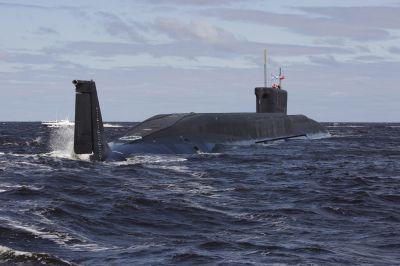
Russian nuclear submarines resuming patrols in southern hemisphere

A new Russian nuclear submarine, the Yur

A new Russian nuclear submarine, the Yuri Dolgoruky, drives in the water area of the Sevmash factory in the northern city of Arkhangelsk on July 2, 2009.

Russian President Vladimir Putin watches

Russian President Vladimir Putin watches a military exercises in the Barents Sea aboard of “Pyotr Veliky” heavy nuclear missile cruiser, 17 August 2005.

MOSCOW — Russia plans to resume nuclear submarine patrols in the southern seas after a hiatus of more than 20 years following the break-up of the Soviet Union, Itar-Tass news agency reported on Saturday, in another example of efforts to revive Moscow’s military.
The plan to send Borei-class submarines, designed to carry 16 long-range nuclear missiles, to the southern hemisphere follows President Vladimir Putin’s decision in March to deploy a naval unit in the Mediterranean Sea on a permanent basis starting this year.
“The revival of nuclear submarine patrols will allow us to fulfill the tasks of strategic deterrence not only across the North Pole but also the South Pole,” state-run Itar-Tass cited an unnamed official in the military General Staff as saying.
The official said the patrols would be phased in over several years. The Yuri Dolgoruky, the first of eight Borei-class submarines that Russia hopes to launch by 2020, entered service this year.

Putin has stressed the importance of a strong and agile military since returning to the presidency last May. In 13 years in power, he has often cited external threats when talking of the need for a reliable armed forces and Russian political unity.
Fears of a nuclear confrontation between Russia and the United States has eased in recent years, and the Cold War-era foes signed a landmark treaty in 2010 setting lower limits on the size of their long-range nuclear arsenals.
But the limited numbers of warheads and delivery vehicles such as submarines that they committed to under the New START treaty are still enough to devastate the world. Putin has made clear Russia will continue to upgrade its arsenal.
Russia’s land-launched Intercontinental Ballistic Missiles (ICBMs) would fly over the northern part of the globe, as would those fired from submarines in the northern hemisphere.
Both the Borei-class submarines and the Bulava ballistic missiles they carry were designed in the 1990s, when the science and defense industries were severely underfunded.
Russia sees the Bulava as the backbone of its future nuclear deterrence, but the program has been set back by several botched launches over the past few years.

Our submarines are free to navigate international waters: China

Our submarines are free to navigate international waters: China
BEIJING: Amid the long-simmering territorial row between China and Japan, Chinese military has asserted that its submarines are free to navigate international waters.

Chinese submarines are free to navigate international waters, including the Northwest Pacific, which is also visited by other nations’ maritime forces, spokesman for China’s Ministry of National Defence, Geng Yansheng, said yesterday.

Geng also criticised the so-called “China Military Threat”, as described by some Japanese media, as an act of “intentionally creating tension with an ulterior political motive,” state-runXinhua news agency reported today.

“Such act is irresponsible and not conducive to peace and stability in the region,” he said.

Geng made the remarks in response to a question regarding some Japanese media outlets’ recent, frequent reporting on the voyages of China’s Yuan-type submarines in Japan’s contiguous zones.

Japan’s coastguard recently said that the Chinese maritime surveillance vessels were spotted inside the 12-nautical-mile zone off the Senkaku islands, which China calls the Diaoyus, in the East China Sea.

The move marked the latest in the decades long standoff between Beijing and Tokyo as they jostle over ownership of the resource-rich islands.

Last September, Japan nationalised three islands in the chain, angering China.

Source – Economic Times


There’s nothing sadder than the wreck of a once-great submarine

There's nothing sadder than the wreck of a once-great submarine

They dove beneath the waves, and helped to win massive global wars. But submarines can’t submerge forever. Eventually, these old warhorses get swept away by history. Here are some images of the most haunting dead submarines of all time.

Puget Sound Naval Shipyard, May 17 1993

There's nothing sadder than the wreck of a once-great submarine

One submarine tender and 16 nuclear submarines are awaiting scrapping.

The remains of two XT-Craft midget submarines, Aberlady Bay, Scotland, UK

There's nothing sadder than the wreck of a once-great submarine

The XT-Craft submarines are the training versions of the X-Craft that attacked the Battleship Tirpitz in September 1943. Two of these vessels were transported to Aberlady Bay and used for target practice and gun tests by Royal Air Force aircraft.

There's nothing sadder than the wreck of a once-great submarine

There's nothing sadder than the wreck of a once-great submarine

There's nothing sadder than the wreck of a once-great submarine

There's nothing sadder than the wreck of a once-great submarine

Near the Russian naval base of Olenya Bay, Kola Peninsula, Russia

There's nothing sadder than the wreck of a once-great submarine Continue reading

Indian submarine in distress gets Egyptian help

India’s submarine INS Sindhurakshak received help from Egyptian Navy when it encountered extreme bad weather and rough sea on its way back home after mid-life up-gradation in Russia.
The Sindhurakshak, a Russian Kilo Class submarine built in 1997 at Admiralteiskie Verfi shipyard in St Petersburg, underwent mid-life up-gradation.

The Egyptian Navy towed the submarine to Port Said along the coast of the Mediterranean Sea in March, sources said.
Indian submarine in distress gets Egyptian help

Welcoming the gesture, Indian ambassador to Egypt Navdeep Suri praised the professional handling by the Egyptian Navy.
Indian submarine in distress gets Egyptian helpIn thank you cable to Egypt’s Defence and Military Production Minister Gen Abdel-Fattah el-Sisi, Suri said, “(Egyptian) Naval troops towed the submarine in a professional way to a safe Egyptian port”, the official MENA news agency reported.

Source – Zee News

World’s biggest Russian nuke-submarines to be scrapped

Russian nuke-submarine

Russia will decommission and scrap two of the world’s largest submarines by 2018, a defence industry source has said.
The Severstal and the Arkhangelsk, both Project 841 (Typhoon-class) ballistic-missile submarines, are based at Severodvinsk on the White Sea. They will be withdrawn from the Navy by this year-end and will begin to be dismantled.
“This process is to be completed before 2018-2020 at the latest,” the source said, adding the boats are outdated and it is too costly to modernise them.
A third submarine of this class, the Dmitry Donskoy, has been modernised as a test platform for Russia’s new Bulava submarine-launched ballistic missile It will remain in service in that capacity for some time yet, the source said.
Six Typhoon-class submarines entered service with the Soviet Navy in the 1980s, and remain the largest submarines ever built. Three have already been scrapped.

Source – India Today

Spain just spent $680 million on a submarine that can’t swim

The S-80, clearly computer-generated.Navartia

One of Spain’s largest defense splurges may also be one of its most embarrassing. After spending nearly one-third of a $3 billion budget to build four of the world’s most advanced submarines, the project’s engineers have run into a problem: the submarines are so heavy that they would sink to the bottom of the ocean.

Miscalculations by engineers at Navantia, the construction company contracted to built the S-80 submarine fleet, have produced submarines that are each as much as 100 tonnes (110 US tonnes) too heavy. The excess weight sounds paltry compared to the 2,000-plus tonnes (2,205 US tonnes) that each submarine weighs, but it’s more than enough to send the submarines straight to the ocean’s floor.

Given the mistake, Spain is going to have to choose between two costly fixes: slimming the submarines down, or elongating them to compensate for the extra fat. All signs point to the latter, which will be anything but a breeze—adding length will still require redesigning the entire vessel. And more money on top of the $680 million already spent.

Spain’s defense ministry, the government arm responsible for overseeing the project, has yet to say how much the setback will cost in both time and money. But Navantia has already estimated that its mistake will set the project back at least one or, more likely, two years. And the Spanish edition of European news site The Local reported that each additional meter added to the S-80s, already 71 meters in length, will cost over $9 million.

It’s a costly mistake on many fronts. The state-of-the-art submarines were meant to be the first entirely Spanish-designed and built. Incompetence is likely going to cost the country at least some of the glory. Electric Boat, a subsidiary of US-based technology firm General Dynamics, has already evaluated the project and could be hired as a consultant to save the job.

Another bailout for Spain. This is getting all too familiar.

Source – Quartz

WWI German submarine has an underwater Lake Michigan grave (Video Clip)

Click on picture for Video clip

A view of the German U-boat, UC-97

It is no secret that one of the major attractions at Chicago’s Museum of Science and Industry is a World War II German submarine.

What you may not know is that Chicago also has a World War I German submarine but it happens to be resting in a place where very few people can see it.

We are turning the clock back to 1919 which was an incredible year in Chicago’s history.

There were race riots that took lives and others died when a hydrogen blimp crashed in the loop.  There was a transit strike, political scandal, the Black Sox lost the series and the City of Chicago became host to a German submarine that has disappeared, but never left.

It was something of a trophy from the Great War.  The German mine-laying sub U-C 97 was brought to the states in the summer of 1919.  It toured some of the Great Lakes making stops in Racine, Milwaukee and its final destination Chicago.  Along the way people could see, board, touch, perhaps curse this modern machine of war.

“The U-Boat was on tour.  It was kind of a post-war, ‘we won’ tour, and so people got to go on to it and see it, and then as a condition of the armistice, it had to be sunk,” Pritzker Military Library CEO Ken Clarke said.

Indeed, the order was to sink the UC-97 in deep water.  In June of 1921, the sub was towed 20 to 30 miles off of Highland Park.  The USS Wilmette was brought within rang, and fired her four inch guns.

“My understanding is they fired about 15 shots and they hit her about the water line and she went down pretty quick.  She nose down and down she went,” well-known maritime searcher Taras Lyssenko said.

And out there she rests – on the bottom of Lake Michigan.

“You know where the submarine is.  I can take you right to the submarine and put you in the hatch if you want to go,” Lyssenko said.

How about the aft hatch?  It’s there  In 300 feet of water.  Sleeping with the fishes.  Here’s a hole from one of the Willmette’s shells.

Cold, fresh water has kept the sub in pretty good shape as the years have passed.  Lyssenko and colleagues spent four years searching for it, and found it back in the 1990s.

In the years since, he’s recovered numerous World War II fighter planes from the Lake – now restored and displayed, but Lyssenko’s continuing dream is to do the same with the sub.  But raising, restoring, and finding a home for it would cost, he says, upwards of 50 million dollars.

“That’s huge, but the value to this city and state and country is far, multiplier.  It’s an exponential multiplier of the value,” Lyssenko said.

“If I was a betting person, it’s going to take somebody with a very particular specific interest and desire to see this piece of history come alive again,” Clarke said.

And here’s one more piece of history.  The ship that sunk the UC-97, The USS Wilmette, had different name and purpose a few years earlier.  It was the Steamship Eastland that in 1915 turned onto its side while docked in the Chicago River.  Over 800 lives were lost in one of the worst maritime disasters ever.

The Eastland, later the Wilmette, was cut up for scrap after World War II.  The UC-97 sits at the bottom, this appetizing, unseen pearl of history.

Pearls are expensive, and raising this one, while doable, will most definitely require “digging deep” in many respects.

Source – ABC Local

South Africa – Submarine open days turn ugly over delays

        SAS Charlotte Maxeke
Tempers frayed and tensions rose as hundreds of people who had queued for hours to see the SA Navy’s attack submarine in Port Elizabeth harbour were turned away yesterday.

A few hotheads became aggressive after the long wait.

The SAS Charlotte Maxeke docked on Friday and was berthed near the port’s naval base, the SAS Donkin, where it was to be open for public viewing between 9am and 3pm on Saturday and yesterday.

But the submarine was relocated to another berth on Saturday, causing a three-hour delay. This led to a lot of sightseers being turned away on both days.

Lieutenant Gert van Staaden, of the Port Elizabeth naval cadet base, said port control had ordered the relocation of the submarine because another ship was due to dock near the naval base.

“Moving the sub is not a simple task and takes time,” he said.

In addition, a pontoon, which keeps the vessel from colliding with the side of the quay, had to be put in place at the new berth.

“The submarine was moved at 10am and was open to the public again at 1pm,” said Van Staaden.

“A decision was taken to issue tickets to people, some of whom had been waiting for many hours.

“There were about 100 [people] left at the end of the day and they were given tickets and instructed to return early on Sunday,” he said.

The tours finished at 7pm on Saturday.

But frustrations in the queues arose again yesterday, when scores of ticket holders, some of whom were said to have brought others with them, arrived later than requested and demanded to be taken to the front of the growing queue.

Harbour Master Rajesh Dana said the relocation was in the interests of public safety because another vessel had docked nearby, causing “heavy truck movement” .

“We were also completely overwhelmed by the public interest. Adding to the logistical challenges was that only 10 visitors could go on board at a time.

“To avoid people standing for hours and not getting on board we closed the gates early.”

Dana said improved public access would be introduced as soon as possible.

Source – Times Live