Category Archives: The world’s submarines

News, views and stories about the rest of the world’s submarines

Three Russian nuclear submarines to be recommissioned

27_big

Three nuclear submarines of the Russian Navy currently under maintenance will be recommissioned by 2014, a Navy spokesman said.

The K-410 Smolensk cruise missile submarine, which is undergoing repairs since 2011, will resume its service in the Northern Fleet, the spokesman said Tuesday.

The Pacific Fleet will be rejoined by the K-150 Tomsk cruise missile submarine, which was docked in 2010 due to problems with the cooling engine of its nuclear reactor; and the K-419 Kuzbass attack submarine, under repairs since 2010.

The Kuzbass belongs to the same Akula II class as the ill-fated K-152 Nerpa, on which 20 people were killed during sea trials in 2008 due to malfunction of the fire suppression system.

The Russian Navy has 48 nuclear submarines, 20 of which are currently undergoing repairs or upgrade, according to Russian-ships.info database.

Source – DESI

One of Singapore’s most advanced submarines declared battle-ready

The last of Singapore’s most advanced submarines was declared battle-ready on Tuesday, April 30, 2013, sharpening the capabilities of the Republic of Singapore Navy (RSN) in underwater warfare.

The last of Singapore’s most advanced submarines was declared battle-ready on Tuesday, sharpening the capabilities of the Republic of Singapore Navy (RSN) in underwater warfare.

The RSS Swordsman was commissioned, following more than two years of tests and torpedo-firing exercises in Sweden and in the warmer and more corrosive waters here. The 60.5m diesel-electric vessel arrived in Singapore in last December. This is the second Archer-class vessel to be added to the RSN’s 171 Squadron, after the first, RSS Archer, was declared operational in 2011. The submarine squadron also comprises four ageing Challenger-class submarines.

Deputy Prime Minister Tharman Shanmugaratnam, who was at the ceremony in Changi Naval Base, said the new vessel will strengthen the navy’s ability to safeguard Singapore’s “continued and unimpeded access to the maritime routes”.

He noted that Tuesday’s ceremony also marked the end of the RSN’s eight year journey to replace some of the Challenger-class submarines, which were built in the 1960s.

Source – Straits Times

Israel’s 5th Dolphin class submarine launched in north Germany

The INS Rahav submarine is seen at the dry dock at the Howaldtswerke-Deutsche Werft shipyard in Kiel, Germany. (file photo)

 
The INS Rahav submarine is seen at the dry dock at the Howaldtswerke-Deutsche Werft shipyard in Kiel, Germany.


Israel has launched its fifth Dolphin-class submarine, which was constructed to undertake long-range classified missions and carry missiles armed with nuclear warheads, at a shipyard in northern Germany.
.

The director general of Israel’s Ministry of Military Affairs, Major General Udi Shani, the commander of the Israeli navy, Rear Admiral Ram Rothberg, and a number of other Israeli and German officials attended the inauguration of the submarine at the Howaldtswerke-Deutsche Werft (HDW) shipyard in Kiel Port on Monday.

.
The submarine, named the INS Rahav, will cost $500 million and will arrive in Israel in one year upon the completion and installation of its relevant systems. It is considered one of the most advanced submarines in the world and will be Israel’s most expensive piece of military equipment.
.
Israel’s first three Dolphin-class submarines are believed to be some of the most sophisticated diesel-electric submarines in the world. The fourth submarine, the INS Tanin, the first of the new generation Dolphin II submarines, was delivered in May 2012.
.
Germany donated the first two submarines after the first Persian Gulf War and agreed to cover a third of the cost of the third one.
.
In March 2012, Israel signed a contract for a sixth Dolphin-class submarine, to be delivered in a few years.
.
Israeli officials consider the submarines to be a critical aspect of the Israeli nuclear deterrent. Prime Minister Benjamin Netanyahu called the submarines “a strong and strategic tool” for the Israeli navy.
.
Source – Press TV

Explore HMCS Victoria, submarine docked at Canada Place – Video Clip

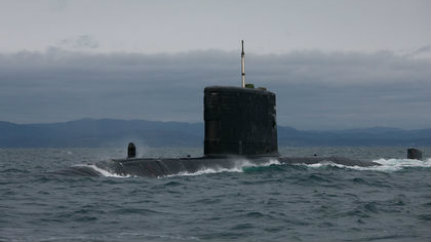
The Canadian Maritime Force has four Victoria class diesel-electric submarines, formerly Upholder Class submarines of the UK Royal Navy.

The Canadian Maritime Force has four Victoria class diesel-electric submarines, formerly Upholder Class submarines of the UK Royal Navy.

Click on picture for video

HMCS VICTORIA’s displacement  is approximately 2,200 tons surfaced and 2,400 tons submerged.

Covered in  anechoic tiles to reduce her detection by active SONAR, HMCS VICTORIA is 70.3  meters long, 7.6 meters across the beam and has a deep diving depth in excess of  200 meters.

The main hull is constructed of high tensile steel sections  stiffened by circular internal frames. Equipment located outside the main hull  is covered by the Casing, which also gives the crew a safe walkway when the  submarine is surfaced.

The Fin, which helps support the masts, serves as a kind  of keel and provides a raised conning position.

HMCS VICTORIA has six torpedo  tubes and can carry up to eighteen Mark 48 Mod 4 heavyweight torpedoes for use  against surface and sub-surface targets. She is also capable of carrying  sub-harpoon missiles and laying mines.

HMCS VICTORIA’s SONAR sets allow her to  locate and track ships and other submarines “passively”, that is without  transmitting on active sonar and thus giving way her location.

HMCS VICTORIA is  fitted with RADAR for general navigation, attack and search periscopes  (incorporating video recording and thermal imaging), and an Electronic Support  Measures suite.

HMCS VICTORIA has two diesel generators, each capable of  producing up to 1,410 kilowatts, and one main motor. The generators are used to  charge two main batteries, each consisting of 240 battery cells. These batteries  are used to power the submarine, which can reach a submerged speed of up to 20  knots.

The HMCS Victoria is one of several Canadian navy vessels anchoring in  Vancouver this weekend.

The long-range hunter-killer submarine will be docked at Canada Place until  Sunday, along with the HMCS Algonquin, a destroyer.

While the Algonquin is open to the public, who can enter the ship and meet  the crew, the Victoria is not. But you can take a tour in this video.

The Victoria, decommissioned in 1994, is 70.3 meters long, 7.6 meters across  the beam, and has a deep diving depth in excess of 200 meters. It has a crew of  280. It also has six torpedo tubes and can carry up to eighteen heavyweight  torpedoes for use against surface and sub-surface targets. The Victoria is also  capable of laying mines. The submarine can reach a submerged speed of up to 20  knots.

Source – Vancouver Sun

Quebec museum saves Cold-War submarine from the scrap heap

Onondaga

Just one step inside a unique museum at this St. Lawrence River port and that’s enough for some visitors.

That first step inside gives an immediate impression of what this museum is all about and that’s enough to make some people back out. Other visitors come with a toothbrush, their jammies and the excitement of staying overnight.

Both types of visitors learn what it is like to live and work in a submarine.

HMCS Onondaga patrolled below the North Atlantic for 36 years for the Canadian Navy and there was no life like it for the 70-man crew.

That's museum guide Alberic Gallant looking very much the role of a grizzled submariner at the back amidst ithe sub's diesel engines.

The museum guide Alberic Gallant looking very much the role of a grizzled submariner at the back amidst ithe sub’s diesel engines.

Now the general public can come aboard and experience that same life below the waves. The sub no longer dives below the surface. It has been hauled up on the south shore of The St. Lawrence River. But once those watertight doors are closed, you wouldn’t know the difference.

The Canadian Navy retired Onondaga in 2000 and planned to cut the sub into a half dozen pieces in Halifax, truck it up to Ottawa’s Canadian War Museum and stitch it back together again. The navy’s bean counters said that was too expensive and instead the submarine was to be sold for $60,000 as scrap metal.

But the people who operate a maritime museum in Rimouski decided one of the few Canadian vessels remaining from the Cold War should not end up as razor blades or subway rails.

They managed to put together nearly $5 million to buy the sub and tow it to Rimouski. It was one of the most harrowing voyages this sub ever made.  It had to ride out several late fall storms, which in its active days it would simply duck under.

The last 50 metres were the most dangerous. It rolled on its side as it road on a makeshift dolly up onto the beach.

But Rimouski seafarers have been handling ships since Champlain sailed by in 1608 and they were able to get Onondaga righted and secure its permanent berth.

Volunteers spent a cold winter inside the sub making it ship shape to open as Canada’s only submarine museum.

Visitors can wander through the vessel in 45 minutes escorted by dosun Alberic Gallant, who looks exactly what you’d expect a submariner to look like – but he’s an actor.

Or you can get a deeper impression of what it is like at sea in a sub by spending a night aboard. The overnight visitors duplicate the workday of a submariner.  They track surface ships by radar and sonar, they peer through the telescope at passing ships, or just check on their car in the parking lot.

One of the exercises includes learning how to escape a sub that is sitting incapacitated on the bottom – in water less than 1,000 feet deep.  Visitors wrestle their way into a survival suit, but they’re not required to climb into a tight chamber, inflate their suit with air, flood the chamber and then shoot up like a helium balloon to the surface.

Maurice Allard has done that during his 17 years as a Canadian Navy submariner, including six years on the Onondaga. Fortunately, he only had to do it in training sessions in Hawaii and in the Mediterranean.

Allard helped bring his former sub to Rimouski, worked on its restoration and he sits on the board of directors of the Pointe-au-Pere Maritime Museum.

He can tell stories about sitting quietly below Soviet spy ships stationed off the coast of Northern Ireland and going without hot food to avoid making any noise.

Sailors with claustrophobia didn’t go to sea in subs and visitors with the same affliction likely won’t roam through this museum. If you choose to stay overnight all the conversation and instructions are in French – plus, try to get a bunk amidst the torpedoes in the forward torpedo room. It’s the most spacious area in the vessel.

The Onondaga is the latest addition to Rimouski’s Pointe-au-Pere Maritime Museum.

Source – Canada dot com

Spain – Navantia overhaul of submarine almost complete

Spanish shipbuilder Navantia has floated the Spanish navy’s S-73 submarine, the Mistral, after finishing 80 percent of its dry dock overhaul.

Dry dock work on the vessel is being conducted at the company’s shipyard in Cartagena and, when completed, will give the submarine another five years of service life.

The S-73 is a diesel-powered vessel with a surface speed of 12 knots and a submerged speed 10.5 knots. It entered service with the Spanish navy in 1977.

The dry dock overhaul involved dismantling the submarine, replacing components and equipment in poor condition and then reassembling the vessel. Navantia said more than 15,000 pieces of equipment were removed and inspected, as well as its hull.

Mistral is docked at the shipyard for the remainder of the overhaul, which includes completion of assembly and testing at port and at sea.

The vessel is scheduled to be returned to the Spanish Navy in September, Navantia said.

Mistral is one of four Spainish Naval, S-70 “Agosta Class” submarines .

built by Cartagena dockyard

  • Galerna (S 71) – completed 1983 – in service
  • Siroco (S 72) – completed 1983 – decommissioned 2012
  • Mistral (S 73) – completed 1985 – in service
  • Tramontana (S 74) – completed 1985 – in service

Source – UPI.com

Source – Wikipedia

Two North Korean Submarines Allegedly Missing – Video Clip

Mini Submarines at Pipa Got Naval Base, North Korea
Two North Korean submarines have reportedly disappeared from  port. Although the subs were last seen at a naval base in the Hwanghae Province  in early April, the news is just now filtering out to media outlets. While the  capability of North Korea to shoot a long-range missile at the United States has  largely been nixed during press conference about EMP attack threats, the possibility of a missile attack from  a submarine has rarely been mentioned.

The thought of missing North Korean subs aiming a missile at a coastal city  is causing concern for some Americans. While any coastal city could become a  target, some analysts think California is a very likely location. If North Korea  shot a missile along the coast of the state, some feel than an earthquake could  occur and allow the attack to go largely undetected – at least for a time.

North Korea also allegedly bought 1,452 pounds of silver from China. Some  researchers believe the silver was purchased to use for batteries on the Sang-O  (Shark) mini-subs. Generals in the North Korean Navy allegedly feel the Shark  submarines are viable weapons which could be used against both America and South  Korea. The Sang-O submarines are typically considered coastal submarines. The  subs can reportedly carry at least 15 crew members and a dozen scuba  commandos.

While many Americans might believe that a missing North Korean submarine  trolling the coast would quickly be detected, that may not necessarily be the  case. During a recent discussion about the EMP Commission, Dr. William Forstchen  highlighted just how real the possibility is for an EMP attack from a cargo ship or a submarine.

In 2012, a Russian boomer went unnoticed for nearly a month in US waters on  the Gulf of Mexico. The nuclear-powered submarine sighting was not the only such  occurrence in recent history. In 2009, another Russian submarine patrolled very  close to the United States. The incident happened about the same time as Russian  bombers were spotted in restricted airspace near Alaska and  California.

Dr. Forstchen, a North Carolina college professor said just how woefully unprepared America is for an EMP attack. The  professor wrote the bestselling novel One Second  After. The book details the chaos which occurred in a small town after  an EMP attack. His research was cited on the floor of Congress during  discussions about EMP threats and the vulnerability of the power grid.

As the renowned professor so aptly noted, life as we know it would end  without a functioning power grid. The nation’s electrical systems could be  repaired, but most of the necessary components are made in China. The time frame  to repair a downed power grid is a hotly disputed topic, but a quick flip of the  switch after a visit to the storage room would not be a possibility. Many  experts feel that it would take months, if not years, to get the overly-taxed

The bestselling author also pointed out the many ways a downed power grid  would increase the EMP attack death toll sooner rather than later. The most  obvious and immediate impact would involve the thousands of Americans who would  perish when planes near the EMP zone would fall from the sky.

Without power, hospitals with still-functioning generators would not be able  to keep patients alive after they run out of stored fuel. Grocery stores would  reportedly have only empty shelves after about three days, leaving those without  a garden or ability to hunt or fish with very empty stomachs. Civil unrest would  also cause an unthinkable amount of deaths, according to Dr. Forstchen.

The EMP Commission was established under a Republican-controlled  Congress in 2001. The commission was re-established under a Democratic majority  in 2006. The EMP preparedness commission was disbanded in 2008. EMPact America  is an outspoken advocate for re-convening the Congressional commission to  further preparedness efforts.

How concerned are you about the missing North Korea missing submarines and  the possibility of a downed power grid?

Source – The Inquisitr

Submarines ready to enter Royal Canadian Navy fleet

RIMPAC 2012 off Hawaii marks the first overseas deployment of the submarine HMCS Victoria

RIMPAC 2012 off Hawaii marks the first overseas deployment of the submarine HMCS Victoria

TORONTO – Run silent, run deep.

In a matter of weeks the Royal Canadian Navy will have three submarines ready to do just that.

The fourth will be in dry dock and not released until 2015.

These conventional diesel-electric boats were all purchased second  hand from Britain in 1998 and transferred to the RCN at an initial cost  of  $750 million.

Years of controversy and refit followed before last year’s historic  visit by HMCS Victoria to the RIMPAC exercises off Hawaii. That passage  culminated in its firing an MK 48 heavyweight torpedo and sinking the  decommissioned transport USNS Concord.

News that HMCS Victoria is to be joined by its sisters is welcome for  the defence establishment. For critics — of which there are many — it  is just another chapter in a convoluted tale of mismatched procurement  meeting ill-defined strategic needs.

The Canadian taxpayer has been left to pick up the now estimated $3  billion (and rising) tab prompting the question: does the RCN even need  to stay in the submarine business?

It’s in good company if it does.

Across the Pacific Rim, alone, countries as far apart as South Korea  and Australia, Indonesia and Japan, China, Vietnam, Malaysia and  Singapore operate conventional submarines.

Further afield Bangladesh is acquiring its first submarines to boost  its naval power in the Bay of Bengal while India operates 14 boats,  including a nuclear-powered attack submarine leased from Russia.

All are used for sea-lane security in a variety of scenarios  including clandestine work delivering special forces operators in  shallow coastal waters.

Still, those tasks should be viewed through an entirely different  geo/strategic setting to that of Canada’s, cautions Steven Staples,  president of the Rideau Institute, a defence and foreign policy  think-tank in Ottawa.

He acknowledges the growing submarine capabilities in other parts of  the globe but maintains Canada is historically not in the trade of  long-range power projection.

“We live in a self-evidently different neighbourhood to Asia,”  Staples said, “and our submarines are more coastal. They were designed  to sit on the sea floor during the Cold War to watch and listen for  Soviet fleet activity.

“There is a strong argument against whether we need them at all. The  three Oberon class boats that preceded the current subs were mostly used  to provide opposition training for the U.S. Navy.

“We may well find the new boats doing that as well. That’s a pretty expensive way to stay friends with an ally.”

Sitting, watching and listening. Three things non-nuclear submarines excel at.

Surely with increased shipping activity in the Arctic thanks to  receding pack ice and more and bigger ships transiting the route for a  short-cut to Europe, doesn’t it make sense for Canada to have eyes and  ears monitoring a potentially ice free Northwest Passage?

“Well, it would help if they were ever fully operational, put it that  way” Staples said. “If they could dive without hitting the ocean floor  or even remember to close hatches before submerging.

“Look, I just don’t think this project has been worth the money and  the time spent to deliver a marginal capability. I wouldn’t call it a  textbook case of how Canada should NOT go about procuring extremely  complicated defence equipment because, sadly, there are other contenders  for that title.”

If Canada eventually embraces the “use ‘em if you’ve got ‘em”  doctrine, they might want to look at what Australia did with its six  Oberon-class diesel-electric boats during the last decades of the Cold  War.

The Royal Australian Navy conducted perilous intelligence-gathering  operations off the coasts of Vietnam, Indonesia, China and India as part  of an American-led effort to check the Soviet Navy’s formidable fleet.

Between 1978 and 1992 Australian submarines would secretly track Soviet ships as they transited the South China Sea.

There were 16 patrols in all.

In one case an Australian boat famously trailed a new Soviet frigate  all the way to the entrance of Vietnam’s Cam Ranh Bay naval base and  photographed its hull shape, propellers, weapons systems and sonar. All  undetected despite being just being 1.8-metres from the frigate’s hull  at one stage.

Difficult but not impossible to replicate in Arctic waters if RCN  submariners ever get the call to covertly see just who is using the  trans-polar shipping route. And why.

Source – Sun News Network


India – State gets ‘retired’ Navy submarine

INS Vagli, the oldest operational submarine of the Indian Navy, was handed over to the State government on Wednesday to be converted into a maritime museum that will be established at Mamallapuram.

Vagli, decommissioned in Visakhapatnam on December 2010, arrived here on March 25. It was handed over to State Finance Minister O Paneerselvam and Tourism Minister P Chendur Pandian by Vice-Admiral Anil K Chopra, Flag Officer Commanding-in-Chief, Eastern Naval Command.

The submarine is likely to be stationed in harbour till September before being transferred for installation on about 30 acres of land abutting the beach near the Shore Temple, a UNESCO world heritage site. Chopra said that the submarine was towed to Chennai port free of cost. Paneerselvam thanked the vice admiral and sought his help in installing the submarine on at the selected site.

The ship, which will be converted into a museum,  will have food courts, audio-visual studio, souvenir shops and an aquarium. It will be planned and executed in a phased manner using the ‘build-own-operate-transfer’ model.

The Vagli, a Type 641B Foxtrot-class submarine, was commissioned by then Lieutenant Commander Lalit Talwar on August 10, 1974 at Riga, Latvia, in the erstwhile Soviet Union. It had completed 36 years of dedicated service under 23 commanding officers.

INS Vagli, the oldest operational submarine of the Indian Navy undertook her last dive. The submarine is scheduled to be decommissioned in December after 36 glorious years of service. Vice Admiral Anup Singh, Flag Officer Commanding-in-Chief, Eastern Command along with other senior officers sailed on the submarine to mark the historic occasion. In his message on the occasion, the Flag Officer commended the crew for their professionalism and enthusiasm and said that the submarine had sailed into history with pride and honour.
The submarine, presently commanded by Cdr AA Kapre, is the last of the Foxtrot class of submarines which were built in the erstwhile USSR. She was commissioned  on August 10, 1974 at Riga and since then has operated extensively on both the coasts. The submarine has participated in large number of exercises with ships and aircraft including recently concluded bilateral exercise with the Singapore Navy.
-Cdr TLP Babu from Visakhapatnam
Source – Vagli Last Dive

The Global Submarine Market 2013-2023 – Report

Reportlinker.com announces that a new market research report is available in its catalogue:
The Global Submarine Market 2013-2023

http://www.reportlinker.com/p01158672/The-Global-Submarine-Market-2013-2023.html#utm_source=prnewswire&utm_medium=pr&utm_campaign=Aerospace_and_Defense

Product Synopsis This report is the result of SDI’s extensive market and company research covering the global Submarine industry. It provides detailed analysis of both historic and forecast global industry values, factors influencing demand, the challenges faced by industry participants, analysis of the leading companies in the industry, and key news.
Introduction and Landscape Why was the report written? “The Global Submarine Market 2013-2023” offers the reader detailed analysis of the global Submarine market over the next ten years, alongside potential market opportunities to enter the industry, using detailed market size forecasts.
What are the key drivers behind recent market changes? In 2013 the global submarine market is estimated to value US$14.4 billion and is expected to grow to US$21.7 billion by 2023, representing a CAGR of 4.2% during the forecast period. The market consists of three categories: SSN, SSBN and SSK. The global expenditure on SSNs is expected to account for a major share of approximately 41% during the forecast period. The remaining expenditure is accounted for by SSBN and SSK with shares of 33% and 26% respectively.
What makes this report unique and essential to read? “The Global Submarine Market 2013-2023” provides detailed analysis of the current industry size and growth expectations from 2013 to 2023, including highlights of key growth stimulators. It also benchmarks the industry against key global markets and provides a detailed understanding of emerging opportunities in specific areas.
Key Features and Benefits The report provides detailed analysis of the market for submarines during 2013-2023, including the factors that influence why countries are investing or cutting defense expenditure. It provides detailed expectations of growth rates and projected total expenditure.
Navantia, Fincantieri, DCNS, Kockums, BAE Systems, Mazagon Docks, Hyundai Heavy Industries, Daewoo Shipbuilding and Marine Engineering, PO Sevmash, Huntington Ingalls Industries, General Dynamics Electric Boat Limited, Admiralty Shipyards, ThyssenkKrupp Marine Systems, ASC, Golcuk Naval Shipyard, Mitsubishi Heavy Industries, Kawasaki Shipbuilding Corporation, SaaB, Thales, Lockheed Martin
A significant number of countries such as the US, the UK, Germany, France, and India are currently in the process of replacing their existing fleet of submarines. Most of these submarines are being retired as they have reached the end of their operational cycle. Additionally, Soviet era submarines currently in use by countries such as Russia, India, and China need to be replaced. The demand for modern submarines creates a lucrative opportunity for suppliers across the world.
Key Market Issues The market for submarines in the Western world drastically reduced after the end of the Cold War and those possessing substantial submarine building capabilities are virtually self-sufficient in this regard. However BRIC countries and the developing economies of Southeast Asia are becoming financially able to fund a cost consuming submarine capability. China, with its anti-access strategy and its claim to the South China Sea, and North Korea, with its belligerent attitude, have triggered the demand for submarines in the Far East. Regional rivalries among countries such as India and Pakistan, and Greece and Turkey, and the push for general modernization are seen as drivers for the submarine market worldwide.
The global submarine industry requires skilled labor to design submarines and provide maintenance and upgrades throughout its operational life. However, budget cuts have led to a shortage of skilled professionals such as reactor engineers and scientists, causing a resource crunch within the industry. The UK’s submarine industry is currently facing a 14% shortage of civilian safety experts and a 7% shortage of submarine reactor engineers, largely due to a lack of defense budget allocation.
Key Highlights A submarine that draws power by onboard nuclear reactors has a nearly boundless range and advanced maneuverability. The submarine can be positioned in distant waters across the globe with no need to surface except for crew provisions every three months or so. Therefore, the innovation of the nuclear reactor is serving at least six international navies: the US, Russia, the UK, France, China, and India, all of which possess nuclear submarines.
The decreased demand for submarines in the West and the increasing number of technologically advanced sub-systems included in these vessels means that no single industry would be able to develop and sustain a submarine manufacturing base. This has gradually resulted in consolidation in the industry. There is also increasing collaboration on joint development and production activities amongst firms. For example American firms Huntington Ingalls Shipbuilding and General Dynamics Electric Boat jointly produce the Virginia-class submarines.

Table of Contents
1 Introduction 1.1 What is this Report About? 1.2 Definitions 1.3 Summary Methodology 1.4 Continue reading