Category Archives: UK Submarines

News, views and stories about UK submarines

Gosport knitters make giant scarf for submarine HMS Alliance

Local knitting group Priddys Purlers revealing part of the giant scarf in front of HMS Alliance

Knitting groups including the Priddys Purlers are taking part in the project

Knitters across Hampshire are making a giant scarf to wrap around the last surviving British WWII submarine.

It is to highlight the final stage of the £7m restoration of HMS Alliance, which has corroded after decades of exposure to sea water and dampness.

The 60-metre (196 ft) scarf for the conning tower is being made by more than 200 knitters from Gosport.

HMS Alliance, based at the Royal Navy Submarine Museum in Gosport, will be relaunched in Spring 2014.

The knitters have completed 40 metres (131 ft) and have appealed for more wool to finish it off.

The scarf will be unveiled in time for Christmas

Source – BBC News

Syria action ‘would involve submarine cruise missiles’

The HMS Triumph was among the submarines that fired sea to land Tomahawk cruise missiles in Libya.

Any UK military action in Syria would involve submarine-launched cruise missiles rather than air strikes, a military expert has predicted.

Nick de Larrinaga of IHS Jane’s Defence Weekly told ITV News: “I’d be very surprised if any military action by the UK didn’t consist of cruise missile strikes.

“Equally, I’d be very surprised if it did involve air strikes. It would be very risky given the strength of Syrian air defences.”

David Cameron has recalled Parliament to discuss Syria. Credit: Toby Melville/PA Wire

Reports emerged today that warplanes had arrived in the UK’s Akrotiri airbase in Cyprus, but De Larrinaga does not believe these would be used against Syria.

“The Akrotiti base could play a supporting role to any military action, but it’s highly unlikely that manned aircraft would be involved at this point – although it’s possible the UK could support the US by monitoring airspace.”

De Larrinaga, the magazine’s Europe Editor, said the chances of western military action are increasing and strikes could occur “quickly” after a decision was made.

“The likelihood of small scale, precision strikes using Tomahawk cruise missiles has significantly increased since Britain, France and the US essentially accused Assad of using chemical weapons,” he said.

UN inspectors entered Syria after the alleged chemical attack by the regime. Credit: REUTERS/Abo Alnour Alhaji

Submarines would likely be deployed in eastern Mediterranean waters or in the Gulf.

De Larrinaga added that airstrikes could be possible “to a limited degree” within Syria using stand-off weapons, without entering Syrian airspace, but cruise missiles remained “the far most likely option”.

Parliament is being recalled on Thursday for MPs to discuss the issue, although De Larrinaga says military action would not get UN backing.

“UN Security Council-endorsed military action is a no-go because Russia and China would veto it. It could be a US-led coalition, or possibly a NATO-endorsed mission,” he said.

In 2011, the UK carried out strikes on Libya two days before Parliamentary approval was sought, although there had been a UN resolution endorsing a no fly-zone.

Source – ITV News

British nuclear submarine ‘surfaces off Gibraltar’ as row with Spain heats up

Witnesses said  they saw the submarine surface on Saturday

  • Believe sub is  HMS Tireless but officials refuse to confirm sighting
  • Comes days  after Royal Navy warship HMS Westminster arrived

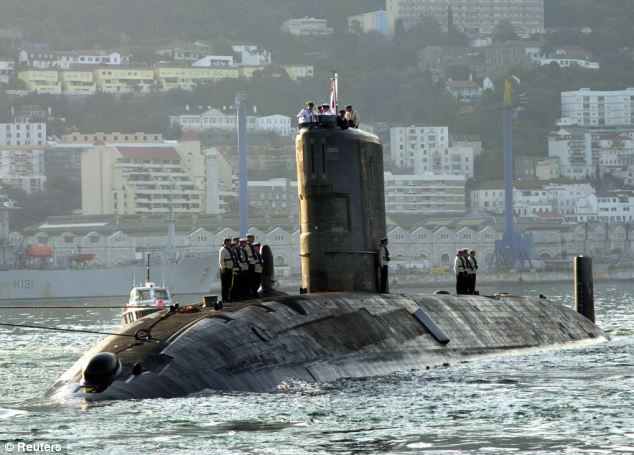
A British nuclear submarine has reportedly  been spotted off the Gibraltar coast.

Witnesses said they saw the vessel surface on  Saturday as tensions between Spain and Britain continue to rise over fishing  rights around the Mediterranean enclave.

The sighting comes days after Royal Navy  warship HMS Westminster arrived in Gibraltar.

Witnesses say a British nuclear submarine, believed to be HMS Tireless (pictured), surfaced off GibraltarWitnesses say a British nuclear submarine, believed to  be HMS Tireless (pictured), surfaced off Gibraltar

The Ministry of Defence refused to confirm or  deny today if a nuclear submarine is currently stationed at the enclave.

 A spokeswoman said if it was in Gibraltar  then it was for ‘routine business’.

The Sun quoted an ‘insider’ as saying: ‘There  is only one reason a submarine breaks the surface – and that is to be spotted.

Last time the Trafalgar-class sub docked by the Rock it provoked anger and protests from activists (pictured) Last time the Trafalgar-class sub docked by the Rock it  provoked anger and protests from activists (pictured)

‘These things do not show themselves unless  they want to be seen.’

The website shipspotting.com reported that  HMS Tireless – a Trafalgar-class nuclear submarine – was seen in Gibraltar in Z  Berth last month.

Local news in Gibraltar reported that HMS  Tireless sailed into the area last month for a ‘short stay as part of (the  submarine’s scheduled operational tasking’.

If confirmed, it will be the first time the  nuclear submarine has docked in the contested region since 2004.

The docking of HMS Tireless, which is due to  be decommissioned this year, sparked protests from Spanish activist nine years  ago – the same year as the 300th  anniversary of the capture of Gibraltar from Spain.

The submarine caused diplomatic tensions  between Britain and Spain once again in 2000 when it docked in Gibraltar for a  year after the submarine developed a serious leak in the nuclear reactor primary  cooling circuit.

Another Trafalgar-class submarine, HMS  Talent, stopped in Gibraltar this year and the enclave’s first minister Fabian  Picardo and his deputy Dr Joseph Garcia were given a tour.

Tensions between the two countries have  ramped up this year over fishing rights.

Gibraltar’s creation of an artificial reef  with concrete blocks has provoked fury from Spanish fisherman, which they say  blocks their access to certain waters.

Spanish police were criticised last week when  they unfurled a Spanish flag during an inspection of the reef.

Spanish police were criticised recently after they held up a Spanish flag Spanish police were criticised recently after they held  up a Spanish flag during an inspection of an artificial reef that has caused  anger among fishermen

Gibraltar accused the police of violating  ‘British sovereignty’ by attempting to exercise jurisdiction in its  territory.

Last week, a fleet of almost 40 boats sailed  into British waters to demand the reef be removed.

Spain has also increases border checks,  leading to long queues for workers and tourists entering Gibraltar.

The Gibraltar government has tried in recent  days to defuse tensions by proposing a change in local law to let the Spanish  resume fishing in parts of the sea near the Rock.

Source –   Daily Mail

UK – Redcar Submariner will cycle from Coast to Coast – despite undergoing intensive chemotherapy

A YOUNG submariner from the region who is battling with a rare form of cancer is to cycle from Coast to Coast in aid of a children’s cancer charity.

JJ Nicholson, a tactical submariner with the Royal Navy who is from Redcar, East Cleveland, said training for the challenge was keeping his mind off his treatment and keeping his fitness levels up.

The 22-year-old was diagnosed with Ewing’s sarcoma, a rare form of bone and soft tissue cancer, after feeling an agonising pain in his left shoulder.

“It turned my world upside down. It was the worst news ever,” he said.

“I knew there was something seriously wrong.”

He was put straight on to the most intensive form of chemotherapy and has also had to watch his mother, Debra Ford, 47, battling breast cancer for the last three years.

“I cannot imagine what she is feeling but she just keeps going on normally,” said JJ, who is based at HMS Neptune, near Glasgow with the Royal Navy.

JJ,formerly of Rye Hills School in Redcar, has been engaged to fiancee Samantha for four years. He has undergone four sessions of chemotherapy and will have six in total before having an operation to remove bone from his upper arm in October. It will be replaced with an implant.

To find out more about the Toma Fund visit www.toma-fund.org

Source- The Northern Echo

UK – Court told of Corsock throat cutting attack

High Court in Glasgow

Prosecutors accepted that Hills was suffering from a mental disorder at the time of the attack

A court has heard how a former Royal Navy submariner cut his wife’s throat with a knife after thinking she was conspiring against him.

John Hills, 47, struck his spouse Karen during the attack at their home in the village of Corsock in April.

He faced a charge of assaulting her to the danger of her life.

However, a judge acquitted him at the High Court in Glasgow after prosecutors accepted Hills was suffering from a mental disorder at the time.


He said that if he had meant to kill her then he could do so”

Paul KearneyAdvocate depute

Hills – who has no previous convictions – will remain in the State Hospital at Carstairs before returning to the dock in November.

The court heard how he was working as a call handler for the ambulance service based in Nottingham at the time of the attack.

This required him to spend time away from the family home in Corsock near Castle Douglas.

He had previously been with the Royal Navy for 23 years and had also been employed as a beekeeper.

In the weeks before she was assaulted, Mrs Hills had concerns about her husband, who believed people in the village were spreading rumours about him.

He mentioned “silent phone calls” and claimed that during one he had heard the sound of a gun being drawn.

On the morning of the attack, Hills unexpectedly returned home from Nottingham in the early hours.

Mrs Hills was later making breakfast when her husband suddenly walked into the kitchen naked.

Prosecutor Paul Kearney told the court: “He then began accusing her of being behind all the silent phone calls and of being responsible for his workmates being hostile towards him.

“He was saying things like: ‘I know what you are doing’.”

State Hospital, Carstairs
Hills was ordered to remain in the State Hospital at Carstairs until a review hearing

Mr Kearney said Mrs Hills was “very afraid” before her husband suddenly grabbed her face and pushed her against a door.

She started to struggle for breath and began to panic.

Mrs Hills then spotted a knife in his hand and he used the weapon to strike her across the neck.

She managed to break free and grab a towel to stem the heavy bleeding.

Hills meantime sat down on a chair and demanded she “tell the truth”.

Mr Kearney went on: “He said that he knew she could hear him as the wounds she had were not deep enough.

“He said that if he had meant to kill her then he could do so.”

Mrs Hills eventually escaped to a neighbour’s house where an emergency call was made.

‘Profound impact’

Hills was later discovered by police at his house lying in blood with a wound to his arm.

He told a doctor that he and his wife had been having “issues” and that he suspected her of being involved in a “conspiracy” at home and at his work.

Mrs Hills was found by medics to have two deep wounds to her neck, which were potentially life-threatening. They have left her permanently scarred.

Advocate depute Mr Kearney said: “The impact upon her has, as might be expected, been profound.”

The court heard Hills was assessed by two consultant psychiatrists, who both concluded he was suffering from a delusional disorder at the time.

It was their opinion that, due to this, he did not “appreciate the nature and wrongfulness” of his conduct.

Source – BBC News

Judge Lord Doherty imposed an interim compulsion order for Hills to remain at Carstairs.

The case was continued until a review hearing at the High Court in Edinburgh on 4 November.

Ready, steady cook! Submarine museum event’s a smash hit – Video clip

  •  

    image of snow covered countryside

    Click on the picture for Video clip

CHILDREN had the chance to bake and learn about food that sailors on a submarine would have to eat.

The Royal Navy Submarine Museum in Haslar Road, Gosport, invited children of all ages to take part in a summer activity.

Sammy Sardine’s Summer School had children discovering the food that sailors ate on board a submarine during the Second World War.

On board HMS Alliance, children got to see a Frog in the Bog, also known as Toad in the Hole, illustrated by the museum’s Horrible Science of a Submarine exhibition.

Gareth Brettell, education manager at the Royal Navy Submarine Museum, said: ‘Everyone had a great time cooking the different cakes inspired by the submarine.

‘They got to pick their favourite that others had made, then they had the chance to cook their own.

‘They enjoyed making their little cakes with different parts of the submarine in different flavours and ingredients.

‘We had a tropical fruit cake and a coconut and chocolate cake which the kids loved.’

As well as the cooking classes, families who visit the museum can also learn old ways to communicate.

Kids will have the opportunity to learn Morse code, semaphore and how to write using invisible ink.

Once they have mastered this, they can write secret messages and send a signal across the museum.

The communications day is on August 13.

Gareth added: ‘There is something for everyone this summer

Source – The News

Falklands War Admiral Sandy Woodward dies aged 81

Admiral Sandy Woodward at his home in Wimbledon in 1992

Adm Woodward was described as a “modern-day hero” by Falkland Islanders

An admiral who led Britain’s task force in the 1982 Falklands War has died after a long illness, aged 81, his daughter has told the BBC.

Adm Sir Sandy Woodward was commander of the carrier force sent by PM Margaret Thatcher to retake the Falklands.

He served as deputy chief of the defence staff from 1985 and was promoted to admiral in 1987.

David Cameron said the UK was “indebted” to Adm Woodward for his role in ensuring freedom for islanders.

“The admiral was a truly courageous and decisive leader, proven by his heroic command of the Royal Navy Taskforce during the Falklands conflict,” said the prime minister.

“We are indebted to him for his many years of service and the vital role he played to ensure that the people of the Falkland Islands can still today live in peace and freedom. My thoughts and prayers are with Adm Woodward’s family and friends at this difficult time.”

‘Inspirational leadership’

Daniel Allan, founder of the Falklands United Movement, which represents some islanders, said he was a “modern-day hero”.

“We owe him a debt of gratitude and he is in the thoughts of every islander, past and present, today,” he said.

A look back at the life and career of Admiral Sir Sandy Woodward (R)

Defence Secretary Philip Hammond said he would be remembered as the “Fighting Admiral”.

“Adm Woodward served his country with distinction throughout his career,” he said.

First Sea Lord Admiral Sir George Zambellas said: “Undaunted by the challenge of fighting a capable enemy over 8,000 miles from the UK, in the most demanding and extreme of weather conditions, and against uncertain odds, Admiral Woodward’s inspirational leadership and tactical acumen – meshing the realities of the higher political command at home with the raw and violent fight at sea – was a major factor in shaping the success of the British forces in the South Atlantic.

Analysis

image of Caroline Wyatt
Caroline Wyatt Defence correspondent, BBC News


A tall plain-speaking man, Adm Woodward will be best remembered in the Falklands – briefing his men with a blunt statement as they deployed: “People will die, ships will be lost, that’s the deal. Go to it.”

He made clear that, as a leader, it was more important to be respected than liked, writing that: “A truly good leader should seek respect and regard any liking simply as profit.”

It was Adm Woodward who wanted to torpedo the Argentine ship the Belgrano because of the threat he believed it posed to British forces, even though it was outside the exclusion zone when sunk – a decision agreed by Margaret Thatcher.

He did not regret the move, saying Britain never realised how close it came to losing the war.

After retirement, Adm Woodward continued to speak out for the navy, angered by the scrapping of the UK’s aircraft carriers and the Sea Harriers, which had proved so vital in retaking the Falklands.

He described the decision as appalling, and warned the UK would no longer be able to retake the islands as it did more than 30 years ago.

“Highly regarded and widely respected within the military, he will be sorely missed and our thoughts are with his family and friends at this difficult time.”

Sukey Cameron, the Falkland Islands’ government representative in the UK, tweeted: “Sad to learn of the death of Admiral Sir Sandy Woodward; remembering with gratitude the important part he played in #Falklands Liberation.”

Adm Woodward was born John Woodward in Penzance, Cornwall, on 1 May 1932, according to the Who’s Who database.

He trained at the Royal Naval College, Dartmouth, joining the navy in 1946 at the age of 13, and quickly rising through the ranks to command submarines.

During his time serving in submersibles, Adm Woodward married Charlotte Mary McMurtrie in 1960 and they had a son and a daughter.

When Argentina invaded the British overseas territory of the Falkland Islands on 2 April 1982, he was a newly appointed rear admiral and acted as commander of the Carrier Battle Group from the flagship HMS Hermes.

Three days later the first British task force ships left Britain, and by 14 June, following a number of key battles, the British had liberated the capital, Port Stanley.

Among the most controversial actions of the British during the war was the sinking of the Argentine cruiser General Belgrano, killing 368 crew.

BBC defence correspondent Caroline Wyatt said Adm Woodward had wanted to torpedo the ship because of the threat he believed it posed to British forces, even though it was outside the exclusion zone when sunk – a decision agreed by Mrs Thatcher.

During the conflict, an estimated 600 Argentines were killed along with 255 UK servicemen and three Falklands civilians.

Knighthood

Adm Woodward, who also went on to be the Flag Aide-de Camp to the Queen, was knighted for his service in the Falklands campaign in 1983.

He retired in 1989 but never forgot his time in the Falklands, later writing a book titled One Hundred Days on his experiences and chairing the Falkland Islands Memorial Chapel Trust, which raised money to build a chapel in Pangbourne, Berkshire, in memory of those who had died.

“Start Quote

I found her [Margaret Thatcher] to be the best top executive I’d ever met”

End Quote Adm Woodward April 2013

Robert Fox, defence editor of the London Evening Standard, said Adm Woodward had to take “some of the biggest risks of any commander in modern British history”.

“He knew how to take risks… the lack of air cover, the way the whole thing was conducted against the unknown – it would simply be deemed as unacceptable by Westminster today,” he said.

Writing for the Daily Telegraph earlier this year, Adm Woodward described working with Mrs Thatcher between 1985 and 1987, when he was the head of defence staff operations and would attend cabinet meetings.

He said their relationship was one of mutual respect, describing Mrs Thatcher as “the best top executive I’d ever met”.

In June 2011 Adm Woodward wrote in the Daily Mail that he feared the Falkland Islands were “now perilously close to being indefensible”.

“Twenty-nine years ago today, we reclaimed the Falklands for Britain in one of the most remarkable campaigns since the Second World War,” he wrote.

“The simple truth is without aircraft carriers and without the Americans, we would not have any hope of doing the same again today.”

And in written evidence to the Commons Defence Committee in May of this year, he warned Britain would be unable to defend itself if cuts to the navy continued to be made.

Source – BBC News

Revealed: Shock ‘Code Red’ safety report on British nuclear subs as fleet is hit by leaking, cracked reactors and lack of trained staff

  • Safety issues with UK’s nuclear subs and facilities used to repair missiles
  • Cracks in reactors and nuclear discharges found in Navy’s oldest boats
  • Nuclear-qualified engineers are quitting over poor pay and conditions
  • Experts described latest report as the most worrying they had seen


An official watchdog discovered major safety issues with both the UK’s nuclear-powered submarines and facilities used to repair nuclear missiles, raising the risk of a catastrophic accident involving radioactive material.

Last night, experts described the Defence Nuclear Safety Regulator (DNSR) report for 2012-13 as the most worrying they had seen.

Leak: Tireless, the oldest submarine in the Royal Navy fleet, which entered service in 1984, suffered damage to its circuits earlier this year resulting in a radioactive leakCode Red: Tireless, the oldest submarine in the Royal Navy fleet, which entered service in 1984, suffered damage to its circuits earlier this year resulting in a radioactive leak

The document, obtained by this newspaper, reveals:

  • Cracks in reactors and nuclear discharges are directly attributable to the Royal Navy’s oldest Trafalgar Class SSNs (Ship Submarine Nuclear) remaining in service beyond their design date.
  • Faults with the new Astute Class submarines will delay their entry into service, forcing the Navy to continue sailing the ageing and potentially dangerous Trafalgars.
  • The Atomic Weapons Establishment (AWE) failed to notice or rectify corrosion to a nuclear missile treatment plant in Berkshire.
  • Nuclear-qualified engineers are quitting the Navy in droves over poor pay and conditions, creating a skills crisis.

Head of the DNSR Dr Richard Savage wrote: ‘Significant and sustained attention is required to ensure maintenance of adequate safety performance and the rating [Red] reflects the potential impact if changes are ill-conceived or implemented.

 ‘The inability to sustain a sufficient number of nuclear suitably competent personnel is the principal threat to safety. Vulnerabilities exist in core skill areas, including safety, propulsion, power and naval architects.

HMS TIRELESS THE ‘KILLER SUB’

Two Submariners killed in an explosion aboard the HMS Tireless, 32-year-old Paul McCann (left) and 20-year-old Anthony HuntrodIn March 2007, sailors Anthony Huntrod, 20, (right) and Paul McCann, 32, (left)  were killed on HMS Tireless when a self-contained oxygen generator exploded during an Arctic exercise north of Alaska.

They died trapped in a small, smoke-filled compartment.

An inquest heard that there was a significant possibility the generator was salvaged from a hazardous waste depot in a cost-cutting bid  by the MoD.

‘Due to build delays with the Astute Class, there has been a requirement to extend the Trafalgar Class beyond their original design life in order to maintain the SSN flotilla at a fully operational level.

Some of the emergent technical issues affecting the Trafalgar Class over the last few years can be directly attributed to the effects of plant ageing.’

The report also raises concerns over whether the UK’s nuclear fleet and its inland nuclear establishments could withstand an earthquake on the same scale as the one that struck the Fukushima reactor plant in  Japan in 2011.

The document notes that facilities which form part of Britain’s Defence Nuclear Programme (DNP) require ‘continued priority attention’ to reach recommended safety standards.

Last night, nuclear expert John Large told The Mail on Sunday that the DNSR report revealed a crisis in Royal Navy nuclear safety.

He said: ‘This is the most self-damning and concerning report that I have seen. We’re talking about a ticking time-bomb, with a higher risk to the public and the environment than we previously feared.

‘The combination of a lack of nuclear engineers, the Astute submarines being so far behind schedule and the Trafalgar Class sailing beyond their design date is very worrying.

‘The Trafalgars, including HMS Tireless, the oldest boat of the class, should be withdrawn immediately.’

HMS Tireless, which entered service in 1984, suffered damage to  its circuits earlier this year resulting in a radioactive leak.

The nuclear sub was patrolling off South-West England when the problem arose, forcing its captain to return to Devonport. A more serious leak  was avoided because of swift remedial action.

Nuclear materials – including Trident missiles – are brought to the AWE’s site at Aldermaston, Berkshire, for assembly, maintenance and decommissioning.

Warning: There are also fears over the Aldermaston centre where Trident missiles are servicedWarning: There are also fears over the Aldermaston centre where Trident missiles are serviced

These processes include ‘uranium polishing’ – the removal of impurities from the material in order to extend its life cycle as a component in nuclear missiles.

The DNSR report states: ‘Inspection programmes have not been as comprehensive as regulators would expect.

As an example, corrosion in the structural supports of a building was not identified as early as would be expected which resulted in the Office for Nuclear Regulation issuing a Safety Improvement Notice.’

Last night the AWE admitted corrosion had affected its uranium component manufacturing facility, but added repairs had been completed.

An MoD spokesman said: ‘We would not operate any submarine unless it was safe to do so and this report acknowledges that we are taking  the necessary action to effectively manage the technical issues raised by the regulator.

‘It also highlights that the MoD is committed to maintaining expertise in submarine technology and operation – underlined by last month’s operational handover of the first two Astute Class submarines.’

Source – Daily Mail

Bob’s tales of life on a submarine – New book

Bob Clarke

Bob Clarke

A MAN who grew up in Thurrock before joining the Royal Navy has written a book about his time as a submariner during the Cold War.

Bob Clarke, who was born in Chadwell St Mary, regales a host of fascinating stories logged during his time in the Navy in the book If You Can’t Take A Joke.

He was inspired to join the UK’s sea force when his interest was stirred when he found the wreck of HMS Truculent, a wartime submarine, on Grays Beach.

On leaving school at 15, Bob joined the Navy, where he found himself embroiled in one of the most tense periods in history as submarines circumnavigated the world, on call should a nuclear war begin.

If You Can’t Take A Joke covers a year spent at a boys training establishment, 18 months aboard a major warship in the East Indies as well as ten years of service in submarines during the Cold War era and during the Cuban Missile Crisis.

It also features 20 colour illustrations by up-and-coming Essex artist Shaun Stone.

Bob, who now lives in South Woodham Ferrers, said of his time in the Navy: “There was some excitement, but it was interspersed with a lot of boredom.

“Some of the stories are humorous, while some are about the serious things we did during the Cold War.”

Each possessed nuclear weapons and were met with the threat of mutually assured destruction.

But while no missiles were ever fired, the two were engaged in psychological warfare.

For more information about Bob’s book, visit  http://www.ifyoucanttakeajoke.co.uk/

 Source – Thurrock Gazette

Major new submarine museum planned for River Clyde

3679838275

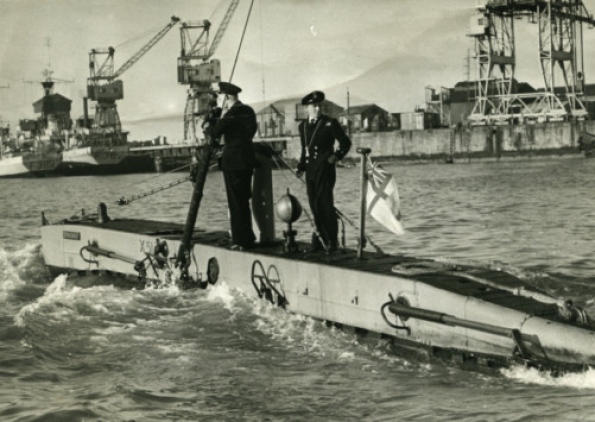
Two Navy servicemen on a ‘Stickleback’ submarine in 1954. Picture: Royal Maritime Museum

A MULTI-million pound museum to create the biggest ­memorial in the world to more than 5,300 Commonwealth sailors killed in the line of duty, and honour Scotland’s role in the ­development of submarine technology, is planned for the banks of the River Clyde.

 Award-winning architect ­Gareth Hoskins, who designed the £47 million National Museum of Scotland redevelopment, the Culloden Battlefield Memorial Centre and the Bridge Arts Centre, has been asked to draw up plans for the new £6m building overlooking the Firth of Clyde at Helensburgh.

Funding for the proposed Scottish Submarine Centre is being sought from a consortium of private and public bodies with organisers claiming to have secured pledges of more than £1m so far.

An application for £240,000 is due to go before the Scottish Regional Armed Forces Community Covenant Awards Board for approval later this month.

The Community Covenant grant scheme was launched by the Ministry of Defence in August last year. It offers funding of £30m over four years to UK projects which strengthen ties between serving and former military personnel with their communities.

The proposed Submarine Centre will be the only one of its kind in Scotland. Already, the Royal Navy Museum has agreed to donate an X51-class submarine as a centrepiece of the state-of-the-art digital museum to act as a memorial to submariners from around the world.

The midget submarine is a direct descendant of the X-class subs whose crews trained in the Firth of Clyde during the ­Second World War to develop the techniques needed to attack enemy shipping in the narrow fjords of Norway. The X51, improved on the wartime midget submarines, was first unveiled in 1954 on the Gareloch in the Firth of Clyde. Capable of carrying a crew of five, the miniature subs were used for a variety of roles. However, the history of submarines and the Clyde is much longer.

It is hoped the new facility will open by the end of 2016 in time for the 100th anniversary of the K13 disaster. Thirty-two people died when the steam-driven submarine failed during sea trials in the Gareloch near Helensburgh on 29 January, 1917 within sight of the location proposed for the new museum and memorial. Brian Keating, a Helensburgh-based businessman who is driving the project, said: “Helensburgh and the Clyde have been associated with the submarine service for more than 100 years. A lot of work was done here to pioneer the technology.

“The Clyde has also played a major role as a home to submarines on active duty. Many of the most famous and daring ­missions carried out during the Second World War either began here or were in some way connected with the Clyde.

“We want to create a world-class museum which celebrates the marine engineering heritage of the Clyde shipbuilders involved in the development of submarines and serves as a memorial to the brave men from all over the Commonwealth who served in the ­‘silent service’.”

Architect Hoskins, a native of Helensburgh, was recently awarded a series of top awards.

Source – The Scotsman