Category Archives: UK Submarines

News, views and stories about UK submarines

UK – Forgotten logbook reveals bid to raise WWI submarine

The forgotten logbook of a former Royal Navy diver has revealed a fascinating  insight into attempts to raise a unique First World War submarine that sank more  than 80 years ago as the result of a tragic accident.

The faded and yellowing diary was rediscovered by the family of Plymouth-born  Albert “Bob” Smale who, as a 23-year-old recently-qualified navy diver took part  in a year-long salvage operation to raise the world’s very first underwater  aircraft carrier, HMS M2.

  1. Lee Smale, 62, pictured with his father's logbook

    Lee Smale, 62, pictured with his father’s  logbook

  2. The world's first underwater aircraft carrier HMS M2 in action with her two-man Parnell Peto biplane – the ship sank while on a routine training exercise off West Bay, Dorset, in 1932

    The world’s first underwater aircraft carrier HMS  M2 in action with her two-man Parnell Peto biplane – the ship sank while on a  routine training exercise off West Bay, Dorset, in 1932

  3. Lieutenant Commander Lionel 'Buster' Crabbe disappeared in the murky waters of Portsmouth Harbour

    Lieutenant Commander Lionel ‘Buster’ Crabbe  disappeared in the murky waters of Portsmouth Harbour

  4. Albert 'Bob' Smale during his Royal Navy career, in which he served as a diver

    Albert ‘Bob’ Smale during his Royal Navy career,  in which he served as a diver

Lee Smale, 62, of Plymouth,  the youngest son of four children born to Bob  and Gladys Smale, remembers his father’s logbook from childhood.

He said: “The logbook had always been in the family but we’d never really  given it much thought. He died in 1968 but it was only when we began sorting  through my mother’s things when she moved into sheltered accommodation that it  resurfaced.

“But looking through all his belongings and coming across the logbook again,  the family recognised its significance.”

The M2 was one of four “M” class submarines put into service during the First  World War and following the cessation of hostilities was modified to carry a  small two-seater Parnell Peto biplane.

Intended for aerial reconnaissance during advance scouting missions, the aircraft had hinged wings to allow it to fit within a specially designed watertight hangar. Launched by hydraulic “catapult”, the Peto was recovered via a deck-mounted crane on its return.

On January 26, 1932, during a routine training exercise off West Bay, Dorset,  after advising her support vessel of her intention to dive, all contact with the  M2 was lost and the submarine disappeared without trace.

A major search ensued but with her position unknown it was eight days before  the M2’s location was eventually discovered.  All of the vessel’s   60-strong  crew lost their lives in the tragedy – believed to be a direct consequence of a  failure to secure the submarine’s hangar doors before diving.

Lying upright on the seabed at a depth in excess of 30 metres, the Royal Navy  salvage team, hindered by the strong tidal currents that swirled around the M2,  worked around the clock for   11 months to seal the hull before filling the  vessel with air to refloat the stricken submarine.

However, as the salvage attempt reached its final stage, and only six metres  from the surface, a heavy gale resulted in the operation being aborted and the  M2 dropped back down to the seabed.

The neat handwritten pages of the logbook initially record Mr Smale’s diver  training, but further examination  revealed a passage dedicated to the M2  salvage work carried out by himself and his colleagues.

Under a heading entitled “M2 Salvage,” Mr Smale describes the “method of  sealing hatches with cement”.

“Hatch is closed down and then a layer of small bags filled with cement is  placed on top, and then a few buckets of loose cement is put on to fill in the  spaces between bags,” he wrote.

The logbook also contains a detailed hand-drawn illustration of the submarine  showing its position, features and amendments before the failed lifting  operation.

The difficulties of working at such a depth, contending with strong tides,  poor visibility and bad weather while dressed in the heavy brass helmets of the  era are also conveyed in detail in a collection of newspaper cuttings pasted  among the book’s pages.

The Dorset Echo newspaper reported: “He has an electric torch swung around  his neck. The feeble illumination of this helps him when the torch is held  close, but his principal asset is a sense of direction acquired by experience  and that astonishing sensitiveness of touch which utter darkness gives to a  diver as to a man who is blind.”

“My dad had quite a varied and distinguished career,” said Lee, who also has  a certificate in recognition of his father’s Mention in Dispatches during the  Wanhsien Incident on the Yangtze River, China in 1926.

Going on to achieve the rank of Petty Officer, Bob Smale was a contemporary  and close friend of Lionel “Buster” Crabb, the Royal Navy frogman who  disappeared in mysterious circumstances at the height of the Cold War.

Lieutenant Commander Crabb, came to prominence for his pioneering work in  underwater bomb disposal during the Second World War and while he had all but  retired by 1955, just a year later he was recruited by MI6 to investigate an  advanced propulsion system used by the Soviet cruiser Ordzhonikidze during the  vessel’s visit to the United Kingdom.

On the evening of  April 19, 1956, Crabb descended into the murky waters of  Portsmouth Harbour on what was to be his final mission and was never seen  again.

Several months later the headless and handless corpse of a diver was  discovered floating in a nearby harbour, but this was not the end of Commander  Crabb’s story.

At the inquest into Crabb’s disappearance, the coroner’s report suggested the  body was in all probability that of the missing 47-year-old OBE and George Medal  holder – despite the lack of firm evidence which could have been provided by  fingerprints or dental records.

Unsurprisingly, various theories abounded as to Crabb’s fate: he was killed  by a Soviet sniper; eliminated by MI5 or even defected to the USSR to head their  military diving team.

However, Lee Smale is adamant that his father’s friend did not die on that  fateful night.

“He and my father were apparently very close and he told members of the  family at the time that he didn’t believe for one minute that Crabb was dead,”  he said.

With her protected status as a War Grave, the wreck of HMS M2 has now become  popular dive site with recreational scuba divers.

Allowed to dive her remains on a “look-but-don’t-touch” basis, the modern-day  diver can observe the M2’s final resting place, just as Bob Smale did more than  80 years ago.

Source – This is Cornwall

Hunt for lost First World War submarines

Explorers are launching a new project to locate dozens of British and German submarines which sank off the coast of England during the First World War, as part of a major new study to mark the centenary of the conflict.

Day trippers crowd around the German Submarine U Boat U118, washed up on the beach at Hastings, East Sussex, in 1919.

Day trippers crowd around the German Submarine U Boat U118, washed up on the beach at Hastings, East Sussex, in 1919.

The English Heritage research will involve identification and analysis of all submarine shipwrecks from the period which are within territorial waters – 12 miles from the coast.

Preliminary research by the team, studying historical records, has already identified three British and 41 German submarines from the conflict which are known to have sunk in the area.

The locations of some of these have already been established, but others have yet to be discovered.

Once they have been found, the team will dive onto them to assess their condition. They will then decide whether any measures can be taken to slow down the shipwrecks’ rate of decay on the seabed.

Depending on their historical significance, the vessels may also be added to existing list of shipwrecks covered by the Protection of Wrecks Act, which tightly controls such sites, or scheduled as an ancient monument.

If the vessels sank with men on board, they could be added to the register covered by the Protection of Military Remains Act, to ensure the war graves cannot be disturbed.

Mark Dunkley, a marine archaeologist with EH, said: “These sites may be out of sight, but they are still an important part of our heritage. There are people still around who will have a link to the men lost on these boats.

“They are an important part of family, as well as military, history.

“People might know more about U-boats in the Second World War, but this project will show just what a significant part they played in the first world war – and very close to land.”

The locations of around half of the 44 vessels are known. To find the others, EH is planning to enlist the help of local diving groups around the coast.

Although most associated with the Second World War, submarine warfare was first deployed during the earlier conflict, as German U-boats attempted to cut supply lines into and around the British Isles, while Royal Navy vessels patrolled in search of enemy ships.

At the start of the war, submarines were supposed to abide by international rules which complied them to then allow the crews of merchant ships to get to safety before sinking their vessels.

But this swiftly became impractical and led to the adoption of unrestricted submarine warfare by Germany, which, nearly brought Britain to its knees in 1917.

During the course of the war, German U-boats sank more than 12 million tons of shipping – around 5,000 ships – with the loss of 178 submarines and almost 5,000 men killed.

Most of the wrecks covered by the English Heritage project, which is expected to run throughout the four years of the Great War centenary, are German submarines which were targeting coastal routes, either attacking merchant shipping with torpedoes or laying mines.

They include UB65, which sank HMS Arbutus, a Royal Navy sloop, as well as six merchant ships and damaged six more, before sinking with the loss of all 37 crew near Padstow, Cornwall in July 1918.

The vessel, which went to the bottom after an apparent accident, had been plagued by bad luck and deaths and before its loss the German navy is said to have called a priest on board to perform an exorcism.

They also include UB115, which sank off the coast of Northumberland in 1918 with the loss of all 39 crew, after being attacked by British armed trawlers, warships, and even an airship, R29, which dropped bombs on it.

Several others went down off the east coast, among them UB107, which sank off Flamborough Head in July 1918, either as a result of an attack by British vessels, an accident, or after hitting a mine; UB41, last sighted by the SS Melbourne on October 5 1917 off Scarborough, which is thought to have struck a mine of suffered an internal explosion; and UB75, which had left Borkum on November 29, 1917 for the Whitby area. She succeeded in sinking four ships but never made it back home.

The only three Royal Navy submarines covered by the project were lost in accidents: HMS G3, which ran aground in Filey Bay, North Yorkshire, after the war in 1921; HMS G11, which ran aground near Howick, Northumberland, 1918; and HMS J6, which was sunk in a friendly fire incident, after being mistaken for a U-boat in 1918.

A young couple pose for photographs on the wreck of HMS G3 in Filey Bay, North Yorkshire.

English Heritage has responsibility for all historic wrecks off the English coast, but most of those it cares for are wooden warships.

To find out more about how to preserve the metal vessels from the First World War, it conducted a preparatory survey last year, on the wrecks of two submarines which sank just before the conflict – the Holland No 5, which sank off Beachy Head in 1912 and the A1, which went down in Bracklesham Bay a year earlier.

Both vessels sank without loss of life, although the A1 had previously sunk, in 1904, with the loss of all hands.

Both boats had a hull half an inch thick, but after more than 100 years on the seabed, researchers found these had thinned to as little as a quarter of an inch in places.

The team believe that some wrecks can be preserved by placing on them “sacrificial” anodes, which corrode at a faster rate, protecting the hulls.

Source – The Telegraph

Submarine deal secures future for hundreds of Glasgow jobs

 IT IS taller than a Glasgow tenement and packs more punch than the late Gorbals-born world flyweight boxing champion Benny Lynch ever did.

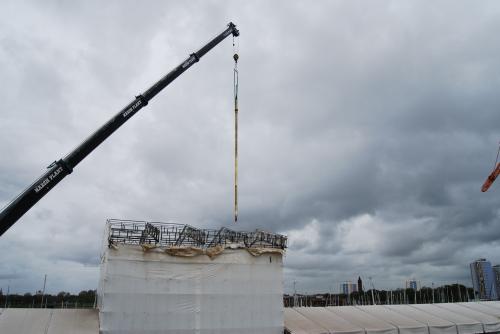
The latest structure completed by Clyde shipbuilders

The latest structure completed by Clyde shipbuilders

The latest structure completed by Clyde shipbuilders

BAE Systems Clyde shipbuilders unveiled its latest engineering fete – a man-made island of steel which will tower over Britain’s newest aircraft carrier.

The Aft Island unit is 31m tall.

It is the tallest structure ever to be built at the Scotstoun warship yard and is the maritime equivalent of an air traffic control tower.

A flight commander will take charge of the hand picked personnel who will manage the fighter jets and helicopters which will fly from the new carrier.

The Ministry of Defence has yet to release details of the number of staff who will be on operational duty on ‘the island’ when the nation’s biggest warship goes into action.

But it is thought the on-board controllers could be responsible for up to 40 fighter jets, though the average number is likely to be 12.

The towering steel structure comprises nine decks, which include sleeping accommodation and a briefing room for pilots.

Once completed, it will bristle with radar and antenna.

It will also be used by a sailor to steer the massive carrier, under instruction from the ship’s captain who will be located elsewhere on the vessel.

The latest carrier block to be manufactured by Scotstoun and workers at the sister Govan yard is 32 metres long and unlike any ship ever seen on the Clyde.

Project head Derek McCaffrey, from Stewarton, East Ayrshire, said: “It’s shape dictates its radar signature. The smaller the signature the safer the crew from enemy attack.”

From the first steel cut in January last year it has taken 86 weeks to build the unit. It will be loaded and welded on to a barge in less than two weeks time before taken around Scotland’s northern coastline to Rosyth, where the super sized carrier – being built in sections at yards across the UK – is being put together like a giant metal jigsaw.

The Aft Island is the most intricate and most advanced block produced so far on the Clyde for the multi-billion pound carrier programme and the workmanship has impressed Systems Into Service Director Steven Carroll.

He is responsible for the delivery of both carriers – the Prince of Wales is the second of the fleet.

From the tradesmen at Scotstoun to the yard’s own specialist design engineers, he saluted them all when he said: “They have done a fantastic job.

“It was a 90-week programme but they managed to complete four weeks earlier than scheduled, which is all to their credit.”


Govan-based Thales Optronics is to help support the Royal Navy’s fleet of submarines as part of 10-year deal with the Ministry of Defence.

The deal will see the French-owned defence contractor manage the visual systems fitted on every Royal Navy submarine including the periscopes for the four Vanguard nuclear ballistic missile subs which form Britain’s so called nuclear deterrent as well as the five nuclear-powered Trafalgar fleet.

The contract will also see Thales maintain optronic masts fitted on the Navy’s new of Astute nuclear-driven subs.

Thales UK chief executive Victor Chavez, said: “This contract reinforces our positive well-established relationship with the Royal Navy.”

And Philip Dunne, Minister for Defence Equipment, Support and Technology, said said the new long term contract was good for the MoD and Thales.

He added: “Not only will it secure a number of jobs across the UK while delivering savings but will also provide essential support for the combat equipment that helps give the Royal Navy’s fleet of ships and submarines a vital technological edge wherever they are based in the world.”

The latest bumper contract comes almost exactly two years after Thales Optronics won the Queen’s Award for Enterprise after selling more than £100m of military equipment to foreign buyers over a 36-month period.

The defence manufacturer which specialises in optronic based products including hi-tech binoculars used by frontline soldiers as well as laser rangefinders and infra-red thermal cameras was previously known as Barr & Stroud Ltd.

It was a leading Scots engineering company launched 125 years ago in Glasgow and is now located in custom built premises in Linthouse Road.

News of the £600m deal comes as BAE Systems Clyde shipbuilders unveiled its latest engineering fete – a man-made island of steel which will tower over Britain’s newest aircraft carrier.

The Aft Island unit is 31m tall. It is the tallest structure ever to be built at the Scotstoun warship yard and is the maritime equivalent of an air traffic control tower.

A flight commander will take charge of the hand picked personnel who will manage the fighter jets and helicopters which will fly from the new carrier.

The Ministry of Defence has yet to release details of the number of staff who will be on operational duty on ‘the island’ when the nation’s biggest warship goes into action.

But it is thought the on-board controllers could be responsible for up to 40 fighter jets, though the average number is likely to be 12.

The latest carrier block to be manufactured by Scotstoun and workers at the sister Govan yard is 32m long and unlike any ship ever seen on the Clyde.

Project head Derek McCaffrey, from Stewarton, East Ayrshire, said: “It’s shape dictates its radar signature. The smaller the signature the safer the crew from enemy attack.”

From the first steel cut in January last year it has taken 86 weeks to build the unit. It will be loaded and welded on to a barge in less than two weeks time before taken around Scotland’s northern coastline to Rosyth, where the super sized carrier – being built in sections at yards across the UK – is being put together like a giant metal jigsaw.

Source – Evening Times

Applied Integration, in Stokesley, North Yorkshire, wins contract to supply control systems for HMS Agamemnon and HMS Ajax

Applied Integration, in Stokesley, North Yorkshire, wins contract to supply control systems for HMS Agamemnon and HMS Ajax

One of the Royal Navy's astute-class submarines

One of the Royal Navy’s astute-class submarines

NUCLEAR-POWERED Royal Navy attack submarines will defend the nation backed by North-East technology firm.

Applied Integration, based in Stokesley, North Yorkshire, has secured a multi-million pound deal to design and develop control systems for HMS Agamemnon and HMS Ajax.

The company, which already designs software for the HMS Audacious and HMS Anson submarines, will devote a 12-strong engineering team to a four-year programme building visual mechanisms allowing Royal Navy operators and sailors to manage conditions on the UK’s largest and most powerful fleet of submarines.

One of the Royal Navy's astute-class submarines


Garry Lofthouse, director, said the contract, with BAE Systems, was one of the most technical in the world, and similar to building a space shuttle.

He revealed it had helped the company create three engineering jobs and hoped to increase that number in the near future.

He said: “To be involved in the defence of the nation is amazing.

“It was a lot of hard work getting there but we’re unbelievably proud to be designing and developing the most complex build in the world here in the North-East.

“It is a massive challenge but we’ve already proved we are more than up to the job.”

Mr Lofthouse said it has achieved its five-year targets in only fine months, and the latest contract is the company’s third submarine deal with BAE.

My Raywood said: “Our first contract five years ago gave us stability and acted as the launch pad for us to grow the business, and to secure deals three times ahead of some of the UK’s largest systems manufacturers has been a major coup.

“It is a very tough and challenging programme but we have built our reputation on delivering world-class results to the Ministry of Defence and Royal Navy.

“It’s been an extremely steep learning curve but the experience we have gained means we are now in the perfect position to continue to meet the highest standards every time the bar is raised.”

“Our senior engineers are truly exceptional and our staff deserve great credit for our success.”

Source – The Northern Echo

UK – HMS Trenchant returns home after 11 month deployment

A NUCLEAR submarine that has been deployed for 11 months is due to  return  home tomorrow.

The captain of HMS Trenchant, Commander Irvine Lindsey, said it is believed  to be the “longest ever” nuclear submarine deployment.

The crew, seven of whom have been onboard for the entire trip, will be  reunited with their loved ones at the boat’s home port, HM Naval Base Drake late  on Wednesday afternoon.

The hunter-killer submarine left Devonport  on June 22 last year. When it  arrives home it will have been away for 335 days – 30 days short of a year.


On high alert as the United Kingdom’s frontline strike asset, the submarine  spent 267 days east of Suez, continuing the nuclear-powered submarine presence  that has been established there since 2001.

Operating under joint command, the submarine has completed several periods of  national tasking and contributed to NATO operations against terrorism and  counter narcotics.

Cdr Lindsay said: “It is believed that this 11-month period away from the UK  is the longest ever UK nuclear submarine deployment.

“The ship’s company have met every challenge head-on.  They have achieved  success on operations, maintaining the material state of the submarine in a  harsh environment  and demonstrating the unique and potent military utility of the submarine.

“Whilst I am enormously proud of the achievements of my ship’s company I do  not believe that they are a unique body of men.

“I am convinced that the resilience, dedication, professional pride and sheer  grit demonstrated by this ship’s company is indicative of the high calibre of  personnel serving across the whole of the submarine service and indeed the Royal  Navy.”

During the deployment the vessel has visited six different ports: Fujairah,  UAE; the British Indian Ocean Territory – Diego Garcia; the Kingdom of Bahrain;  Aqaba, Jordan; Souda Bay, Crete; and Gibraltar.

HMS Trenchant conducted training and multi-national exercises with seven UK  warships, a French submarine, multiple US warships and auxiliaries, a US  submarine and a range of multinational aircraft.

During the deployment the chefs onboard have cooked 103,350 meals, and  produced over 44,000 homemade rolls.

The deployment has spanned 38,800 nautical miles – the equivalent of 1¾ times  around the world – and the submarine has spent over 4700 hours underwater the  equivalent of 6½ months.

Source – This is Plymouth


UK – Submarine business fined after hand crush

A submarine maintenance company has been fined after a labourer crushed his hand while working on a submarine refit project at Devonport Dockyard in Plymouth.

The 19 year-old worker had to have plates inserted to repair broken bones after his right hand was drawn into the rotating bar of a drum rolling machine while working for Thales Underwater Systems on 22 April 2012.

Plymouth Crown Court heard that the labourer had been working on the exterior of a submarine prior to the incident. An investigation by the Health and Safety Executive (HSE) found that Thales Underwater Systems did not conduct any risk assessments in relation to the operation of the machine.

Thales Underwater Systems, of The Bourne Business Park in Addlestone, Surrey, was fined a total of £50,000 and ordered to pay £15,236 in costs after pleading guilty to single breaches of the Management of Health and Safety at Work Regulations 1999 and the Provision and Use of Work Equipment Regulations 1998.

“This incident could have been prevented had the guard not be removed from the drum roller,” said HSE inspector Georgina Speake. “Thales Underwater Systems clearly failed to ensure the safety of its employees, with painful consequences for the injured worker.”

Source – InsiderMedia

UK – Nuclear submarines banned on two lochs following safety failures

DEFENCE watchdogs took action after Navy exercises at Loch Goil and Loch Ewe showed up inadequate plans in the event of accidents.

HMS Ambush
HMS Ambush
t

NUCLEAR submarines have been banned from two lochs over safety fears.

Three Royal Navy exercises to test responses to simulated submarine accidents in March and April failed assessments by Government safety regulators.

And the MoD’s internal watchdog, the Defence Nuclear Safety Regulator (DNSR), have responded by imposing the ban.

It prohibits nuclear subs from berthing in Loch Goil, near the Faslane naval base on the Clyde, and in Loch Ewe in Wester Ross.

Nuclear subs have been banned from Loch Goil

Loch Goil

 Loch Goil is used for testing the noise range of the Navy’s 11 nuclear subs to ensure they can navigate oceans undetected.

But the DNSR are demanding a satisfactory rerun of Exercise Strathport, which was staged last month, before the subs are allowed in the loch again.

The Office for Nuclear Regulation, who work with the DNSR, said: “Exercise Strathport was deemed an inadequate demonstration as their plan was considered inadequate.

“This needs to be revised and reissued, after which the DNSR and ONR will reinspect as a basis for providing consent to use Loch Goil on a case-by-case basis.”

Nuclear subs have been banned from Loch Ewe

Loch Ewe

Emergency exercises at Loch Ewe have been plagued with problems for years, prompting the DNSR to secretly ban submarines from the loch in 2008.

An exercise late last year failed “due to an inadequate plan, communications and facilities”, said the ONR spokesman.

The DNSR have also ordered an emergency exercise at the nuclear weapons depot at Coulport, near Faslane, to be rerun.

The specifics of the exercises are classified so it is not known what failures were recorded. But in past exercises, there have been communication breakdowns, radiation exposure risks and
failures to properly account for the number of casualties.

John Ainslie, of Scottish CND, said: “We cannot sleep easily in our beds so long as these floating Chernobyls remain in our lochs. The MoD has been given a red card by its own internal regulator. It is clearly not ready to respond to a nuclear accident at Coulport, Loch Goil or Loch Ewe.”

SNP defence spokesman Angus Robertson promised to raise questions in Parliament.

He said: “Any suggestion that there are inadequate safety plans in place will be deeply disturbing to the local communities and to Scotland as a whole.”

The MoD last night declined to say what impact the loch bans might have on their submarine operations.

A spokesman said: “The MoD takes its nuclear safety responsibilities seriously and conducts regular training to maintain high standards.

“We are taking steps to address issues raised by regulators following recent exercises but there is no risk of harm to the public or to the environment. The Royal Navy continues to operate submarines safely out of HM Naval Base Clyde.”

Source – Daily Record

UK – Periscopes Are Returned To WW2 Submarine In Gosport

Periscopes

The periscopes of the historic HMS Alliance were returned by a giant crane today as part of a £7m conservation project to restore the only surviving WW2 era A-class submarine sited at the Royal Navy Submarine Museum in Gosport, Hampshire.  The periscopes have been conserved by the Babcock International Group at the submarine base Faslane in Scotland.

HMS Alliance was equipped with two 40ft periscopes, one for general use and one for attack. The Attack scope is made of bronze and dates from the submarine’s construction in 1945. Both periscopes were removed last year for restoration. The returned periscopes will be fully functional and allow visitors to HMS Alliance, the opportunity to view Portsmouth Harbour where the historic submarine is based.

Bob Mealings, Curator at the Royal Navy Submarine Museum said, “Before the restoration visitors on-board HMS Alliance could not use either periscope. Now they will for be able to look through the scopes for the first time in thirty years. The views will be amazing.”

The Museum’s restoration contractor ML UK Ltd, based in Portsmouth, will be using two large cranes to re position the historic periscopes. The periscopes will then be set for the best view in elevation and power.

The conservation project to restore HMS Alliance will be completed in Spring 2014, meanwhile the Submarine Museum is open to visitors, however HMS Alliance will be temporarily closed while the periscopes are refitted.  HMS Alliance will reopen Tuesday 21 May.

For more information on the Saving HMS Alliance Project, visit www.submarine-museum.co.uk

Source – About My Area

Discovered WW1 British And German Submariners Solidarity In Gosport

sbbbbbb

The personal photographs from a WW1 Royal Navy submarine commander have revealed the mutual respect he shared with his German adversary. Curators at the Royal Navy Submarine Museum in Gosport, Hampshire discovered this story after recently taking possession of a remarkable personal photograph album from Lt Cdr Samuel Gravener, Commanding Officer of HMS E2 which included photographs of a German submariner and his family.

Ninety – eight years ago, on 29th April 1917, HMS E2 was on patrol in the Mediterranean when she sighted German U-boat UC37, who herself was about to destroy an Italian sailing ship off Marsala, Sicily.  Gravener, E2’s Commanding Officer, fired a torpedo at UC37 which hit but failed to detonate. The Officer of the Watch onboard UC37 that day was Fritz Boie.  Fourteen years later, the German submariner, Boie tracked down Gravener and sent him a letter which concluded “So I send you now my kindest regards, hoping you are still alive and well off”. That was the start of an exchange of letters and family photographs by the two former adversaries.

Bob Mealings, Curator at the Royal Navy Submarine Museum said, “This is a wonderful discovery of opposing sides uniting through their submariner experiences.”

The Royal Navy Submarine Museum recently purchased Samuel Gravener’s photograph album which included copies of the original letter and original photographs of Boie and his family, along with three contemporary crew photographs.

The photo album will be on temporary display in the Submarine Museum which is open every day to visitors and includes a visit to the historic WW2 era HMS Alliance, X24 and the Royal Navy’s very first submarine Holland1.

For more information please visit http://www.submarine-museum.co.uk or call 023 92510354.

Source – About My Area

BAE Systems to Aid U.S. Navy in Maintaining Submarine Torpedoes

BAE Systems supports the Naval Undersea Warfare Center Keyport Division in Washington State with a range of services, helping to maintain the operational readiness of submarine torpedoes and other weapon systems. (Photo: BAE Systems)

BAE Systems supports the Naval Undersea Warfare Center Keyport Division in Washington State with a range of services, helping to maintain the operational readiness of submarine torpedoes and other weapon systems. (Photo: BAE Systems)


The U.S. Navy has awarded BAE Systems an $80 million contract to continue providing systems engineering and other technical services to support the Naval Undersea Warfare Center (NUWC) Keyport Division in Washington State. BAE Systems, along with six local subcontractors, will assist the Navy in maintaining the operational readiness of submarine torpedoes and other weapon systems.

The three-year contract, managed by Naval Sea Systems Command, builds on BAE Systems’ ongoing support of the Navy’s submarine weapons programs. For more than 30 years, the company has provided a range of services to NUWC in Keyport, Washington; Newport, Rhode Island; and Groton, Connecticut. In addition, for more than 40 years, BAE Systems has provided systems engineering and integration to the Navy’s submarine-based Strategic Systems Programs. That workforce, based in Rockville, Maryland, ensures the readiness of the Trident II fleet ballistic missile and the SSGN Attack Weapons System.

“All of these systems are critical to national defense and security,” said Kris Busch, vice president and general manager of Maritime & Defense Solutions at BAE Systems. “Our team has the experience and the expertise to continue supporting these Navy programs for many years to come.”

At the Keyport site, the BAE Systems team provides life-cycle systems support services for the Heavyweight and Lightweight Torpedo, and for information assurance and submarine towed systems. These services include engineering and technical support, performance analysis and monitoring, training, logistics, troubleshooting and problem resolution, and project management.

The team also supports tactical software systems development at Keyport, in addition to administrative, training and ammunition operations at the Strategic Weapons Facility Pacific in nearby Bangor, Washington.

Source – Market Watch

Source – Business Wire