Tag Archives: Canada

Submarines ready to enter Royal Canadian Navy fleet

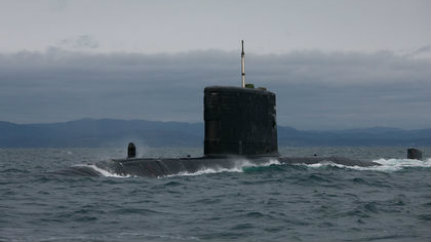
RIMPAC 2012 off Hawaii marks the first overseas deployment of the submarine HMCS Victoria

RIMPAC 2012 off Hawaii marks the first overseas deployment of the submarine HMCS Victoria

TORONTO – Run silent, run deep.

In a matter of weeks the Royal Canadian Navy will have three submarines ready to do just that.

The fourth will be in dry dock and not released until 2015.

These conventional diesel-electric boats were all purchased second  hand from Britain in 1998 and transferred to the RCN at an initial cost  of  $750 million.

Years of controversy and refit followed before last year’s historic  visit by HMCS Victoria to the RIMPAC exercises off Hawaii. That passage  culminated in its firing an MK 48 heavyweight torpedo and sinking the  decommissioned transport USNS Concord.

News that HMCS Victoria is to be joined by its sisters is welcome for  the defence establishment. For critics — of which there are many — it  is just another chapter in a convoluted tale of mismatched procurement  meeting ill-defined strategic needs.

The Canadian taxpayer has been left to pick up the now estimated $3  billion (and rising) tab prompting the question: does the RCN even need  to stay in the submarine business?

It’s in good company if it does.

Across the Pacific Rim, alone, countries as far apart as South Korea  and Australia, Indonesia and Japan, China, Vietnam, Malaysia and  Singapore operate conventional submarines.

Further afield Bangladesh is acquiring its first submarines to boost  its naval power in the Bay of Bengal while India operates 14 boats,  including a nuclear-powered attack submarine leased from Russia.

All are used for sea-lane security in a variety of scenarios  including clandestine work delivering special forces operators in  shallow coastal waters.

Still, those tasks should be viewed through an entirely different  geo/strategic setting to that of Canada’s, cautions Steven Staples,  president of the Rideau Institute, a defence and foreign policy  think-tank in Ottawa.

He acknowledges the growing submarine capabilities in other parts of  the globe but maintains Canada is historically not in the trade of  long-range power projection.

“We live in a self-evidently different neighbourhood to Asia,”  Staples said, “and our submarines are more coastal. They were designed  to sit on the sea floor during the Cold War to watch and listen for  Soviet fleet activity.

“There is a strong argument against whether we need them at all. The  three Oberon class boats that preceded the current subs were mostly used  to provide opposition training for the U.S. Navy.

“We may well find the new boats doing that as well. That’s a pretty expensive way to stay friends with an ally.”

Sitting, watching and listening. Three things non-nuclear submarines excel at.

Surely with increased shipping activity in the Arctic thanks to  receding pack ice and more and bigger ships transiting the route for a  short-cut to Europe, doesn’t it make sense for Canada to have eyes and  ears monitoring a potentially ice free Northwest Passage?

“Well, it would help if they were ever fully operational, put it that  way” Staples said. “If they could dive without hitting the ocean floor  or even remember to close hatches before submerging.

“Look, I just don’t think this project has been worth the money and  the time spent to deliver a marginal capability. I wouldn’t call it a  textbook case of how Canada should NOT go about procuring extremely  complicated defence equipment because, sadly, there are other contenders  for that title.”

If Canada eventually embraces the “use ‘em if you’ve got ‘em”  doctrine, they might want to look at what Australia did with its six  Oberon-class diesel-electric boats during the last decades of the Cold  War.

The Royal Australian Navy conducted perilous intelligence-gathering  operations off the coasts of Vietnam, Indonesia, China and India as part  of an American-led effort to check the Soviet Navy’s formidable fleet.

Between 1978 and 1992 Australian submarines would secretly track Soviet ships as they transited the South China Sea.

There were 16 patrols in all.

In one case an Australian boat famously trailed a new Soviet frigate  all the way to the entrance of Vietnam’s Cam Ranh Bay naval base and  photographed its hull shape, propellers, weapons systems and sonar. All  undetected despite being just being 1.8-metres from the frigate’s hull  at one stage.

Difficult but not impossible to replicate in Arctic waters if RCN  submariners ever get the call to covertly see just who is using the  trans-polar shipping route. And why.

Source – Sun News Network


Ultra Electronics Maritime Systems Awarded Maintenance Contract for Canadian Submarine Sonars

Submarine Image Gallery

Canadian submarine HMCS Chicoutimi in heavy seas

DARTMOUTH, NOVA SCOTIA- – Ultra Electronics Maritime Systems Inc (UEMS) (LSE:ULE) is pleased to announce that it has been awarded a contract to provide services for the ongoing maintenance of the Royal Canadian Navy’s submarine towed array sonars. The towed array sonars are the principal long range underwater sensor for the submarines. Under the contract, UEMS will be responsible for repairing and refurbishing the towed arrays as well as updating obsolete components and technology. The contract has a total value of $6.96M (CAD).

Dan Simard, UEMS’s Director Business Development, stated “We welcome this opportunity to continue our work for the Royal Canadian Navy and to contribute to the operational effectiveness of Canada’s submarines.”

Ultra Electronics Maritime Systems Inc. (UEMS)

ABOUT ULTRA ELECTRONICS MARITIME SYSTEMS

Ultra Electronics Maritime Systems Inc (UEMS) is an international leader in the development of equipment and systems for undersea surveillance and anti-submarine warfare (ASW). Established in Dartmouth, Nova Scotia, Canada in 1947, UEMS delivers sophisticated sonar systems to navies around the world including Multi-static Active Passive Sonar for the Dutch Navy, Integrated Sonar Suite for the Royal Australian Navy, and the Surface Ship Torpedo Defence System for the Royal Navy. UEMS provides unique engineering, development, manufacturing, test, evaluation, and management capabilities to develop and deliver advanced electronic, electromechanical, and underwater sensor systems for military applications.

Source – Market Wire


‘Freakiest thing’: Hunter-killer class submarine spotted in Howe Sound – Video Clip

News title suggests “Hunter-killer” Not me…!!!

John Buchanan of the Squamish Environmental Society filmed HMCS Victoria, a military submarine, after spotting it near Anvil Island from the Sea-to-Sky Highway on Friday, Feb. 8, 2013.

West Vancouver residents looking out on Howe Sound over the weekend may have seen a 2,500-tonne steel leviathan emerge from the water just off Anvil Island.

The Royal Canadian Navy’s HMCS Victoria, a hunter-killer class submarine, surfaced in Howe Sound Friday afternoon as part of a training exercise in the area.

The Victoria was spotted by John Buchanan, caretaker with the Squamish Environmental Society, as he made his way down the Sea-to-Sky Highway.

“It was just the freakiest thing. I’ve never seen a submarine before in my life,” Buchanan said. “I looked over at Anvil Island and there’s this bloody submarine. This thing is huge, eh?”

Buchanan pulled over to shoot pictures and video of the rare sighting. No one in Buchanan’s circle could remember any other instances of a submarine coming into Howe Sound in the past, he said.

As a conservationist, Buchanan said he has some concerns with military activity in Howe Sound, but not enough to sound a red alert.

“I don’t want them out there every day with their sonar, do I?” he said. “But I don’t know enough about them to know what the environmental consequences of what their manoeuvres may be.”

The Department of National Defense purchased the Victoria from the British Government in 1998 but it spent years in dry dock undergoing retrofitting and repairs. It successfully fired its first torpedoes in 2012 and is entering service in 2013.

Source – The Province

Canada – Subs headed back under water

Ill-fated Chicoutimi to be operational by year-end

The naval submarine HMCS Chicoutimi , shown here in 2009 prior to being hauled to the west coast via the Panama Canal, is undergoing extensive work. Despite a tragic past that saw a Halifax naval officer die in a fire, the Defence Department says a refit in Victoria, B.C., will have the sub ready for operation later this year.(TED PRITCHARD/Staff)

The naval submarine HMCS Chicoutimi , shown here in 2009 prior to being hauled to the west coast via the Panama Canal, is undergoing extensive work. Despite a tragic past that saw a Halifax naval officer die in a fire, the Defence Department says a refit in Victoria, B.C., will have the sub ready for operation later this year.

OTTAWA — Three of Canada’s four Victoria-class, diesel-electric submarines are to be operational by the end of the year.

But there are still questions about whether Canada still has the personnel to handle a submarine fleet, and if the subs are even worth fixing.

HMCS Victoria, which has been docked since 2005, was declared operational last year on the West Coast after sinking a decommissioned United States navy ship in a live torpedo test.

HMCS Windsor, docked since 2007, has already started live tests in Halifax Harbour. Last November, it completed a live diving exercise in the harbour, known as a camber dive. It made its first run out to sea in December.

HMCS Chicoutimi, on which a navy officer died after it caught fire during its 2004 maiden voyage, is also undergoing extensive work. Despite its tragic past, the Defence Department says the refit in Victoria, B.C., will have it ready for operation later this year.

“What that is is really heavy maintenance on more than 200 systems,” said department spokeswoman Jocelyn Sweet. “So absolutely everything gets looked at and either replaced or fixed or repaired or overhauled.”

With three of the four subs operational, the Defence Department will consider it at a “steady state” of operation.

The fourth submarine, HMCS Corner Brook, ran aground in a test last year. It will undergo repairs until 2016.

But some analysts say it’s a waste of money to repair the submarines, which were bought second-hand from the British navy for $750 million in 1998.

Since they started sailing in 2003, the subs have been at sea for a combined 1,083 days. That means the sticker price alone works out to almost $700,000 per day.

“These things aren’t submarines, they’re lemons,” said Steven Staples, president of the Rideau Institute, a defence and foreign policy think-tank in Ottawa.

Staples said the submarines will never live up to their billing, which is why the British government originally intended to mothball them. He said the submarines are not needed for defence and are in fact sucking resources from more valuable projects.

“The first thing you do when you find yourself in a hole is you stop digging,” he said.

The Defence Department says the subs will be used for various activities, including patrols, intelligence gathering and acting as a deterrent.

While the vessels might work soon, some wonder if Canada still has the staffing capacity to run three submarines after years of very limited testing ability.

In November 2011, Vice-Admiral Paul Maddison, commander of the Royal Canadian Navy, said the number of submariners who are active and ready had fallen to 80 from 300. An internal report in early 2012 raised concerns about the navy’s ability to train enough officers in time.

In April, Defence Minister Peter MacKay said the navy had 278 submariners who were working within the program, with 60 more on the way.

Source – Herald News

Canada – Submarine air quality under the microscope

The Canadian Maritime Force has four Victoria class diesel-electric submarines, formerly Upholder Class submarines of the UK Royal Navy.

The Canadian Maritime Force has four Victoria class diesel-electric submarines, formerly Upholder Class submarines of the UK Royal Navy.

OTTAWA – Navy engineers have decided not to install a central monitoring system to track air quality on board Canada’s oft-maligned submarine fleet, internal National Defence documents say.

It’s a move that’s being questioned by some former submariners.

The system was part of the military’s 13-year struggle to bring the four British-built second-hand boats in line with North American standards and convert certain fixtures for Canadian use.

Keeping the right balance of oxygen and carbon dioxide is crucial on board the submarines, which are required to remain submerged for extended periods of time, making air quality a particular concern for technicians.

In 2002, engineers initially proposed installing a ship-wide atmospheric monitoring system, but a series of internal documents show that more than 10 years later, the plan has been abandoned.

“Such a system is unlikely to be practical, requiring installation during the (extended deep work period),” said a briefing note to the navy’s director of maritime force development on Oct. 19, 2011.

Including the system raised the potential of derailing the navy’s plan to bring the submarines into full operational service.

The briefing, obtained by The Canadian Press under access to information laws, estimated installing the system would have pushed the initial roll-out of the boats to 2018 with the last touches — known as final operating capability — not achievable until 2025.

By that time, the submarines would be near the end of their lifespan.

“The current intent is to consider portable devices, which are expected to address the requirement in a reasonable amount of time and cost less than $5 million,” said the note, which evaluated the entire submarine life support project.

A navy spokesman confirmed the “fixes” to the air monitoring system are being implemented through a minor capital project and that there is no health and safety concern.

“The air standard on board meets established standards,” Navy Lt. Mark Fifield said in a recent email.

Former submarine captain Ray Hunt said he’s startled by the decision, because portable monitors were something the navy relied upon in its now-retired Oberon class submarines.

“I’m surprised at this day in age that we don’t have a more modern system,” said Hunt, who commanded three submarines during his 27-year naval career, including HMCS Okanagan. He also commanded the country’s entire submarine squadron in the 1980s.

He said carbon dioxide poisoning is an ever-present threat that can leave sailors dizzy and sick.

A modern air filtration system was supposed to be one of the major advantages of upgrading to the Victoria class, Hunt added.

But a defence analyst said the navy would not be taking short cuts on safety, especially in the wake of a fatal fire aboard HMCS Chicoutimi in 2004.

Eric Lerhe, a former commodore, said it was curious that engineers took more than a decade to figure out the proposal was impractical, but he hailed as laudable the goal of seeking the very best air quality standard.

It’s been 14 years since the purchase of the submarines was first announced, and the pressure to get them fully operational has been enormous, said Lerhe, who served on the defence planning team that convinced the Liberal government of Jean Chretien to buy the boats.

“The navy very clearly wants to demonstrate these boats are operationally capable,” Lerhe said.

HMCS Victoria was declared fully operational when it fired its first torpedoes and sank a decommissioned US Navy cargo ship in an exercise last summer.

Last fall, HMCS Windsor passed a critical dive test on the road to being declared completely ready. Both the Chicoutimi and HMCS Corner Brook remain in extended maintenance.

Almost a year ago, the head of the navy estimated that once fully underway, Canada could the sail the existing submarine fleet until 2030. But internal briefing documents show navy planners started laying the groundwork for their replacement last year with a study on what kind of boats and technology would be needed after 2020.

Source – Metro News

HMCS VICTORIA – A Long Beginning – Video Clip

A Long Beginning shows highlights of making HMCS VICTORIA “in all respects ready” for sea in late 2011 and 2012, culminating in her successful SINKEX at RIMPAC12. The CO shares the challenges faced by his boat and her crew along the way — and their accomplishments.

Source – Royal Canadian Navy Videos

Volunteer, retired Canadian Submariner receives Diamond Jubilee medal

Local volunteer and retired navy chief Larry Skaalrud has been honoured with a new medal.

Skaalrud, 70, an Airdrie resident since 1996, received a Diamond Jubilee Medal on Nov. 27 during a ceremony at McDougall Centre in Calgary.

“It’s a feeling you just can’t explain,” said Skaalrud who said it was an honour to receive it.

He was nominated by members of the Submariners Association of Canada, an organization Skaalrud started in 1995.

Involved with the Canadian Navy for 32 years, Skaalrud said he and other submariners wanted a way to stay in touch.

During his time with the Navy, he worked on submarines. He said the longest trip he took underwater was 29 days from Victoria to Hawaii.

“You really get to know one another,” he said, explaining the organization is a way for everyone to remain connected years later.

He said inside the submarine about 74 officers would work together. Now, because of technology, less crewmen are needed – about 60. He said everyone worked together and knew how to man all aspects of the vessel.

After forming the submariner association in 1995, two other chapters have started up in Canada.

The association attends local memorial ceremonies and services, naval ceremonies, and provides financial assistance to veteran groups and area sea cadets.

It’s open to people qualified on submarines and hosts reunions, the most recent one four years ago, which allows former submariners to get together and remember their days together.

He also said new submariners are part of the organization as well.

He’s still involved with the association and recently toured the HMCS Ojibwa, Canada’ first Cold War submarine, now decommissioned and docked in Port Burwell Harbour, Ontario as the centrepiece for the new Museum of Naval History.

Skaalrud who grew up in Carsland, left when he joined the navy. He returned to his home province in 1996 and settled in Airdrie.

And once he arrived, Skaalrud immersed himself in the community here and worked eight years at the City of Airdrie as a utility technician.

He is a past president of the Airdrie Legion, a former member of Citizens on Patrol and helps with Ducks Unlimited. Currently, he is president of Airdrie Village Association, a group of local residents dedicated to maintaining the atmosphere of Airdrie’s downtown neighbourhoods.

The Diamond Jubilee Medal marks the 60th anniversary of Queen Elizabeth II’s accession to the throne.

The medal honours significant contributions and achievements by 60,000 Canadians.

Source – Airdrie City View

Canadian Submarine arrives at military museum

HMCS Ojibwa is nearly home.

McKeilSub-322 crop//


Home, for the last of Canada’s Oberon class submarines, is the Elgin Military Museum in Port Burwell, Ontario on the north shore of Lake Erie.

When it was decommissioned from the Royal Canadian Navy in 1998, the vessel was destined to be scrapped, but a movement to save the ship resulted in it becoming the property of the museum. The plan is for the museum to turn the HMCS Ojibwa into a land-based historical artifact located next to the Elgin Military Museum of Naval History—a submarine interpretation centre—and now that plan is entering its final stage.

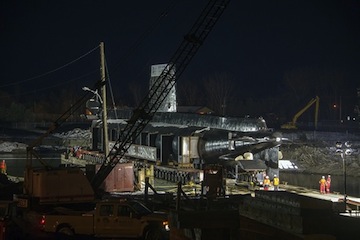
The sub arrived at the port November 27th. It was originally scheduled to have arrived the week before, but ongoing dredging work at the port proved insufficient to provide clearance for the sub and the barge that carried it from Hamilton, Ontario. With the work complete, and an obstruction (believed to be an old seawall) cleared, the barge and sub were free to dock.

On November 28th, 2012 the sub is to be lifted off the barge and placed into the concrete cradles that will be its permanent home.

Heavy lift and transport company Mammoet Canada Eastern Ltd and Heddle Marine will work together to carefully shift the weight of the submarine from the barge using 48 axle-lines of self-propelled modular transporters (SPMTs).

The SPMT trailers will be assembled and rolled onto the barge using ramps, which will provide the transition between the barge and the shore.

On the barge, the SPMTs are positioned under the transportation stands and the submarine is then hydraulically elevated. When the submarine is secure, the roll-off procedure will use a ballast plan that consists of filling the barge compartments with water as needed to maintain a level position and avoid undue stress on the barge and submarine.

Once it has been successfully rolled off the barge, HMCS Ojibwa will be transported to its final resting place and positioned onto its permanent mount at the museum.

The submarine has spent the past few months making its last voyage from Halifax, Nova Scotia to Port Burwell, with a stop in Hamilton where it underwent some refurbishing.

“Ojibwa presented a unique opportunity to bring the story of Canada’s role in the cold war and our entire rich naval history to central Canada. She began her service in the height of the Cold War earning herself a proud place in Canadian history,” says Ian Raven, executive director of the Elgin Military Museum.

“Many people will be surprised to learn what a key role Canadian O-boats played in the Cold War undertaking dangerous covert missions and shadowing Soviet nuclear submarines.”

The Ojibwa is the second Canadian submarine to be turned into a museum exhibit. The HMCS Onondaga is an Oberon-class (as is the Ojibway) sub that now resides at the Site historique maritime de la Pointe-au-Père in Rimouski, Quebec, and is open to the public.

 Source – Canadian Manufacturing