Tag Archives: Royal Navy

Plymouth Submariner surfaces to collect MBE

A MARINE Engineering Officer who had the “relentless” task of keeping a nuclear submarine at sea for 11 months has been awarded an MBE.

Lieutenant Commander Andy Sharp was deployed aboard HMS Triumph in 2011 and 2012 when the boat was sent to the Gulf and Libya.

Lieutenant Commander Andy Sharp was deployed aboard HMS Triumph in 2011 and 2012 when the boat was sent to the Gulf and Libya.


Servicemean Andy Sharp receives his MBE, accompanied by his fiancee Kay Talbot

The 45-year-old regularly faced repairing the ageing Trafalgar-Class boat but each and every time ensured HMS Triumph and her crew remained tightly on schedule.

The citation explained how the boat remained on station for Operations Ellamy and Unified Protector for more than 100 days providing vital intelligence to NATO and as the UK’s strategic strike capability.​

mbe

It continued: “Throughout that time Andy led his department with selfless dedication, tenacity and resourcefulness as they kept the submarine in a first class state of repair through what was, at the time, the longest ever operational SSN deployment.

“By the time she returned to the UK, HMS Triumph had spent over 14 of the previous months away from home and that achievement was due in no small part to Andy.”

Commander Rob Dunn, the Commanding Officer of HMS Triumph at the time, said: “Too often in the past what submariners have done has been out of sight and therefore out of mind. But the challenges faced by my engineers in keeping Triumph ready for operations was immense and I was delighted to see Andy, along with several other members of my crew, recognised in the Operational Awards.”

Also to be recognised in the Operational Honours with a Queen’s Commendation for Valuable Service was Warrant Officer 2 Alasdair McCall who supported Andy throughout the deployment.

Andy said: “It was a brilliant day, it was presented by the Queen. She said congratulations and asked me if I was busy last year because of the award.”

He said the MBE represented the hard work of an “excellent team”.

The Lt Cdr was presented his MBE by the Queen at Buckingham Palace with his fiancee Kay Talbot and children Danny and Kirsty.

His son Danny, a Royal Navy Air Engineering Technician, was flown off HMS Illustrious especially for the occasion.

Source – ThisisPlymouth

ROYAL NAVY SUBMARINER EARNS DOLPHINS THE AMERICAN WAY

Royal Navy Submariner earns dolphins - the American way

A Royal Navy submariner recently received US Navy Submarine Service “dolphins”, making him just the second UK officer to qualify on a US Navy submarine.

It has been a tough process, but getting my US Navy dolphins is one of the highlights of my career and I have enjoyed every minute of it.

Lieutenant Matt Main RN

Lieutenant Matt Main has already earned his Royal Navy dolphins – the unique badge which signifies a qualified submariner – but on June 10 he was presented with the US equivalent after a gruelling 27 month training and qualification process.

Matt, a Marine Engineer (Submarines) in the Royal Navy, was presented with the US dolphins by Commander George Perez, Commanding Officer of the USS New Mexico, after his success as part of the US-UK Personnel Exchange Programme.

Fully integrated into the crew of USS New Mexico, Matt is currently the Damage Control Assistant and will become the Assistant Engineer in due course before returning to the Royal Navy.

US Navy submarine officers must qualify both forward and aft to earn their dolphins and so, for Matt, learning to drive the submarine both surfaced and submerged has been a unique experience.

“It is a real privilege to serve on this fine submarine with such a professional, motivated crew,”

said Matt.

“It has been a tough process, but getting my US Navy dolphins is one of the highlights of my career and I have enjoyed every minute of it.

“The welcome I received when I reported on board a year ago was incredibly warm and I am proud to call these men my brothers.”

Commander Perez said:

“After a fast-paced, demanding year of intense operations, Lieutenant Main has earned his gold US dolphins.

“He is fully qualified to stand Officer of the Deck on USS New Mexico and will do so repeatedly over the next year as he assumes an even larger role in the day-to-day operations of the ship.

“When an officer earns his dolphins in the US Navy, it signifies that they have demonstrated, through performance as the Officer of the Deck, a thorough understanding of all aspects of submarine operations.”

Lieutenant Main was presented his dolphins during a ceremony alongside HM Naval Base Clyde. Witnessing events were the crew of USS New Mexico as well as Royal Navy colleagues.

Matt is the second Royal Navy officer to earn US Navy submarine dolphins, with the first, Lieutenant Commander Ralph Coffey, receiving his after serving with USS Providence from 2010-12.

Source – Royal Navy Website

HMS Alliance – Submarine close to surfacing again

Alliance

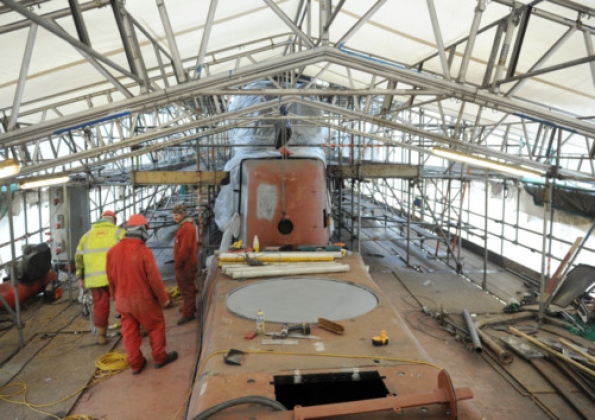
The HMS Alliance refurbishment at the Royal Navy Submarine Museum in Gosport. Standing on top of the submarine

In less than three weeks the refurbished hull of a Second World War era submarine will be revealed for all to see.

Piece by piece the scaffolding surrounding HMS Alliance at the Royal Navy Submarine Museum, in Gosport, is being taken down.

The final section is due to be removed early next month.

It will be a major milestone in a project that has already seen many.

Sitting atop her home on a concrete cofferdam, she will, for the first time in decades, be looking her best.

A gleaming black finish – itself painted on top of anti-corrosive paint and a holding coat – will mask the major work embarked upon in October 2011 to restore her.

Alliance had suffered such corrosion that huge parts of her were damaged so badly they had to be replaced, rather than repaired.

Bob Mealings is the curator at the museum and calls sections of the submarine, which is not yet finished, ‘a real work of art.’

But he added if this project had not been started, the ‘irreplaceable’ submarine would have been lost to the public.

‘Eventually I think she would have been in such a poor state you couldn’t have opened her to the public,’ he says.

‘She would have become a health and safety hazard to people surrounding the submarine because bits were dropping off.

‘And also she would have been an environmental hazard because the rust and the paint coatings, all of which are not supposed to be in the water, gradually dropping off and contaminating the sea around us.

‘And she is the only surviving Second World War submarine – she’s irreplaceable.

‘It would have been a major loss for UK maritime heritage, for naval heritage and indeed for Gosport, as the town that is essentially the historical home of the British submarine service.’

She is also a memorial to the 5,300 British submariners who have lost their lives in service.

At the end of £6.7m project in March 2014, Alliance will have been bought another 60 years.

To get to that stage, the restoration so far has been nothing if not extensive.

Around 40 tonnes of new steel has been put into the boat to replace parts that were beyond repair.

Bob adds: ‘The restoration itself has included absolutely everything.

‘Down at the bow, by the bow’s keel, we’ve had to restore from the bottom of the keel all the way up and all the way down.

‘All of that has been blasted back and repainted and a lot of welding repair work carried out.

‘The bow is a very good example of the challenge of producing a really good restoration in terms of the quality of workmanship.

‘To actually roll steel plate and weld it in that [compound curve] shape is a real work of art, it’s real craftsmanship.’

The work has been guided by the 1945 original build drawings, supplied to the museum by BAE Systems at Barrow-in-Furness.

But that has not made it plain sailing for Portsmouth-based firm ML UK which has carried out the work.

Getting access to certain parts has been difficult.

That included the ballast tanks, which could only be accessed by cutting through the hull.

‘There are dozens of ballast tanks aboard Alliance,’ says Bob.

‘Every one of them has had to be opened up, blasted and repainted in order to preserve the interior.

‘The shot blasters have had to go in there and blast all the rust away, the painters have had to go in there and paint.

‘Some of the work in the confined spaces has been challenging.

‘It’s in the nature of the way submarines are constructed, they’re not the easiest thing to work on and maintain.

‘There’s so much machinery crammed into confined spaces.

‘Simply obtaining access to various parts of the submarine has been one of the challenges of the project.’

A major consideration during the restoration work has been safeguarding against any future corrosion.

And that has meant protecting the boat, which is on the historic ship’s register, against birds.

The A-Class’s casing has more than 100 distinctive free-flood holes.

But each one of them is now covered with mesh to stop it becoming an aviary.

Bob said: ‘A lot of the superstructure of a submarine is free-flood, so when it dives, water floods into these spaces, which is obviously meant to happen.

‘The problem with a preserved historic submarines is that birds like to go in there and nest.

‘Every one of these free-flood holes, and they’re all over the hull of the submarine, has to be meshed over.

‘It’s a shame because it’s a very distinctive feature of a Second World War submarine to have all these holes but a bit fatal when you’re trying to protect it.’

‘Birds contaminate the boat with their guano but they also make it unhygienic to work on.

‘At the height of the problem there were probably 200 birds nesting or associated with the boat.

‘Now we’re down to a handful of stragglers.’

Instead, regular groups of visitors can be found aboard, being shown around by one of the museum’s many volunteers.

When the programme of work is completed, visitors can see what it was like for 65 crew and six officers that used to be on board.

A state-of-the-art sound and lighting system will bring the boat to life.

She is open for visitors now and museum staff are keen to share their enthusiasm for her with others.

Volunteering

JUST as museum staff want the submarine to be open to the public, so is the restoration work itself.

An army – or crew – of volunteers has been taken on to help with the work.

Roy Furse, a former member of the Fleet Air Arm, is a conservation volunteer.

The 67-year-old, from Seafield Road, in Portchester, will be working on bringing some of the electronic equipment back to life.

He was busy in a workshop at the museum when he spoke to The News.

He said: ‘I’ve been working on the submarine.

‘I’ll be working on the electronics, which is quite exciting, trying to get some of it working again for lights and visual effects.

‘I worked at IBM for 28 years in project management and needed something really different and this is it.

‘It’s keeping the past alive, and people not involved with the sea can come and

see what it was all about years and years ago.’

Mr Furse has been volunteering on the project for three months.

Volunteers are given initial training but are given space to fit into the project.

Curator Bob Mealings added that the museum hopes the volunteers involved will stay for the long term to help with the upkeep of the fully-restored vessel.

He said: ‘We’d like people around to help us maintain the submarine in the long term.

‘There are all sorts of projects on board the boat, which we won’t get a chance to sort out before March next year when we relaunch.’

To volunteer on the project, call (023) 9251 0354, extension 231.

Fundraising events

EVEN after getting £3.4m from the Heritage Lottery Fund, refurbishing a submarine is a costly business.

Bosses need around a further £200,000 to hit the project’s target.

Those behind the £6.7m project run fundraising events to bring in more cash to pay for the work.

And this week a travelling speaker, with the stage name of Eric, will be talking at the museum to help bring in the cash.

Fresh from a world tour, which included Australia, London and Leicester, the former submariner will talk about the secret world of submarines.

Tickets cost £10 for the show on Thursday at the museum.

Then on Thursday, July 18 from 7pm to 9pm, the museum’s own archivist will give a talk.

George Malcolmson will give his talk, Donald’s Navy 1900 – 1945, about the seaside artist Donald McGill.

And on Thursday, September 12 a dinner aboard HMS Victory will raise cash for the ongoing restoration.

Diners are invited to enjoy fine dining and fine wines on Admiral Lord Nelson’s Lower Gun Deck in aid of the restoration appeal.

The night will be in full naval tradition style and will end with a prize auction.

All tickets can be bought online at supportusalliance.co.uk or by calling (023) 9254 5036.

To support the cause further, become a friend of the museum on rnsubmusfriends.org.uk

Source – The News

Barrow submarine heritage dream hits rocks after news HMS Onyx to be scrapped

DREAMS of a submarine heritage centre in Barrow have suffered a blow as the proposed centre piece is due to depart for the wreckers’ yard.

HMS Onyx has been sitting in Barrow since May 2006 when a group of submariners, led by Terry Spurling, helped bring the boat back to Barrow.

The group had hoped the boat would become an interactive centre piece at a submarine heritage centre but the plans ran into trouble after the group could not secure funding from the Heritage Lottery Fund without the backing of Barrow Borough Council or Cumbria County Council.

As the boat is prepared to be towed to Hull, where it will be dismantled, Mr Spurling said the dream of using a submarine is no longer possible.

He said: “It’s sad for Barrow that it’s going but there’s now no chance of getting a submarine.

“It was the last O-class (Oberon) class submarine available and it’s about to be made into razor blades.

“It’s the end of the dream based around a submarine but I still believe there’s a heritage story to tell.”

Mr Spurling said the decision had been taken after HMS Onyx had been sitting in Buccleuch Dock for the best part of seven years – which has led to rusting and corrosion.

He added: “When the climate is right and when there is money available I think there will be some-thing.

“We have a paintings collection at Barrow Town Hall, a large book collection and a lot of hardware and materials that have been loaned to Faslane.”

Mr Spurling said he understands the reasons Onyx is to be scrapped but added he is sad the heritage centre has lost its centre piece.

Source – North West Evening Mail

UK – Fears of Navy cuts and dock job losses in nuclear debate

The £100 billion price tag of   a “like-for-like” replacement for Britain’s Trident nuclear weapon would mean more cuts to the Royal Navy, a former armed forces minister has warned.

Sir Nick Harvey, Liberal Democrat MP for North Devon, said he believed Britain could not afford, and did not need, a further generation of nuclear weapons on such a scale, and that an “open mind” should be kept on doing something at a lesser cost.

 ​submarines

But speaking during a  Commons debate on the issue, fellow Westcountry MPs raised fears over the impact on jobs at Devonport dockyard – the biggest private sector employer in Devon and Cornwall – of a scaled-back nuclear deterrent. The Plymouth yard boasts the only UK licence to refit, repair and refuel submarines that carry the Trident missile.

Sir Nick, sacked as a Ministry of Defence minister in last year’s  reshuffle, said the UK had to decide by the middle of 2016 whether or not to proceed with a replacement of the existing Trident nuclear deterrent. He said: “I do not believe that we need to have a further generation of nuclear weapons based on the scale we thought we needed in 1980 at the height of the Cold War, and I don’t think that we can afford to do so either.”

Sir Nick said he did not   believe that Britain’s national   security assessment and strategy suggested the country needed it.

When Britain had a known nuclear adversary in the shape of the former Soviet Union, there had been a “logic” to having continuous at-sea deterrents, he said, but the circumstances of today were “very different”.

Sir Nick outlined the capital investment of a further generation of submarines, the running costs and decommissioning.

He said: “When you begin to total this out and factor in decommissioning at the end, what we are talking about is an expenditure of over £100 billion and we need to look closely at whether that is justified.”

The impact of committing to such sums, he argued, would be felt “above all else by the Royal Navy”.

Of the three Armed Forces, the Navy has the strongest presence in the Westcountry, from commandos in Plymouth, Taunton and North Devon to warships based at Devonport Naval Base. There are sharp differences between the Tories and Lib Dems over the future of a replacement for Trident, with most Conservative ministers and backbenchers reluctant to reduce its capability.

Oliver Colvile, Tory MP for Plymouth Sutton and Devonport, said in the Commons: “The nuclear licence is vital to my constituency. It is our stake in the ground and we must ensure that lots of work comes out of it.”

Sheryll  Murray, Conservative MP for South East Cornwall, added: “I was concerned at our going into coalition with partners who stated in their last election manifesto that they would be saying no to like-for-like replacement of the Trident nuclear weapons system.

“I am still concerned that they might scale down our vital nuclear deterrent in increasingly uncertain times.”

Source – This is Cornwall

Consett submarine commander presented with MBE at Palace

A RETIRED submarine commander surfaced at Buckingham Palace to be presented with an honour for service to his country.

Lieutenant Commander Stuart Hobson, from Consett, in County Durham, collected an MBE announced during the Queen’s Birthday Honours.

The 55-year-old was given the award for his dedication to the UK’s continuous at sea deterrent and helping to promote relations between the Royal Navy and US Navy.

After leaving Blackfyne Secondary School, Lieutenant Commander Hobson embarked on a 38-year career with the Royal Navy, serving on the Polaris submarines HMS Renown, HMS Repulse and HMS Resolution followed by tours with Vanguard submarines HMS Victorious and HMS Vengeance.

He ended his military career on shore as officer-in-charge of HMNB Clyde’s Strategic Weapons Support Building.

He said: “The investiture was a unique experience which made me and my wife very proud, yet humble. It made me feel that my 38-years before the mast was not in vain.”

Since retirement, Mr Hobson has started a new career in the private sector with Lockheed Martin UK Strategic Systems.

Accompanying him to the Buckingham Palace ceremony were his wife, Wendy, and their three children, Chris, Nick and Emma.

Source – The Northern Echo