Leave a reply
Monthly Archives: January 2013
Submarine Diary 2012 in review
Statistics of this site since its birth in early Dec 2012.

Here’s an excerpt:
600 people reached the top of Mt. Everest in 2012. This blog got about 8,800 views in 2012. If every person who reached the top of Mt. Everest viewed this blog, it would have taken 15 years to get that many views.
MOD Releases Funds for More Astute Class Submarines

Fourth Astute class submarine, Audacious, under construction in the Devonshire Dock Hall. Photo: BAE Systems
The UK MOD has committed £2.7 billion for continued work on the Royal Navy future attack submarines. The programme, which has been beset by difficulties since it was commissioned in 1997, is expected to cost up to £10bn for a seven-submarine fleet that is already years late.
The lead submarine of this new class, HMS Astute had suffered technical problems that raised questions about the performance and reliability of the boat. Last November, the Guardian revealed that during sea trials, HMS Astute, the lead ship of this new class, has been unable to reach its intended top speed. Other problems that have affected the boat in recent months include:
- Flooding during a routine dive that led to Astute performing an emergency surfacing.
- Corrosion even though the boat is essentially new.
- The replacement or moving of computer circuit boards because they did not meet safety standards.
- Concern over the instruments monitoring the nuclear reactor because the wrong type of lead was used.
- Questions being raised about the quality and installation of other pieces of equipment.
- Concern reported among some crew members about the Astute’s pioneering periscope, that does not allow officers to look at the surface “live”.
On Friday, October 22, 2010, Tug boats moved in to assist HMS Astute after it ran aground in shallow water off the Isle of Skye, Scotland. The sub ran into trouble near the Isle of Skye during a routine maneuver that included dropping some sailors ashore, according to reports. During the operation to tow Astute clear, there was a collision between the rescue tug and the submarine, which resulted in damage to her starboard foreplane. The submarine returned under her own power to Faslane, where the damage incurred in the grounding and afterwards was described as “minor”.

Astute aground with the emergency tow vessel Anglian Prince
According to the new contract announced last week, MOD awarded BAE Systems a contract worth £1.2bn for Audacious, the fourth submarine in the Astute class. The full contract covers the design, build, test and commissioning programme. First steel was cut in 2007 and Audacious is at an advanced stage of construction at BAE Systems’ site in Barrow-in-Furness, Cumbria.

HMS Astute seen along HMS Dauntless on one of her recent missions. Photo: MOD
The MoD also confirmed that a further £1.5bn has been committed to the Astute programme for the remaining three submarines in the class, which includes early build work on boat 5 HMS Anson, whose keel was laid in October 2011.
Planning for Audacious began in 2007 and her keel was laid at Barrow in March 2009, according to the Royal Navy website. The submarine will benefit from improvements identified during building of HMS Astute (commissioned 27 August 2010), HMS Ambush (currently on sea trials, launched at 5 January 2011) and HMS Artful (keel laid down 11 March 2005). Three more submarines are planned in the future, orders had been made for 2; HMS Anson (under construction, ordered March 2010, keel laid down 13 October 2011), HMS Agamemnon (ordered March 2010) and HMS Ajax (confirmed but not yet ordered).
Source – Defence update
Full details of submarine fatal shooting to be heard
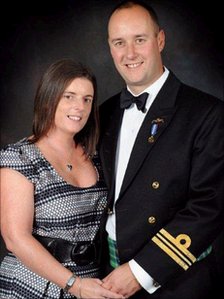
Lt Cdr Ian Molyneux
THE details of how a hero sailor was killed in a shooting on a nuclear submarine docked in Southampton will be heard today.
A two-week inquest into the death of Lieutenant Commander Ian Molyneux on board HMS Astute last April will be held at Southampton Coroner’s Court.
The 36-year-old father-of-four this year posthumously received the George Medal – the second highest civilian award for gallantry, belowthe George Cross.
As reported, he was killed when he ignored the obvious risk to his own safety as he tried to stop Able Seaman Ryan Donovan, who had begun shooting a semiautomatic rifle on board the submarine while it was on a formal visit to Southampton.

Ryan Donovan
The officer, with 20 years of experience in the Navy, was shot in the side of the head at point blank range as he rushed towards the gunman, who had been acting as sentry on the vessel.
Donovan was eventually overpowered by the then leader of Southampton City Council Royston Smith and chief executive Alistair Neill, who had been on a civic tour of the submarine.
In September last year, Donovan was sentenced to at least 25 years behind bars after admitting the murder of Lt-Cdr Molyneux, and the attempted murder of two other officers
Winchester Crown Court heard Donovan was as an “immature” fan of violent computer games and gangster rap who failed to cope with the stresses of cramped submarine life.
Despite spending four years in the Royal Navy, the then-22- year-old able seaman was said to have struggled to deal with the strict authority of the armed services and resented those he believed had unfairly targeted him.
Under the nickname “Reggie Moondog”, Donovan, from Dartford, Kent, wrote rap songs with lyrics about guns and killing, including a reference to the SA80 rifle he was to later use on his murderous rampage.
The court heard Donovan had repeatedly spoken of his desire to kill, and just hours before his terrifying gun frenzy he told a colleague he would shoot someone that day – advising him to “watch the news” later.
Donovan was said to suffer no mental illness, and far from being a crazed loner, was popular with many friends, relatives and colleagues, but saw “no way out”
of his predicament.
Angry at missing out on a draft to another ship after getting into trouble and facing military imprisonment for refusing orders over cleaning duty, he decided to kill the officers he held responsible.
He waited two days for the chance to murder Petty Officer Christopher Brown and Chief Petty Officer David McCoy, after which he planned to turn the gun on himself.
But his revenge mission failed when his shots missed the officers, and courageous Lt-Cdr Molyneux, from Wigan, Lancashire, made his fatal intervention.
Source – Daily Echo
DARPA drone ship tracks submarines – Video Clip
DARPA – the Defense Advanced Research Projects Agency – is known for designing a variety of high-tech and futuristic platforms for the US military.
One of the most recent projects from DARPA? An oceangoing drone ship specially designed for submarine hunting by engineers at SAIC.

The ship – dubbed the ACTUV sub-tracking drone – is specifically built to monitor very quiet diesel-electric submarines. In terms of real-world scenarios, the Navy would deploy sonar buoys around a specific area to give the drone ship an idea of where to search.
After the search area is defined, the drone ship would be capable of taking over the search using long-range and short-range sonars for up to 13 weeks at a time. The ship is also able to detect and gauge the intent of other ships in its path, with human failsafes built into the system.
The ACTUV is currently categorized as a work in progress, so it will be years before the vessel is actually ready to plow through the oceans searching for enemy submarines.
SAIC says the ship won’t requires human interaction or maintenance for the entire term of its 60 to 90 day deployment. Indeed, the only time human assistance is needed during the ACTUV mission is when the harbormaster escorts the ship out of the dock.
Source – TG Daily
ROV submarine finds wreck of bullion liner sunk by WW2 U-32

On 28 October 1940 U-32, under the command of Hans Jenisch, sank the 42,348-ton liner Empress of Britain, which had been previously damaged by German bombs. Empress was the largest ship sunk by a U-boat. U-32 was sunk northwest of Ireland, in position 55°37′N 12°19′W, by depth charges from the British destroyers HMS Harvester and Highlander on 30 October 1940. Nine of her crew died, 33 survived and were taken prisoner, including Jenisch, who spent six and a half years in British captivity before returning to Germany in June 1947
AN Irish-built robot submarine has shed new light on the biggest passenger ship sunk by a German U-boat.
The 42,000-ton Empress of Britain was carrying gold worth millions of euro when it was sunk on October 28, 1940, off Bloody Foreland in Co Donegal.

A 1995 expedition reported finding the Empress upside down in 500ft of water.
The salvagers broke into the ship’s strong room only to find a single skeleton — but no gold.
Now a survey by a Marine Robotics Team from the University of Limerick (UL), using a “Smart” remotely operated vehicle (ROV), has discovered the ship is actually on its side.
The Empress of Britain was hit by two bombs from a Luftwaffe Condor on October 26, 1940 and caught fire about 70 miles northwest of Aran Island, Co Donegal.
Most of the 578 survivors were picked up by British ships, while the liner continued under tow to the Clyde in Scotland.
However, a German submarine, the U-32, shadowed the salvage convoy for nearly 24 hours before firing three torpedoes.
Two hit and sank the Empress northwest of Bloody Foreland. Some 25 crew members and 20 passengers were killed when she went down.
The gold is now thought to have been taken off the ship while it was on fire and its passengers were being evacuated.
Source – Herald.i.e
Iran Almost Through with Indigenization of Submarine Technology

A senior Iranian defense industry official announced on Monday that the country has almost completely indigenized building of military submarines.
Deputy Head of the Naval Industries Organization of the Iranian Ministry of Defense General Babayee said Iran can now manufacture different types of naval equipments, including submarines.
“In construction of military submarines, this organization has achieved more than 90% indigenization now ,” Babayee said.
As regards other products, the official said, “We have indigenized some products up to 92%, while with regard to the production of some other products and depending on the type of the project, indigenization has taken place from 65 to 70%.”
Last month, Iran boosted its naval power in Persian Gulf waters after a new missile launching vessel and two light submarines joined its Navy fleet.
During the ceremony attended by Iranian Navy Commander Rear Admiral Habibollah Sayyari, two Qadir-class light submarines also joined the Iranian naval fleet.
All parts of the Qadir-class submarines, including the hull, radar equipment and advanced defense systems, have been made domestically.
The submarines are appropriate vessels for different naval missions, including reconnaissance and combat in territorial waters, specially in the Persian Gulf and the Strait of Hormuz which are not wide enough for the maneuvering of large warships and submarines.
Meantime, the Iranian Navy tested the operational capabilities of its submarine units on the second day of Velayat 91 naval wargames on Saturday.
Spokesman of the Wargames Rear Admiral Amir Rastegari announced that on the second day of the drills, Iran’s light and kilo-class submarines have traversed the territorial and international waters, conducted reconnaissance missions and traced hypothetical enemies successfully.
Source – Fars News Agency
 Submarine Diary