Monthly Archives: June 2013

Canadian submarine fleet’s future could be at risk

No mention of sub replacements in $33B National Shipbuilding Procurement Strategy, report says

The HMCS Chicoutimi sits aboard the heavy lift ship Tern in Halifax harbour on April 6, 2009. The vessel was transported to Victoria for a refit.The HMCS Chicoutimi sits aboard the heavy lift ship Tern in Halifax harbour on April 6, 2009. The vessel was transported to Victoria for a refit. (CBC)

Stealth and silence are hallmarks of the Royal Canadian Navy’s submarine fleet but those qualities may also apply to the federal government’s vision for the beleaguered force, says a new report released Tuesday on the future of the navy’s sub squadron.

The report, titled “That Sinking Feeling” said there are indications that the future of submarines in the navy may be as shaky as the spotty service record of the second-hand Royal Canadian Navy subs.

A hint of looming doom for the submarine fleet could be that there is no mention of replacements in the much-touted National Shipbuilding Procurement Strategy (NSPS), said the report, which is produced by the Rideau Institute and the Canadian Centre for Policy Alternatives.

“Nowhere in the plan is there any mention of one particular, significant, readily identifiable and probably imminent procurement — namely, the replacement of Canada’s troubled Victoria-class submarines,” the report said.

The report is co-authored by Stewart Webb, a researcher with the Rideau Institute, and Professor Michael Byers, a University of British Columbia defence expert.

Byers has been critical of both the Harper government and Canada’s military procurement strategy in the past. In 2008, Byers sought the New Democratic Party nomination for the federal riding of Vancouver Centre but lost to Liberal incumbent Hedy Fry.

The government plans on spending $33 billion over the next three decades replacing the ships of Canada’s navy.

New supply and logistics ships, a fleet of Arctic patrol vessels and up to 15 replacements for the navy’s front-line frigates and destroyers are planned. But submarines, which the navy claims are vital to Canada’s defence, do not surface in the ambitious warship construction program.

“Canada’s Victoria-class submarines may have as little as one decade of remaining service-life, and too many mistakes have been made with submarine procurement in the past,” the report said.

Victoria-class fiasco

The report chronicles the history of Canada’s dabbling with submarines — from the failed attempt to build up to a dozen powerful nuclear submarines in the late 1980s to the decision to buy four mothballed British submarines that had to be retro-fitted around an American-supplied torpedo.

By the time Canada decided to buy the four bargain-priced submarines, the oldest had spent a total of nine years languishing in salt water without a crew.

“Unfortunately, the apparent bargain quickly became a costly fiasco,” states the report.

The report provides a scathing account of the “inferior vessels” since the first sub, HMCS Victoria, entered service in the Canadian navy in 2000.

The time all the submarines have spent at sea is a telling number.

While in service with the British navy for four years, the subs spent 1,077 days at sea. But after 13 years in service with the Canadian navy, the boats have spent only 783 days patrolling, the report said.

One sailor was killed and several others injured because of a fire aboard the submarine HMCS Chicoutimi and there have been constant, and later confirmed, reports of cracked valves, a dented hull, shoddy electrical systems, rusted parts and cost overruns.

CBC reported last month that HMCS Windsor’s planned two-year refit actually lasted five years and cost $209 million.

After the submarine was relaunched in Halifax in the fall of 2012 it was discovered that one of the vessel’s two generators didn’t work, resulting in the submarine being restricted to near-home waters until the multi-million generator can be replaced. That replacement might not happen for years, confirmed the navy.

The federal government signed a controversial $1.5 billion contract in 2008 with the Canadian subsidiary of a British-based company to provide “in-service support” for the submarines.

But Tuesday’s report said that money could have funded a new fleet of state-of-the art submarines.

“The Harper government could have procured three to four brand new diesel-electric submarines, based on proven designs from France, Germany, or Sweden,” states the report.

Future plans sketchy

The report challenges Canadians to decide whether the navy needs submarines or not but it also ponders whether the Harper government is quietly planning to procure new submarines.

Military brass have made it clear that submarines are front and centre in its plans for Atlantic, Pacific and Arctic defence. But the government has not been so forthright.

“There is clearly a desire within [the Department of National Defence] and the Canadian Armed Forces for the procurement of new submarines. But the absence of submarines from the NSPS remains unexplained,” write the authors.

The report suggests there may be three possible scenarios for Canada’s submarine future: a possible secret plan for the Victoria class replacement; a possible secret plan to terminate Canada’s sub capability; or there is no plan to either keep or replace the current fleet.

“Condemning Canada’s submarine program to death through neglect and obsolescence rather than design,” the report said.

Other countries have decided to scrap submarine capabilities altogether.

The Danish navy pulled the plug on its sub fleet, and the possibility of new submarines in 2004 after a national debate.

Instead of subs, the Danes opted to build a small but mighty fleet of surface ships to patrol in both home and international waters.

But many other countries have decided to invest in submarines as the ideal way to deny other nations access to their waters.

China, India, Iran, Chile, Malaysia and Israel are all building or buying new fleets of advanced submarines.

The report said there are several submarine designs Canada might consider to replace the aging but low mileage Victoria class submarines.

The German-built U-214 class has the ability to remain underwater for weeks at time because of new air-independent technology.

Canada’s submarines must surface, or send mast to the surface, several times a day in order to charge batteries.

New submarines like the French Scorpene or Swedish Gotland would allow Canada to patrol under the ice in the Arctic and do so with just 25 sailors — half the crew needed for the Victoria class.

But if history is any guide, it takes Canada 15 to 20 years to design and build a new class of complex warships.

“The best-before date of Canada’s Victoria-class is approaching, perhaps as soon as 2023,” warns the report.

Cmdr. Hubert Genest, with the navy’s public affairs office, told CBC News that the navy plans to operate the Victoria-class submarines until the late 2020s, saying that the navy has “always said that the Victoria-class submarines was the bridge to the next generation of submarines for Canada.”

Source – CBC News

UK – Forgotten logbook reveals bid to raise WWI submarine

The forgotten logbook of a former Royal Navy diver has revealed a fascinating  insight into attempts to raise a unique First World War submarine that sank more  than 80 years ago as the result of a tragic accident.

The faded and yellowing diary was rediscovered by the family of Plymouth-born  Albert “Bob” Smale who, as a 23-year-old recently-qualified navy diver took part  in a year-long salvage operation to raise the world’s very first underwater  aircraft carrier, HMS M2.

  1. Lee Smale, 62, pictured with his father's logbook

    Lee Smale, 62, pictured with his father’s  logbook

  2. The world's first underwater aircraft carrier HMS M2 in action with her two-man Parnell Peto biplane – the ship sank while on a routine training exercise off West Bay, Dorset, in 1932

    The world’s first underwater aircraft carrier HMS  M2 in action with her two-man Parnell Peto biplane – the ship sank while on a  routine training exercise off West Bay, Dorset, in 1932

  3. Lieutenant Commander Lionel 'Buster' Crabbe disappeared in the murky waters of Portsmouth Harbour

    Lieutenant Commander Lionel ‘Buster’ Crabbe  disappeared in the murky waters of Portsmouth Harbour

  4. Albert 'Bob' Smale during his Royal Navy career, in which he served as a diver

    Albert ‘Bob’ Smale during his Royal Navy career,  in which he served as a diver

Lee Smale, 62, of Plymouth,  the youngest son of four children born to Bob  and Gladys Smale, remembers his father’s logbook from childhood.

He said: “The logbook had always been in the family but we’d never really  given it much thought. He died in 1968 but it was only when we began sorting  through my mother’s things when she moved into sheltered accommodation that it  resurfaced.

“But looking through all his belongings and coming across the logbook again,  the family recognised its significance.”

The M2 was one of four “M” class submarines put into service during the First  World War and following the cessation of hostilities was modified to carry a  small two-seater Parnell Peto biplane.

Intended for aerial reconnaissance during advance scouting missions, the aircraft had hinged wings to allow it to fit within a specially designed watertight hangar. Launched by hydraulic “catapult”, the Peto was recovered via a deck-mounted crane on its return.

On January 26, 1932, during a routine training exercise off West Bay, Dorset,  after advising her support vessel of her intention to dive, all contact with the  M2 was lost and the submarine disappeared without trace.

A major search ensued but with her position unknown it was eight days before  the M2’s location was eventually discovered.  All of the vessel’s   60-strong  crew lost their lives in the tragedy – believed to be a direct consequence of a  failure to secure the submarine’s hangar doors before diving.

Lying upright on the seabed at a depth in excess of 30 metres, the Royal Navy  salvage team, hindered by the strong tidal currents that swirled around the M2,  worked around the clock for   11 months to seal the hull before filling the  vessel with air to refloat the stricken submarine.

However, as the salvage attempt reached its final stage, and only six metres  from the surface, a heavy gale resulted in the operation being aborted and the  M2 dropped back down to the seabed.

The neat handwritten pages of the logbook initially record Mr Smale’s diver  training, but further examination  revealed a passage dedicated to the M2  salvage work carried out by himself and his colleagues.

Under a heading entitled “M2 Salvage,” Mr Smale describes the “method of  sealing hatches with cement”.

“Hatch is closed down and then a layer of small bags filled with cement is  placed on top, and then a few buckets of loose cement is put on to fill in the  spaces between bags,” he wrote.

The logbook also contains a detailed hand-drawn illustration of the submarine  showing its position, features and amendments before the failed lifting  operation.

The difficulties of working at such a depth, contending with strong tides,  poor visibility and bad weather while dressed in the heavy brass helmets of the  era are also conveyed in detail in a collection of newspaper cuttings pasted  among the book’s pages.

The Dorset Echo newspaper reported: “He has an electric torch swung around  his neck. The feeble illumination of this helps him when the torch is held  close, but his principal asset is a sense of direction acquired by experience  and that astonishing sensitiveness of touch which utter darkness gives to a  diver as to a man who is blind.”

“My dad had quite a varied and distinguished career,” said Lee, who also has  a certificate in recognition of his father’s Mention in Dispatches during the  Wanhsien Incident on the Yangtze River, China in 1926.

Going on to achieve the rank of Petty Officer, Bob Smale was a contemporary  and close friend of Lionel “Buster” Crabb, the Royal Navy frogman who  disappeared in mysterious circumstances at the height of the Cold War.

Lieutenant Commander Crabb, came to prominence for his pioneering work in  underwater bomb disposal during the Second World War and while he had all but  retired by 1955, just a year later he was recruited by MI6 to investigate an  advanced propulsion system used by the Soviet cruiser Ordzhonikidze during the  vessel’s visit to the United Kingdom.

On the evening of  April 19, 1956, Crabb descended into the murky waters of  Portsmouth Harbour on what was to be his final mission and was never seen  again.

Several months later the headless and handless corpse of a diver was  discovered floating in a nearby harbour, but this was not the end of Commander  Crabb’s story.

At the inquest into Crabb’s disappearance, the coroner’s report suggested the  body was in all probability that of the missing 47-year-old OBE and George Medal  holder – despite the lack of firm evidence which could have been provided by  fingerprints or dental records.

Unsurprisingly, various theories abounded as to Crabb’s fate: he was killed  by a Soviet sniper; eliminated by MI5 or even defected to the USSR to head their  military diving team.

However, Lee Smale is adamant that his father’s friend did not die on that  fateful night.

“He and my father were apparently very close and he told members of the  family at the time that he didn’t believe for one minute that Crabb was dead,”  he said.

With her protected status as a War Grave, the wreck of HMS M2 has now become  popular dive site with recreational scuba divers.

Allowed to dive her remains on a “look-but-don’t-touch” basis, the modern-day  diver can observe the M2’s final resting place, just as Bob Smale did more than  80 years ago.

Source – This is Cornwall

Tangled in red tape, India’s submarine fleet sinking

 
Tangled in red tape, India's submarine fleet sinking
The Indian Navy is making do with just 14 aging conventional diesel-electric submarines.
NEW DELHI: The navy’s desperate attempts to rescue its sinking underwater combat arm have been dealt a double whammy. First, the ongoing project to construct six Scorpene submarines has been delayed by another 14-18 months, with the first vessel now slated to roll out of Mazagon Dock Limited(MDL) by November 2016 at the earliest.More worryingly, the new project to construct six advanced stealth submarines, armed with both land-attack missile capabilities and air-independent propulsion for greater underwater endurance, is still stuck in political apathy and bureaucratic red-tape. It has already been examined by three committees after being granted “acceptance of necessity” in November 2007.

The finance ministry has now again returned the file for the over Rs 50,000-crore project, code-named Project-75India, to the defence ministry for clarifications.

“The draft Cabinet Committee on Security (CCS) note for P-75I is simply being tossed around with no resolution in sight. The global tender or RFP (request for proposal) for it can be issued only after the CCS approves the file,” said a source.

Even if the P-75I tender is floated today, it will take at least three years to ink the contract with the selected foreign collaborator, and another seven to eight years after that for the first submarine to be built.

With the over Rs 23,000 crore Scorpene (P-75) project already running four years behind the original 2012-17 induction schedule, alarms bells are now ringing. The navy is making do with just 14 aging conventional diesel-electric submarines — 10 Russian Kilo-class and four German HDW ones — which are to be progressively retired in the coming years despite life-extension refits. China and Pakistan, meanwhile, are adding muscle to their underwater combat fleets.

Way back in 1999, the CCS approved a 30-year submarine-building plan, which envisaged induction of 12 new submarines by 2012, followed by another dozen by 2030. But the government’s inability to plan and take decisions means the navy is yet to get a single submarine 14 years later.

P-75I is embroiled in a debate over the “selection of Indian shipyards” and the “indigenization level to be achieved”. While two submarines are to be imported, four will be constructed in India.

The navy wants private shipyards to be involved in the project to save time since MDL is overburdened with orders. But the MoD’s defence production department has insisted that three will be built at MDL in Mumbai and one at Hindustan Shipyard in Visakhapatnam.

The Scorpene project, with contracts being inked with French firms in October 2005 has been grossly mismanaged, with huge time and cost overruns. The deal for the ‘MDL procured material packages’, including sensors, propulsion and the likes, with the French firms was signed only last December. The order for heavy-weight torpedoes to arm the submarines is also yet to be placed.

Projections show only five to six of the present 14 Indian submarines will be fully operational by 2020. Even with a few Scorpenes by then, India will remain far short of the minimum 18 conventional submarines required to deter Pakistan and China.

Source – Times of India

Spain – The mistake will cost £9million over three years to rectify

Spain’s £1.75billion submarine programme is torpedoed after realising near-complete vessel is 70 tonnes too heavy because engineer put decimal point in the wrong place

  • Experts fear that the Isaac Peral will not surface again if sent to sea
  • The mistake will cost £9million over three years to rectify
  • A US company is to present a range of options to Spanish officials
  • The project could be set back two years by the error


A £1.75 billion Spanish submarine project has run aground after officials realised that the vessel is more than 70 tonnes too heavy – because an engineer put a decimal point in the wrong place.

A former Spanish official has described the mistake, which has led to fears that the submarine might not resurface if sent to sea, as ‘fatal’.

The Isaac Peral, the first in a new class of diesel electric submarines, was almost complete when the problem was noticed.

Too heavy: The Isaac Peral, a new, Spanish-designed submarine is more than 70 tons too heavy, and officials fear if it goes out to sea, it will not be able to surface. Officials are pictured next to the engine of the vessel last NovemberToo heavy: The Isaac Peral, a new, Spanish-designed submarine is more than 70 tons too heavy, and officials fear if it goes out to sea, it will not be able to surface. Officials are pictured next to the engine of the vessel last November

Spain will now pay US Navy contractor Electric Boat £9million over three years to assess the issue and carry out the work required to correct it, according to the Spanish Defence Ministry.

Rafael Bardaji, former director of the Office of Strategic Assessment at Spain’s Defense Ministry said that officials will review options suggested by Electric Boat.

But he said the preference has been to extend the length of the submarine’s hull, perhaps by 5 to 6 meters, to increase buoyancy.

Otherwise, the weight of the 2,200 tonne submarine would have to be reduced, and he said the Spanish Navy would not want to compromise features such as the combat system or an air-independent propulsion system.

Experts: Electric Boat, the company who will help the Spanish rectify the problem, helped to build the Astute class attack submarine, pictured, for the British Navy in 2003Experts: Electric Boat, the company who will help the Spanish rectify the problem, helped to build the Astute class attack submarine, pictured, for the British Navy in 2003

Electric Boat, the primary contractor for the U.S. Navy’s fleet of nuclear submarines, accepted the contract through a foreign military sales agreement between the American Navy and the Spanish Defense Ministry, the U.S. Naval Sea Systems Command announced this week.

THE ISAAC PERAL SUBMARINE

The submarine project has cost the Spanish some £1.75billion so far. But what exactly are they getting for their money with the SSK submarine:

  • Weight: 2,200 tonnes (surfaced) / 2,426 tonnes submerged)
  • Length: 71,05 metres
  • Power: 3 x diesel engines, 1 x electric engine, 1 x AIP reactor
  • Speed: 12 knots (14mph) surfaced / 19 knots (22mph) submerged
  • Complement: Space for three officers, four subofficers, 25 sailors and eight special forces soldiers
  • Armament: 6 x 533mm torpedo launchers, DM2/A4 Torpedos, Mk48 Torpedos, Sub-Harpoon Block II missiles, Tomahawk TacTom Cruise missiles (range about 1,600 km)

Electric Boat, a division of General Dynamic Corp., has helped other countries with their submarine programs.

It began assisting with development of the Astute-class nuclear attack submarine for the British Royal Navy in 2003, and it is working under another foreign military sales agreement on Australia’s Collins class of submarines.

The 233ft long submarine will carry a crew of 32, along with eight special forces troops, and weapons systems for surface and anti-submarine warfare.

The Defense Ministry said technical problems are normal for projects of this scale.

It said in a statement: ‘The technology challenges that these programs face during development are much more than simple calculations.

‘All the major military programs, especially submarines, have experienced delays and often have required the support of a technology partner.’

Mr Bardaji added: ‘Apparently somebody in the calculations made a mistake in the very beginning and nobody paid attention to review the calculations.’

The Isaac Peral, named after a 19th century Spanish submarine designer, is one of four vessels in the class that are in various stages of construction. The country has invested about £1.75 billion in the program.

The first vessel was scheduled to be delivered in 2015 but the Spanish state-owned shipbuilder, Navantia, has said the weight problems could cause delays of up to two years.

Source – Daily Mail

Hunt for lost First World War submarines

Explorers are launching a new project to locate dozens of British and German submarines which sank off the coast of England during the First World War, as part of a major new study to mark the centenary of the conflict.

Day trippers crowd around the German Submarine U Boat U118, washed up on the beach at Hastings, East Sussex, in 1919.

Day trippers crowd around the German Submarine U Boat U118, washed up on the beach at Hastings, East Sussex, in 1919.

The English Heritage research will involve identification and analysis of all submarine shipwrecks from the period which are within territorial waters – 12 miles from the coast.

Preliminary research by the team, studying historical records, has already identified three British and 41 German submarines from the conflict which are known to have sunk in the area.

The locations of some of these have already been established, but others have yet to be discovered.

Once they have been found, the team will dive onto them to assess their condition. They will then decide whether any measures can be taken to slow down the shipwrecks’ rate of decay on the seabed.

Depending on their historical significance, the vessels may also be added to existing list of shipwrecks covered by the Protection of Wrecks Act, which tightly controls such sites, or scheduled as an ancient monument.

If the vessels sank with men on board, they could be added to the register covered by the Protection of Military Remains Act, to ensure the war graves cannot be disturbed.

Mark Dunkley, a marine archaeologist with EH, said: “These sites may be out of sight, but they are still an important part of our heritage. There are people still around who will have a link to the men lost on these boats.

“They are an important part of family, as well as military, history.

“People might know more about U-boats in the Second World War, but this project will show just what a significant part they played in the first world war – and very close to land.”

The locations of around half of the 44 vessels are known. To find the others, EH is planning to enlist the help of local diving groups around the coast.

Although most associated with the Second World War, submarine warfare was first deployed during the earlier conflict, as German U-boats attempted to cut supply lines into and around the British Isles, while Royal Navy vessels patrolled in search of enemy ships.

At the start of the war, submarines were supposed to abide by international rules which complied them to then allow the crews of merchant ships to get to safety before sinking their vessels.

But this swiftly became impractical and led to the adoption of unrestricted submarine warfare by Germany, which, nearly brought Britain to its knees in 1917.

During the course of the war, German U-boats sank more than 12 million tons of shipping – around 5,000 ships – with the loss of 178 submarines and almost 5,000 men killed.

Most of the wrecks covered by the English Heritage project, which is expected to run throughout the four years of the Great War centenary, are German submarines which were targeting coastal routes, either attacking merchant shipping with torpedoes or laying mines.

They include UB65, which sank HMS Arbutus, a Royal Navy sloop, as well as six merchant ships and damaged six more, before sinking with the loss of all 37 crew near Padstow, Cornwall in July 1918.

The vessel, which went to the bottom after an apparent accident, had been plagued by bad luck and deaths and before its loss the German navy is said to have called a priest on board to perform an exorcism.

They also include UB115, which sank off the coast of Northumberland in 1918 with the loss of all 39 crew, after being attacked by British armed trawlers, warships, and even an airship, R29, which dropped bombs on it.

Several others went down off the east coast, among them UB107, which sank off Flamborough Head in July 1918, either as a result of an attack by British vessels, an accident, or after hitting a mine; UB41, last sighted by the SS Melbourne on October 5 1917 off Scarborough, which is thought to have struck a mine of suffered an internal explosion; and UB75, which had left Borkum on November 29, 1917 for the Whitby area. She succeeded in sinking four ships but never made it back home.

The only three Royal Navy submarines covered by the project were lost in accidents: HMS G3, which ran aground in Filey Bay, North Yorkshire, after the war in 1921; HMS G11, which ran aground near Howick, Northumberland, 1918; and HMS J6, which was sunk in a friendly fire incident, after being mistaken for a U-boat in 1918.

A young couple pose for photographs on the wreck of HMS G3 in Filey Bay, North Yorkshire.

English Heritage has responsibility for all historic wrecks off the English coast, but most of those it cares for are wooden warships.

To find out more about how to preserve the metal vessels from the First World War, it conducted a preparatory survey last year, on the wrecks of two submarines which sank just before the conflict – the Holland No 5, which sank off Beachy Head in 1912 and the A1, which went down in Bracklesham Bay a year earlier.

Both vessels sank without loss of life, although the A1 had previously sunk, in 1904, with the loss of all hands.

Both boats had a hull half an inch thick, but after more than 100 years on the seabed, researchers found these had thinned to as little as a quarter of an inch in places.

The team believe that some wrecks can be preserved by placing on them “sacrificial” anodes, which corrode at a faster rate, protecting the hulls.

Source – The Telegraph

US – Buying Submarines in an Age of Austerity

U.S. Navy submarine.

The US Navy’s plan to increase the size of its fleet is on a collision course with budget austerity. But, fortunately, there’s a nuclear option.

The  Navy’s shipbuilding plan is simply “unaffordable,” as Rep. Mike McIntyre, D-N.C., pointed out during the House Armed Services Seapower Subcommittee’s markup of the National Defense Authorization Act for Fiscal Year 2014 last week.

Why is the Navy’s plan “unaffordable”? One of the culprits is the Navy’s new nuclear ballistic missile submarines, known as the SSBN[X]. The Navy is planning to procure 12 SSBN[X] at a cost of nearly $6 billion each. These extraordinarily high costs “crowd out spending for other necessary ships,” according to Senate Armed Services Seapower Subcommittee Chairman Jack Reed, D-R.I., who represents the state where the current Ohio class nuclear missile submarines were manufactured.

Echoing Reed’s concerns, Randy Forbes, R-Va., chairman of the House’s Seapower Subcommittee, said during the markup that buying these 12 SSBN[X] at such a prohibitive price “will serve to significantly reduce [the size of] our naval forces.”

Fortunately, there’s a simple solution, according to Hans Kristensen, director of the Nuclear Information Project at the Federation of American Scientists – buy fewer SSBNs. Kristensen’s argument for purchasing fewer new nuclear subs is not about costs – though buying fewer ships would, of course, save billions of dollars – it’s about how the Navy actually uses its nuclear submarines.

Since the Cold War ended, the Navy has reduced its number of nuclear sub deterrent patrols – a justifiable reduction given the need to focus on 21st century, not Cold War, threats. In fact, the number of deterrent patrols undertaken now is less than a third of what was done at the end of the Cold War, according to Kristensen’s data.

But, if one logically believes the SSBN fleet is 1/3rd the size of what it was at the end of the Cold War, think again. There are only four fewer nuclear launch subs now than there were in the mid-1990’s (14 vs. 18), as the Navy’s response to Kristensen’s report concedes. Thus, each nuclear sub is now doing much less of what it was first designed to do – patrolling as a nuclear deterrent.

All of this leads Kristensen to conclude that “Fewer SSBNs can do the job …The navy could easily cut the SSBN fleet from 14 to 12 boats now and reduce the requirement for the next-generation SSBN from 12 to 10 boats and save billions of dollars in the process.”

The savings would give the Navy desperately needed flexibility in a shipbuilding budget that the House Seapower Subcommittee calls “unsustainable.” This would allow the Navy to fully fund other ships better suited to the Asia pivot, such as the Virginia class multi-mission submarines – whose cost is half that of an SSBN[X] – which conducts anti-submarine missions, delivers special operations forces in close-to-shore operations and launches Tomahawk missiles.

As Congressman Ed Markey, D-Mass., said, “It is insane to spend hundreds of billions on new nuclear bombs and delivery systems to fight a long-past Cold War while ignoring our 21st century security needs.” Cutting the size of our nuclear submarine fleet would both save money yet accomplish the Navy’s worldwide mission of nuclear deterrence in an era of military belt-tightening.

Source – USNEWS.COM

Electric Boat gets contract to help lighten Spanish sub

Groton — The first of the Spanish Navy’s four new submarines is too heavy and Electric Boat has been asked to help.

The U.S. Navy hired Electric Boat as the contractor for a foreign military sales agreement with the Spanish Ministry of Defence, in support of the Spanish Navy, according to a statement the U.S. Naval Sea Systems Command issued Monday.

The agreement is worth up to $14 million, an official at the Embassy of Spain who is familiar with the contract said. EB will provide technical assistance and review the S-80 Submarine project for almost three years, the official added.

The S-80 Submarine is Spain’s first submarine design. According to Spanish press reports, the S-81 Isaac Peral, the first member of the class, is at least 75 tons overweight. The diesel-electric submarine weighs 2,400 tons submerged and the excess weight could prevent it from surfacing after it dives.

Navantia, a Spanish state-owned company, is building the S-80 submarine fleet. Each submarine will have a crew of 32 and eight special forces.

The Isaac Peral was scheduled to be delivered in 2015 at a cost of about $700 million, but it is estimated that correcting the weight and balance issues could take up to two years.

When asked whether EB would help with the weight problem specifically, the Embassy official said, “We hope.” He did not know how many EB employees would be involved.

EB referred questions to the U.S. Navy.

In 2003, the British Ministry of Defence solicited EB’s help for its Astute submarine program through a foreign military sales agreement with the United States.

With a substantial gap between the design and construction of the Vanguard class and the start of the Astute program, submarine design and construction skills had atrophied in the United Kingdom, according to the RAND Corp., and about 100 experienced EB designers and managers worked with BAE Systems on the design effort.

Source – Patch . Com

Russian nuclear submarines resuming patrols in southern hemisphere

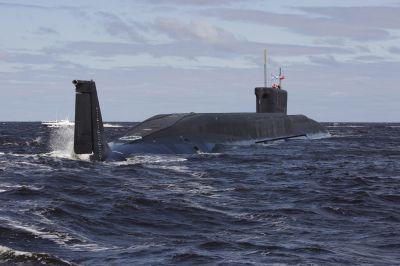
A new Russian nuclear submarine, the Yur

A new Russian nuclear submarine, the Yuri Dolgoruky, drives in the water area of the Sevmash factory in the northern city of Arkhangelsk on July 2, 2009.

Russian President Vladimir Putin watches

Russian President Vladimir Putin watches a military exercises in the Barents Sea aboard of “Pyotr Veliky” heavy nuclear missile cruiser, 17 August 2005.

MOSCOW — Russia plans to resume nuclear submarine patrols in the southern seas after a hiatus of more than 20 years following the break-up of the Soviet Union, Itar-Tass news agency reported on Saturday, in another example of efforts to revive Moscow’s military.
The plan to send Borei-class submarines, designed to carry 16 long-range nuclear missiles, to the southern hemisphere follows President Vladimir Putin’s decision in March to deploy a naval unit in the Mediterranean Sea on a permanent basis starting this year.
“The revival of nuclear submarine patrols will allow us to fulfill the tasks of strategic deterrence not only across the North Pole but also the South Pole,” state-run Itar-Tass cited an unnamed official in the military General Staff as saying.
The official said the patrols would be phased in over several years. The Yuri Dolgoruky, the first of eight Borei-class submarines that Russia hopes to launch by 2020, entered service this year.

Putin has stressed the importance of a strong and agile military since returning to the presidency last May. In 13 years in power, he has often cited external threats when talking of the need for a reliable armed forces and Russian political unity.
Fears of a nuclear confrontation between Russia and the United States has eased in recent years, and the Cold War-era foes signed a landmark treaty in 2010 setting lower limits on the size of their long-range nuclear arsenals.
But the limited numbers of warheads and delivery vehicles such as submarines that they committed to under the New START treaty are still enough to devastate the world. Putin has made clear Russia will continue to upgrade its arsenal.
Russia’s land-launched Intercontinental Ballistic Missiles (ICBMs) would fly over the northern part of the globe, as would those fired from submarines in the northern hemisphere.
Both the Borei-class submarines and the Bulava ballistic missiles they carry were designed in the 1990s, when the science and defense industries were severely underfunded.
Russia sees the Bulava as the backbone of its future nuclear deterrence, but the program has been set back by several botched launches over the past few years.

Our submarines are free to navigate international waters: China

Our submarines are free to navigate international waters: China
BEIJING: Amid the long-simmering territorial row between China and Japan, Chinese military has asserted that its submarines are free to navigate international waters.

Chinese submarines are free to navigate international waters, including the Northwest Pacific, which is also visited by other nations’ maritime forces, spokesman for China’s Ministry of National Defence, Geng Yansheng, said yesterday.

Geng also criticised the so-called “China Military Threat”, as described by some Japanese media, as an act of “intentionally creating tension with an ulterior political motive,” state-runXinhua news agency reported today.

“Such act is irresponsible and not conducive to peace and stability in the region,” he said.

Geng made the remarks in response to a question regarding some Japanese media outlets’ recent, frequent reporting on the voyages of China’s Yuan-type submarines in Japan’s contiguous zones.

Japan’s coastguard recently said that the Chinese maritime surveillance vessels were spotted inside the 12-nautical-mile zone off the Senkaku islands, which China calls the Diaoyus, in the East China Sea.

The move marked the latest in the decades long standoff between Beijing and Tokyo as they jostle over ownership of the resource-rich islands.

Last September, Japan nationalised three islands in the chain, angering China.

Source – Economic Times