Author Archives: jasonlockley

Major new submarine museum planned for River Clyde

Two Navy servicemen on a 'Stickleback' submarine in 1954. Picture: Royal Maritime Museum

Two Navy servicemen on a ‘Stickleback’ submarine in 1954. Picture: Royal Maritime Museum

A MULTI-million pound museum to create the biggest ­memorial in the world to more than 5,300 Commonwealth sailors killed in the line of duty, and honour Scotland’s role in the ­development of submarine technology, is planned for the banks of the River Clyde.


Award-winning architect ­Gareth Hoskins, who designed the £47 million National Museum of Scotland redevelopment, the Culloden Battlefield Memorial Centre and the Bridge Arts Centre, has been asked to draw up plans for the new £6m building overlooking the Firth of Clyde at Helensburgh.

Funding for the proposed Scottish Submarine Centre is being sought from a consortium of private and public bodies with organisers claiming to have secured pledges of more than £1m so far.

An application for £240,000 is due to go before the Scottish Regional Armed Forces Community Covenant Awards Board for approval later this month.

The Community Covenant grant scheme was launched by the Ministry of Defence in August last year. It offers funding of £30m over four years to UK projects which strengthen ties between serving and former military personnel with their communities.

The proposed Submarine Centre will be the only one of its kind in Scotland. Already, the Royal Navy Museum has agreed to donate an X51-class submarine as a centrepiece of the state-of-the-art digital museum to act as a memorial to submariners from around the world.

The midget submarine is a direct descendant of the X-class subs whose crews trained in the Firth of Clyde during the ­Second World War to develop the techniques needed to attack enemy shipping in the narrow fjords of Norway. The X51, improved on the wartime midget submarines, was first unveiled in 1954 on the Gareloch in the Firth of Clyde. Capable of carrying a crew of five, the miniature subs were used for a variety of roles. However, the history of submarines and the Clyde is much longer.

It is hoped the new facility will open by the end of 2016 in time for the 100th anniversary of the K13 disaster. Thirty-two people died when the steam-driven submarine failed during sea trials in the Gareloch near Helensburgh on 29 January, 1917 within sight of the location proposed for the new museum and memorial. Brian Keating, a Helensburgh-based businessman who is driving the project, said: “Helensburgh and the Clyde have been associated with the submarine service for more than 100 years. A lot of work was done here to pioneer the technology.

“The Clyde has also played a major role as a home to submarines on active duty. Many of the most famous and daring ­missions carried out during the Second World War either began here or were in some way connected with the Clyde.

“We want to create a world-class museum which celebrates the marine engineering heritage of the Clyde shipbuilders involved in the development of submarines and serves as a memorial to the brave men from all over the Commonwealth who served in the ­‘silent service’.”

Architect Hoskins, a native of Helensburgh, was recently awarded a series of top awards.

Source – Scotsman

TV review – Time Team Special: The Lost Submarine of WWI

It’s hard to look at Sir Tony Robinson without conjuring an image of perennial idiot and Blackadder whipping boy Baldrick, writes  Tim Spiers.

cunning

Sir Tony Robinson with the nuclear powered boat HMS Ambush (Blog editor takes no credit for this obvious inaccuracy!!)

His cunning plans and overwhelming stupidity earned Baldrick and Robinson cult status in the BBC sitcom and launched the actor’s career.

And rather oddly that career has taken a peculiar turn in recent years, with Robinson earning a niche for himself tucked away on Channel 4 on Sunday nights.

Time Team is, in the nicest possible sense, Geek TV, at least in its subject matter.

But as The Lost Submarine of WWI proves, that subject matter can be fascinating, educational and entertaining.

In it we see Robinson explore the story behind the very first submarines of warfare, focusing on the run-up to WWI and an arms race to build the most technologically advanced subs to try to win the war.

Submarines are compared favourably to tanks and machine guns in the way that they changed the face of warfare forever – they’re labelled as the weapon that changed the world, and with good reason.

First off Robinson travels to a secret location off the island of Skye to see firsthand the very latest in submarine technology.

Nuclear-powered sub HMS Ambush weighs 7,400 tonnes, can purify its own air and water, travel around the globe without ever popping above the surface and will never be refuelled in its 25 years of service.

It’s a far cry from the primitive early boats of the early 1900s, but comparisons between then and now are plentiful.

To prove this we’re taken back more than 100 years to discover a submarine which changed warfare forever.

And the Holland 5 was built here in Britain.

All design elements that modern designers take for granted came to life in this sub, which actually began life as an anti-British terrorist weapon.

Irish Republican John Holland designed the early Holland prototypes and was linked with what was effectively the US arm of the IRA.

The plan was to build a submarine capable of sinking a battleship, but Holland’s designs never came to fruition and his business partner came to the UK and duly licensed the Holland 5 for the Royal Navy.

The first incarnation of the series – Holland 1 – was extremely basic but by the time Holland 5 came around, complete with a periscope, a storage tank for water to help keep its balance and a new system for diving gently into the water, the British had designed a submarine fit to take on the Germans.

Perhaps surprisingly submarines were criticised by some – they were labelled as underhand and ‘un-English’, with a strong sense of questioning the morality at being so sneaky, even if it meant the enemy would be defeated.

History buffs will eat this stuff up with a spoon but there’s interest for casual observers too.

And Time Team excels in keeping it simple for the viewer, so that even the most unlikely subject matters become accessible.

As for the Holland 5, it sank in the English Channel and rapid technological advances meant that it soon became outdated and new fleets of submarines – on both sides of the war – were hastily constructed from 1914 onwards. But the groundwork had been done and the British submarines played a substantial role in winning the war, making the Holland 5 a hugely successful invention.

Or as Robinson might put it, a rather good cunning plan.

Source – Shropshire Star

‘HMS Talent’ pays another visit to Gibraltar

HMS-Talent-July-4

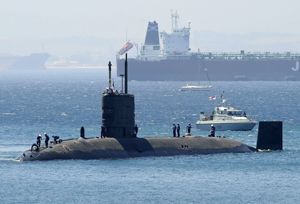
The British nuclear submarine HMS Talent is pictured above as it sailed into the bay of Gibraltar yesterday escorted by a patrol boat from the Royal Navy’s Gibraltar Squadron.

This is the submarine’s second visit to the Rock so far this year.
It called here last May, the first British submarine to stop in Gibraltar in five years.
The Trafalgar-class ‘hunter killer’ submarine arrived yesterday afternoon and it is not known how long it will stay in port.
As is routine in such cases, the Ministry of Defence disclosed no information about the submarine’s visit.
A one-line statement contained the standard line that HMS Talent was visiting Gibraltar “…as part of scheduled operational tasking.”
The visit comes against continued tension in the Bay of Gibraltar over recent incursions by Guardia Civil and Spanish navy vessels.
HMS Talent is described by the Royal navy as a technically advanced, nuclear powered ‘hunter-killer’ submarine, the penultimate in a series of seven Trafalgar Class submarines.
Launched by Princess Anne in Barrow in Furness in 1988, the submarine has conducted operations all around the world.
The principal role of the ‘hunter-killer’ is to attack ships and other submarines.
In this capacity, vessels of this type could support and protect a convoy or taskforce.
HMS Talent can also be used in a surveillance role as it is fitted with cameras and thermal imaging periscopes.
HMS Talent is also fitted with Tomahawk Land Attack Missiles, which gives it a land attack role.

Source – Gibraltar Chronicle

Canada – New $531-million submarine contract protects 200 jobs at Esquimalt

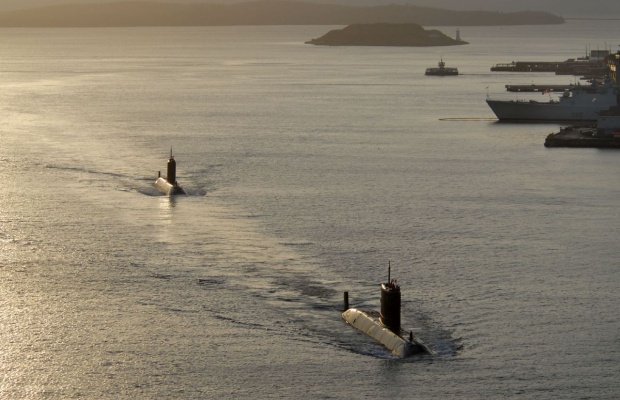
A rare site of two Canadian subs sailing together into homeport for the Christmas holidays. Seen leading the pack is the HMCS Cornerbrook with the HMCS Windsor following. The HMCS Cornerbrook and the HMCS Windsor arrived in the early dawn coming along side in Halifax today in Nova Scotia on the 21st of December 2006

Canada

The Harper government is set to announce a five-year, $531-million contract  extension to repair and upgrade Canada’s fleet of four diesel-electric  submarines

OTTAWA — B.C.’s shipbuilding and repair industry will get a shot of good news  Thursday when the Harper government announces a five-year, $531-million contract  extension to repair and upgrade Canada’s fleet of four diesel-electric  submarines, The Vancouver Sun has learned.

The contract, following a similar agreement struck in 2008, will protect  roughly 200 jobs at the department of national defence’s Fleet Maintenance  Facility in Esquimalt, according to a federal official.

Another 200 jobs will be protected at locations elsewhere in Canada, he  said.

“This significant federal investment will support more than 400 high-quality  jobs, improve the long-term sustainability of B.C.’s shipbuilding industry and  provide the best tools for Canada’s sailors,” he said in a prepared  statement.

The contract was won in a competitive bid by Babcock Canada Inc., a  subsidiary of the British multinational firm Babcock International Group  PLC.

Babcock International won the original contract in 2008 after it teamed up  with Weir Canada Inc. of Mississauga, Ont., to create a consortium called the  Canadian Submarine Management Group.

However, Babcock announced in 2011 that CSMG would be renamed Babcock Canada  Inc. after Weir’s share of the joint venture was transferred to Babcock.

The original contract award caused a political flap because Babcock beat out  Irving Shipbuilding, which wanted to keep the repair work in Halifax.

One of the critics was Green party leader Elizabeth May, who at the time was  planning her run against Defence Minister Peter MacKay in his Nova Scotia  riding.

May, who accused the government of an “anti-Atlantic bias,” is now the MP for  the Vancouver Island riding of Saanich-Gulf Islands.

The original five-year contract in 2008 was worth $370 million over five  years, but if CSMG met performance targets the contract was to be extended over  15 years, for a total value of up to $1.5 billion.

Thursday’s announcement gives a clear indication that Babcock has met those  targets.

The fleet of four Victoria-class diesel-electric submarines has had a rocky  history after the Liberal government made what appeared to be the  bargain-basement purchase of the mothballed subs from the Royal Navy for $750  million in 1998.

It took far longer and was costlier than expected to make the vessels  seaworthy, and in 2004 the HMCS suffered a fire that left one officer dead. In  2011, HMCS Corner Brook ran aground near Vancouver Island during manoeuvres.

There are now two subs, HMCS Victoria and HMCS Windsor, that are fully  operational.

HMCS Chicoutimi is currently being serviced at Esquimalt but is expected to  be ready for sea trials later this year.

The HMCS Corner Brook is also in Esquimalt for both repairs and a refit.

The fleet is “at the highest state of readiness that they’ve ever been,” the  source said.

Source – The Vancouver Sun

UK – AMS wins submarine equipment contract

UK – Stokesley-based firm Analox Military Systems has won a valuable contract to supply submarine equipment to the Norwegian Navy

Analox Military System is to supply the Norwegian Navy with submarine equipment


A manufacturing specialist has won a six-figure contract to supply the Norwegian Navy with submarine equipment.

Analox Military Systems (AMS), which specialises in the design and manufacture of gas analysis equipment, has signed the contract with Norwegian Defense Logistics Organisation (NDLO) to supply the Norwegian Navy with two carbon monoxide monitoring systems for six ULA-class submarines.

Established more than 30 years ago, the Stokesley-based firm already exports to navies around the world including the USA, Brazil, Holland, Australia and Sweden.

It will undertake the development, manufacture, installation and commissioning of the new system, with the first due to be delivered in February.

Analox Ltd divided its operation into two divisions in 2011, launching Analox Military Systems Ltd to help it continue the business growth.

AMS, which also won Exporter of the Year Award at the North East Business Awards 2006, delivers services and products for military customers around the world. It is currently working with Hakon Rygh, its Norwegian distributor, on the installation and commissioning phase.

Vicky Brown, sales and marketing director at AMS, said: “We’re very proud to be supplying the Norwegian Navy with gas analysis equipment.

“Historically, carbon monoxide monitoring has been problematic for submarines owing to the presence of hydrogen.

“AMS’s new system uses an accurate infra-red technique and as a result, is not sensitive to hydrogen, giving the submariners confidence in the accuracy of the monitoring.”

Commander Baard Gjerstad, project manager submarine projects for NDLO, added: “We needed equipment which would not be affected if hydrogen was present, and Analox Military Systems is able to deliver systems which meet this specific need. We are looking forward to working with AMS on this contract.”

The submarine has people living and working within a confined space. It is therefore essential the atmosphere is carefully managed at all times to limit exposure of the crew to potentially harmful substances.

The new CO monitoring system, which is designed specifically for submarines, will be officially launched at DSEi, a major defence and security exhibition in London, from September 10 to 13.

Brown added: “ We are expanding our team and boosting our engineering capability. This contract win, and the growth of our team, is testament to the commitment and hard work of everyone at AMS.”

This contract win, and the growth of our team, is testament to commitment and hard work

Source –  The Journal

Trident: Lib Dems consider end to continuous at-sea nuclear deterrent

Trident nuclear submarine

The future of Britain’s Trident nuclear programme has split the coalition

The Liberal Democrats are considering calling for Britain to give up its permanent at-sea nuclear deterrent within the next few years.

They are expected to use a review of Trident to say some of the UK’s four nuclear submarines should not be replaced after they are decommissioned.

But senior figures are now pushing to end Britain’s continuous at-sea deterrent even earlier, from 2016.

A decision about the future of Trident has to be made by that point.

This would mean that some of the existing Vanguard submarines would be confined to port with skeleton crews and used for spare parts to keep the remaining boats operational.

The hope among Lib Dems is that this would not just save billions of pounds but would also send a signal that it is possible for a nuclear state to reduce its arsenal while keeping some kind of a deterrent.

‘Kept in port’

This was hinted at last week when Lib Dem Treasury chief secretary Danny Alexander said it was time “to move on from the Cold War postures of the past” with a credible deterrent that “can play a role in supporting disarmament in future”.

One senior Lib Dem MP said: “We are looking at ending continuous at-sea deterrent even earlier. We don’t have to wait until the subs need replacing. We could just keep them in port now.”

Another Lib Dem MP said: “If you thought that you could sustain a meaningful deterrent with two boats, then nothing would prevent you using the existing boats on the same principle.

“It would be reckless to scrap them but you could cannibalise them for parts.

The proposal is contained in an internal party policy paper on defence which is said to be at a “pretty late stage of development” and will be put to the Lib Dem conference in September.

Mr Alexander has chaired the government’s review of Trident which is sitting on David Cameron’s and Nick Clegg’s desks and will be published shortly.

It is expected to say that some of the potential alternative ways of delivering nuclear weapons – from land or from air – are either too expensive or too impractical. But the review is expected to consider the option of scaling back the current submarine-launched system.

Most military experts agree that it would be impossible to provide a continuous, around-the-clock nuclear deterrent with less than four Vanguard submarines. With training and repairs, there is frequently only one submarine on duty at sea.

‘Credible’

The Conservatives are committed to a like-for-like replacement of Trident which is estimated to cost as much as £20bn. But many Lib Dems believe that Trident is too expensive and distorts the defence budget.

They hope to argue that it would be better to spend the money on troops and kit.

Last week Mr Alexander told the BBC’s Andrew Marr programme that the review was seeking to answer whether like-for-like replacement was “the only way to protect our country in future”.

“And while the review doesn’t come to any conclusions, I think when we publish the results in a few weeks time people will see that there are choices available to this country, there are alternatives where we can move on from the Cold War postures of the past and try and set out a new future for this country with a deterrent that is credible but where this country can play a role in supporting disarmament in future.”

A Lib Dem spokesman said: “The Cabinet Office-led review into alternatives to Trident has now been submitted to the prime minister and deputy prime minister.

“The review’s findings will now be considered and an unclassified version will be published in due course.”

A senior Conservative source said: “Abandoning our continuous at sea deterrence, which has been the ultimate safeguard of our national security for more than 45 years, would be a reckless gamble.

“And leaving our nuclear-armed submarines rusting in port, and then seeking to deploy them at a time of crisis would not only put Britain’s security at risk, but would also risk escalating global tensions.

“Conservative policy is clear: we will safeguard Britain’s national security and maintain our continuous at sea deterrent.”

John Woodcock, Labour MP for Barrow and Furness, said: “Unilaterally ending the commitment to keeping at least one nuclear submarine operational at all times will make no meaningful contribution to global non-proliferation, in fact it could have the opposite result by unsettling other countries who are currently under NATO’s umbrella of protection.

“The Liberal Democrats are finally admitting there is no alternative mini-deterrent that could save billions, but few will be taken in by their latest fallacy that a part-time deterrent could save lots of money and protect Britain adequately in the event of a threat in future decades.”

Source – BBC News

UK – MPs back submarine building in Barrow

Workers at Barrow’s BAE Systems plant in front of an Astute class submarine

MPs and members of the House of Lords met to show their support for the UK’s submarine building industry, a key employer in the North West.

Politicians met with key figures in the industry and representatives of the supply chain and trade unions, who wanted to illustrate the chain of jobs that sten form submarine construction in areas like Barrow.

The event was supported by BAE Systems and the Keep Our Future Afloat Campaign, a trade union organisation which campaigns to keep high-tech jobs in the North West and across the UK.

Philip Dunne MP, minister for defence equipment, and Rt Hon Jim Murphy MP, Labour’s shadow secretary of state, were among those who spoke at the event to show their strong support for Britain’s submarine-based nuclear deterrent.

All the speakers paid tribute to the cutting edge work of the firms forming the supply chain for the Astute-class submarines, currently under construction in Barrow, and stressed the importance for these firms of the Vanguard replacement programme.

John Woodcock, MP for Barrow and Furness, who hosted the event said:

“It was fantastic to see so many MPs and peers from every corner of the country and all political parties coming to meet representatives of the firms and workers who form the supply chain for Britain’s cutting edge submarines. They will have been left in no doubt of the importance of the submarine programme to supporting British manufacturing and rebalancing the economy, as well as to securing Britain’s security – I hope they will bear this in mind when the time comes in 2016 to make a decision on renewing our at-sea nuclear deterrent.

“I am particularly grateful for the strong political support given to the submarine programme by government and opposition frontbenchers, Philip Dunne and Jim Murphy, in their speeches – the 1,200 firms in the supply chain will have taken heart from what they both said.”

Source – ITV News

US – Former Navy leader Adm. Frank Kelso dies in Norfolk

Adm. Frank Kelso, who died Sunday, was chief of naval operations from 1990 to 1994.

Adm. Frank Kelso, who died Sunday, was chief of naval operations from 1990 to 1994.

In the place where he was born and where he retired, he was known as a hometown hero who made it all the way to chief of naval operations, influenced men of power and maintained the humility of an ordinary guy next door.

In Norfolk, where he served pivotal years in his 38-year career, Adm. Frank Kelso was a senior regional commander who helped run operations at the end of the Cold War and during heated years in the Middle East before being tapped to run the entire Navy.

Kelso, 79, died Sunday after suffering a fall, according to Navy officials. He was in Hampton Roads visiting his son Robert, a Navy captain who was chief of staff of Navy Cyber Forces until this year. Kelso attended the high school graduation of his grandson, Robbie Kelso, who, following in his grandfather’s footsteps, will go to the Naval Academy in the fall.

“As CNO, he led our Navy through the Gulf War and the uncharted early days of the post-Cold War era with skills and dedication,” Navy Secretary Ray Mabus said in a statement. “Adm. Kelso was a submariner, an accomplished commander and an unmatched leader known for his intelligence and integrity.”

Kelso spent nearly four decades building a career from his days as a submariner to his place at the Navy’s helm. He led forces in strikes against Libya, helped rescue hostages of Palestinian hijackers, and oversaw a difficult drawdown of the Navy at the end of the Cold War. During that period, he realigned the Navy to work more closely with the other services.

But he told a historian that despite his career of nearly four decades, he feared his name would always be tied to the 1991 Tailhook scandal, in which dozens of women were sexually assaulted during a convention of Navy and Marine Corps aviation officers in Las Vegas.

“He lamented… that for many people, that may be the only thing people will remember about him – and he did so much,” said Paul Stillwell, who conducted 37 hours of oral interviews with Kelso as the director of the U.S. Naval Institute’s history division.

The scandal marked the end of numerous officer careers and ultimately led Kelso to retire early. He said he had become “a lightning rod” and hoped his stepping down would shift the focus forward.

Kelso was accused of witnessing abusive acts and turning a blind eye, something he vehemently denied, Stillwell said.

“My assessment was that was not something he would stand for, nor would he lie about it,” Stillwell said. “He was just an individual for whom I had great admiration. He was unpretentious, down to earth, and for someone who accomplished as much as he did, that was very refreshing.”

Kelso’s two sons both served in the Navy, and two weeks ago he attended the graduation of a grandson who is headed into the Navy.

Kelso led the Navy’s 6th Fleet in the Mediterranean Sea during the 1980s, leading the operation to capture hijackers of the Achille Lauro cruise ship and the subsequent air strikes on Libya in response to state-sponsored terrorism.

He served in Norfolk from 1986 until 1990, first as commander in chief of the Atlantic Fleet and then as NATO’s supreme allied commander, Atlantic and as commander in chief of U.S. Atlantic Command.

Retired Vice Adm. Robert Dunn, who commanded Naval Air Force Atlantic in those years, said he never saw Kelso fall short of his duties as a leader.

“He always had a kind word for everyone,” Dunn said. “Good people just naturally flocked to him.”

Kelso became chief of naval operations in 1990 and served until his retirement in 1994. He oversaw the Navy in the Gulf War even as he managed severe budget cuts. Kelso realigned the Navy to meet new, tighter demands. He also supported the integration of women into more wide-ranging roles and command, particularly in the wake of Tailhook.

In Fayetteville, Tenn., where Kelso is to be buried Saturday, businesses lowered flags to half-staff for a man described as a lifelong friend and active community leader, said Ann Hatcher, associate pastor at the First United Methodist Church.

“He was a remarkable man and what has always impressed me so much about him was his humility,” said Hatcher, who knew Kelso from the time she was a young girl.

“He was probably the most important person I would ever meet in my lifetime, but it was never about him. It was always about someone else.”

Source – PilotOnline.com

Russian submarines heading to NZ waters

The Russians are coming, again, in submarines to waters near New Zealand.

The state-run Itar-Tass agency says Russia will send submarines armed with nuclear ballistic missiles to the South Pacific and the Southern Ocean.

“The revival of nuclear-submarine patrols will allow us to fulfil the tasks of strategic deterrence not only across the North Pole but also the South Pole,” an unnamed official in the military General Staff was quoted as saying.

Given that the South Pole is 1500 kilometres from the sea, it suggests the new Borei-class submarines, with 16 long-range nuclear missiles, might end up in the Ross Sea.

“As the Russian Navy receive the Borei-class missile submarines, they will not only continue to patrol the Arctic, Atlantic and Pacific Oceans, but will resume execution of combat missions in those regions of the world’s ocean, where in the late 90s of the last century used to be the Soviet Navy, and where they have ceased to appear following the collapse of the Soviet Union,” the report said.

It echoes the Soviet days and in 1982, when a Russian submarine was photographed by the Royal New Zealand Air Force east of New Zealand.

The air force still has submarine-hunting capacity in the form of its six P3 Orions, but it seldom practises finding them now.

In 1972, the navy was ordered to sea as intelligence suggested a Soviet submarine was near New Zealand.

Several ships and the air force were well out to sea when they heard, on what was then the NZBC, that a Soviet hydrographic submarine had docked in Suva that morning.

Just before Christmas in 1982, the diesel-powered Soviet Foxtrot submarine Regul was spotted on the surface near Tahiti sailing with a research vessel.

It continued towards the South Island and was last seen near the Chatham Islands. The Soviets said they were doing oceanographic work.

Three years later, there were headlines and claims that the French submarine Rubis was in the Waitemata Harbour, supporting the agents bombing the Rainbow Warrior. It was never proved.

German and Japanese submarines operated near New Zealand during World War II.

U862 captain Heinrich Timm claimed later that while they were off Hawke’s Bay, crew landed to get fresh milk from the dairy herd they saw.

In the 1870s, New Zealand built 17 harbour forts around the country, fearing that Tsarist Russia, in the wake of the Crimean War, might invade. It was never clear why it wanted Auckland.

Source – Stuff.co.nz

Plymouth Submariner surfaces to collect MBE

A MARINE Engineering Officer who had the “relentless” task of keeping a nuclear submarine at sea for 11 months has been awarded an MBE.

Lieutenant Commander Andy Sharp was deployed aboard HMS Triumph in 2011 and 2012 when the boat was sent to the Gulf and Libya.

Lieutenant Commander Andy Sharp was deployed aboard HMS Triumph in 2011 and 2012 when the boat was sent to the Gulf and Libya.


Servicemean Andy Sharp receives his MBE, accompanied by his fiancee Kay Talbot

The 45-year-old regularly faced repairing the ageing Trafalgar-Class boat but each and every time ensured HMS Triumph and her crew remained tightly on schedule.

The citation explained how the boat remained on station for Operations Ellamy and Unified Protector for more than 100 days providing vital intelligence to NATO and as the UK’s strategic strike capability.​

mbe

It continued: “Throughout that time Andy led his department with selfless dedication, tenacity and resourcefulness as they kept the submarine in a first class state of repair through what was, at the time, the longest ever operational SSN deployment.

“By the time she returned to the UK, HMS Triumph had spent over 14 of the previous months away from home and that achievement was due in no small part to Andy.”

Commander Rob Dunn, the Commanding Officer of HMS Triumph at the time, said: “Too often in the past what submariners have done has been out of sight and therefore out of mind. But the challenges faced by my engineers in keeping Triumph ready for operations was immense and I was delighted to see Andy, along with several other members of my crew, recognised in the Operational Awards.”

Also to be recognised in the Operational Honours with a Queen’s Commendation for Valuable Service was Warrant Officer 2 Alasdair McCall who supported Andy throughout the deployment.

Andy said: “It was a brilliant day, it was presented by the Queen. She said congratulations and asked me if I was busy last year because of the award.”

He said the MBE represented the hard work of an “excellent team”.

The Lt Cdr was presented his MBE by the Queen at Buckingham Palace with his fiancee Kay Talbot and children Danny and Kirsty.

His son Danny, a Royal Navy Air Engineering Technician, was flown off HMS Illustrious especially for the occasion.

Source – ThisisPlymouth