Category Archives: The world’s submarines

News, views and stories about the rest of the world’s submarines

Soviet submarine wreck found off Sweden – Video clip

 Sub reck
Video clip can be viewed by clicking the picture “or” the source link at the bottom…..
 

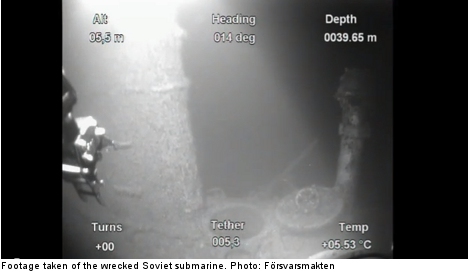
The wreck was discovered earlier this autumn following reports in the Russian media that Swedish civilian divers had found a submarine wreck southeast of Öland, the Swedish Armed Forces (Försvarsmakten) said in a statement.
The wreck was localized by the submarine rescue ship HMS Belos, which also managed to take pictures of the sunken Soviet sub.

According to the Swedish military, the wreck is likely that of S6, a Soviet submarine that went missing in September 1941.
The wreck was found near the Wartburg mine barrier in international waters, but within Sweden’s economic zone.
While it remains unclear exactly what may have caused S6 to go down, an open hatch provides some clues as to what may have happened.
“Boats at the time often sailed on the surface in order to quickly flee and/or to recharge their batteries,” Commander Christian Allerman of the Swedish Navy said in a statement.
The Swedish military theorized that the submarine simply sailed right into the mine barrier and was blown up by a mine.
The wreck consists of two main pieces, with the bow section coming to rest about 20 metres north of the stern section, which was found next to a torpedo-like object.
The images captured by the HMS Belos also show Russian text on the wreck, as well as the Soviet hammer and sickle.

Source – The Local

Russia sees opportunities in India’s new submarine deal

Russia sees opportunities in India’s new submarine deal
Russia sees opportunities in India’s new submarine deal. Source: Press Photo

India is set to loosen its purse strings for some big ticket arms acquisitions in the coming months. The latest order about to come out from the Indian repertoire is for submarines, which is going to be worth a whopping ten billion US dollars. The Russians will be close competitors for this deal and Rosoboronexport of Russia would be high up among the competing companies. Other serious contenders would be HDW of Germany and Navantia of Spain.

Earlier this year, India had released a 15 billion dollar defence deal which went to the French, much to the chagrin of the Russians and other players in the international arms market. In February 2012, India had awarded the highly lucrative deal worth $15 billion to the French company Dassault Aviation for 126 fighter aircraft for the Indian Air Force.  The talks with Dassault on fastening the nuts and bolts of the deal are presently going on.

The upcoming defence deal is for the Indian Navy. It is aimed at buying six state-of-the-art submarines, mainly with an eye on China. The deal with Dassault for 126 fighter aircraft too was aimed at developing Indian defence capabilities vis-a-vis China.

Project 75I

 The Indian government is soon going to come up with a Request for Proposal (RFP) for six next generation submarines. Indian Navy Chief Admiral DK Joshi has gone on record as saying that the Defence Acquisition Council a high-powered body of the defence ministry, has already given the green signal for buying six submarines under a project codenamed P-75I and a global tender would be floated “very soon”.

This will be a huge opportunity and a challenge for the Russians to bag the deal because the RFP would be a global competitive bid process in which the winner takes all. The Russians and the French are expected to be among the top contenders. Both would have plus and minus points for getting the deal, and needless to say, no country would like to miss the bus.

Russia to Face Stiff Competition from France

 Russia will inevitably face a stiff competition from the French for the new submarines deal. The French have an edge because they are already building six Scorpene submarines for India. The argument for them is that since they are already working on a submarine project with India it would be logical to have continuity as the French already have an elaborate infrastructure in place. But the flip side is that the upcoming $10 billion submarine deal would be a global competitive bid. It is like playing an entirely new match on a new turf where it would depend on which players emerge as performers of the day.

The Russian USP would be that India is already operating over a dozen Russian-made submarines and Russia is a tried, tested and trusted arms supplier for India. The latest order, as an when it materialises, is aimed at significantly beefing up the muscle of the Indian Navy whose existing humble submarine fleet comprises of just 10 Russian Kilo-class, four German HDWs and an Akula-2 nuclear-powered attack submarine leased from Russia at $1 billion. This will be in addition to the six Scorpene submarines which are being built in India with technology from Dassault under a project codenamed P-75.

A USP of the new to-be-ordered submarines, according to Admiral Joshi, would be that these would be bigger than the Scorpene  and would be equipped with air-independent propulsion (AIP) systems to recharge their batteries without having to surface for more than three weeks. Besides, the new boats would also have land attack missile capability.

INS Chakra’s Delimitations

 The Indian submarine fleet got a valuable addition when INS Chakra, the nuclear submarine from Russia was finally inducted in April 2012, thus once again heralding the Indian Navy into the nuclear age after an interregnum of two decades. However there is a flip side to INS Chakra, the Akula-2 class submarine given by Russia to India on a lease for ten years. INS Chakra cannot be armed with strategic weapons or nuclear tipped ballistic missiles. Its symbolic importance is that it will certainly help India keep a watchful eye on the vast expanse of Indian Ocean which of late has emerged as the epicentre of global naval activities.

India, a principal littoral state with fourth largest naval fleet in the world, needs to have a robust navy in Indian Ocean and beyond considering the rapid advancements of the Chinese Navy. China is stepping up its naval presence in the Indian Ocean though it is not an Indian Ocean power. China has almost five dozen submarines, including a dozen nuclear submarines, which give them a head start over India in naval terms.

The Russian Edge


The upcoming RFP for the six submarines is aimed at correcting this anomaly.  India, which at one point of time had 18 submarines, is now down to just 14 submarines, including ten Sindhughosh class Russian Kilo submarines and four Shishumar class German HDW diesel submarines. For 17 years India did not construct indigenous submarines. Further bad news from the Indian perspective is that its submarine fleet is expected to go down to half as the Kilo class submarines acquired in late eighties are facing retirement after two and half  decades  of service.

Under the six-submarine Scorpene deal, India is expecting to get the first two submarines in 2014 and 2015. The delivery schedule for all the six boats is likely to be completed by 2019. But the flip side is that the first two out of six would be simple diesel submarines and the next four would be equipped with Air Independent Propulsion (AIP) technology called MESMA in French parlance.

This is where the Russians can smell the kill for the new $10 billion submarine deal. While the Scorpene deal with the French did not focus on the AIP technology, the proposed deal would have all six submarines equipped with AIP technology.  The Russian engineers have already mastered the AIP technology, in vogue for the past one decade. India has retained Russian engineers since 2011 in Vishakhapatnam to understand complex operational aspects of a nuclear powered submarine.

Source – Indrus

Top-secret submarine may settle Russia’s claim in the Arctic

A unique Arctic expedition has brought a top-secret Russian submarine into the limelight. The AS-12 bathyscaphe Losharik has now been enlisted to help Russia gain evidence of its right to territorial waters in the Arctic.

Top-secret submarine may settle Russia’s claim in the Arctic
The Arctic region is expected to be the disputed territory between the world’s powers. Source: Alamy / Legion Media

Moscow is prepared to present evidence to the U.N. Convention on the Law of the Sea that would expand Russia’s territorial waters in the Arctic, thus asserting its right to the bed of the Arctic that is extremely rich in hydrocarbons. Russia filed a similar application once before, but the bid was turned down due to a lack of geological samples. The new evidence has been obtained by AS-12 Losharik – Russia’s top-secret deep-sea nuclear-powered bathyscaphe.

The North Pole expedition was undertaken in late September as part of the Arctic 2012 research project. The mission required working at a depth of 1.5-1.8 miles for 20 days. The deep-sea station collected earth samples using robotic arms, a dredging device (a rock filtration system), a clamp bucket (a scoop with a video camera) and a hydrostatic sampler. The results of the sample tests will be released in early 2013, when they are also expected to be handed over to the United Nations.

Losharik will very soon be getting a younger “sister.” According to Izvestia, Russia has resumed the construction of another top secret deep-sea nuclear-powered station. A source in the defense industry has told Izvestia that the vessel will actually be a smaller version of Losharik that is intended, just like her older brother, to conduct special operations on the ocean bed, including in the Arctic.

Until recently, the competing territorial claims to the Arctic made by Russia, Norway, Canada, the U.S. and Denmark have been ineffectual, since, apart from political statements, none of the countries has been able to provide any factual evidence to justify their claims. If Losharik’s recent operation does not close the matter for good, then it at least puts Russia ahead of the game. Before Losharik, no one had been able to bring up any actual samples from the seabed that could formally prove Russia right.

Meanwhile, little is actually known about the main character in the story – the nuclear-powered deep-sea bathyscaphe AS-12, nicknamed Losharik (NATO reporting name NORSUB-5).

One of the reasons behind the scarce public knowledge is the fact that the submarine was created for the Main Intelligence Directorate of the Defense Ministry and, given the specific nature of the ministry’s mission, was never intended to be declassified – just like an undercover spy. However, Moscow eventually decided to go all in and play for the sake of winning the territorial dispute.

The submarine was dubbed Losharik for its extraordinary shape: Its hull consists of spherical titanium modules. The nickname comes from the name of a Soviet cartoon character – a funny little horse with a body made up of small spheres.

Russia sees opportunities in India’s new submarine deal

losharik

Russian submarine passes Arctic trials

According to its engineers, the unusual hull construction permits the 196-foot-long bathyscaphe to withstand the enormous pressure of ocean depths of up to 3.7 miles. Losharik is powered by a small nuclear reactor with a fundamentally new model of nuclear steam generating plant: the KTP-7I Fenix. The reactor enables the bathyscaphe to travel at a speed of up to 30 knots (37 miles) per hour and does not limit the time it can stay submerged in virtually any way. The crew consists of 25 officers.

The bathyscaphe is carried by the K-129 Orenburg submarine, which is a Project 667BDR Kalmar strategic nuclear submarine redesigned specifically for the purpose.

While assigned to Russia’s Northern Fleet, the submarine is not actually part of it, as it remains an asset of the Main Intelligence Directorate. It is stationed at Olenya Bay, where Russia’s naval spies are based.

While the AS-12 does not carry any weapons, it still poses a serious threat to the national security of many countries, since it is equipped to perform intelligence and diversion operations at depths out of reach of any other vessel in the world.

The kind of operations that the vessel could perform include using its mechanical arms not only to collect seabed samples, but also to disrupt telecommunications between continents or, conversely, plant wiretaps, which, even if detected, would be impossible to remove because of the depths.

There is also an apocalyptic theory that the work of designing the bathyscaphe was launched back when a nuclear conflict between Moscow and Washington was still on the table. The bathyscaphe is believed to have been intended to become an invincible carrier of a gigantic T-15 thermonuclear torpedo (5 feet in diameter) developed by Nobel Prize-winning physicist Andrei Sakharov.

The Soviets believed that, if detonated at a depth of 3.7 miles, the torpedo could generate an unprecedented and deadly tsunami that would wash away an entire coast of the United States, West or East.

Whatever their past plans, Moscow and Washington are now partners intent on resolving their disagreements at the negotiating table. This was the main reason why, in the mid-1990s, Russia almost stopped financing the Losharik project. The country even invited the United States to be a co-investor, suggesting that the deep-sea bathyscaphe could be involved in rescue operations.

While Losharik failed to become a rescue vessel, it has nevertheless proved a very valuable national security asset.

Source – Indrus
Canadian Submarine arrives at military museum

HMCS Ojibwa is nearly home.

McKeilSub-322 crop//


Home, for the last of Canada’s Oberon class submarines, is the Elgin Military Museum in Port Burwell, Ontario on the north shore of Lake Erie.

When it was decommissioned from the Royal Canadian Navy in 1998, the vessel was destined to be scrapped, but a movement to save the ship resulted in it becoming the property of the museum. The plan is for the museum to turn the HMCS Ojibwa into a land-based historical artifact located next to the Elgin Military Museum of Naval History—a submarine interpretation centre—and now that plan is entering its final stage.

The sub arrived at the port November 27th. It was originally scheduled to have arrived the week before, but ongoing dredging work at the port proved insufficient to provide clearance for the sub and the barge that carried it from Hamilton, Ontario. With the work complete, and an obstruction (believed to be an old seawall) cleared, the barge and sub were free to dock.

On November 28th, 2012 the sub is to be lifted off the barge and placed into the concrete cradles that will be its permanent home.

Heavy lift and transport company Mammoet Canada Eastern Ltd and Heddle Marine will work together to carefully shift the weight of the submarine from the barge using 48 axle-lines of self-propelled modular transporters (SPMTs).

The SPMT trailers will be assembled and rolled onto the barge using ramps, which will provide the transition between the barge and the shore.

On the barge, the SPMTs are positioned under the transportation stands and the submarine is then hydraulically elevated. When the submarine is secure, the roll-off procedure will use a ballast plan that consists of filling the barge compartments with water as needed to maintain a level position and avoid undue stress on the barge and submarine.

Once it has been successfully rolled off the barge, HMCS Ojibwa will be transported to its final resting place and positioned onto its permanent mount at the museum.

The submarine has spent the past few months making its last voyage from Halifax, Nova Scotia to Port Burwell, with a stop in Hamilton where it underwent some refurbishing.

“Ojibwa presented a unique opportunity to bring the story of Canada’s role in the cold war and our entire rich naval history to central Canada. She began her service in the height of the Cold War earning herself a proud place in Canadian history,” says Ian Raven, executive director of the Elgin Military Museum.

“Many people will be surprised to learn what a key role Canadian O-boats played in the Cold War undertaking dangerous covert missions and shadowing Soviet nuclear submarines.”

The Ojibwa is the second Canadian submarine to be turned into a museum exhibit. The HMCS Onondaga is an Oberon-class (as is the Ojibway) sub that now resides at the Site historique maritime de la Pointe-au-Père in Rimouski, Quebec, and is open to the public.

 Source – Canadian Manufacturing


Collins Class submarines set for a longer life


Stephen Smith

Defence Minister Stephen Smith, visiting a shipbuilding yard in Adelaide, says the Collins Class submarines could keep operating until 2038.

THE life of the navy’s Collins Class submarines may be extended to 2038, with the federal government claiming the boats’ performance can be significantly improved within three years to meet new performance targets.

Defence Minister Stephen Smith released the second part of the Coles report in Adelaide today, which concludes that achieving “acceptable availability and reliability” of the Collins fleet can be achieved by 2016.

Mr Smith said that extending the life of the notoriously problematic boats would not delay the building of the navy’s new submarine fleet, which is slated to begin service in 2036.

“There is nothing in the reports today which would cause us to put off the build of the future submarine program,” Mr Smith said at the ASC shipbuilding yard in Port Adelaide.

“On the contrary, there is a lot of information in the Coles review which will be of assistance to our decisions on the future submarine program.”

Mr Smith said a final decision on which submarine option Defence would choose for the new fleet would be made by 2017, but dismissed criticism of a potential $36 billion cost for an Australian built and designed fleet.

“We continue to exhaustively assess all of the options – all of the options are an off-the-shelf submarine, an off-the-shelf submarine modified, a derivative of the Collinsor a brand new design,” he said.

“The only option we have ruled out is a nuclear-powered option.”

The potential to extend the life of the Collins Class boats for an additional seven-year operating cycle would mean that the ageing vessels would be available to the navy through from 2031 until 2038.

However Mr Smith cautioned that the potential extended lifespan was a finding “on paper”.

“I say on paper because by that time we will be dealing with an ageing platform or an ageing submarine.”

“(But) it gives us confidence that we can do the work on the future submarine program and not have a gap in capability,” he said.

The second part of the Coles Review, which was received by the government in June, recommends new availability targets for the six-boat fleet, which would ensure two submarines are available 100 per cent of the time, three submarines available 90 per cent of the time, and four submarines available 50 per cent of the time.

The review includes 25 recommendations for meeting the new availability targets and says that previous expectations for availability had been overly optimistic.

“The performance of Collins Class submarines can be substantially improved,” Mr Smith said.

“Once the Collins is in the water, it is a very good and effective submarine, what we need to do is get it in the water on a more regular basis.”

Mr Smith said Adelaide-based ASC, which was allocated an additional $700 million in May this year to sustain the Collins Class submarines, would be able to meet the new availability targets with its current resources.

The government also announced today that a future submarine land-based test site would be built in Adelaide at an approximate cost of $100 million to test systems for the future submarines.

However, Mr Smith said the government was still working through the details for the project’s funding, which would be found within the existing Defence budget.

Source – The Australian

Stephen Smith to rule on submarine building – Australia

DEFENCE Minister Stephen Smith will make a significant announcement today about Australia’s naval capability.

The minister will release the long-awaited second volume of the Coles report on the sustainment of the Collins-class submarines, which is believed to be highly critical of past measures to keep the boats operational.

Mr Smith will say the issues the report raises have largely been fixed over the eight months he has had the report.

It is considered likely he will confirm that the navy’s promised 12 new Future Submarines will be built in Adelaide, at or near the Australian Submarine Corporation facilities.

A giant testing unit will enable close examination of the entire propulsion system for the new submarines before the systems are built into the Future Submarines. It is hoped this will ensure there is no repeat of the problems that emerged as the Collins submarines were developed.

Source – The Australian

Submarine propulsion test site augurs well for Adelaide


Hillary Clinton's visit to Adelaide

Hillary Clinton, Jay Weatherill and Air Warfare Destroyer Alliance CEO Rod Equid tour the Techport Australia shipbuilding facility in Adelaide last month. Source: adelaidenow

A HI-TECH propulsion testing site will be built in Adelaide, making it an “irresistible” case for the future submarines to be built in South Australia.

Federal Defence Minister Stephen Smith will today visit Outer Harbor’s Techport facility to announce the Land Based Test Site, which industry sources say will cost about $30 million to build, will be based in SA.

The testing facility allows the submarine propulsion systems to be tested and proved before installation, a capability aimed at overcoming criticism levelled at the ageing Collins Class fleet.

Today’s announcement comes as the Federal Government weighs up options for the future sub program, ranging from a complete Australian design and build to an off-the-shelf foreign option.

South Australia is angling for as much local design and build input as possible to get more jobs and investment and Mr Weatherill says that the state is now positioned for “immense” investment.

The ageing Collins Class submarines have been beset by criticism that their propulsion systems are too loud and prone to breakdown. One expert has likened it to an “underwater rock concert”.

Mr Smith said the future sub project, which would create thousands of jobs in SA, was to be the “largest and most complex Defence project ever undertaken by Australia” but came with significant risks.

The new Outer Harbor testing site would help reduce these risks.

“Regardless of the submarine design option that is ultimately chosen, the establishment of the Land Based Test Site will significantly reduce the risk of delay and cost blow-outs,” Mr Smith said.

“This facility will address some of the potential risk areas for the future submarine. (It) will also help ensure that challenges encountered from the maintenance of the Collins Class fleet are addressed.”

Independent reports estimate the cost of the 12 future subs at $36 billion. Further work is to be done on the “form and function” of the program, which will also include investment in research and development with further details to be revealed next year.

WA and Victoria are also to take part in the program, but the main testing site will be at Techport.

Premier Jay Weatherill said building the propulsion test site in Adelaide was a significant step.

“It is building an irresistible case for SA to be the base of the future submarine project,” he said.

“The significance of this project cannot be underestimated – when it goes ahead it will be the largest government procurement project Australia has seen and potentially worth tens of billions of dollars.

“Building a submarine has been described as being as complex as building a spaceship, so the jobs, investment and skills a project of this magnitude would bring to South Australia is immense.

“I look forward to continuing to work closely with the Federal Government to make the Future Submarine project a reality to SA.”

SA Defence Industries Minister Jack Snelling met federal officials in January to make the case for a propulsion testing site and said he was prepared to back the bid with funding.

Other states, including WA and NSW, were expected to start a bidding war for the facility.

The federal and state governments have not revealed how much is being contributed to the build. Defence Teaming Centre chief executive Chris Burns has previously pushed for construction of a propulsion testing facility at Techport, arguing it could be used to test and repair propulsion systems for other boats. Many small manufacturers in SA build propulsion system components.

The test site may attract new projects to bridge the so-called “valley of death” looming in 2017. That is the gap between the end of the Air Warfare Destroyer program and the beginning of future submarine construction, expected in 2020 or later.

Industry figures fear the lack of work in that time will lead high-skilled workers to leave the state and create extreme costs in recruiting when work later ramps up on the future submarines.

Source – Herald Sun

K-152 Nerpa: Russia submarine disaster retrial opens

Video grab of Russian submarine following accident in Pacific. File photo

The accident happened during tests in the Sea of Japan

A retrial has begun in the eastern Russian city of Vladivostok of two men accused of causing an accident on a nuclear submarine in which 20 people died in 2008.

Another 21 people were injured when the K-152 Nerpa’s fire extinguishing system was activated, releasing a deadly gas.

Captain Dmitry Lavrentyev and engineer Dmitry Grobov are accused of causing “death by negligence”.

They were acquitted last year, but the verdict was later overturned on appeal.

The two men deny responsibility and blame faulty equipment for the accident in November 2008 in the Sea of Japan.

Lethal gas

The first session of the retrial focused mainly on procedural questions, and the trial was later adjourned until 20 December.

In 2008, the submarine’s fire extinguishing system was apparently activated without warning while the vessel was undergoing tests in the Sea of Japan.

The fire extinguishing system – typical on Russian submarines – uses the gas freon, which suppresses fires quickly by displacing oxygen.

But it can also be lethal for any crew members who are still in the area when the gas is released.

All those who died on Nerpa are thought to have suffocated.

It was the worst accident involving a Russian submarine since the sinking of the Kursk in 2000 when 118 people died.

Source – BBC News

India expanding submarine force to meet China threat

India expanding submarine force to meet China threat

Indian Navy Submarine of the modified German Type 209 Class

The government of India has approved $10 billion in funding to vastly expand and improve the Indian Navy’s undersea warfare capabilities. Shipbuilders in France, Germany, Russia and Spain are this week lining up bids on the new Indian Navy project which comes less than a year after $18 billion was funded to equip the Indian Air Force with new Rafale fighter aircraft.

The new project includes next generation diesel-electric attack submarines to augment the current fleet which consists of 10 Kilo Class of Russian design; four modified German Type 209 Class and two nuclear powered Akula Class attack submarines leased from Russia. An additional six Scorpene Class diesel-electric submarines of French & Spanish joint design are being built at India’s Mazagon Dock Ltd. shipyards.

Though the total number of new submarines has not been decided, the newer subs will be larger than the six Scorpenes currently building and would include both land attack missile capability and air-independent propulsion (AIP) systems; developed by Swedish naval engineers allowing a diesel-electric submarine to run their ‘air breathing’ engines at low power in conjunction with batteries while submerged for three or more weeks almost as stealthily as a nuclear submarine.

Defense analyst and international security experts alike often ponder confusedly as to why India feels the need for a powerful ‘blue water’ navy in a region with no serious naval power present aside from the United States with whom India has had more or less friendly relations since the end of British rule in 1947; the answer of course being China.

India and China have had tensions off and on since Communist China’s victory over the Nationalist Chinese in 1949. The two nations finally came to blows in a brief border war in 1962. China is a long time supporter of India’s arch nemesis Pakistan. Until recently however, there was no serious naval threat posed to India by China’s minor coastal naval force; separated by the whole of Southeast Asia from the Indian Ocean.

However in tandem with Chinese naval expansion was an expansion of inroads in the Indian Ocean region with purchases of local sea port facilities and airports or investment in joint ventures to expand such facilities or build new ones in partnerships with Burma, Thailand, Seychelles and Pakistan. Projects particularly troublesome to India since all Chinese companies are owned in some fashion by the Chinese government despite the widely held belief in Chinese ‘privatization’.

The sea ports and air ports would provide China bases from which to operate naval aircraft and vessels against Indian seaborne commerce and naval forces on a much shorter logistical leash than if they tethered to bases in China. Of particular concern is China’s fleet of 50 diesel electric submarines which could easily operate out of friendly ports in the Indian Ocean.

India clearly recognizing the problem is now embarking on the best solution $10 Billion can buy. India is also expanding its surface battle fleet with purchases of the former Soviet aircraft carrier Admiral Gorshkov (renamed Vikramaditya) and the Russian designed Talwar Class stealth frigates for air defense and anti-submarine warfare. India has also begun domestic construction of two 65,000 ton aircraft carriers. There have however been delays and disputes with the Russians over quality and workmanship on the frigates and the rebuilt Gorshkov.

Source – Examiner

Iran unveils unusually colored blue submarine

Iran unveils unusually colored blue submarine

The Iranian Navy’s unusually colorful new Sina 7 submarine (AP)It looks like the Iranian Navy really wanted people to see its new submarine. In a live broadcast on state TV on Wednesday, the Islamic Republic showed off a new Sina 7 submarine that is painted in an unusually bright turquoise blue hue.

So, why exactly would any military want to design its ship in a color that can be easily spotted ? TheDaily Mail speculates that the ship’s designers mistakenly chose the color, believing it would help the craft blend in with the ocean’s waters.

Launched from Bandar Abbas, near the Strait of Hormuz, the Sina 7 and two Ghadir-class submarines represent the first wave of the country’s “indigenously built” warships, Iran said.

“Since the beginning of the Islamic Revolution, we have learned not to ask for help from other countries and stand on our own feet in meeting our demands,” Iranian Navy commander Habibollah Sayyari said during the broadcast.

“Thanks to the Islamic Revolution, Iran has acquired the know-how to build submarines. No one believed that we would reach a point where we would build destroyers capable of carrying helicopters and missiles in the Sea of Oman and oceans … because it’s a very difficult task to build destroyers and submarines.”

The Sina 7 is reportedly capable of firing anti-ship missiles, which the Iranian government says is a centerpiece of its new defense strategy.

Two repaired hovercraft vehicles were also showcased during the broadcast.

The Iranian Navy’s new blue submarine