Category Archives: UK Submarines

News, views and stories about UK submarines

TV review – Time Team Special: The Lost Submarine of WWI

It’s hard to look at Sir Tony Robinson without conjuring an image of perennial idiot and Blackadder whipping boy Baldrick, writes  Tim Spiers.

cunning

Sir Tony Robinson with the nuclear powered boat HMS Ambush (Blog editor takes no credit for this obvious inaccuracy!!)

His cunning plans and overwhelming stupidity earned Baldrick and Robinson cult status in the BBC sitcom and launched the actor’s career.

And rather oddly that career has taken a peculiar turn in recent years, with Robinson earning a niche for himself tucked away on Channel 4 on Sunday nights.

Time Team is, in the nicest possible sense, Geek TV, at least in its subject matter.

But as The Lost Submarine of WWI proves, that subject matter can be fascinating, educational and entertaining.

In it we see Robinson explore the story behind the very first submarines of warfare, focusing on the run-up to WWI and an arms race to build the most technologically advanced subs to try to win the war.

Submarines are compared favourably to tanks and machine guns in the way that they changed the face of warfare forever – they’re labelled as the weapon that changed the world, and with good reason.

First off Robinson travels to a secret location off the island of Skye to see firsthand the very latest in submarine technology.

Nuclear-powered sub HMS Ambush weighs 7,400 tonnes, can purify its own air and water, travel around the globe without ever popping above the surface and will never be refuelled in its 25 years of service.

It’s a far cry from the primitive early boats of the early 1900s, but comparisons between then and now are plentiful.

To prove this we’re taken back more than 100 years to discover a submarine which changed warfare forever.

And the Holland 5 was built here in Britain.

All design elements that modern designers take for granted came to life in this sub, which actually began life as an anti-British terrorist weapon.

Irish Republican John Holland designed the early Holland prototypes and was linked with what was effectively the US arm of the IRA.

The plan was to build a submarine capable of sinking a battleship, but Holland’s designs never came to fruition and his business partner came to the UK and duly licensed the Holland 5 for the Royal Navy.

The first incarnation of the series – Holland 1 – was extremely basic but by the time Holland 5 came around, complete with a periscope, a storage tank for water to help keep its balance and a new system for diving gently into the water, the British had designed a submarine fit to take on the Germans.

Perhaps surprisingly submarines were criticised by some – they were labelled as underhand and ‘un-English’, with a strong sense of questioning the morality at being so sneaky, even if it meant the enemy would be defeated.

History buffs will eat this stuff up with a spoon but there’s interest for casual observers too.

And Time Team excels in keeping it simple for the viewer, so that even the most unlikely subject matters become accessible.

As for the Holland 5, it sank in the English Channel and rapid technological advances meant that it soon became outdated and new fleets of submarines – on both sides of the war – were hastily constructed from 1914 onwards. But the groundwork had been done and the British submarines played a substantial role in winning the war, making the Holland 5 a hugely successful invention.

Or as Robinson might put it, a rather good cunning plan.

Source – Shropshire Star

‘HMS Talent’ pays another visit to Gibraltar

HMS-Talent-July-4

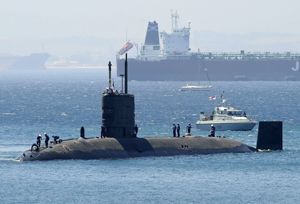
The British nuclear submarine HMS Talent is pictured above as it sailed into the bay of Gibraltar yesterday escorted by a patrol boat from the Royal Navy’s Gibraltar Squadron.

This is the submarine’s second visit to the Rock so far this year.
It called here last May, the first British submarine to stop in Gibraltar in five years.
The Trafalgar-class ‘hunter killer’ submarine arrived yesterday afternoon and it is not known how long it will stay in port.
As is routine in such cases, the Ministry of Defence disclosed no information about the submarine’s visit.
A one-line statement contained the standard line that HMS Talent was visiting Gibraltar “…as part of scheduled operational tasking.”
The visit comes against continued tension in the Bay of Gibraltar over recent incursions by Guardia Civil and Spanish navy vessels.
HMS Talent is described by the Royal navy as a technically advanced, nuclear powered ‘hunter-killer’ submarine, the penultimate in a series of seven Trafalgar Class submarines.
Launched by Princess Anne in Barrow in Furness in 1988, the submarine has conducted operations all around the world.
The principal role of the ‘hunter-killer’ is to attack ships and other submarines.
In this capacity, vessels of this type could support and protect a convoy or taskforce.
HMS Talent can also be used in a surveillance role as it is fitted with cameras and thermal imaging periscopes.
HMS Talent is also fitted with Tomahawk Land Attack Missiles, which gives it a land attack role.

Source – Gibraltar Chronicle

UK – AMS wins submarine equipment contract

UK – Stokesley-based firm Analox Military Systems has won a valuable contract to supply submarine equipment to the Norwegian Navy

Analox Military System is to supply the Norwegian Navy with submarine equipment


A manufacturing specialist has won a six-figure contract to supply the Norwegian Navy with submarine equipment.

Analox Military Systems (AMS), which specialises in the design and manufacture of gas analysis equipment, has signed the contract with Norwegian Defense Logistics Organisation (NDLO) to supply the Norwegian Navy with two carbon monoxide monitoring systems for six ULA-class submarines.

Established more than 30 years ago, the Stokesley-based firm already exports to navies around the world including the USA, Brazil, Holland, Australia and Sweden.

It will undertake the development, manufacture, installation and commissioning of the new system, with the first due to be delivered in February.

Analox Ltd divided its operation into two divisions in 2011, launching Analox Military Systems Ltd to help it continue the business growth.

AMS, which also won Exporter of the Year Award at the North East Business Awards 2006, delivers services and products for military customers around the world. It is currently working with Hakon Rygh, its Norwegian distributor, on the installation and commissioning phase.

Vicky Brown, sales and marketing director at AMS, said: “We’re very proud to be supplying the Norwegian Navy with gas analysis equipment.

“Historically, carbon monoxide monitoring has been problematic for submarines owing to the presence of hydrogen.

“AMS’s new system uses an accurate infra-red technique and as a result, is not sensitive to hydrogen, giving the submariners confidence in the accuracy of the monitoring.”

Commander Baard Gjerstad, project manager submarine projects for NDLO, added: “We needed equipment which would not be affected if hydrogen was present, and Analox Military Systems is able to deliver systems which meet this specific need. We are looking forward to working with AMS on this contract.”

The submarine has people living and working within a confined space. It is therefore essential the atmosphere is carefully managed at all times to limit exposure of the crew to potentially harmful substances.

The new CO monitoring system, which is designed specifically for submarines, will be officially launched at DSEi, a major defence and security exhibition in London, from September 10 to 13.

Brown added: “ We are expanding our team and boosting our engineering capability. This contract win, and the growth of our team, is testament to the commitment and hard work of everyone at AMS.”

This contract win, and the growth of our team, is testament to commitment and hard work

Source –  The Journal

Trident: Lib Dems consider end to continuous at-sea nuclear deterrent

Trident nuclear submarine

The future of Britain’s Trident nuclear programme has split the coalition

The Liberal Democrats are considering calling for Britain to give up its permanent at-sea nuclear deterrent within the next few years.

They are expected to use a review of Trident to say some of the UK’s four nuclear submarines should not be replaced after they are decommissioned.

But senior figures are now pushing to end Britain’s continuous at-sea deterrent even earlier, from 2016.

A decision about the future of Trident has to be made by that point.

This would mean that some of the existing Vanguard submarines would be confined to port with skeleton crews and used for spare parts to keep the remaining boats operational.

The hope among Lib Dems is that this would not just save billions of pounds but would also send a signal that it is possible for a nuclear state to reduce its arsenal while keeping some kind of a deterrent.

‘Kept in port’

This was hinted at last week when Lib Dem Treasury chief secretary Danny Alexander said it was time “to move on from the Cold War postures of the past” with a credible deterrent that “can play a role in supporting disarmament in future”.

One senior Lib Dem MP said: “We are looking at ending continuous at-sea deterrent even earlier. We don’t have to wait until the subs need replacing. We could just keep them in port now.”

Another Lib Dem MP said: “If you thought that you could sustain a meaningful deterrent with two boats, then nothing would prevent you using the existing boats on the same principle.

“It would be reckless to scrap them but you could cannibalise them for parts.

The proposal is contained in an internal party policy paper on defence which is said to be at a “pretty late stage of development” and will be put to the Lib Dem conference in September.

Mr Alexander has chaired the government’s review of Trident which is sitting on David Cameron’s and Nick Clegg’s desks and will be published shortly.

It is expected to say that some of the potential alternative ways of delivering nuclear weapons – from land or from air – are either too expensive or too impractical. But the review is expected to consider the option of scaling back the current submarine-launched system.

Most military experts agree that it would be impossible to provide a continuous, around-the-clock nuclear deterrent with less than four Vanguard submarines. With training and repairs, there is frequently only one submarine on duty at sea.

‘Credible’

The Conservatives are committed to a like-for-like replacement of Trident which is estimated to cost as much as £20bn. But many Lib Dems believe that Trident is too expensive and distorts the defence budget.

They hope to argue that it would be better to spend the money on troops and kit.

Last week Mr Alexander told the BBC’s Andrew Marr programme that the review was seeking to answer whether like-for-like replacement was “the only way to protect our country in future”.

“And while the review doesn’t come to any conclusions, I think when we publish the results in a few weeks time people will see that there are choices available to this country, there are alternatives where we can move on from the Cold War postures of the past and try and set out a new future for this country with a deterrent that is credible but where this country can play a role in supporting disarmament in future.”

A Lib Dem spokesman said: “The Cabinet Office-led review into alternatives to Trident has now been submitted to the prime minister and deputy prime minister.

“The review’s findings will now be considered and an unclassified version will be published in due course.”

A senior Conservative source said: “Abandoning our continuous at sea deterrence, which has been the ultimate safeguard of our national security for more than 45 years, would be a reckless gamble.

“And leaving our nuclear-armed submarines rusting in port, and then seeking to deploy them at a time of crisis would not only put Britain’s security at risk, but would also risk escalating global tensions.

“Conservative policy is clear: we will safeguard Britain’s national security and maintain our continuous at sea deterrent.”

John Woodcock, Labour MP for Barrow and Furness, said: “Unilaterally ending the commitment to keeping at least one nuclear submarine operational at all times will make no meaningful contribution to global non-proliferation, in fact it could have the opposite result by unsettling other countries who are currently under NATO’s umbrella of protection.

“The Liberal Democrats are finally admitting there is no alternative mini-deterrent that could save billions, but few will be taken in by their latest fallacy that a part-time deterrent could save lots of money and protect Britain adequately in the event of a threat in future decades.”

Source – BBC News

UK – MPs back submarine building in Barrow

Workers at Barrow’s BAE Systems plant in front of an Astute class submarine

MPs and members of the House of Lords met to show their support for the UK’s submarine building industry, a key employer in the North West.

Politicians met with key figures in the industry and representatives of the supply chain and trade unions, who wanted to illustrate the chain of jobs that sten form submarine construction in areas like Barrow.

The event was supported by BAE Systems and the Keep Our Future Afloat Campaign, a trade union organisation which campaigns to keep high-tech jobs in the North West and across the UK.

Philip Dunne MP, minister for defence equipment, and Rt Hon Jim Murphy MP, Labour’s shadow secretary of state, were among those who spoke at the event to show their strong support for Britain’s submarine-based nuclear deterrent.

All the speakers paid tribute to the cutting edge work of the firms forming the supply chain for the Astute-class submarines, currently under construction in Barrow, and stressed the importance for these firms of the Vanguard replacement programme.

John Woodcock, MP for Barrow and Furness, who hosted the event said:

“It was fantastic to see so many MPs and peers from every corner of the country and all political parties coming to meet representatives of the firms and workers who form the supply chain for Britain’s cutting edge submarines. They will have been left in no doubt of the importance of the submarine programme to supporting British manufacturing and rebalancing the economy, as well as to securing Britain’s security – I hope they will bear this in mind when the time comes in 2016 to make a decision on renewing our at-sea nuclear deterrent.

“I am particularly grateful for the strong political support given to the submarine programme by government and opposition frontbenchers, Philip Dunne and Jim Murphy, in their speeches – the 1,200 firms in the supply chain will have taken heart from what they both said.”

Source – ITV News

Plymouth Submariner surfaces to collect MBE

A MARINE Engineering Officer who had the “relentless” task of keeping a nuclear submarine at sea for 11 months has been awarded an MBE.

Lieutenant Commander Andy Sharp was deployed aboard HMS Triumph in 2011 and 2012 when the boat was sent to the Gulf and Libya.

Lieutenant Commander Andy Sharp was deployed aboard HMS Triumph in 2011 and 2012 when the boat was sent to the Gulf and Libya.


Servicemean Andy Sharp receives his MBE, accompanied by his fiancee Kay Talbot

The 45-year-old regularly faced repairing the ageing Trafalgar-Class boat but each and every time ensured HMS Triumph and her crew remained tightly on schedule.

The citation explained how the boat remained on station for Operations Ellamy and Unified Protector for more than 100 days providing vital intelligence to NATO and as the UK’s strategic strike capability.​

mbe

It continued: “Throughout that time Andy led his department with selfless dedication, tenacity and resourcefulness as they kept the submarine in a first class state of repair through what was, at the time, the longest ever operational SSN deployment.

“By the time she returned to the UK, HMS Triumph had spent over 14 of the previous months away from home and that achievement was due in no small part to Andy.”

Commander Rob Dunn, the Commanding Officer of HMS Triumph at the time, said: “Too often in the past what submariners have done has been out of sight and therefore out of mind. But the challenges faced by my engineers in keeping Triumph ready for operations was immense and I was delighted to see Andy, along with several other members of my crew, recognised in the Operational Awards.”

Also to be recognised in the Operational Honours with a Queen’s Commendation for Valuable Service was Warrant Officer 2 Alasdair McCall who supported Andy throughout the deployment.

Andy said: “It was a brilliant day, it was presented by the Queen. She said congratulations and asked me if I was busy last year because of the award.”

He said the MBE represented the hard work of an “excellent team”.

The Lt Cdr was presented his MBE by the Queen at Buckingham Palace with his fiancee Kay Talbot and children Danny and Kirsty.

His son Danny, a Royal Navy Air Engineering Technician, was flown off HMS Illustrious especially for the occasion.

Source – ThisisPlymouth

DECISION ON NEW BARROW BUILT SUBMARINES ‘MUST NOT BE DELAYED’

EXTENDING the life of Barrow-built nuclear submarines would not be safe, a top politician has claimed.

P886100.jpgds
 

Defence secretary Phillip Hammond made the admission in response to a parliamentary question asked by Barrow and Furness MP John Woodcock.

There have been fears that the government’s Trident Alternative Review could recommend a further delay in bringing in new submarines, a move that would risk leaving a gap in the order book at Barrow shipyard.

The coalition government has already ordered a four-year delay to the in-service date of the successor deterrent boats, meaning that the existing Vanguard class vessels will have served for a record 35 years before they retire.

Following a question from Mr Woodcock in the House of Com mons, Mr Hammond confirmed the life of the hulls of the Vanguard submarine fleet cannot safely be extended beyond their latest retirement date, which for Vanguard – the oldest of the boats – is 2028.

Mr Hammond said: “We have already extended the life of the Vanguard class once and it is not judged possible or safe to extend it further.”

Speaking after receiving the response, Mr Woodcock said: “This clear view from the MoD that it would be unsafe to further extend the life of Vanguard should knock on the head any idea the government could put yet another delay into the build programme at Barrow.

“Aside from the extra cost and disruption that another delay would cause, we cannot countenance asking the sailors who bravely provide Britain’s nuclear deterrent to serve in life-expired, potentially unsafe hulls.

“By 2028, the Vanguards will have done good service, but the time will have come to provide the country’s vital deterrent with new submarines rather than spend huge amounts of money to extend the life of Vanguard still further, simply so we can again postpone the urgent decision on new boats.”

Source – North West Evening Mail

ROYAL NAVY SUBMARINER EARNS DOLPHINS THE AMERICAN WAY

Royal Navy Submariner earns dolphins - the American way

A Royal Navy submariner recently received US Navy Submarine Service “dolphins”, making him just the second UK officer to qualify on a US Navy submarine.

It has been a tough process, but getting my US Navy dolphins is one of the highlights of my career and I have enjoyed every minute of it.

Lieutenant Matt Main RN

Lieutenant Matt Main has already earned his Royal Navy dolphins – the unique badge which signifies a qualified submariner – but on June 10 he was presented with the US equivalent after a gruelling 27 month training and qualification process.

Matt, a Marine Engineer (Submarines) in the Royal Navy, was presented with the US dolphins by Commander George Perez, Commanding Officer of the USS New Mexico, after his success as part of the US-UK Personnel Exchange Programme.

Fully integrated into the crew of USS New Mexico, Matt is currently the Damage Control Assistant and will become the Assistant Engineer in due course before returning to the Royal Navy.

US Navy submarine officers must qualify both forward and aft to earn their dolphins and so, for Matt, learning to drive the submarine both surfaced and submerged has been a unique experience.

“It is a real privilege to serve on this fine submarine with such a professional, motivated crew,”

said Matt.

“It has been a tough process, but getting my US Navy dolphins is one of the highlights of my career and I have enjoyed every minute of it.

“The welcome I received when I reported on board a year ago was incredibly warm and I am proud to call these men my brothers.”

Commander Perez said:

“After a fast-paced, demanding year of intense operations, Lieutenant Main has earned his gold US dolphins.

“He is fully qualified to stand Officer of the Deck on USS New Mexico and will do so repeatedly over the next year as he assumes an even larger role in the day-to-day operations of the ship.

“When an officer earns his dolphins in the US Navy, it signifies that they have demonstrated, through performance as the Officer of the Deck, a thorough understanding of all aspects of submarine operations.”

Lieutenant Main was presented his dolphins during a ceremony alongside HM Naval Base Clyde. Witnessing events were the crew of USS New Mexico as well as Royal Navy colleagues.

Matt is the second Royal Navy officer to earn US Navy submarine dolphins, with the first, Lieutenant Commander Ralph Coffey, receiving his after serving with USS Providence from 2010-12.

Source – Royal Navy Website

HMS Alliance – Submarine close to surfacing again

Alliance

The HMS Alliance refurbishment at the Royal Navy Submarine Museum in Gosport. Standing on top of the submarine

In less than three weeks the refurbished hull of a Second World War era submarine will be revealed for all to see.

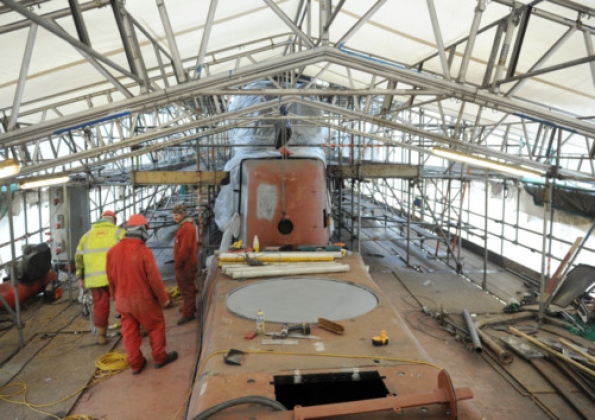
Piece by piece the scaffolding surrounding HMS Alliance at the Royal Navy Submarine Museum, in Gosport, is being taken down.

The final section is due to be removed early next month.

It will be a major milestone in a project that has already seen many.

Sitting atop her home on a concrete cofferdam, she will, for the first time in decades, be looking her best.

A gleaming black finish – itself painted on top of anti-corrosive paint and a holding coat – will mask the major work embarked upon in October 2011 to restore her.

Alliance had suffered such corrosion that huge parts of her were damaged so badly they had to be replaced, rather than repaired.

Bob Mealings is the curator at the museum and calls sections of the submarine, which is not yet finished, ‘a real work of art.’

But he added if this project had not been started, the ‘irreplaceable’ submarine would have been lost to the public.

‘Eventually I think she would have been in such a poor state you couldn’t have opened her to the public,’ he says.

‘She would have become a health and safety hazard to people surrounding the submarine because bits were dropping off.

‘And also she would have been an environmental hazard because the rust and the paint coatings, all of which are not supposed to be in the water, gradually dropping off and contaminating the sea around us.

‘And she is the only surviving Second World War submarine – she’s irreplaceable.

‘It would have been a major loss for UK maritime heritage, for naval heritage and indeed for Gosport, as the town that is essentially the historical home of the British submarine service.’

She is also a memorial to the 5,300 British submariners who have lost their lives in service.

At the end of £6.7m project in March 2014, Alliance will have been bought another 60 years.

To get to that stage, the restoration so far has been nothing if not extensive.

Around 40 tonnes of new steel has been put into the boat to replace parts that were beyond repair.

Bob adds: ‘The restoration itself has included absolutely everything.

‘Down at the bow, by the bow’s keel, we’ve had to restore from the bottom of the keel all the way up and all the way down.

‘All of that has been blasted back and repainted and a lot of welding repair work carried out.

‘The bow is a very good example of the challenge of producing a really good restoration in terms of the quality of workmanship.

‘To actually roll steel plate and weld it in that [compound curve] shape is a real work of art, it’s real craftsmanship.’

The work has been guided by the 1945 original build drawings, supplied to the museum by BAE Systems at Barrow-in-Furness.

But that has not made it plain sailing for Portsmouth-based firm ML UK which has carried out the work.

Getting access to certain parts has been difficult.

That included the ballast tanks, which could only be accessed by cutting through the hull.

‘There are dozens of ballast tanks aboard Alliance,’ says Bob.

‘Every one of them has had to be opened up, blasted and repainted in order to preserve the interior.

‘The shot blasters have had to go in there and blast all the rust away, the painters have had to go in there and paint.

‘Some of the work in the confined spaces has been challenging.

‘It’s in the nature of the way submarines are constructed, they’re not the easiest thing to work on and maintain.

‘There’s so much machinery crammed into confined spaces.

‘Simply obtaining access to various parts of the submarine has been one of the challenges of the project.’

A major consideration during the restoration work has been safeguarding against any future corrosion.

And that has meant protecting the boat, which is on the historic ship’s register, against birds.

The A-Class’s casing has more than 100 distinctive free-flood holes.

But each one of them is now covered with mesh to stop it becoming an aviary.

Bob said: ‘A lot of the superstructure of a submarine is free-flood, so when it dives, water floods into these spaces, which is obviously meant to happen.

‘The problem with a preserved historic submarines is that birds like to go in there and nest.

‘Every one of these free-flood holes, and they’re all over the hull of the submarine, has to be meshed over.

‘It’s a shame because it’s a very distinctive feature of a Second World War submarine to have all these holes but a bit fatal when you’re trying to protect it.’

‘Birds contaminate the boat with their guano but they also make it unhygienic to work on.

‘At the height of the problem there were probably 200 birds nesting or associated with the boat.

‘Now we’re down to a handful of stragglers.’

Instead, regular groups of visitors can be found aboard, being shown around by one of the museum’s many volunteers.

When the programme of work is completed, visitors can see what it was like for 65 crew and six officers that used to be on board.

A state-of-the-art sound and lighting system will bring the boat to life.

She is open for visitors now and museum staff are keen to share their enthusiasm for her with others.

Volunteering

JUST as museum staff want the submarine to be open to the public, so is the restoration work itself.

An army – or crew – of volunteers has been taken on to help with the work.

Roy Furse, a former member of the Fleet Air Arm, is a conservation volunteer.

The 67-year-old, from Seafield Road, in Portchester, will be working on bringing some of the electronic equipment back to life.

He was busy in a workshop at the museum when he spoke to The News.

He said: ‘I’ve been working on the submarine.

‘I’ll be working on the electronics, which is quite exciting, trying to get some of it working again for lights and visual effects.

‘I worked at IBM for 28 years in project management and needed something really different and this is it.

‘It’s keeping the past alive, and people not involved with the sea can come and

see what it was all about years and years ago.’

Mr Furse has been volunteering on the project for three months.

Volunteers are given initial training but are given space to fit into the project.

Curator Bob Mealings added that the museum hopes the volunteers involved will stay for the long term to help with the upkeep of the fully-restored vessel.

He said: ‘We’d like people around to help us maintain the submarine in the long term.

‘There are all sorts of projects on board the boat, which we won’t get a chance to sort out before March next year when we relaunch.’

To volunteer on the project, call (023) 9251 0354, extension 231.

Fundraising events

EVEN after getting £3.4m from the Heritage Lottery Fund, refurbishing a submarine is a costly business.

Bosses need around a further £200,000 to hit the project’s target.

Those behind the £6.7m project run fundraising events to bring in more cash to pay for the work.

And this week a travelling speaker, with the stage name of Eric, will be talking at the museum to help bring in the cash.

Fresh from a world tour, which included Australia, London and Leicester, the former submariner will talk about the secret world of submarines.

Tickets cost £10 for the show on Thursday at the museum.

Then on Thursday, July 18 from 7pm to 9pm, the museum’s own archivist will give a talk.

George Malcolmson will give his talk, Donald’s Navy 1900 – 1945, about the seaside artist Donald McGill.

And on Thursday, September 12 a dinner aboard HMS Victory will raise cash for the ongoing restoration.

Diners are invited to enjoy fine dining and fine wines on Admiral Lord Nelson’s Lower Gun Deck in aid of the restoration appeal.

The night will be in full naval tradition style and will end with a prize auction.

All tickets can be bought online at supportusalliance.co.uk or by calling (023) 9254 5036.

To support the cause further, become a friend of the museum on rnsubmusfriends.org.uk

Source – The News

Barrow submarine heritage dream hits rocks after news HMS Onyx to be scrapped

DREAMS of a submarine heritage centre in Barrow have suffered a blow as the proposed centre piece is due to depart for the wreckers’ yard.

HMS Onyx has been sitting in Barrow since May 2006 when a group of submariners, led by Terry Spurling, helped bring the boat back to Barrow.

The group had hoped the boat would become an interactive centre piece at a submarine heritage centre but the plans ran into trouble after the group could not secure funding from the Heritage Lottery Fund without the backing of Barrow Borough Council or Cumbria County Council.

As the boat is prepared to be towed to Hull, where it will be dismantled, Mr Spurling said the dream of using a submarine is no longer possible.

He said: “It’s sad for Barrow that it’s going but there’s now no chance of getting a submarine.

“It was the last O-class (Oberon) class submarine available and it’s about to be made into razor blades.

“It’s the end of the dream based around a submarine but I still believe there’s a heritage story to tell.”

Mr Spurling said the decision had been taken after HMS Onyx had been sitting in Buccleuch Dock for the best part of seven years – which has led to rusting and corrosion.

He added: “When the climate is right and when there is money available I think there will be some-thing.

“We have a paintings collection at Barrow Town Hall, a large book collection and a lot of hardware and materials that have been loaned to Faslane.”

Mr Spurling said he understands the reasons Onyx is to be scrapped but added he is sad the heritage centre has lost its centre piece.

Source – North West Evening Mail