Category Archives: US Submarines

News, views and stories about US submarines

Civil War submarine may have been destroyed by its own torpedo

During the Civil War, the Confederate army fielded a submarine called the H.L. Hunley. After sinking an enemy ship called the USS Housatonic in 1864, the submarine disappeared after signaling a successful mission. Exactly what caused the Confederate submarine to sink has remained a mystery.

ap-confederate-submarine-4_3_r536_c534

However, scientists studying the ship have discovered new evidence that may shed light on what caused the submarine to sink and how the sub and its crew were able to sink the union ship. The sinking of the union ship made the Hunley the first successful combat submarine in history. New evidence discovered during the study of the submarine suggests that the submarine was less than 20 feet away from the torpedo when it exploded, sinking the union ship.

According to the researchers, new evidence suggests that the torpedo was bolted to a 16-foot-long spar. This discovery was made during an investigation of what remained of the two-foot-long torpedo. According to the researchers, the torpedo held 135 pounds of gunpowder and was not designed to separate from the spar as previously believed.

Previously it was believed that the torpedo was placed against the ship’s hull and then detonated remotely. New evidence suggests that the submarine was no more than 20 feet away when the torpedo was detonated. As close as the submarine was to the ship when the torpedo exploded, the researchers believe that the concussion from the explosion may have damaged the submarine and injured the crew. The submarine was discovered off the South Carolina Charleston Harbor in 1995 and return to the surface in 2000.

Source – Slash Gear

Capt. John Markowicz, Who Led Fight To Save Groton Sub Base, Has Died

Markowicz, of Waterford, served in the Navy for 34 years, built a business that grew from six to more than 400 employees, and worked to improve the local economy.

Capt. John C. Markowicz, a naval officer who spearheaded the fight in 2005 to save the Groton submarine base from closing, has died.

He was 68.

Markowicz, of Waterford, graduated from the U.S. Naval Academy and  received some of his early submarine training in Groton. He served in  posts including communications officer, weapons officer and engineering  officer on submarines, and he was honored with decorations for his  service and leadership.

He continued to serve in the reserves after leaving active duty, commanding several reserve units.

In 1976, Markowicz started a private defense-contracting business  that grew from six to more than 400 employees. Then he joined the  Southeastern Connecticut Enterprise Region, where he worked to improve  the local economy.

“I respected John an awful lot,” said former Groton Town Councilor Mick O’Beirne, who worked with Markowicz on a group to save the sub base.

“It was really a pleasure working with him, and I think practically   everyone on the sub base coalition team would say basically same thing.  We worked well as a group, and that is really a function of the   leadership.”

O’Beirne said he first met Markowicz in 1993, when they were working  against a proposal to remove submarines and basically the waterfront  from Naval Submarine Base New London in Groton.

For about five years, the two also served as co-chairs of what’s  now The Subase Coalition. O’Beirne became vice chair  of the group in 2005, when the base was threatened with closure.

He said  it was awkward to have two chairmen, and the coalition needed one  voice. O’Beirne and Markowicz continued to work together to save the  base and succeeded.

Markowicz’ obituary, published on the Byles-MacDougall Funeral Service, Inc.

Captain John C. Markowicz, naval officer, executive, and  civic leader in southeastern Connecticut died of brain cancer on Friday,  January 18, 2013.

He was born in Lynn, Massachusetts on March 4, 1944, the son of Stanley  and Stella (Buba) Markowicz. He grew up in Salem, Mass. where he  attended St. John the Baptist grammar school and was class president at  Salem High School.

He graduated from U.S. Naval Academy with the class of 1965 and launched a  career in nuclear submarines.  His early training as a submariner  included completing Nuclear Power School in Bainbridge, Md., prototype  training in Windsor Locks, Conn., and Submarine School in Groton, Conn.

He  served on the commissioning crew of USS PARGO (SSN 650) as  Communications Officer and then as Weapons Officer during testing of the  Mark 48 torpedo in 1970.  Following assignments included Submarine  Development Group Two as Squadron Weapons Officer and Engineering  Officer on USS GUITARRO (SSN 665).

His distinguished service in the  Submarine Force was recognized with several unit citations and numerous  personal decorations, including the Steven Decatur leadership award.  In  1976, he left active duty service and continued his naval service  through the Naval Reserve.  He participated in and commanded several  Reserve units before retiring after 34 years of honorable service.

He started his private career in 1976 by joining David and Muriel Hinkle  in starting a new defense contracting company in Sonalyst, Inc. and  came to live in Waterford, Conn.  He helped the small company grow from a  one floor office building of six employees to become Chief Operations  Officer of over 400 employees with offices located throughout the  country.

He left Sonalyst in 1994 and continued his leadership in the business  community through his commitment to the economic development of  Southeastern Connecticut.

He worked with Tech Conn and Sea Tech to stir  business development throughout the region.  In 1997, he joined  Southeastern Connecticut Enterprise Region (seCTer) and tirelessly  worked on sustaining the health of the local economy.

In 2005, he  spearheaded the coalition effort that successfully defended the  Submarine Base and overturned the recommendation of Base Realignment and  Closure Commission to close the facility.

His community service  included membership to the Waterford Nuclear Advisory Board,  Lawrence  and Memorial Hospital Corporators, and the St. Joseph Parish Council  where he was a long time parishioner.

He married Dolores “Laurie” Treptow in Holy Cross Church, Trenton, New  Jersey, on June 7, 1969.  He is survived by her and son John C.  Markowicz, Jr. and his wife Kristin Bache Markowicz and their children  John Carter, Joseph Thomas, James Stanley and Jane Lolitia and daughter,  Karen Lynn Noyes and her husband Brian Noyes and children Griffen  Horne, Avery Horne and Jilian Noyes of Duxbury, Mass.

He is survived by  his brother Joseph Markowicz and his wife Gail McGrane Markowicz of  Salem, Mass. and his mother-in law Wanda Kochanowicz Treptow and sister in  law Christine Treptow Servis and her husband David Servis of Punta Gorda, Florida and numerous cousins, nieces and nephews.

Source – GrotonPatch

GD Awarded ‘USS Mississippi’ Maintenance Contract

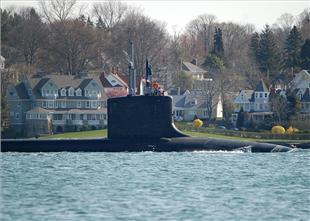
USS Mississippi in River Thames

USS Mississippi in River Thames

General Dynamics Electric Boat awarded a US$ 51.7-million Navy contract for maintenance work on the submarine ‘USS Mississippi’.

The contract is to to plan and perform the post-shakedown availability (PSA) on the nuclear submarine USS Mississippi (SSN-782). (Electric Boat is a wholly owned subsidiary of General Dynamics).

The PSA includes maintenance, repairs, alterations and testing. It will be performed at Electric Boat’s Groton shipyard. Up to 400 employees will be engaged in the work, which is scheduled for completion by December 2013. Initially awarded in April 2012, the contract has a total potential value of $67 million.

In May 2012, Electric Boat delivered Mississippi to the U.S. Navy a year ahead of contract schedule and more than US$60-million below target cost.
Mississippi is the ninth ship of the Virginia Class, the most advanced submarines in the world. These ships are providing the Navy with the capabilities it requires to retain its undersea dominance well into the 21st century.

Source – Marine Link

USA – Clamagore veterans want more time to raise money to save aging submarine

USS Clamagore riding in her new berth next to the Charleston Harbor Resort & Marina and Castle Pinckney (War of 1812) in the background.

That’s what the Clamagore Veterans Association pleaded for Friday to keep the aging submarine parked at Patriots Point from making one final mission to the bottom of the sea as an artificial reef.

The veterans group raised about $40,000 since Patriots Point first announced last summer it could no longer afford the upkeep or repair on the retired Cold War vessel.

Patriots Point gave them until June to come up with the money.

“We are not going to raise $3 million by June,” Clamagore Association President Bob Dewar of Florida frankly told the Patriots Point board.

The group wants to use some of the money already raised to enlist a professional fundraiser and have him under contract by Feb. 28.

Patriots Point has no problem with them trying to raise the money and hiring a fundraiser, but the board didn’t answer their plea for a one-year extension. Instead, the board decided to ask the group back in July for a status report on their fundraising efforts, according to Mac Burdette, Patriots Point executive director.

That left the veterans group scratching its head over whether to hire the fundraiser, not knowing if their efforts would be cut short in July.

“We would have to take a blind leap and go forward,” said Jackie Heard of the Save the Clamagore Committee after the meeting. The Huntsville, Ala., resident’s father, Jack F. Heard, served as commanding officer of the Clamagore from 1956 to 1958. She presented the latest Clamagore proposal Friday to Patriots Point.

“Do you throw the towel in now, or do you press on”? she said. “We won’t know until those lists are studied.”

Heard was referring to the lists of Clamagore veterans that the fundraiser would analyze to see the best potential for raising money.

“We would like nothing more than to have that money raised and keep the Clamagore where she is,” Burdette said. “But you have to do what is right for the long-term benefit of the museum.”

The waterfront tourist attraction intends to press on with the lengthy federal process of turning the Clamagore into a reef or finding another suitor for the submarine, board Chairman Ray Chandler said.

Citing an independent engineer’s assessment, Burdette is worried that rising water from a strong hurricane could swamp the submarine’s open hatches, causing it to sink and creating an environmental disaster in Charleston Harbor because of fluids and batteries still on the sub.

The naval and maritime museum in Mount Pleasant doesn’t have the money to repair the rusting vessel that’s been sitting in the harbor’s salt water for more than three decades beside the World War II aircraft carrier Yorktown, the centerpiece attraction that is staring at an estimated $81 million overhaul.

Under an agreement worked out last summer, the veterans group was to hire a qualified marine engineer to survey the vessel, but to save money the group deferred to a study commissioned by Patriots Point.

Speaking by phone during the meeting from Seattle, former Clamagore commander Don Ulmer said he had spoken with Boeing about committing $1.5 million in matching funds if the group raised the rest, but he said it was not a firm commitment and would revisit the aerospace giant if the time extension is granted.

Ulmer said also the group has been in contact with author and marine archaeologist Clive Cussler, who has offered support but no money. The group is also in talks with the Seattle Museum of Flight to see if it is interested in taking the submarine, Heard said.

If the extension is granted, the association pledged to shore up the open hatches as an interim measure against hurricanes.

The group has also contacted United States Submarine Veterans Inc., which has offered to handle monetary collections for the group because it’s a nonprofit organization.

If the final decision is to turn the submarine into a reef, Dewar asked that the sail and periscope be removed so they could be become part of a permanent memorial.

Some vestige of the vessel would remain as part of Patriots Point, Chandler said.

Source – The Post & Courier

US Navy’s next-gen stealth sub could run silently for 50 years

The

In this file photo, the Ohio-class ballistic missile submarine USS Maryland transits the Saint Marys River. Details are emerging about the ship’s replacement, scheduled for deployment in 2031.

The Navy’s next-generation nuclear submarine may have an electric drive and new reactor plant that allow it to patrol the seas with near-silent stealth for half a century, according to emerging details about the secretive program.

The electric drive would replace a direct mechanical connection between the nuclear-powered steam turbines and the submarine’s propellers. In the new configuration, the nuclear power source will run electric motors that propel the ship.

“Electric drives could prove to be much quieter than the current direct-drive method,” the U.S. Naval Institute explained in a brief detailing the new design. The institute is an independent, non-profit forum on national defense.

The military tried electric drives in the 1960s and ’70s, but found them to be too slow and maintenance needy. Technological advancements over the past few decades could provide the hassle-free speed required.

Since Navy submarines rely on stealth to hide from enemies, a nearly silent engine will make them harder to find. The Ohio-class replacement nuclear-powered ballistic missile submarine will also be covered in echo-free tiles that reduce detection from active sonars.

In addition, the program is aiming for a newly designed reactor plant “that will last the life of the boat,” Sean Stackley, Assistant Secretary of the Navy for Research, Development, and Acquisition, said in an interview with the U.S. Naval Institute.

“That’s important because what it does is effectively eliminate the midlife refueling associated with the current Ohio class.”

That is, current nuclear subs are hauled out for mid-life overhaul that can keep a sub out of the water for three years. To compensate for the downtime, the Navy has 14 Ohio-class ships.

The new design will still require a mid-life checkup and update, but should be out of the water for a shorter period. This would mean that the Navy only needs to have 12 ships. “That’s a significant cost improvement over the life of the program at the expense of the development for that new reactor-plant design,” Stackley said.

The Navy is under budget pressure to keep the cost of the boats to $4.9 billion each; that’s down from the $6 or $7 billion price tag proposed in 2009. Current plans call for construction of the next-generation submarine to begin in 2021, with first deployment in 2031.

Source – NBC News

USS Hartford & USS San Juan Sailors receive dolphins

John Carcioppolo, president, Submarine Veterans Groton Chapter laughs with Sailors from USS Hartford (SSN 768) during a recognition ceremony. Carcioppolo congratulated thirty officers and enlisted Sailors from Los Angeles class attack submarines USS Hartford and USS San Juan (SSN 751), who were recognized for earning their gold and silver “dolphins” onboard their respective submarines at the Submarine Veteran’s Clubhouse in Groton, Jan. 7.


Thirty officers and enlisted Sailors from the Los Angeles class attack submarines USS Hartford (SSN 768) and USS San Juan (SSN 751) were recognized under the SUBVETS Submarine Qualification Recognition Program, at the Submarine Veterans Clubhouse in Groton, Jan. 7.

The Sailors, who previously received their coveted gold and silver “dolphins” onboard their respective submarines, were recognized by former submariners, many of them Holland Club veterans in attendance, who warmly welcomed the newest submarine warfare qualifiers into the special community.

“We had never recognized Sailors from two boats at one meeting,” said John Carcioppolo, president, Submarine Veterans Groton chapter.

Commander Steve Wilkinson, commanding officer, USS Hartford attended the rite of passage ceremony and reflected on the caliber of the Sailors serving in the submarine force today.

“As you can see, your legacy is in good hands. These men represent all the best of our nation,” said Wilkinson.

Groton Base Member Phil Marshall from Narragansett, R.I., who served on 13 submarines, called out his submarine qualification, which was earned in 1955 aboard USS Sterlet (SS 392), reflected on how great it was to see the newly qualified Sailors referring to them as “our future.”

Master Chief Machinist’s Mate (SS) Eric Mathley, chief of the boat, USS Hartford also reflected on the legacy of the submarine force.

“It’s great that these young Sailors, who worked so hard to earn their dolphins, have an opportunity to see the long legacy of the submarine service,” said Mathley. “I think it means more to them, having seen that. They can really appreciate the lineage of their service.”

Master Chief Electronics Technician (SS) Gaylord Humphries, chief of the boat, USS San Juan, also sounded off his qualification date, providing his solid support to the next generation of submariners.

“This is the new generation of submariners and the submarine force is in good hands,” said Humphries.

Source – Dolphin News

US Sea Cadets tour submarine at Point Loma

Sea Cadets tour submarine at Point LomaU.S. Naval Sea Cadet Corps participants stand in formation prior to boarding  the Los Angeles-class attack submarine USS Jefferson City (SSN 759) for a tour.  Since 1958, NSCC has been committed to providing American youth with a drug and  alcohol-free environment to foster their leadership abilities, broaden their  horizons through hands-on training, and guide them to becoming mature young  adults.

SAN DIEGO – Participants from the U.S. Naval Sea Cadet Corps toured the Los  Angeles-class attack submarine USS Jefferson City (SSN 759) aboard Naval Base  Point Loma to see what life is like aboard a U.S. Navy submarine.

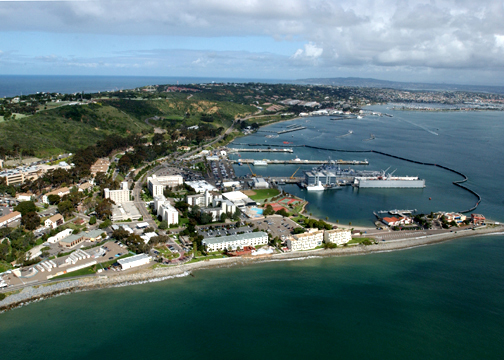
Point Loma - Submarine base (San Diego, California)

Point Loma – Submarine base (San Diego, California)

Click Point Loma for more information

Submariner tour guides taught the students how the ship moves through the water  and how it stays balanced, heated, and defensive, along with how the crew  lives.

“I enjoy telling people what we do,” said Logistics Specialist 2nd  Class Jared Sainz, one of Jefferson City’s appointed tour guides. “Most people  don’t understand what happens in a submarine or how a submarine works on a basic  level.”

Twenty-three children, ranging in age from 11 to 17, toured the  vessel along with their chaperones in an effort to better understand what a  career as a submariner would be like.

“It’s a good eye-opener for these  guys to pinpoint what they want to do when they graduate from high school,” said  Ginny Fessler, a chaperone and parent volunteer. “Some of them said, ‘Yeah, I  could do this,’ and others were like, ‘No, I think I’m too tall!’”

The  tour allowed the visitors to see virtually all of the unclassified spaces on the  nuclear-powered submarine including the control center, sleeping quarters,  galley, torpedo space and wardroom.

Hannah Lockmann, a 14-year-old  student at Hill Creek Elementary School, said she enjoyed the firsthand  experience. “Today was a lot of fun and I learned a lot.” Lockmann said. She  added that her career ambition is to become a Navy Corpsman, but not on a sub. “It’s just too small!” she said.

Sainz, the tour guide, said there was  real value for the touring children in familiarizing themselves with actual Navy  equipment and culture.

“I wish these opportunities existed when I was  younger,” Sainz said. “They get to see what’s going on in the Navy and they’ll  understand a little bit better what they’re getting into if they do decide to  join.”

Since 1958, the Naval Sea Cadet Corps has been committed to  providing American youth with a drug and alcohol-free environment to foster  their leadership abilities, broaden their horizons through hands-on training,  and guide them to becoming mature young adults.

For more information on  the U.S. Naval Sea Cadet Corps visit http://www.seacadets.org

For more  news from Commander, Submarine Force, U.S. Pacific Fleet, visit  www.navy.mil/local/subpac

Source – Dvids

Russia Sails New Nuclear Submarine While U.S. Continues Fleet Delays


Last week, after long delays, Russia made operational a new ballistic missile submarine (SSBN), or nuclear submarine, for the first time in over 20 years. This marks a significant step forward for the Russian Navy, which has pledged tens of billions of dollars to revitalize its fleet in the near future. The U.S. Navy unfortunately has had trouble both in revitalizing its SSBNs as well as its overall naval fleet.

The Russian navy made the announcement that the Yury Dolgoruky (Project 955)—the first-in-class of the new Borey-class SSBN—made operational status as it prepares for one of its largest naval exercises since the end of the Cold War. In fact, Russia’s commitment to increasing naval strength has been a central theme during Russian President Vladimir Putin’s tenure as president—despite Russia’s historically meager performance as a naval power. The Borey-class subs were first designed in the 1980s and the Yury Dolgoruky construction was launched in 1996.

Meanwhile, the U.S. navy has shrunk significantly since the Reagan years. The days of the 600-ship fleet have long since ended, and now U.S. naval leaders are struggling to find ways to meet a new requirement of around 300 ships. Currently around 285, the fleet will shrink further if more investment isn’t made in naval modernization.

The U.S. fleet was eroding long before the Budget Control Act and sequestration became part of the equation. In 2010, the Congressional Budget Office (CBO) reported that actual funding levels for 2005–2010 fell below the CBO’s and the Navy’s estimates to achieve fleet goals. Predictions show current funding levels would reduce the fleet to 263 ships. While the sequestration cuts to defense have been temporarily delayed as part of the fiscal cliff deal, they are still a looming possibility and would shrink the fleet to its lowest level since 1915.

While Russia has shown improvements in its strategic SSBN fleet (two more Borey-class subs are under construction), the U.S. has fallen behind its own standards. The legal minimum for the U.S. Navy’s SSBN fleet is 12 boats. Given this fleet’s status as the most survivable leg of the U.S. nuclear triad, the requirement should not be taken lightly. However, the Obama Administration delayed the development of an Ohio-class SSBN replacement for two years, which will in turn cause the fleet to fall below 12 boats for a 14-year period. As rogue states such as Iran and North Korea get closer to having nuclear weapons and increasing ballistic missile technology, the significance of this fleet is certainly not shrinking.

The President has downplayed the size of the fleet by making oversimplified arguments that each ship’s capability makes strength in numbers less significant. Yet with Russia aggressively growing its naval capability, resulting in a greater presence on the high seas, as well as China paying increased attention to naval capability, the U.S. must continue to uphold its status as the dominant global naval power. The fiscal year 2013 National Defense Authorization Act states that “the continuous at-sea deterrence provided by a robust and modern fleet of nuclear-powered ballistic missile submarines is critical to maintaining nuclear deterrence and assurance and therefore is a central pillar of the national security of the United States.”

Both Congress and the President need to keep this support up to maintain America’s robust naval

Source – The Foundry

Submarine USS Boise wins award for battle readiness

The nuclear-powered Los Angeles-class submarine Boise has been named one of the winners in the 2012 Battle Efficiency competition.

The Norfolk-based sub is led by Cmdr. Brian Sittlow. One vessel from each submarine squadron in the Atlantic Fleet is recognized annually, according to a news release.

The Battle “E” awards are presented by the commodore of each squadron to the submarine under their command that has demonstrated the highest level of battle readiness during the evaluation year.

Source – Pilot online

General Dynamics Gets Trio of Submarine Contracts

Electric Boat, a wholly owned subsidiary of General Dynamics Corporation (GD – Analyst Report), procured three contracts worth $4.6 billion from the U.S Navy for designing and development of the next-generation strategic deterrent submarine. The contracts also included the task of construction and purchasing of materials for Virginia-class attack submarines.

Per the first contract worth $1.85 billion with a span period of five years, the company will perform research and development work for the next-generation strategic deterrent submarine under the Ohio Replacement Program. The construction for this new class of ballistic-missile submarine is expected to begin in 2021. Simultaneously, the company will continue to develop Common Missile Compartment for Ohio Replacement submarines and the UK Successor-class ballistic-missile submarine. Common Missile Compartment is jointly owned by the U.S. Navy and Royal Navy.

The company also received a contract to build two Virginia-class submarines, South Dakota (SSN-790) and Delaware (SSN-791). These two ships are the 17th and 18th ships of the class. The contract worth $2.5 billion will be performed jointly by Electric Boat and its team mate Newport News Shipbuilding, a division of Huntington Ingalls Industries, Inc. (HII).

Per the third contract worth $308 million, the company will purchase long lead-time materials for SSN-792, SSN-793 and SSN-794. Till date, these Virginia-class submarines have not been named.

Electric Boat has specialty in performing tasks for Virginia-class submarines. Of late in November 2012, Electric Boat had also received a contract modification to provide research and development and lead-yard services for Virginia-class nuclear-powered attack submarines.

The company believes that these contracts will bring in stability to the submarine industrial base, thereby helping it to accomplish greater cost reduction through improved efficiencies. Moreover, these contracts also demonstrate the Navy’s confidence in the ability of General Dynamics.

General Dynamics is well equipped to build nuclear-powered submarines in the U.S. Also, some acquisitions make the company more capable to perform its tasks well. In December 2012, General Dynamics had acquired Applied Physical Sciences Corporation that became a part of General Dynamics Electric Boat. This acquisition will allow the company to provide more competent submarines that will help in maintaining global undersea dominance.

Based in Falls Church, Virginia, General Dynamics engages in mission-critical information systems and technologies; land and expeditionary combat vehicles, armaments and munitions; shipbuilding and marine systems; and business aviation. General Dynamics’ revenue exposure is spread over a broad portfolio of products that allows to keep the overall growth momentum steady.

Source – Zacks