Category Archives: US Submarines

News, views and stories about US submarines

Xmas message – “Keep the bubble” Dolphin 36

"Capt Sir OOW contact report - Right ahead at 5,000 yards I have Santa" Yeahhh!!

“Capt Sir OOW contact report – Right ahead at 5,000 yards I have Santa” Yeahhh!!

For most, this day represents the last working day before Christmas, not that there’ll be as much work done as usual I suspect! Many of us will be looking to secure our work stations, hide what we should have done in the lead up to Xmas and make the relevant cast iron excuses.  We’ll finish mid way through the afternoon (if not before) and make haste back to our loved ones.

It’s seems that the country’s media is asking us to spare a thought for the Armed Forces and the sterling job they at Christmas; I would echo and indeed endorse this sentiment but in this instance would look within at our own brothers (And in some countries – “sisters”).

Being an ex-Submariner of 20+ years I remember the happy and the not so happy times at this festive time of year. Below are a few examples that might strike a chord with you Past, Present or Future:

  • Most of the boats back for Xmas stand off. The Imps, the G&D, the RNA brimming with submarine crews readying themselves to go on leave.
  • Sitting on an upturned milk crate or an Elephant’s Tam**x, on trot, on Christmas Day, in Faslane at Two O’clock in the afternoon, with 2 hours to go wondering if being a submariner was indeed the best decision you ever made.
  • Relaxing in the sunshine, in a bar, half-way across the world reading about how wet and windy it is in Plymouth with no sign of a let up.
  • Climbing into your rack on Christmas eve night with only your thoughts of home for company. The rush air from the punkah louvre streaming uncomfortably across your chest and the constant whirrr of the on-board ventilation. With Christmas day only hours away you’re not even “round the buoy” on that 12 week patrol.
  • The excitement of returning to port in time for Christmas having been away for 3 days, 3 weeks, 3 months, 6 months. Tossing and turning, pacing about, willing the clock to run faster and finally “Fall out of Harbour Stns below. D’ya hear there – Leave, leave to those not required by…………..”
  • Being standby Submarine and getting called in on Christmas eve to put to sea to track, chase a submarine of “interest”.

Some personal memories, not all my own but I hope it jogs some of yours. Spare a thought this Christmas for those brothers we know, those we have known (God rest their souls) and those we are yet to know.

Be good, be kind, stay safe!

Merry Christmas and a happy New Year to you all.

Kind regards

Jason Lockley (Blog author)

Linkedin memeber

5 win $900M Navy contract for submarine C5ISR capabilities

Five contractors have won a $179.9 million task order contract to provide production, installation and in-service support services to the U.S. Navy for work on submarines and other platforms. With options, the contract hits $899.5 million.

The five contractors that won are as follow:

  • AMSEC LLC
  • BAE Systems Technology Solutions and Services Inc.
  • Computer Sciences Corp.
  • Engility Corp.
  • Science Applications International Corp.

Services to be performed include design support, acquisition, production, integration, testing, installation and configuration management of certified command, control, communications, computers, combat systems, surveillance and reconnaissance capabilities.

There is a special focus on submarine and surface new construction, modernization, systems production/integration, installation and life cycle support of systems and subsystems integrated within or in support of the subsurface and surface platforms, afloat and based on the shore, according to a Defense Department announcement.

Contract options will bring the total value of this contract to $899.5 million, with work being performed worldwide until December 2017; otherwise, work is expected to be completed in December 2013.

This contract received 15 offers via full and open competition on the Space and Naval Warfare Systems Center e-commerce Central website and the Federal Business Opportunities website, the announcement said.

Space and Naval Warfare Systems Center Atlantic, in Charleston, S.C., is the contracting activity.

Source – Washington Technology

Submarine USS San Francisco leaves on deployment

The 361-foot San Francisco was built at Newport News Shipbuilding in Virginia.

The 361-foot San Francisco was built at Newport News Shipbuilding in Virginia. US Navy

The fast attack submarine San Francisco left Point Loma Tuesday for a six-month deployment to the western Pacific, says the Navy. The boat, commissioned 31 years ago, went to sea with a crew of roughly 140 sailors. The Navy said San Francisco’s mission involves “maritime security, forward presence, sea control, and power projection.”

The San Francisco has been homeported here since 2009. The boat was moved to Point Loma after it underwent a bow replacement that became necessary after the San Francisco slammed into an underwater seamount more than 400 miles southwest of Guam in 2005.

San Francisco is one of six Los Angeles-class nuclear-powered submarines homeported at Point Loma. One of those boats, the Topeka, just arrived at the Portsmouth Naval Shipyard in Kittery, Maine for a three year overhaul. Earlier this year, Topeka completed a 35,000 mile mission in the western Pacific.

Northrop’s X-47B drone shot into air via ground-to-flight catapult

The 361-foot San Francisco was built at Newport News Shipbuilding in Virginia.

The Topeka arrives at the Portsmouth Naval Shipyard in Maine. US Navy

The 361-foot San Francisco was built at Newport News Shipbuilding in Virginia.

The Point Loma-based Jefferson City underway recently. US Navy

Source – UT San Diego

General Dynamics Awarded $41 Million for Submarine Maintenance and Modernization

EB_News-landing-page

GROTON, Conn. –General Dynamics Electric Boat has been awarded a U.S. Navy contract worth $41 million to perform non-nuclear submarine modernization and maintenance work. Electric Boat is a wholly owned subsidiary of General Dynamics (NYSE: GD).

Under the contract, Electric Boat will continue operating the New England Maintenance Manpower Initiative at the Naval Submarine Base here, providing a wide range of non-nuclear overhaul, repair and modernization services in support of submarines, floating dry docks, support and service craft and other equipment at the base. About 250 Electric Boat employees will be engaged in the work.

The contract includes four annual options. If these options were exercised, the cumulative value of the contract would be $222.3 million

More information about General Dynamics is available on the Internet at www.generaldynamics.com

Source – General Dynamics Website.

Fast attack submarine arrives in Maine for maintenance

KITTERY — The USS Topeka (SSN 754), a Navy fast attack submarine, and its crew of 120 enlisted personnel and 13 officers arrived Sunday at Portsmouth Naval Shipyard in Kittery.

In this 2009 photo, the USS Topeka departs Naval Base Point Loma in San Diego for a scheduled deployment to the western Pacific Ocean. Topeka was showcased in the movie, “Transformers: Revenge of the Fallen.”

Shipyard spokesperson Danna Eddy said the Topeka, which recently completed a six-month deployment that took the submarine to the western Pacific Ocean, will undergo maintenance and system upgrades during its stay in Maine.

Its tour of duty, which covered more than 35,000 nautical miles, took the submarine to Japan, Singapore and Guam.

Topeka is the third ship of the U.S. Navy named for the city of Topeka. It is a Los Angeles-class nuclear powered submarine featuring a retractable bow plane and a reinforced sail for working under ice. It has Tomahawk cruise missile capability.

Topeka is assigned to the Pacific fleet . Its homeport is San Diego.

Source – Portland Press Herald

Brothers perished in Thresher submarine disaster

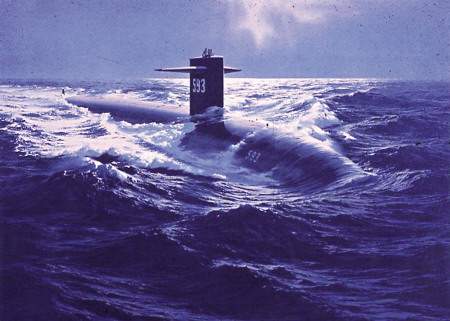
This portait of USS Thresher by RDML. Tom Eccles was released in April 2008, as part of the 45th anniversary of the submarine disaster.

This portait of USS Thresher by RDML. Tom Eccles was released in April 2008, as part of the 45th anniversary of the submarine disaster.

Scores of families were devastated when the nuclear submarine USS Thresher went down on April 10, 1963, but the blow to the Shafer clan of Connecticut was doubly brutal.

A total of 129 U.S. Navy sailors and civilian workers were lost aboard Thresher in the worst submarine disaster of all time. They were fathers, husbands, sons and brothers. In the case of Benjamin and John Shafer, they were brothers from the same bloodline.

Both were electrician’s mates, and both were career sailors. Benjamin, the oldest of the two, had achieved the rank of master chief petty officer, the highest standard achieved by enlisted men; John was a senior chief, the next highest enlisted rank.

They were also both fathers. When Thresher (SSN 593) was lost during sea trials more than 200 miles off the New England coast, Benjamin left behind three sons and a daughter, while John was survived by four sons.

Michael Shafer, Benjamin’s youngest boy, would grow up to devote 29½ years of his life to the Army, enlisting as a private and retiring as a major in 2005. As a military man, he understands the push to get the world’s most advanced submarine of its day into action. It was, after all, the height of the Cold War with the Soviet Union. As hindsight suggests, however, Thresher may not have been ready for the deep-dive tests it was conducting when it sank.

“They gambled and lost,” Michael said.

Both he and his sister Penny Shafer Craig take pride in the sacrifice their father and uncle made for their country, but acknowledge the heavy toll it took on the family.

According to a 1963 newspaper account that ran in the New London (Connecticut) Day in the wake of the Thresher tragedy, the Shafer brothers’ parents were so distraught they had to be placed under heavy sedation by a physician. Family members gathered in the parents’ home were in a state of shock that day, the report stated; Benjamin’s wife Joyce wept as she disclosed the fatal cruise was to be his last before transferring to another command.

And the Shafers’ mother, according to the newspaper, could be heard wailing repeatedly, “Both my sons! Both my sons!”

“Neither one of them lived long after that,” Clara Main, their only surviving sibling, said of her parents this week. “You can truly die of a broken heart — I believe that.”

Brothers and heroes

Benjamin Nathan Shafer was born in September 1926. He enlisted in the Navy in August 1944, after graduating from Robert E. Fitch High School in Groton, Conn. He then completed basic training in Sampson, N.Y., and served aboard the destroyer USS Doyle (DD 494), during World War II. Benjamin was awarded the Asiatic-Pacific Theater Service Medal, the World War II Victory Medal and other decorations earned prior to his discharge in May 1946.

He worked for a time as a welder at the Electric Boat Division of General Dynamics in Connecticut, then according to Michael, opened an electrical repair shop. After his partner took off with the money from their business, Michael said, Benjamin re-entered the Navy in February 1949. He attended the Navy’s Electrician’s Mate School, and ultimately volunteered for submarine duty

He earned his coveted Silver Dolphins when he qualified as a submariner aboard USS Cobbler (SS 344), and attended the Nuclear Power Training Unit at West Milton, N.Y. He also served aboard the nuclear submarine USS Skipjack (SSN 585) before his assignment to Thresher in February 1961.

John Davis Shafer joined his older brother as a crewmember of Thresher in September of that same year.

“They asked to be on the same submarine,” Clara recalled. “They loved each other; they were brothers. They just wanted to be together.”

John was born in August 1929 in Fort Pierce, Fla. During his school years in Groton, Conn., he received awards in both spelling and history competition. Much of his free time was spent fishing, hunting and bowling.

After graduating from Robert E. Fitch High School in 1947, John enlisted in the Navy and entered basic training at the U.S. Naval Training Center in Great Lakes, Ill. He served aboard the aircraft carrier USS Franklin D. Roosevelt (CVA 42) and the heavy cruiser USS Salem (CA 139) before volunteering for submarines.

He followed his brother to Electrician’s School and proceeded to serve aboard the subs USS Harder (SS 568), Kingfish (SS 234) and Trutta (SS 421), earning his Silver Dolphins aboard Entemedor (SS 340).

A third brother — the oldest, Joe — was also a Navy veteran of World War II, while their father had served in France with the Navy in the First World War.

Michael, the retired Army major, takes solace in knowing the Thresher tragedy directly resulted in the creation of SUBSAFE, the Navy’s enhanced submarine safety program. No vessel has been lost after passing through SUBSAFE in the nearly half-century since Thresher’s loss.

Asked about his thoughts regarding the family’s legacy with the submarine, he cites “The Ballad of the Thresher,” a song by the popular folk band the Kingston Trio. Famous for such 1950s and ’60s hits as “Tom Dooley” and “Where Have All the Flowers Gone,” the band paid tribute to the Thresher’s crew in verse shortly after the disaster. In the ballad’s chorus, the trio sings:

“Every man jack on board was a hero

Every man jack on board there was brave

Every man jack on board was a hero

Each man risked a watery grave”

“If you listen to that song, you’ll know,” Michael explained. “It says it all to me.”

‘I was Daddy’s girl”
In 1969, the 116-man Bachelor Enlisted Quarters at the Atlantic Undersea Test and Evaluation Center on Andros Island in the Bahamas was named Shafer Brothers Hall in honor of Benjamin and John.

“I was very proud that the Navy named this building after my father and uncle,” Penny said. “Even though it’s only a barracks, it’s not very often that they name buildings after servicemen.”

However, the decade was otherwise unrelenting on the family. Penny notes both sets of grandparents died in the 1960s, and just days before Christmas 1969 her oldest brother Steve — a high school senior — died in an auto accident. Their mother was “out of it” for a while after that, Penny said. She would listen to the Glen Campbell tune “My Baby’s Gone” and cry as the country artist sang, “Dry all the raindrops/hold back the sun/the world has ended/my baby’s gone.”

“That one almost did her in,” Penny said of her brother’s death. “Eventually, she came back to us.”

Joyce Shafer went to work at the Navy exchange on the New London Submarine Base in Groton, Conn., and eventually retired as private secretary for the head of research and development there, Penny said. She described her mother as independent, strong and stubborn, but said she rarely talked about the loss of her husband. Joyce never remarried and died of cancer at age 55. Penny was only 5 when her father died, while Michael was 6. They remember very little of their dad.

Penny recalled that he loved the amorous animated skunk Pepe Le Pew, and that a photo of herself at the age 2 or 3 wrapped around her father’s arm was inspired by her mother teasing that Benjamin was “MY daddy!”

“I was Daddy’s girl,” she said.

Michael said his father’s legacy as an honest, responsible family man provided him with a “measuring stick” that he applied as a standard while growing up.

“By all accounts he was a great guy,” Michael said, “but I never got a chance to know him.”

About a dozen members of the Shafer clan, including 79-year-old Clara, plan to attend 50th anniversary Thresher ceremonies in Kittery this April.

Impact on the American psyche

After its commissioning in August 1961, Thresher was considered the fastest, quietest, deepest-diving and most lethal submarine the world had ever known. Its loss was a stunning blow to the nation and the world.

It says something of the Thresher disaster’s impact on the American psyche at the time that in addition to the Kingston Trio’s tribute, legendary folk singer Phil Ochs also dedicated a song to the doomed submarine. “The Thresher” appears on Ochs’ first album, “All the News That’s Fit to Sing,” released in 1964. With haunting lyricism, Ochs captures the early enthusiasm surrounding the submarine’s construction “in Portsmouth town on the eastern shore/Where many a fine ship was born.”

“She was shaped like a tear/She was built like a shark/She was made to run fast and free,” he sings. But eventually a sense of impending doom creeps into his lyrics and the vessel becomes “a death ship all along.” He describes the sub’s final voyage, culminating in a stark final verse that conveys her fate:

“And she’ll never run silent

And she’ll never run deep

For the ocean had no pity

And the waves, they never weep

They never weep.”

LOST AT SEA

For a list of personnel who perished aboard Thresher, visit www.history.navy.mil/danfs/t/thresher1.htm

Source – Sea Coast Online

First women qualify as submarine officers

First women qualify as submarine officers»Play Video

In this Navy photo, Master Chief Rusty Staub congratulates Lt. j.g. Amber Cowan, Wednesday, Dec. 5, 2012 in Bangor, Wash. Lt. j.g. Jennifer Noonan is seen at center.
For the last century all fully-qualified submarine officers have been men. But that all changed when two women were honored with their Navy dolphin pins.
The ceremony on Wednesday at Naval Base Kitsap was a graduation day of sorts with crowds, caps, and uniforms.
From a cluster of colleagues, two female crew members of the USS Maine ballistic missile submarine were called front and center for a designation that made them qualified submariners. The two junior lieutenants were among the first three women in the submarine force’s 112-year history to get their dolphins.
“This is the mark where your command puts their confidence in you,” said Lieutenant junior grade Jennifer Noonan.
Fellow submariner Lieutenant junior grade Amber Cowan also got her pin and said she was thrilled.
“I’m a little bit in shock I think,” she said.
Cowan, a University of Washington graduate, and Noonan, a Boston native, each reported to the USS Maine nearly one year ago after completing 15 months of nuclear power school and rigorous training.
Now, they’re officially part of the team.
“They really become like a family more than just the people you work with every day,” said Noonan.
The next group of female submariners will begin arriving at boats in January. That’s when they’ll begin their training toward earning their own dolphin pins.
Source – Komo

Submarine with new design nears completion

Submarine with new design nears completion

The military contractor, which got a boost this week when Congress agreed to not delay the purchase of a Virginia-class sub, is hoping that its record of delivering submarines under budget and ahead of schedule will help protect it from cuts in Washington.”There’s no question we’re in a very constrained fiscal environment,” said Robert Hamilton, a company spokesman. “Any program that is over-running on costs and schedule is going to get a second look.”

The last major piece of the new submarine, the 113-foot-long bow section, arrived at the Groton shipyard a week ago from the company’s partner contractor in the Virginia-class submarine project, Newport News Shipbuilding. The Navy contract calls for the completed sub to be delivered in August 2014.

The new design introduces larger, more versatile weapons tubes in the bow. Despite the changes, the submarine is expected to be ready for delivery ahead of schedule, partly because the design reduced the number of parts in the bow and made construction more manageable, said Chris Cameron, a construction program manager at Electric Boat.

The U.S. is building two Virginia-class submarines a year, at a cost of about $2.6 billion each. The cost-savings for the Navy that come with the redesign of the bow will add up to about $800 million over 20 submarines, Hamilton said.

A budget proposal from President Barack Obama had called for the Navy to purchase only one submarine in 2014, but the U.S. Senate and House of Representatives agreed this week to include money for a second sub that year in the National Defense Authorization Act.

Bob Ross, the director of the state’s Office of Military Affairs, noted the Virginia-class program has been praised for efficiency by the defense secretary.

“It’s really great from our position to be able to articulate that this is the premier, major acquisition program in the country right now,” Ross said. “It puts us on very solid ground when we argue don’t disrupt that production schedule.”

Like other defense contractors around the state and the nation, Electric Boat is still keeping a wary eye on developments in Washington, where talks are under way to reach a deal that would avoid the double hit of tax hikes and automatic spending reductions dubbed the “fiscal cliff.”

Even if those automatic cuts do not take effect, Ross said Connecticut is expected to see a 10 percent reduction in its defense spending over the next six years. He said the automatic cuts could raise that figure as high as 18 percent, but officials have no way to know which programs would be hit.

“The sooner we deal with this issue and remove the uncertainty, the better it is for all of defense contractors in the state,” Ross said.

Source – Hampton Roads

Delaware’s namesake submarine was a long time coming

 Jill Biden (left), Navy Secretary Ray Mabus, Sen. Tom Carper and Lt. Gov. Matt Denn attend the announcement at the Pentagon.

Jill Biden (left), Navy Secretary Ray Mabus, Sen. Tom Carper and Lt. Gov. Matt Denn attend the announcement at the Pentagon.  /  William H. McMichael/The News Journal

//

// // // On Apr. 13, Navy Secretary Ray Mabus announced that the next five Virginia-class attack submarines would be named Illinois, Washington, Colorado, Indiana and South Dakota. He said that none of those states had had a ship named after them “for more than 49 years.” Of those five, only two, Washington and Illinois, have a significant U.S. Navy presence.

Actually, it was more than 60 years – 65, to be precise. So someone gave Mabus some bad information or wasn’t sure and was really fudging it with that phrase. According to the press release, the battleship USS Indiana was decommissioned in October 1963. It was sold for scrapping in September 1963. But it was decommissioned in September 1947 – 65 years ago.

That means Newark’s Steven Llanso had the time lapse right in his April 18 letter to The News Journal editor noting that in announcing the new submarine names, the Navy had missed an obvious candidate in Delaware – an oversight remedied Monday. Llanso’s letter, Delaware’s congressional delegation said, was the spark that initiated their lobbying campaign to get the state its own namesake sub, which will join the fleet in 2018.

Down through history, Navy ships have been named after presidents, war heroes and famous battles. Beginning in 1931, the Navy began naming submarines after fish and “denizens of the deep,” with names such as Barracuda and Skipjack. But a famous about-face took place in 1970, when a submarine was named for William H. Bates, a congressman and staunch Navy supporter on the House Armed Services Committee. The powerful Adm. Hyman Rickover, who governed the Navy sub program with an iron fist for decades, had a pithy explanation for the change: “Fish don’t vote.”

But it is the secretary of the Navy, by custom, who gets to name ships.

If the process of naming ships is something of GREAT interest to you … read the October report by the Congressional Research Service. It notes that recent Navy tradition has followed these rough guidelines:

Aircraft carriers are generally named for past U.S. presidents. Of the last 13, 10 were named for past U.S. presidents and two for Members of Congress.

Virginia (SSN-774) class attack submarines are being named for states. One exception has been made: then-Navy Secretary Donald Winter named SSN-785 after former Sen. John Warner of Virginia. Warner was himself a former Navy secretary and a powerful advocate for the service, particularly in his home state, during his years in the Senate.

Destroyers are named for deceased members of the Navy, Marine Corps and Coast Guard, including secretaries of the Navy.

Littoral Combat Ships (LCSs) are being named for regionally important U.S. cities and communities.

Amphibious assault ships are being named for important battles in which U.S. Marines played a prominent part and for famous earlier U.S. Navy ships that were not named for battles.

San Antonio (LPD-17) class amphibious ships are being named for major U.S. cities and communities and cities and communities attacked on Sept. 11, 2001.

Lewis and Clark (TAKE-1) class cargo and ammunition ships were named for famous American explorers, trailblazers and pioneers.

Mobile Landing Platform (MLP) ships/Afloat Forward Staging Bases (AFSBs) are being named for famous names or places of historical significance to U.S. Marines.

Source – Delaware online