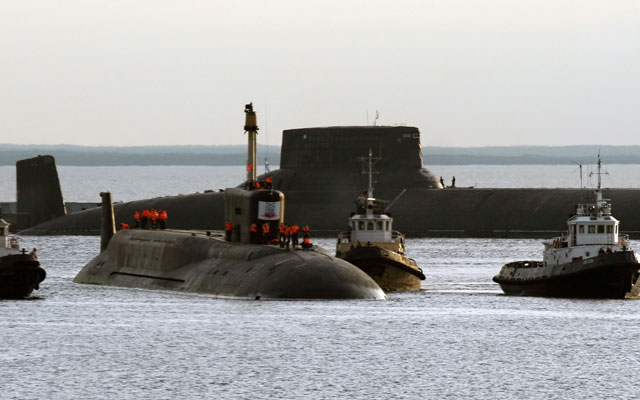
Russia to build 2 nuclear Borei submarines

АПЛ борей подводная лодка борей 2011 декабрь коллаж

Russia is to start building two new advanced nuclear-powered Borei class submarines before year’s end. Once complete, they will be lurking under the sea with 20 Bulava nuclear intercontinental ballistic missiles each.

One of the submarines may be named Aleksandr Suvorov after one of the most decorated generals of the Russian Empire, a source in the defense industry told the media. Its construction is expected to start on July 28, which is Russian Navy Day.

The second vessel is likely to be named after Mikhail Kutuzov, the iconic Russian general of the Napoleonic Wars. Its keel is to be laid down in November.

The vessels are to be built by the shipbuilder Sevmash in Severodvinsk in the north of Russia.

Both submarines are of the Borei class, the most modern strategic nuclear-powered submarines in the Russian Navy. The lead vessel of the class, Yury Dolgoruky, officially entered service on Thursday, with two of his sister-ships currently afloat and undergoing trials.

The two new vessels are distinct from those three, being of an advanced Borei-A version of the same design. They will carry 20 nuclear ICBMs each, as opposed to 16 on the older submarines. They will also have improved maneuverability and better weapon control systems and will generate less noise.

Russia plans to build five Borei-A submarines. The first of them, Knyaz Vladimir, is already in construction.

Russia’s new submarine: arming for peace

From December 10, Russia is starting to exploit a new military submarine, called “Yuri Dolgoruky”. This is a long-standing project that had been suspended for some time. Then, the old project underwent some modifications. The new submarine has already been successfully tested. It is expected that the submarine will defend Russia’s borders.

This submarine is only a small part of Russia’s large-scale program of rearming itself with military equipment of the newest generation.

Russia’s President Vladimir Putin was visiting the city of Severomorsk in Russia’s north, when Defense Minister Sergey Shoygu connected with him through video communication and reported that the new submarine had undergone testing and would soon be exploited.

“This is good news,” the President answered. “But this is not enough. I hope that Russia will continue to further strengthen its navy.”

“It is one of Russia’s top priorities to have a modern, well-developed nuclear navy,” Mr. Putin said. “I hope that we’ll develop both new surface-water ships and submarines. It is planned that in the next few years, Russia will build and start to exploit more than 100 new ships and submarines of various types. I have no doubts that we’ll cope with this task.”

“Yuri Dolgoruky” is a nuclear submarine of the “Borey” type, armed with ballistic missiles. It was built in the Russian city of Severodvinsk, one of Russia’s largest centers of producing nuclear military ships.

Another 3 submarines of the “Borey” type, all named after well-known personalities of old Russian history – “Alexander Nevsky”, “Vladimir Monomakh” and “Knyaz Vladimir” – are still being built. Their equipment will be mainly Russian-made, including radio electronic systems of the latest generation and unique noise reduction transducers.

At present, Russian military submarines are, as a rule, equipped with Russian-made ocean-spanning ballistic missiles “Bulava”. The range capability of such a missile is more than 8,000 kms. One submarine of the “Borey” type can be equipped with 16 “Bulava” missiles.

“It can be said that Russia’s nuclear “shield” consists of three parts – aircraft, navy and land-based missile systems,” Russian military expert Igor Korotchenko says. “Until now, from the point of view of new nuclear equipment, the Russian navy lagged behind the air and the land components of this “triad”. Now, the balance between them will be leveled.”

“The equipment of submarines of the “Borey” type allows to examine the situation under water, to trace and attack various kinds of underwater targets,” Igor Korotchenko continues. “The submarines’ systems of weapons control are also of the latest generation.”

The “Borey” submarines are also more advanced from the point of view of safety than their earlier analogues. In particular, they have a break surface camera where the submarine’s entire crew can be placed in case of emergency.

Russia is planning to build 8 such submarines in the next few years. The construction of each will cost Russia about $ 700 mln.

Speaking about plans for the more distant future, Russia’s Defense Minister Sergey Shoygu says that Russia will have 15 new nuclear submarines before 2012. These submarines will be of various types and meant for various purposes, but all of them will be of the latest generation.

Russian expert in military technologies Ruslan Pukhov says that it is mainly sea-based missiles that make Russia resistant to possible aggression, because land-based missile systems are more vulnerable.

By arming itself with weapons of the latest generation, Russia strengthens its feeling of safety. After all, it is hard to argue with an old saying that goes, “if you want to live in peace, always be ready for a possible war”.

Source – The Voice of Russia

HMS Artemis: A Voyage North – Video Clip

Official British government film.

Impressionistic account of life on the submarine HMS Artemis, told partly through the eyes of Lt. Ellison, a new submarine officer (fifth hand). Includes footage of training at HMS Dolphin, passage aboard HMS Artemis (Amphion class submarine), hydrographic survey on edge of the ice field, and a run ashore in Copenhagen.

Source – Youtube

Australia – 1942 Submarine attack on Newcastle (Book)

A  NEW book about Japanese submarine attacks on Australia in 1942 provides perhaps the most detailed account yet published of Newcastle under fire.

Artwork by Monty Wedd.

A Parting Shot, by Terry Jones and Steven Carruthers, delves into military archives and old records and uses interviews with witnesses to put together a compelling narrative that helps lay to rest some old myths and Novocastrian urban legends.

The authors have disproven, for example, the old story that some of the shells fired by the Japanese submarine I-21 had been made years before in Britain.

The mark in Parnell Place made by a shelling from the submarine.The mark in Parnell Place made by a shelling from the submarine.

And the same close examination of the surviving shells and their distinctive markings has led to the authors’ theory that one shell at the Australian War Memorial – long thought to have been one of those fired on Sydney – is actually a star shell that was fired on Newcastle.

The authors have also taken issue with reports that as many as 34 shells fell on Newcastle.

This estimate was mistaken, they write, insisting that the number can have been no higher than 21 and was probably fewer.Rare photo of the Japanese 121 submarine, believed to be the type of vessel used in the attack on Newcastle.Rare photo of the Japanese 121 submarine, believed to be the type of vessel used in the attack on Newcastle.

Most were high explosive shells, several of which failed to explode.

Some were star shells, designed to illuminate the target area.

The book states that the Japanese were mainly intent on sowing fear in the population and had little real expectation of doing major damage.

Their targets in Newcastle were the BHP steelworks and the old Walsh Island dockyard – which they appeared not to realise had been dismantled years before.

The authors speculate that the submarine switched its attention to the direction of Fort Scratchley and Newcastle East in an attempt to douse the searchlights that had caught it in their beams.

History records that Fort Scratchley successfully frightened the submarine away.

But according to the book, chaos and confusion reigned in Newcastle on June 8, 1942, when the submarine opened fire. Inspecting a terrace with blown-out windows in Parnell Place after the attack.Inspecting a terrace with blown-out windows in Parnell Place after the attack.

The city’s defences were plagued by poor communication and, in some cases, uneasy relationships caused by the conflicting priorities of defence authorities and industry bosses.

A Parting Shot quotes an eyewitness account of the shelling by Lieutenant Ken Robin, aboard HMAS Allenwood, berthed at Kings Wharf in Newcastle Harbour.

‘‘I had a good view to the north, up the river to the steelworks,’’ Lieutenant Robin wrote. ‘‘The flare was white with a yellowish tinge and it floated down slowly on a parachute.

The idea was to illuminate the target for a business round, but they had got the range wrong.

‘‘The star shells burst to the seaward side of the steelworks and didn’t silhouette anything of importance. I would say a maximum of six star shells were fired. They burst over the river, working from north to south from the steelworks to the Horseshoe, opposite the Custom House.

‘‘We heard the case from the last one splash down in the river about 100metres off our starboard beam. There was a slight delay – perhaps 30seconds – after the star shells exploded. Then we heard three or four proper shells coming in. I don’t know where they would have gone. One explosion seemed to come from the seaward side of Fort Scratchley, the next somewhere in the city, south from the station.’’

The good news was that the submarine was frightened away.

The bad news was that the city’s defence communications were shown to be shaky, with the official censor’s report concluding that ‘‘the whole show was a disgrace and should be investigated’’.

ALMOST as interesting as the account of the night of the submarine attack is the book’s description of events a week later, at about 6.30pm on June 14.

Jumpy searchlight operators saw what they thought was a periscope entering Newcastle Harbour and issued a report ‘‘that led to panic and confusion’’.

The book relates that a gun at ‘‘Rail Battery’’ near Nobbys fired at the suspected periscope shortly after 7pm.

‘‘This was followed by light and heavy gunfire from Rail and Wave batteries as the object drifted backwards and forwards at the harbour entrance.

Located on opposite sides of the harbour entrance, both batteries were in each other’s crossfire at various times during the night as they fired at suspicious objects in the water.

The last shot was fired about 2335 hours.’’

During the scare Rail Battery fired five rounds and Wave Battery fired 17.

‘‘One shell ricocheted off the harbour waters and hit the Zaara Street power station, about 75feet above the ground level of No.2 boiler house, fracturing the buttress and making a large hole in the brickwork,’’ the book states.

‘‘Another struck the embankment protecting a petrol supply tank near the pilot station adjacent to HMAS Maitland and Shortland army camp. Several reports record a fragment from this shell made a small hole in the iron roof of a nearby drill hall.’’

The book also reports that a Lewis machine-gun on the northern wave trap at the harbour entrance slipped while being readied for action, firing a stream of bullets towards Newcastle East and forcing troops there to take cover.

The gun fired tracer bullets to illuminate the suspected periscope, but the bullets ricocheted off the water and passed over the army camp.

Searchlight operators and gun crews reported seeing the periscope and also a conning tower, and Wave Battery fired. One of its shells ‘‘struck a metal pole on the perimeter of the battery, cutting a cable, extinguishing the searchlight and slicing through communication lines to the fire commander on Shepherds Hill.’’

A shell fragment hit one artillery spotter’s steel helmet.

According to the book: ‘‘In a move that was either courageous or foolhardy, the RAAF launch Norlan, which was entering harbour when the shelling began, headed down the searchlight beam to look for the submarine during the gunfire.’’

The last shots were fired just before midnight, but the harbour was full of explosions for hours to come, as navy launches and a minesweeper raced around dropping grenades into the water at random intervals.

There appears to have been no submarine, but searchers found a steel drum, some driftwood and a large wooden case.

A Parting Shot will be launched at the Newcastle Maritime Centre on Thursday, January 17, 10 am to noon.

Source – Newcastle Herald

HMCS VICTORIA – A Long Beginning – Video Clip

A Long Beginning shows highlights of making HMCS VICTORIA “in all respects ready” for sea in late 2011 and 2012, culminating in her successful SINKEX at RIMPAC12. The CO shares the challenges faced by his boat and her crew along the way — and their accomplishments.

Source – Royal Canadian Navy Videos

Hawaii-based US Navy submarine damaged in Persian Gulf

US submarine's periscope hits vessel in Persian Gulf

A Pearl Harbor-based submarine was damaged early Thursday when one of its periscopes struck an unidentified vessel in the Persian Gulf, the U.S. Navy said Thursday.

U.S. Naval Forces Central Command said in a statement that no one was hurt in the pre-dawn incident Thursday involving the nuclear-powered USS Jacksonville.

The submarine surfaced from periscope depth to see if the collision damaged the vessel, but the ship continued “on a consistent course” offering no indication of distress or acknowledgement of a collision.

According to a U.S. Navy official, the submarine was submerged when there was a “thump.” When submariners tried to see what happened, they were unable to raise the periscope. When they raised the other periscope, they realized the first one had been sheared off and that a vessel — believed to be a fishing trawler — was motoring away and appeared to be operating normally, the official said.

The official, who was not authorized to discuss an ongoing investigation and spoke on condition of anonymity, said the vessel did not appear to be in any distress. The Navy tried to contact the vessel and determine what it was and what country it belonged to, but was unable to do so. The Navy also reviewed surveillance of the area later and found no vessels in distress, he official said.

The Navy said in its statement that one of the Jacksonville’s two periscopes was damaged. A P-3 Orion aircraft searched the area but saw no debris in the water or vessels in distress, officials said.

The Jacksonville is currently deployed to the Middle East, conducting normal patrol operations in the gulf.

Source – Fox News

Consett submarine commander presented with MBE at Palace

A RETIRED submarine commander surfaced at Buckingham Palace to be presented with an honour for service to his country.

Lieutenant Commander Stuart Hobson, from Consett, in County Durham, collected an MBE announced during the Queen’s Birthday Honours.

The 55-year-old was given the award for his dedication to the UK’s continuous at sea deterrent and helping to promote relations between the Royal Navy and US Navy.

After leaving Blackfyne Secondary School, Lieutenant Commander Hobson embarked on a 38-year career with the Royal Navy, serving on the Polaris submarines HMS Renown, HMS Repulse and HMS Resolution followed by tours with Vanguard submarines HMS Victorious and HMS Vengeance.

He ended his military career on shore as officer-in-charge of HMNB Clyde’s Strategic Weapons Support Building.

He said: “The investiture was a unique experience which made me and my wife very proud, yet humble. It made me feel that my 38-years before the mast was not in vain.”

Since retirement, Mr Hobson has started a new career in the private sector with Lockheed Martin UK Strategic Systems.

Accompanying him to the Buckingham Palace ceremony were his wife, Wendy, and their three children, Chris, Nick and Emma.

Source – The Northern Echo

Russia Sails New Nuclear Submarine While U.S. Continues Fleet Delays


Last week, after long delays, Russia made operational a new ballistic missile submarine (SSBN), or nuclear submarine, for the first time in over 20 years. This marks a significant step forward for the Russian Navy, which has pledged tens of billions of dollars to revitalize its fleet in the near future. The U.S. Navy unfortunately has had trouble both in revitalizing its SSBNs as well as its overall naval fleet.

The Russian navy made the announcement that the Yury Dolgoruky (Project 955)—the first-in-class of the new Borey-class SSBN—made operational status as it prepares for one of its largest naval exercises since the end of the Cold War. In fact, Russia’s commitment to increasing naval strength has been a central theme during Russian President Vladimir Putin’s tenure as president—despite Russia’s historically meager performance as a naval power. The Borey-class subs were first designed in the 1980s and the Yury Dolgoruky construction was launched in 1996.

Meanwhile, the U.S. navy has shrunk significantly since the Reagan years. The days of the 600-ship fleet have long since ended, and now U.S. naval leaders are struggling to find ways to meet a new requirement of around 300 ships. Currently around 285, the fleet will shrink further if more investment isn’t made in naval modernization.

The U.S. fleet was eroding long before the Budget Control Act and sequestration became part of the equation. In 2010, the Congressional Budget Office (CBO) reported that actual funding levels for 2005–2010 fell below the CBO’s and the Navy’s estimates to achieve fleet goals. Predictions show current funding levels would reduce the fleet to 263 ships. While the sequestration cuts to defense have been temporarily delayed as part of the fiscal cliff deal, they are still a looming possibility and would shrink the fleet to its lowest level since 1915.

While Russia has shown improvements in its strategic SSBN fleet (two more Borey-class subs are under construction), the U.S. has fallen behind its own standards. The legal minimum for the U.S. Navy’s SSBN fleet is 12 boats. Given this fleet’s status as the most survivable leg of the U.S. nuclear triad, the requirement should not be taken lightly. However, the Obama Administration delayed the development of an Ohio-class SSBN replacement for two years, which will in turn cause the fleet to fall below 12 boats for a 14-year period. As rogue states such as Iran and North Korea get closer to having nuclear weapons and increasing ballistic missile technology, the significance of this fleet is certainly not shrinking.

The President has downplayed the size of the fleet by making oversimplified arguments that each ship’s capability makes strength in numbers less significant. Yet with Russia aggressively growing its naval capability, resulting in a greater presence on the high seas, as well as China paying increased attention to naval capability, the U.S. must continue to uphold its status as the dominant global naval power. The fiscal year 2013 National Defense Authorization Act states that “the continuous at-sea deterrence provided by a robust and modern fleet of nuclear-powered ballistic missile submarines is critical to maintaining nuclear deterrence and assurance and therefore is a central pillar of the national security of the United States.”

Both Congress and the President need to keep this support up to maintain America’s robust naval

Source – The Foundry

Binge drinking on submarine shocks police investigating fatal shooting

Ian Molyneux inquest

Royal Navy Commander Iain Breckenridge leaves the inquest in Southampton after giving evidence into the death of Lt Cdr Ian Molyneux.

Ryan Donovan had drunk 20 pints, as well as cocktails and vodkas, before he was put on a duty with a gun, hearing told

Police investigating a naval rating shooting dead an officer on board a submarine were so alarmed by the crew’s binge drinking that the chief constable was informed and he then contacted military authorities, an inquest has heard.

Detective Superintendent Tony Harris interviewed the crew aboard HMS Astute following the shooting of Lieutenant Commander Ian Molyneux by Able Seaman Ryan Donovan, who was 76% above the drink-drive limit.

The hearing in Southampton was told the officer was “highly alarmed” by the crew’s alcohol consumption and he wrote to the Hampshire chief constable, Alex Marshall, with his concerns. His boss then contacted Brigadier Neil Baverstock.

After talking to the crew, detectives concluded that Donovan’s drink intake was not out of the ordinary.

The hearing previously heard he had drunk 20 pints of cider and lager, cocktails and double vodkas in the 48 hours before he was put on a guard duty with a gun.

Richard Wilkinson, counsel for Lt Cdr Molyneux’s family, told the hearing police found significant numbers of the crew were involved in getting “drunk out of their minds”.

“Detective Superintendent Tony Harris was highly alarmed at the alcohol consumption of the Astute’s crew and he took the unprecedented action of writing to the chief constable.

“It was normal practice for the crew of the boat to drink heavily while on shore leave, consuming alcohol over an extended period until they passed out and then returned to duty after five or six hours,” he told the hearing.

The Royal Navy has since tightened its rules on alcohol consumption before duty.

At the time sailors were allowed 10 units in the previous 24 hours with no alcohol in the 10 hours before duty, which has been changed to five units.

Wilkinson asked the nuclear-powered sub’s captain at the time, Commander Iain Breckenbridge, whether he had any concerns about his crew drinking ashore during the goodwill visit to Southampton in April 2011 when the killing and the shooting of another officer took place.

He told the inquest he had been told of no concerns about the crew and he had no concerns about Donovan before the shootings and he was surprised to hear of the police’s fears of binge drinking by the crew.

But when asked if tighter controls should be put in place to check such as breathalysing crew, Cdr Breckenbridge said: “To minimise the chances of a similar event, it’s something that should be seriously considered but that’s for the policy-makers.”

The inquest continues.

Source – The Guardian

Giant Squid Attacking a Submarine – Video clip

Our friend “Jonny party”s at The Scuttlefish found this video of the Architeuthis, the living kraken filmed by Tsunemi Kubodera and his team after 400 hours in a research sub. It’s only a few seconds, but you can see the beast both peacefully floating and attacking the submarine.

The monster seems to be mightly annoyed, but who can blame it. According to Kubodera, they live “a solitary existence, swimming about all alone in the deep sea. It doesn’t live in a group, so when I saw it, well, it looked to me like it was rather lonely.”

Source – Gizmodo

Colombia navy seize submarine intended for drug trafficking

Submarine3

The Colombian navy said Tuesday it has found an unmanned semi-submersible submarine used for drug trafficking adrift in the Pacific Ocean.

The submarine was found by a navy patrol 60 nautical miles from the mouth of the Naya river, which enters the Pacific from Colombia’s South coast, without crew or drugs.

Authorities have theorized that had events gone to plan, drug traffickers would have rendezvoused with the submarine, loaded a drugs shipment, and dropped off a crew to pilot the transporter to Central America.

The submarine “could reach the Mexican coast without refueling, and has a fuel capacity of around eight days,” according to Navy Commander Carlos Delgado.

Delgado said the submarine 18 meters long and 3 meters wide, is equipped with two diesel engines and has the capacity to carry three to four people and up to five tons of illicit substances.

It is the first semi-submersible submarine to be seized by authorities in 2013, following the eight that were confiscated in 2012.

Source – Columbia Reports