Tag Archives: Russia

Three Russian nuclear submarines to be recommissioned

27_big

Three nuclear submarines of the Russian Navy currently under maintenance will be recommissioned by 2014, a Navy spokesman said.

The K-410 Smolensk cruise missile submarine, which is undergoing repairs since 2011, will resume its service in the Northern Fleet, the spokesman said Tuesday.

The Pacific Fleet will be rejoined by the K-150 Tomsk cruise missile submarine, which was docked in 2010 due to problems with the cooling engine of its nuclear reactor; and the K-419 Kuzbass attack submarine, under repairs since 2010.

The Kuzbass belongs to the same Akula II class as the ill-fated K-152 Nerpa, on which 20 people were killed during sea trials in 2008 due to malfunction of the fire suppression system.

The Russian Navy has 48 nuclear submarines, 20 of which are currently undergoing repairs or upgrade, according to Russian-ships.info database.

Source – DESI

Russia boosts its submarine exports to Asia

Two Malaysian Air Force Lady officials take a look at the two submarines from France "La Praya" and Pakistan "Hurmat" at the Langkawi International Maritime and Aerospace (LIMA '97) Exhibition 03 December in Malaysia's resort island Langkawi.
Two Malaysian Air Force Lady officials take a look at the two submarines from France “La Praya” and Pakistan “Hurmat” at the Langkawi International Maritime and Aerospace Exhibition in Malaysia’s resort island Langkawi.


During the Langkawi International Maritime and Aerospace exhibition taking place in Malaysia, Igor Vilnit, the CEO of the Russian developer of submarines Rubin, reported on the progress of a number of development projects aimed at exporting Russian submarines to Asian countries. Vasily Kashin, an expert at the Center for Analysis of Strategies and Technologies, analyzes the situation.

This year Vietnam will receive the first of six Project 636 submarines it has ordered. At present, the first Vietnamese submarine, which was named “Hanoi”, is already undergoing testing. At the beginning of this year the Vietnamese team of the future vessel started its training in Russia. Simultaneously, Russian specialists are building in Vietnam the entire necessary infrastructure for using the submarines and training the submarine personnel.

One cannot exclude the possibility that the transfer to Vietnam of the Project 636 submarines will go more quickly than what was stated by Rubin’s CEO, – suggests expert Vasily Kashin. It is known for a fact that the second submarine of the Vietnamese order has already been launched, while the third one is expected to be launched in August. It is quite possible that this year Vietnam will get two submarines and another one in 2014. All six submarines have to be transferred to Vietnam by the end of 2016.

Thus, 2013 will be used to develop the Vietnamese fleet’s submarine forces. Prior to this Vietnam tried to set up its submarine forces by purchasing two superlight submarines from North Korea, but it failed. North Korea’s light submarines turned out to be too weak in their combat capabilities.

According to Vasily Kashin, an expert at the Center for Analysis of Strategies and Technologies, the acquisition of the Project 636 submarines from Russia satisfies Vietnam’s need to defend its sovereignty at sea and in reality poses no threat to the interests of Russia’s strategic partner China. The limited submarine forces would not give Vietnam any chance of winning the battle against the Chinese fleet, which supersedes it by several times, but would allow it to preserve the status-quo with its own resources. The lack of its own effective naval forces could push Vietnam towards a closer partnership with powers from outside the region, like it happened in the Philippines’ case. Taking all this into account, the real conflict between Vietnam and China has a very low probability as China’s policy towards Vietnam is based on the maximum engagement of the Vietnamese in trade and economic cooperation.

Another promising direction for the export of Russian submarines to Asia is India. The India’s navy is getting ready to announce a tender for the purchasing of 6 non-nuclear submarines. According to Rubin’s CEO Igor Vilnit, Russia is planning to offer the Indians its submarines of the Amur-950 project. Amur-950 is a reduced version of the Amur-1650 submarines, the acquisition of which China is currently negotiating to purchase. Compared to Amur-1650 they have a lower displacement and a lower range, while their armament is just slightly inferior to that of the Amur-1650 submarines.

The specific qualities of the Amur-950 submarines include the vertical launch for 10 ballistic missiles, which if needed could be launched within 2 minutes.

The offer to the Indian Navy includes the vessels equipped with ultrasound ballistic missiles “Brahmos” jointly produced by Russia and India. Russia’s participation in the Brahmos project is considered to give a serious advantage to the Russian proposal for this tender, in which the French submarine producers are participating as well. Obviously, these submarines of a low displacement are meant to be used in the Indian Ocean only.

 At the same time, the negotiations with China are still underway to supply four larger Amur-1650 submarines, of which two are likely to be equipped with the new Russian engines which work without air supply. Due to the extended range of action, the Amur-1650 submarines can be used in the Pacific Ocean at far distances from the bases. Compared to the Project 636 submarines supplied to China earlier, Amur-1650 boats have lower level of perceptibility, which increases their chances of overcoming Japan’s system of submarine defense.

The modern diesel-electric submarines are an effective and relatively inexpensive weapon, which gives the naval forces of Asia’s developing countries a chance to stand up to the large fleets of the developed countries, believes Vasily Kashin, a Russian expert on defense issues. The experience of the Falklands war of 1982 and the subsequent naval military exercises of the NATO countries revealed that with proper management such boats can successfully overcome the anti-submarine defense of aircraft carrier combat groups.

Source – The Voice of Russia

China buys 4 submarines, 24 fighters from Russia

China has agreed to buy 24 Su-35 fighters and four Lada-class submarines from Russia in recent arms purchase deals signed shortly before President Xi Jinping‘s just-concluded visit to Russia, China Central Television reported on Sunday.

The deals raised concern among some regional players and media. Chinese observers said the reaction was “unnecessary” because the purchase is not directed at any third party.

A Russian Su-35 fighter jet. The Su-35 is currently the most advanced Russian fighter jet in mass production.  [File Photo]

The purchases represented “the first time in nearly 10 years” that China had bought large military technological equipment from Russia, the report said.

The four submarines will be jointly designed and built by both countries, with two of them to be built in Russia and the other two in China.

“The Su-35 fighters can effectively reduce pressure on China’s air defense before Chinese-made stealth fighters come online,” the report said.

Li Hong, secretary-general of the China Arms Control and Disarmament Association, said the recent purchases and joint building plan serve as an indicator of the evolution of the overall Sino-Russian strategic partnership.

“It is the natural, well-deserved fruit of bilateral defense cooperation, and both sides have made it clear that the bilateral strategic partnership is not targeting anyone,” Li said.

As for some countries and their speculation on the intentions behind the arms deals, Li said China is not the only country that has signed big arms deals with Russia recently.

Shengyang Aircraft Corporation, a Chinese civilian and military aircraft manufacturer who is engaged in the production of J-11BS fighters and the development of J-15 and J-16 fighters, will not participate in the production of Su-35 fighters. [File Photo]

Geng Yansheng, a spokesman of the Ministry of National Defense, said last month that Sino-Russian cooperation on military technology is not directed at a third party, and that it will facilitate peace and stability in the world and the region.

The enhanced agenda of bilateral defense cooperation also has seen Xi, who is also chairman of the Central Military Commission, visit Russia’s Defense Ministry on Saturday.

Xi is the first Chinese head of state to have made the tour, and he said the idea of visiting the ministry was proposed by Russian President Vladimir Putin.

The world is still unequal, unbalanced and tumultuous, with challenges of both “traditional and nontraditional” threats, as well as the further spreading of turmoil in some areas, Xi said.

China and Russia, in the face of complicated international situation, should strengthen their coordination, and work with the international community to deal with all kinds of challenges and threats, he said.

Meng Xiangqing, deputy director of the Strategic Research Institute at the National Defense University of the PLA, said the meetings have shown a profound development of both countries’ armed forces in the field of “pragmatic cooperation” in addition to friendly gestures.

On Sunday, Chang Wanquan, Chinese State councilor and defense minister, said during a meeting with Russian Defense Minister Sergei Shoigu that wide-ranging and multilayer defense cooperation has become a cornerstone of the China-Russia comprehensive strategic partnership.

“Given the complex international scenario today, China-Russia strategic cooperation and coordination will not only benefit the two peoples, but also help promote world peace and stability,” he said.

Shoigu, for his part, hailed the “unprecedented high level” of the Sino-Russian strategic partnership. The consensus reached by the top leaders has shown the direction of future development of bilateral ties, he said.


A file photo of a Su-35 fighter jet. [Photo: bbs.ychouse.cq.cn]

Two of the submarines will be built in Russia, and the other two will be built in China. [File Photo]

A file photo of a Lada-class submarine. [Photo: armystar.com]


Source – China.org.cn

The world’s biggest submarine

Not particularly new news but a very interesting set of pictures taken from an interesting site.

World's Biggest Submarine - Russian Submarine Typhoon

This is submarine “Typhoon” as it was called in NATO documents or “Shark” as it was called in Russia. It is considered to be the biggest submarine in the world, with over than 170 meters (515 feet) long and 23 meter (70 feet) wide. It can carry 20 ballistic nuclear missiles and there were only six of those built. Only 3 left intact, but are staying now out of service with armament control blocks detached according to the agreement between USSR and USA signed by M. Gorbachev. Without those they are way too peaceful.

See more pictures at – English/Russia

Submariner Day in Russia

09.11.2008 АПЛ подлодка подводная лодка судмарина Акула Нерпа

March 19th marks Submariner Day in Russia. 107 years ago, on March 19th 1906, Emperor Nicholas II issued a decree declaring submarines a separate class of warships and including ten submarines in the Russian Navy.

Russia’s first submarine – the Dolphin – rolled off the Baltic Shipyard in 1904.

At present, submarines make up the backbone of the country’s naval strategic nuclear forces.

Naval mariners, Navy veterans and cadets will lay flowers to the monuments of submariners and shipbuilders who took part in the creation of submarines.

Floral tributes will also be laid to the Kursk Submarine Memorial outside the Central Museum of the Armed Forces in Moscow.

Source – The Voice of Russia

Russian Navy to receive 24 submarines, 54 warships by 2020, defense minister says

Russian-manufactured Admiral Gorshkov aircraft carrier

 Russian Defense Minister Sergei Shoigu has announced that the Russian Navy will receive 24 submarines and 54 warships of various classes by the year 2020.

“As a result of the government rearmament program, the Navy will receive eight nuclear-powered strategic submarines, 16 multi-purpose submarines, and 54 surface ships of various classes by 2020,” the RIA Novosti news agency quoted Shoigu as saying on Monday. He stated that constant upgrading of the fleet was an important part of the Russian Navy’s overall development.

Russia plans to build eight Borei class submarines by 2020. The Borei class is a class of nuclear-powered ballistic missile submarine produced by Russia and operated by the Russian Navy. The class is intended to replace the Delta III, Delta IV, and Typhoon classes now in the Russian Navy service and form the core of its nuclear deterrence strategy.

The Russian manufactured Borei class submarine, the Yury Dolgoruky
The first Borei class submarine, the Yury Dolgoruky, was put into active service in January.
A second one, the Alexander Nevsky, has been undergoing sea tests. The construction of a third one, the Alexander Suvorov, is to start in July.
The 16 multi-purpose submarines include Graney class nuclear-powered attack submarines and improved Kilo and Lada class diesel-electric subs.
The Russian Navy will also receive Admiral Gorshkov class frigates, Steregushchy class corvettes, Buyan class corvettes, and Ivan Gren Class landing ships.
Last year, Russian President Vladimir Putin said that the procurement of new warships and submarines for Russia’s Navy would be a priority over the next decade.
The Russian government has earmarked five trillion rubles ($166 billion) — a quarter of the entire armament procurement budget until 2020 — for this purpose.
Source – Press TV

Russia, Vietnam agree on submarine fleet deal

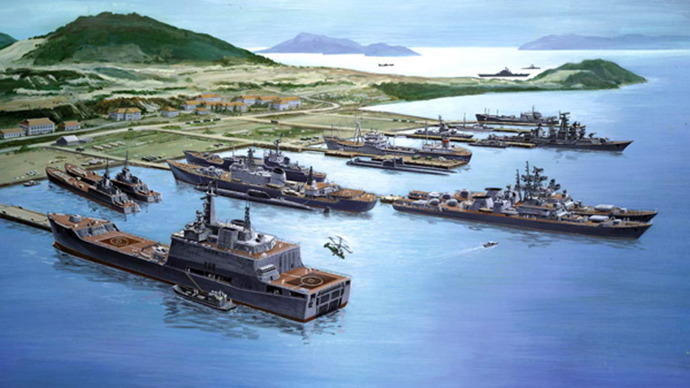
cam_ranh_naval_base_concept__si

Artist’s concept of ships in port at Cam Ranh Bay, Vietnam.

Vietnam will get its own submarine fleet as soon as this year, said Russia’s defense minister while on a visit to Hanoi.

This year a new page will be opened in the history of the Vietnamese Navy – it will get a fleet of submarines,” Sergey Shoigu told reporters following the meeting with the Vietnamese Defense Minister Phung Quang Thanh.

The Russian minister said that they reached an agreement on synchronization in preparing both the submarines and their crews, and also decided that Russian military schools would train more Vietnamese specialists in the nearest future.

In earlier comments Shoigu called the cooperation with Vietnam one of the priorities of Russia’s foreign policy and promised that Moscow would renew active military cooperation with Hanoi.

In particular, the two sides discussed the possibility for Russian specialists to use the naval base and the military airport in Cam Rahn. All talks were held in secrecy, but Shoigu’s visit to Vietnam started from a trip to Cam Rahn, which was once used by Soviet and then by the Russian Navy, but was abandoned in 2002 due to lack of funds.

Russian experts are divided on the possibility and necessity of putting Russian military bases in Vietnam. Colonel-General Leonid Ivashov, former head of the foreign cooperation department of the Russian Defense Ministry, told the Nezavisimaya Gazeta daily that such a step is simply necessary as it would seriously strengthen Russia’s positions in the South East Asia.

At the same time, the Interfax news agency quoted an unnamed source in the Russian Navy HQ as saying that the return of the Cam Rahn base is not necessary and the issue is not even on the agenda.

News of Russia’s future role in the beefing up of the Vietnamese navy comes on the background of the major international row over the South China Sea and its major oil and gas deposits.

In the latest developments, Vietnam has commenced exploratory drilling on the sea shelf, but China replied with a note demanding it to stop. Soon after that China declared that the oil under the South China Sea was its national asset. Other neighboring countries, such as the Philippines and Malaysia also voiced claims to the resource-rich region.

Source – RT dot Com


Back From The Dead – Russian Lada Class Submarine


A year after cancelling its Lada class diesel-electric submarines, Russia has revived the project as part of a joint development effort with an Italian firm (Fincantieri). This effort will build the S-1000 submarine, as well as revive other export versions of Lada. These were called the Amur class, and the S-1000 began as the Amur 950. This was what the export version of the Lada was to be called but working with an Italian shipbuilder the Amur 950 has been transformed into the cheaper (less than $200 million each) S-1000 class submarine. While Fincantieri has never built subs (just destroyers, aircraft carriers, and patrol craft), it is one of the largest ship builders in Europe and has access to a lot of Western military technology. The S-1000 will have a crew of only 16. Top submerged speed is 26 kilometers an hour. There are six torpedo tubes and an AIP (air independent propulsion) system to extend underwater endurance to 15 days or more. Instead of eight torpedo reloads, the S-1000 can carry a dozen commandoes.

Lada was developed in the 1990s, as the successor to the Kilo class, but it was determined that there was not enough difference between the Lada and the improved Kilos being built. So Lada/Amur was canceled last year. One Lada was built and another is partially completed and will probably be finished as the under construction (and may be completed). The Russians are hoping that the S-1000 will spark interest in the various Amur designs. The largest of these is the Amur 1650, which is basically the Lada with some top-secret Russian equipment deleted.

The Ladas have six 533mm torpedo tubes, with 18 torpedoes and/or missiles carried. The Lada has a surface displacement of 1,750 tons, are 71 meters (220 feet) long, and carries a crew of 38. Each crew member has their own cabin (very small for the junior crew, but still, a big morale boost). When submerged the submarine can cruise at a top speed of about 39 kilometers an hour (half that on the surface) and can dive to about 250 meters (800 feet). The Lada can stay at sea for as long as 50 days and can travel as much as 10,000 kilometers using its diesel engine (underwater, via the snorkel). Submerged, using battery power alone, the Lada can travel about 450 kilometers. There is also an electronic periscope (which goes to the surface via a cable) that includes a night vision capability and a laser range finder. The Lada was designed to accept an AIP (air independent propulsion) system. Russia was long a pioneer in AIP design but in the last decade Western European nations have taken the lead. Russia expects to have its own AIP in production within three years.

Construction on the first Lada began in 1997, but money shortages delayed work for years. The first Lada boat was finally completed in 2005. A less complex version, called the Amur, was offered for export. There were no takers.

The Ladas are designed to be fast attack and scouting boats. They are intended for anti-surface and anti-submarine operations as well as naval reconnaissance. These boats are said to be eight times quieter than the Kilos. This was accomplished by using anechoic (sound absorbing) tile coatings on the exterior and a very quiet (skewed) propeller. All interior machinery was designed with silence in mind. The sensors include active and passive sonars, including towed passive sonar. Russian submarine designers apparently believe they can install most of these quieting features into improved Kilos, along with many other Lada features.

Two years ago Russia began construction of its second “Improved Kilo” submarine. These are mostly for the export market, although the Russian Navy is buying a few more of this improved model as well. The Kilos weigh 2,300 tons (surface displacement), have six torpedo tubes, and a crew of 57. They are quiet and can travel about 700 kilometers under water at a quiet speed of about five kilometers an hour. Kilos carry 18 torpedoes or SS-N-27 anti-ship missiles (with a range of 300 kilometers and launched underwater from the torpedo tubes). The combination of quietness and cruise missiles makes the Kilo very dangerous to American carriers. But for the Russians their Kilos are mostly for home defense. Nuclear subs are used for the long distance work.

The Kilo class boats entered service in the early 1980s. Russia only bought 24 of them but exported over 30. It was considered a successful design, especially with export customers. But just before the Cold War ended in 1991, the Soviet Navy began work on the Lada. This project was stalled during most of the 1990s by a lack of money but was revived in the last decade.

Russia has 17 Kilos in service (and six in reserve) and six Improved Kilos on order. More than that is on order from foreign customers.

Source – Strategy Page

Russia – Project 955A submarines to carry 16 missiles

According to a source in the Military-Industrial Commission, quoted by RIA Novosti, Project 955A submarines will carry 16 Bulava SLBMs, not 20, as most reports previously stated.

Construction of the lead submarine of the Project 955A class and the 4th in the Borei class , Knyaz Vladimir, was formally started in July 2012 (although substantial amount of work on the hull had been already done by then). Unlike the three Project 955 submarines, Knyaz Vladimir does not use components of previously build ships.

Source – Missile Threat

S-1000 submarine – joint Russian-Italian development

S-1000

Russia and Italy are resuming their joint development S-1000 submarine, which is an export version of the Amur class submarine. The joint development is between Rubin Design Bureau of Russia and Fincantieri of Italy.

Although the main global producers of submarines such as Germany, France and Russia continue to receive stable revenues by exporting their submarines, the development of modern models is becoming more sophisticated. This often requires cooperation with other countries. Cooperation also enables the partners to make development and production less expensive. In conditions where more and more countries are planning to create or upgrade their own submarine fleet the Russian-Italian project on building the S-1000 submarine promises to become a profitable enterprise for both countries.

The idea of creating a joint Russian-Italian submarine emerged in the late 1990-s. The actual development of the 1000-tons heavy submarine began in 2004. In 2008, the work was interrupted because of the global economic crisis. However, today the situation looks more optimistic with the growing demand for submarines in the Asian-Pacific region.

The new submarine can interest any country that is looking for less expensive solutions. S-1000 is a quite universal submarine. It is designed for anti-submarine and anti-ship warfare, reconnaissance missions, and the transportation of up to 12 troops. The submarine is equipped with a new fuel cell-powered Air Independent Propulsion (AIP) system developed in Italy. The price of the future S-1000 is not unveiled but industry experts say that it won’t exceed $120 million-150 million per unit. This price even together with the costs of maintenance and crew training makes the submarine affordable even for relatively poor countries.

Taking into account the current state of the joint project the production of S-1000 can start already in 2-3 years. Moreover in terms of price this project has almost no competitors.

Cooperating with Italy on S-1000 Russia will also continue working on other Amur-class submarines for example Amur-950. This is a more expensive submarine which also features an impressive array of weaponry including missiles. It is known that Russia’s Defense Ministry is planning to resume the serial construction of 677 submarines for the national Navy. These submarines are equipped with the Air Independent Propulsion (AIP) system. The export version of 677 is known as Amur-1650. China and Indonesia are showing interest in buying these submarines.

Source – The Voice of Russia