Tag Archives: Submarine

Columbia uses submarines to smuggle drugs

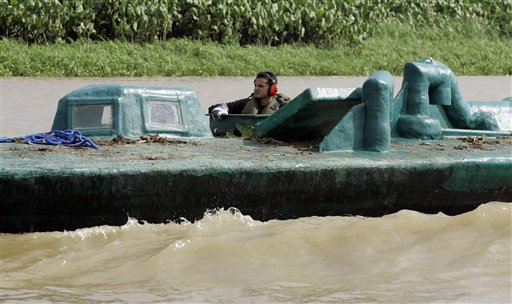
A Navy sailor drives a seized submarine, used by drug-traffickers to smuggle drugs, while displaying it to the media in Atrato River, coast of Turbo, Colombia

A Navy sailor drives a seized submarine, used by drug-traffickers to smuggle drugs, while displaying it to the media in Atrato River, coast of Turbo, Colombia

On January 8th the Colombian Navy captured its first drug smuggling submersible vessel of the year. This one was 18 meters (56 feet) long and capable of carrying over four tons of cocaine. It had been abandoned at sea and was towed back by a Colombian Navy ship to try and find out what happened. Last year the Colombians captured eight of these. Naval forces from the United States and other nations along the Pacific coast and the Caribbean caught even more. But the detection system, run mainly by the United States, locates a lot more of these cocaine subs than there are warships available to run them all down.

For two decades the United States has used a special interagency (Departments of Homeland Security, Justice, State, and Defense) and international (over a dozen nations participate) intelligence sharing/analysis operation (Joint Interagency Task Force-South) to track drug smuggling from South America. For the last decade the task force has become quite expert at tracking the submarines and submersibles built in South America for smuggling cocaine to North America and, recently, all the way to Europe. Some of these long range subs are apparently going all the way from Ecuador to the United States, bypassing the Mexican cartels (who have been fighting each other, in a big way, for the last five years).

A makeshift submarine is lifted out of the water at Bahía Malaga on the Pacific coast,

Particularly worrisome are the larger boats headed for Europe. Little is known about these, expect that they exist. These subs would be more at risk of being lost because of accident or bad weather than being spotted. European navies (especially Portugal and Spain) and coast guards have been alerted and are looking.

Despite losing over a hundred of these vessels to the U.S. and South American naval forces (and dozens more to accidents and bad weather) the drug gangs have apparently concluded that the subs are the cheapest and most reliable way to ship the drugs. It’s currently estimated that over 80 percent of the cocaine smuggled into the United States leaves South America via these submarines or semi-submersible boats.

Most of these craft are still “semi-submersible” type vessels. These are 10-20 meter (31-62 foot) fiberglass boats, powered by a diesel engine, with a very low freeboard and a small “conning tower” providing the crew (of 4-5), and engine, with fresh air and permitting the crew to navigate. A boat of this type was, since they first appeared in the early 1990s, thought to be the only practical kind of submarine for drug smuggling. But in the last decade the drug gangs have developed real submarines, capable of carrying 5-10 tons of cocaine that cost a lot more and don’t require a highly trained crew. These subs borrow a lot of technology and ideas from the growing number of recreational submarines being built.

The Colombian security forces and other Latin American navies have been responsible for most of these vessel captures. Usually these boats are sunk by their crews when spotted but the few that were captured intact revealed features like an extensive collection of communications gear, indicating an effort to avoid capture by monitoring many police and military frequencies. The Colombians have captured several of these vessels before they could be launched. In the last few years the Colombians have been collecting a lot of information on those who actually build these subs for the drug gangs and FARC (leftist rebels that provide security and often transportation for moving cocaine). That includes finding out where the construction takes place.

Colombian police have arrested dozens of members of gangs that specialized in building submarines and semisubmersible boats. As police suspected, some of those arrested were retired or on active duty with the Colombian Navy (which operates two 1970s era German built Type 209 submarines). These arrests were part of an intense effort to find the people responsible for building subs for cocaine gangs. Find the builders and you stop the building efforts. In this case it has only delayed some construction and made it more expensive to build these boats.

Ecuadoran police found the first real diesel-electric cocaine carrying submarine three years ago. It was nearly completed and ready to go into a nearby river, near the Colombian border, and move out into the Pacific Ocean. The 23.5 meter (73 foot) long, three meter (nine feet) in diameter boat was capable of submerging. The locally built boat had a periscope, conning tower, and was air conditioned. It had commercial fish sonar mounted up front so that it could navigate safely while underwater. There was a toilet on board but no galley (kitchen) or bunks. Submarine experts believed that a five man crew could work shifts to take care of navigation and steering the boat. The boat could submerge to about 16 meters (50 feet). At that depth the batteries and oxygen on board allowed the sub to travel up 38 kilometers in one hour, or at a speed of 9 kilometers an hour for 5-6 hours. This would be sufficient to escape any coastal patrol boats that spotted the sub while it moved along on the surface (its normal travel mode). The boat could also submerge to avoid very bad weather. The sub carried sufficient diesel fuel to make a trip from Ecuador to Mexico. There was a cargo space that could hold up to seven tons of cocaine.

The sub was captured where it was being assembled and a nearby camp for the builders appeared to house about fifty people. A lot of evidence was collected, and apparently the U.S. DEA (Drug Enforcement Agency) used that to develop clues about who was involved. It was the DEA that put together the pieces that led to identifying key people.

The Ecuadoran boat was the first such sub to be completed but not the first to be attempted. Back in the 1990s Russian naval architects and engineers were discovered among those designing and building a similar, but larger, boat. However, that effort did not last, as the Russian designs were too complex and expensive. It was found easier to build semi-submersible craft. But more and more of these new type subs are being found.

Source – Strategy Page

CSC set to supply gas cylinders for Astute nuclear submarines

Chesterfield Special Cylinders (CSC) has won a £2m contract by BAE Systems  Submarine Solutions to provide high-pressure gas cylinders for the Royal Navy’s  sixth Astute-class nuclear submarine — the HMS Agamemnon.

The cylinders are critical to a number of operations within the Astute  vessels, including breathing gas storage, hydraulic and valve actuation back-up,  ballast operation and missile launch systems.

The order takes the value of CSC’s contracts for the Astute-class submarines  to more than £12m, having already supplied gas and oxygen systems for the Astute and Ambush submarines, which are already in the water,  and the next three (Artful, Audacious and Anson)  being built by BAE in Barrow-In-Furness. A seventh and final Astute, Ajax, is due to enter service in 2024.

Source – TheEngineer

Chinese Submarine Training

Submarine flotilla in training
Recently, the officers and men of a submarine flotilla under the North China Sea Fleet of the Navy of the Chinese People's Liberation Army (PLA) conducted routine training. The photo features the scene of the training. (chinamil.com.cn/Li Zhikai)
Recently, the officers and men of a submarine flotilla under the North China Sea Fleet of the Navy of the Chinese People’s Liberation Army (PLA) conducted routine training. The photo features the scene of the training. (chinamil.com.cn/Li Zhikai)
.
Recently, the officers and men of a submarine flotilla under the North China Sea Fleet of the Navy of the Chinese People's Liberation Army (PLA) conducted routine training. The photo features the scene of the training. (chinamil.com.cn/Li Zhikai)
Recently, the officers and men of a submarine flotilla under the North China Sea Fleet of the Navy of the Chinese People’s Liberation Army (PLA) conducted routine training. The photo features the scene of the training. (chinamil.com.cn/Li Zhikai)
.
Recently, the officers and men of a submarine flotilla under the North China Sea Fleet of the Navy of the Chinese People's Liberation Army (PLA) conducted routine training. The photo features the scene of the training. (chinamil.com.cn/Li Zhikai)
Recently, the officers and men of a submarine flotilla under the North China Sea Fleet of the Navy of the Chinese People’s Liberation Army (PLA) conducted routine training. The photo features the scene of the training. (chinamil.com.cn/Li Zhikai)
.
Recently, the officers and men of a submarine flotilla under the North China Sea Fleet of the Navy of the Chinese People's Liberation Army (PLA) conducted routine training. The photo features the scene of the training. (chinamil.com.cn/Li Zhikai)
Recently, the officers and men of a submarine flotilla under the North China Sea Fleet of the Navy of the Chinese People’s Liberation Army (PLA) conducted routine training. The photo features the scene of the training. (chinamil.com.cn/Li Zhikai)
.
Recently, the officers and men of a submarine flotilla under the North China Sea Fleet of the Navy of the Chinese People's Liberation Army (PLA) conducted routine training. The photo features the scene of the training. (chinamil.com.cn/Li Zhikai)
Recently, the officers and men of a submarine flotilla under the North China Sea Fleet of the Navy of the Chinese People’s Liberation Army (PLA) conducted routine training. The photo features the scene of the training. (chinamil.com.cn/Li Zhikai)
.
Recently, the officers and men of a submarine flotilla under the North China Sea Fleet of the Navy of the Chinese People's Liberation Army (PLA) conducted routine training. The photo features the scene of the training. (chinamil.com.cn/Li Zhikai)
Recently, the officers and men of a submarine flotilla under the North China Sea Fleet of the Navy of the Chinese People’s Liberation Army (PLA) conducted routine training. The photo features the scene of the training. (chinamil.com.cn/Li Zhikai)
.
Recently, the officers and men of a submarine flotilla under the North China Sea Fleet of the Navy of the Chinese People's Liberation Army (PLA) conducted routine training. The photo features the scene of the training. (chinamil.com.cn/Li Zhikai)
Recently, the officers and men of a submarine flotilla under the North China Sea Fleet of the Navy of the Chinese People’s Liberation Army (PLA) conducted routine training. The photo features the scene of the training. (chinamil.com.cn/Li Zhikai)
.
Recently, the officers and men of a submarine flotilla under the North China Sea Fleet of the Navy of the Chinese People's Liberation Army (PLA) conducted routine training. The photo features the scene of the training. (chinamil.com.cn/Li Zhikai)
Recently, the officers and men of a submarine flotilla under the North China Sea Fleet of the Navy of the Chinese People’s Liberation Army (PLA) conducted routine training. The photo features the scene of the training. (chinamil.com.cn/Li Zhikai)
Source – Global times

Electric Boat Puts Forward Strong Outlook With Plans To Continue Hiring

GROTON — Electric Boat, southeastern Connecticut’s giant naval business that employs thousands in the state, ended the year with an expanded payroll and revenues holding firm at around $4 billion.

Kevin Poitras, the president of Electric Boat, a division of General Dynamics, spoke confidently about the future of sub-making, even as one round of defense cuts have already hit the Pentagon earlier in 2012 and another waits on the horizon.

“There is much uncertainty in federal spending,” Poitras told a conference room full of company executives and legislators at the Mystic Marriot on Thursday. “Many people believe that the overall defense budget will trend down in the next several years.”

That being said, he expects budgets for submarine programs to increase inasmuch as they have been identified as vital to the future national defense strategy. And in short-term, Electric Boat’s contracts are coming through. In December, Congress approved spending to continue the usual work on two Virginia-class submarines as well as design work on the Ohio-class replacement submarine.

If the across-the-board defense cuts that Congress delayed until March go into effect, it wouldn’t necessarily mean layoffs at Electric Boat, Poitras said. The company could possibly manage cost-savings by simply not filling positions emptied through attrition.

The company ended the year with 11,926 employees. Poitras, who took over Electric Boat in May, said that this was the first time in four years that the company has hired in all its divisions, with expectations to hire 300 more tradespeople in Groton to supplement repair work, like the fire-damaged USS Miami. The company also plans to hire about 500 to balance employees lost through attrition.

New hires more than compensated for the company’s 2012 layoffs, pushing Electric Boat’s Connecticut employment at the end of the year up by about 500 employees at 8,900 — 6,100 in Groton and 2,800 in New London.

“To fully appreciate the impact submarine production has and will continue to have in our region, you have to look not just at 2012’s excellent workforce numbers, but at the future of submarines in our national security strategy,” Congressman Joe Courtney, who represents eastern Connecticut and serves on the House Armed Services Committee, said in a written statement.

For 2012, about 61 percent of Electric Boat’s revenues came from production of Virginia-class submarines. Design made up about 28 percent of the company’s revenues, which included preliminary work on an Ohio-class replacement. Maintenance and modernization programs made up 8 percent of revenues.

In December, Electric Boat responded to a request for proposals for the fifth block of Virginia-class submarines, which would be built 2014-2023 and generate about $18 billion in future work, Poitras said. These “stretched” versions of the original Virginia-class include an extra 90-foot section for precision-strike, Tomahawk missile capabilities.

The company also landed a $390 million research and development contract for the Ohio-class replacement submarine, a program that aims to build 12 submarines that will be in service until 2080 and carry about 70 percent of the country’s deployed nuclear weapons.

To state and federal legislators, the message was not unlike the type heard throughout the wider business community: take care of deficit issues, continue to stimulate business development, build on education reform and support jobs.

Hank Teskey, Electric Boat’s director of taxes, said that cuts to jobs programs and incentives would have a negative impact on the state and that the company’s future workforce depends on a strong science and math education.

Source – Courant.com

HMS Artemis: A Voyage North – Video Clip

Official British government film.

Impressionistic account of life on the submarine HMS Artemis, told partly through the eyes of Lt. Ellison, a new submarine officer (fifth hand). Includes footage of training at HMS Dolphin, passage aboard HMS Artemis (Amphion class submarine), hydrographic survey on edge of the ice field, and a run ashore in Copenhagen.

Source – Youtube

Australia – 1942 Submarine attack on Newcastle (Book)

A  NEW book about Japanese submarine attacks on Australia in 1942 provides perhaps the most detailed account yet published of Newcastle under fire.

Artwork by Monty Wedd.

A Parting Shot, by Terry Jones and Steven Carruthers, delves into military archives and old records and uses interviews with witnesses to put together a compelling narrative that helps lay to rest some old myths and Novocastrian urban legends.

The authors have disproven, for example, the old story that some of the shells fired by the Japanese submarine I-21 had been made years before in Britain.

The mark in Parnell Place made by a shelling from the submarine.The mark in Parnell Place made by a shelling from the submarine.

And the same close examination of the surviving shells and their distinctive markings has led to the authors’ theory that one shell at the Australian War Memorial – long thought to have been one of those fired on Sydney – is actually a star shell that was fired on Newcastle.

The authors have also taken issue with reports that as many as 34 shells fell on Newcastle.

This estimate was mistaken, they write, insisting that the number can have been no higher than 21 and was probably fewer.Rare photo of the Japanese 121 submarine, believed to be the type of vessel used in the attack on Newcastle.Rare photo of the Japanese 121 submarine, believed to be the type of vessel used in the attack on Newcastle.

Most were high explosive shells, several of which failed to explode.

Some were star shells, designed to illuminate the target area.

The book states that the Japanese were mainly intent on sowing fear in the population and had little real expectation of doing major damage.

Their targets in Newcastle were the BHP steelworks and the old Walsh Island dockyard – which they appeared not to realise had been dismantled years before.

The authors speculate that the submarine switched its attention to the direction of Fort Scratchley and Newcastle East in an attempt to douse the searchlights that had caught it in their beams.

History records that Fort Scratchley successfully frightened the submarine away.

But according to the book, chaos and confusion reigned in Newcastle on June 8, 1942, when the submarine opened fire. Inspecting a terrace with blown-out windows in Parnell Place after the attack.Inspecting a terrace with blown-out windows in Parnell Place after the attack.

The city’s defences were plagued by poor communication and, in some cases, uneasy relationships caused by the conflicting priorities of defence authorities and industry bosses.

A Parting Shot quotes an eyewitness account of the shelling by Lieutenant Ken Robin, aboard HMAS Allenwood, berthed at Kings Wharf in Newcastle Harbour.

‘‘I had a good view to the north, up the river to the steelworks,’’ Lieutenant Robin wrote. ‘‘The flare was white with a yellowish tinge and it floated down slowly on a parachute.

The idea was to illuminate the target for a business round, but they had got the range wrong.

‘‘The star shells burst to the seaward side of the steelworks and didn’t silhouette anything of importance. I would say a maximum of six star shells were fired. They burst over the river, working from north to south from the steelworks to the Horseshoe, opposite the Custom House.

‘‘We heard the case from the last one splash down in the river about 100metres off our starboard beam. There was a slight delay – perhaps 30seconds – after the star shells exploded. Then we heard three or four proper shells coming in. I don’t know where they would have gone. One explosion seemed to come from the seaward side of Fort Scratchley, the next somewhere in the city, south from the station.’’

The good news was that the submarine was frightened away.

The bad news was that the city’s defence communications were shown to be shaky, with the official censor’s report concluding that ‘‘the whole show was a disgrace and should be investigated’’.

ALMOST as interesting as the account of the night of the submarine attack is the book’s description of events a week later, at about 6.30pm on June 14.

Jumpy searchlight operators saw what they thought was a periscope entering Newcastle Harbour and issued a report ‘‘that led to panic and confusion’’.

The book relates that a gun at ‘‘Rail Battery’’ near Nobbys fired at the suspected periscope shortly after 7pm.

‘‘This was followed by light and heavy gunfire from Rail and Wave batteries as the object drifted backwards and forwards at the harbour entrance.

Located on opposite sides of the harbour entrance, both batteries were in each other’s crossfire at various times during the night as they fired at suspicious objects in the water.

The last shot was fired about 2335 hours.’’

During the scare Rail Battery fired five rounds and Wave Battery fired 17.

‘‘One shell ricocheted off the harbour waters and hit the Zaara Street power station, about 75feet above the ground level of No.2 boiler house, fracturing the buttress and making a large hole in the brickwork,’’ the book states.

‘‘Another struck the embankment protecting a petrol supply tank near the pilot station adjacent to HMAS Maitland and Shortland army camp. Several reports record a fragment from this shell made a small hole in the iron roof of a nearby drill hall.’’

The book also reports that a Lewis machine-gun on the northern wave trap at the harbour entrance slipped while being readied for action, firing a stream of bullets towards Newcastle East and forcing troops there to take cover.

The gun fired tracer bullets to illuminate the suspected periscope, but the bullets ricocheted off the water and passed over the army camp.

Searchlight operators and gun crews reported seeing the periscope and also a conning tower, and Wave Battery fired. One of its shells ‘‘struck a metal pole on the perimeter of the battery, cutting a cable, extinguishing the searchlight and slicing through communication lines to the fire commander on Shepherds Hill.’’

A shell fragment hit one artillery spotter’s steel helmet.

According to the book: ‘‘In a move that was either courageous or foolhardy, the RAAF launch Norlan, which was entering harbour when the shelling began, headed down the searchlight beam to look for the submarine during the gunfire.’’

The last shots were fired just before midnight, but the harbour was full of explosions for hours to come, as navy launches and a minesweeper raced around dropping grenades into the water at random intervals.

There appears to have been no submarine, but searchers found a steel drum, some driftwood and a large wooden case.

A Parting Shot will be launched at the Newcastle Maritime Centre on Thursday, January 17, 10 am to noon.

Source – Newcastle Herald

HMCS VICTORIA – A Long Beginning – Video Clip

A Long Beginning shows highlights of making HMCS VICTORIA “in all respects ready” for sea in late 2011 and 2012, culminating in her successful SINKEX at RIMPAC12. The CO shares the challenges faced by his boat and her crew along the way — and their accomplishments.

Source – Royal Canadian Navy Videos

Hawaii-based US Navy submarine damaged in Persian Gulf

US submarine's periscope hits vessel in Persian Gulf

A Pearl Harbor-based submarine was damaged early Thursday when one of its periscopes struck an unidentified vessel in the Persian Gulf, the U.S. Navy said Thursday.

U.S. Naval Forces Central Command said in a statement that no one was hurt in the pre-dawn incident Thursday involving the nuclear-powered USS Jacksonville.

The submarine surfaced from periscope depth to see if the collision damaged the vessel, but the ship continued “on a consistent course” offering no indication of distress or acknowledgement of a collision.

According to a U.S. Navy official, the submarine was submerged when there was a “thump.” When submariners tried to see what happened, they were unable to raise the periscope. When they raised the other periscope, they realized the first one had been sheared off and that a vessel — believed to be a fishing trawler — was motoring away and appeared to be operating normally, the official said.

The official, who was not authorized to discuss an ongoing investigation and spoke on condition of anonymity, said the vessel did not appear to be in any distress. The Navy tried to contact the vessel and determine what it was and what country it belonged to, but was unable to do so. The Navy also reviewed surveillance of the area later and found no vessels in distress, he official said.

The Navy said in its statement that one of the Jacksonville’s two periscopes was damaged. A P-3 Orion aircraft searched the area but saw no debris in the water or vessels in distress, officials said.

The Jacksonville is currently deployed to the Middle East, conducting normal patrol operations in the gulf.

Source – Fox News

General Dynamics Gets Trio of Submarine Contracts

Electric Boat, a wholly owned subsidiary of General Dynamics Corporation (GD – Analyst Report), procured three contracts worth $4.6 billion from the U.S Navy for designing and development of the next-generation strategic deterrent submarine. The contracts also included the task of construction and purchasing of materials for Virginia-class attack submarines.

Per the first contract worth $1.85 billion with a span period of five years, the company will perform research and development work for the next-generation strategic deterrent submarine under the Ohio Replacement Program. The construction for this new class of ballistic-missile submarine is expected to begin in 2021. Simultaneously, the company will continue to develop Common Missile Compartment for Ohio Replacement submarines and the UK Successor-class ballistic-missile submarine. Common Missile Compartment is jointly owned by the U.S. Navy and Royal Navy.

The company also received a contract to build two Virginia-class submarines, South Dakota (SSN-790) and Delaware (SSN-791). These two ships are the 17th and 18th ships of the class. The contract worth $2.5 billion will be performed jointly by Electric Boat and its team mate Newport News Shipbuilding, a division of Huntington Ingalls Industries, Inc. (HII).

Per the third contract worth $308 million, the company will purchase long lead-time materials for SSN-792, SSN-793 and SSN-794. Till date, these Virginia-class submarines have not been named.

Electric Boat has specialty in performing tasks for Virginia-class submarines. Of late in November 2012, Electric Boat had also received a contract modification to provide research and development and lead-yard services for Virginia-class nuclear-powered attack submarines.

The company believes that these contracts will bring in stability to the submarine industrial base, thereby helping it to accomplish greater cost reduction through improved efficiencies. Moreover, these contracts also demonstrate the Navy’s confidence in the ability of General Dynamics.

General Dynamics is well equipped to build nuclear-powered submarines in the U.S. Also, some acquisitions make the company more capable to perform its tasks well. In December 2012, General Dynamics had acquired Applied Physical Sciences Corporation that became a part of General Dynamics Electric Boat. This acquisition will allow the company to provide more competent submarines that will help in maintaining global undersea dominance.

Based in Falls Church, Virginia, General Dynamics engages in mission-critical information systems and technologies; land and expeditionary combat vehicles, armaments and munitions; shipbuilding and marine systems; and business aviation. General Dynamics’ revenue exposure is spread over a broad portfolio of products that allows to keep the overall growth momentum steady.

Source – Zacks

India’s nuclear subs – The Curse Continues

January 5, 2013: The Indian Navy made public its efforts to get critical (but unnamed) replacement parts for the nuclear submarine (INS Chakra) it received from Russia last January. India has often had problems getting parts or other forms of service for Russian weapons. The Indians are no longer inclined to play nice with the Russians on these matters. President Putin of Russia promised to sort this out quickly.

INS Chakra was formally the Nerpa, a Russian Akula II class submarine that was supposed to be turned over to India (which is leasing it) three years ago. The main reason for the delay was a safety issue. Four years ago, during sea trials, there was an equipment failure that killed 20 sailors and shipyard workers aboard the Nerpa. This delayed sea trials for many months and the Russians found more items that needed attention. These additional inspections and repairs continued until quite recently. India is paying $90 million a year for ten years to lease the Nerpa, an 8,100 ton Russian sub that was then renamed INS Chakra (the same name used by the Charlie class Russian sub India leased from 1988-91) by the Indians.

There have been many reasons for getting this sub from Russia. Back in 2010 the Indian crew, after more than a year of training, found that they were not fully prepared to take over the sub. The crew required another six months of training. The Russians were being blamed, partly because they were in charge of the training and partly because they recently made a lot of internal changes to the Nerpa. But Indians also admit that all their veteran nuclear submarine sailors (who manned a leased Russian nuclear sub from 1988-91) were retired and the difficulties of learning how to run a nuclear boat were underestimated.

The Nerpa was built for this Indian deal and finally completed its sea trials and was accepted into Russian service in late 2009. India was supposed to take possession in May 2010, but there were more delays, mainly because of the accidental activation of the fire extinguisher system and death of twenty on board. There were 208 people aboard the sub at the time, most of them navy and shipyard personnel there to closely monitor all aspects of the sub as it made its first dives and other maneuvers. The source of the fatal accident was poor design and construction of the safety systems. This accident led to sailors and shipyard technicians being fearful of going to sea on the boat. So the sea trials were delayed, even after repairs were made.

The post-accident modifications on the Nerpa cost $65 million. The lease arrangement has India paying $178,000 a day, for ten years, for use of the sub. The 7,000 ton Akula II requires a crew of 73 highly trained sailors. Over a hundred Indian sailors have undergone training to run the boat.

It was Indian money that enabled Russia to complete construction on at least two Akulas. These boats were less than half finished at the end of the Cold War. This was another aftereffect of the collapse of the Soviet Union. Several major shipbuilding projects were basically put on hold (which still cost a lot of money), in the hopes that something would turn up. In this case, it was Indians with lots of cash.

Traditionally, when a new ship loses a lot of people during sea trials it is regarded as “cursed” and unlucky. Sailors can be superstitious, especially when there are dead bodies involved. It’s not known if India will have any problems with this.

India has designed and built its own nuclear sub but the first one is basically a development craft, and mass production of Indian designed nuclear subs is still 5-10 years away. The unlucky Russian sub will enable India to train more nuclear sub sailors in the meantime.

Source – Strategy Page