Tag Archives: Submarine

Brothers perished in Thresher submarine disaster

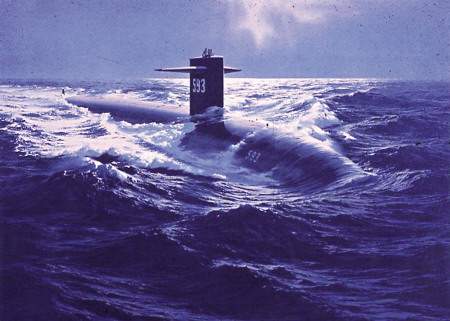
This portait of USS Thresher by RDML. Tom Eccles was released in April 2008, as part of the 45th anniversary of the submarine disaster.

This portait of USS Thresher by RDML. Tom Eccles was released in April 2008, as part of the 45th anniversary of the submarine disaster.

Scores of families were devastated when the nuclear submarine USS Thresher went down on April 10, 1963, but the blow to the Shafer clan of Connecticut was doubly brutal.

A total of 129 U.S. Navy sailors and civilian workers were lost aboard Thresher in the worst submarine disaster of all time. They were fathers, husbands, sons and brothers. In the case of Benjamin and John Shafer, they were brothers from the same bloodline.

Both were electrician’s mates, and both were career sailors. Benjamin, the oldest of the two, had achieved the rank of master chief petty officer, the highest standard achieved by enlisted men; John was a senior chief, the next highest enlisted rank.

They were also both fathers. When Thresher (SSN 593) was lost during sea trials more than 200 miles off the New England coast, Benjamin left behind three sons and a daughter, while John was survived by four sons.

Michael Shafer, Benjamin’s youngest boy, would grow up to devote 29½ years of his life to the Army, enlisting as a private and retiring as a major in 2005. As a military man, he understands the push to get the world’s most advanced submarine of its day into action. It was, after all, the height of the Cold War with the Soviet Union. As hindsight suggests, however, Thresher may not have been ready for the deep-dive tests it was conducting when it sank.

“They gambled and lost,” Michael said.

Both he and his sister Penny Shafer Craig take pride in the sacrifice their father and uncle made for their country, but acknowledge the heavy toll it took on the family.

According to a 1963 newspaper account that ran in the New London (Connecticut) Day in the wake of the Thresher tragedy, the Shafer brothers’ parents were so distraught they had to be placed under heavy sedation by a physician. Family members gathered in the parents’ home were in a state of shock that day, the report stated; Benjamin’s wife Joyce wept as she disclosed the fatal cruise was to be his last before transferring to another command.

And the Shafers’ mother, according to the newspaper, could be heard wailing repeatedly, “Both my sons! Both my sons!”

“Neither one of them lived long after that,” Clara Main, their only surviving sibling, said of her parents this week. “You can truly die of a broken heart — I believe that.”

Brothers and heroes

Benjamin Nathan Shafer was born in September 1926. He enlisted in the Navy in August 1944, after graduating from Robert E. Fitch High School in Groton, Conn. He then completed basic training in Sampson, N.Y., and served aboard the destroyer USS Doyle (DD 494), during World War II. Benjamin was awarded the Asiatic-Pacific Theater Service Medal, the World War II Victory Medal and other decorations earned prior to his discharge in May 1946.

He worked for a time as a welder at the Electric Boat Division of General Dynamics in Connecticut, then according to Michael, opened an electrical repair shop. After his partner took off with the money from their business, Michael said, Benjamin re-entered the Navy in February 1949. He attended the Navy’s Electrician’s Mate School, and ultimately volunteered for submarine duty

He earned his coveted Silver Dolphins when he qualified as a submariner aboard USS Cobbler (SS 344), and attended the Nuclear Power Training Unit at West Milton, N.Y. He also served aboard the nuclear submarine USS Skipjack (SSN 585) before his assignment to Thresher in February 1961.

John Davis Shafer joined his older brother as a crewmember of Thresher in September of that same year.

“They asked to be on the same submarine,” Clara recalled. “They loved each other; they were brothers. They just wanted to be together.”

John was born in August 1929 in Fort Pierce, Fla. During his school years in Groton, Conn., he received awards in both spelling and history competition. Much of his free time was spent fishing, hunting and bowling.

After graduating from Robert E. Fitch High School in 1947, John enlisted in the Navy and entered basic training at the U.S. Naval Training Center in Great Lakes, Ill. He served aboard the aircraft carrier USS Franklin D. Roosevelt (CVA 42) and the heavy cruiser USS Salem (CA 139) before volunteering for submarines.

He followed his brother to Electrician’s School and proceeded to serve aboard the subs USS Harder (SS 568), Kingfish (SS 234) and Trutta (SS 421), earning his Silver Dolphins aboard Entemedor (SS 340).

A third brother — the oldest, Joe — was also a Navy veteran of World War II, while their father had served in France with the Navy in the First World War.

Michael, the retired Army major, takes solace in knowing the Thresher tragedy directly resulted in the creation of SUBSAFE, the Navy’s enhanced submarine safety program. No vessel has been lost after passing through SUBSAFE in the nearly half-century since Thresher’s loss.

Asked about his thoughts regarding the family’s legacy with the submarine, he cites “The Ballad of the Thresher,” a song by the popular folk band the Kingston Trio. Famous for such 1950s and ’60s hits as “Tom Dooley” and “Where Have All the Flowers Gone,” the band paid tribute to the Thresher’s crew in verse shortly after the disaster. In the ballad’s chorus, the trio sings:

“Every man jack on board was a hero

Every man jack on board there was brave

Every man jack on board was a hero

Each man risked a watery grave”

“If you listen to that song, you’ll know,” Michael explained. “It says it all to me.”

‘I was Daddy’s girl”
In 1969, the 116-man Bachelor Enlisted Quarters at the Atlantic Undersea Test and Evaluation Center on Andros Island in the Bahamas was named Shafer Brothers Hall in honor of Benjamin and John.

“I was very proud that the Navy named this building after my father and uncle,” Penny said. “Even though it’s only a barracks, it’s not very often that they name buildings after servicemen.”

However, the decade was otherwise unrelenting on the family. Penny notes both sets of grandparents died in the 1960s, and just days before Christmas 1969 her oldest brother Steve — a high school senior — died in an auto accident. Their mother was “out of it” for a while after that, Penny said. She would listen to the Glen Campbell tune “My Baby’s Gone” and cry as the country artist sang, “Dry all the raindrops/hold back the sun/the world has ended/my baby’s gone.”

“That one almost did her in,” Penny said of her brother’s death. “Eventually, she came back to us.”

Joyce Shafer went to work at the Navy exchange on the New London Submarine Base in Groton, Conn., and eventually retired as private secretary for the head of research and development there, Penny said. She described her mother as independent, strong and stubborn, but said she rarely talked about the loss of her husband. Joyce never remarried and died of cancer at age 55. Penny was only 5 when her father died, while Michael was 6. They remember very little of their dad.

Penny recalled that he loved the amorous animated skunk Pepe Le Pew, and that a photo of herself at the age 2 or 3 wrapped around her father’s arm was inspired by her mother teasing that Benjamin was “MY daddy!”

“I was Daddy’s girl,” she said.

Michael said his father’s legacy as an honest, responsible family man provided him with a “measuring stick” that he applied as a standard while growing up.

“By all accounts he was a great guy,” Michael said, “but I never got a chance to know him.”

About a dozen members of the Shafer clan, including 79-year-old Clara, plan to attend 50th anniversary Thresher ceremonies in Kittery this April.

Impact on the American psyche

After its commissioning in August 1961, Thresher was considered the fastest, quietest, deepest-diving and most lethal submarine the world had ever known. Its loss was a stunning blow to the nation and the world.

It says something of the Thresher disaster’s impact on the American psyche at the time that in addition to the Kingston Trio’s tribute, legendary folk singer Phil Ochs also dedicated a song to the doomed submarine. “The Thresher” appears on Ochs’ first album, “All the News That’s Fit to Sing,” released in 1964. With haunting lyricism, Ochs captures the early enthusiasm surrounding the submarine’s construction “in Portsmouth town on the eastern shore/Where many a fine ship was born.”

“She was shaped like a tear/She was built like a shark/She was made to run fast and free,” he sings. But eventually a sense of impending doom creeps into his lyrics and the vessel becomes “a death ship all along.” He describes the sub’s final voyage, culminating in a stark final verse that conveys her fate:

“And she’ll never run silent

And she’ll never run deep

For the ocean had no pity

And the waves, they never weep

They never weep.”

LOST AT SEA

For a list of personnel who perished aboard Thresher, visit www.history.navy.mil/danfs/t/thresher1.htm

Source – Sea Coast Online

Famous Submarine Commander “Dai Evans” Crosses the bar.

Taken from Facebook – UK Submarines group

Quote “I regret to report the death of Commander DLP (Dai) Evans at the Douglas Macmillan Hospice, Stoke on Trent, on 11th December 2012 after a long battle with cancer. He was 69 years old” Unquote

Dai served in Anchorite, Dreadnought, Osiris and Churchill before Perisher in 1974. He subsequently commanded HMS Narwhal before joining HMS Courageous as XO. After serving on CSST’s staff in Faslane, on the staff of CTF 311 at Northwood and promotion to Commander, he commanded HMS Renown (Port) and then the Commanding Officers’ Qualifying Course. Following service in the MoD/DNW and in Dolphin as Commander SM1, Dai left the navy to form his own very successful company training ‘command’ teams in the offshore, chemical and power industries.

Dai was perhaps most renowned across a wider audience whilst in post as “Teacher” when the Submarine service first opened it’s doors to the outside world through the TV series “Perisher”.

Excerpt of “Perisher” the TV Series”

Russia sees opportunities in India’s new submarine deal

Russia sees opportunities in India’s new submarine deal
Russia sees opportunities in India’s new submarine deal. Source: Press Photo

India is set to loosen its purse strings for some big ticket arms acquisitions in the coming months. The latest order about to come out from the Indian repertoire is for submarines, which is going to be worth a whopping ten billion US dollars. The Russians will be close competitors for this deal and Rosoboronexport of Russia would be high up among the competing companies. Other serious contenders would be HDW of Germany and Navantia of Spain.

Earlier this year, India had released a 15 billion dollar defence deal which went to the French, much to the chagrin of the Russians and other players in the international arms market. In February 2012, India had awarded the highly lucrative deal worth $15 billion to the French company Dassault Aviation for 126 fighter aircraft for the Indian Air Force.  The talks with Dassault on fastening the nuts and bolts of the deal are presently going on.

The upcoming defence deal is for the Indian Navy. It is aimed at buying six state-of-the-art submarines, mainly with an eye on China. The deal with Dassault for 126 fighter aircraft too was aimed at developing Indian defence capabilities vis-a-vis China.

Project 75I

 The Indian government is soon going to come up with a Request for Proposal (RFP) for six next generation submarines. Indian Navy Chief Admiral DK Joshi has gone on record as saying that the Defence Acquisition Council a high-powered body of the defence ministry, has already given the green signal for buying six submarines under a project codenamed P-75I and a global tender would be floated “very soon”.

This will be a huge opportunity and a challenge for the Russians to bag the deal because the RFP would be a global competitive bid process in which the winner takes all. The Russians and the French are expected to be among the top contenders. Both would have plus and minus points for getting the deal, and needless to say, no country would like to miss the bus.

Russia to Face Stiff Competition from France

 Russia will inevitably face a stiff competition from the French for the new submarines deal. The French have an edge because they are already building six Scorpene submarines for India. The argument for them is that since they are already working on a submarine project with India it would be logical to have continuity as the French already have an elaborate infrastructure in place. But the flip side is that the upcoming $10 billion submarine deal would be a global competitive bid. It is like playing an entirely new match on a new turf where it would depend on which players emerge as performers of the day.

The Russian USP would be that India is already operating over a dozen Russian-made submarines and Russia is a tried, tested and trusted arms supplier for India. The latest order, as an when it materialises, is aimed at significantly beefing up the muscle of the Indian Navy whose existing humble submarine fleet comprises of just 10 Russian Kilo-class, four German HDWs and an Akula-2 nuclear-powered attack submarine leased from Russia at $1 billion. This will be in addition to the six Scorpene submarines which are being built in India with technology from Dassault under a project codenamed P-75.

A USP of the new to-be-ordered submarines, according to Admiral Joshi, would be that these would be bigger than the Scorpene  and would be equipped with air-independent propulsion (AIP) systems to recharge their batteries without having to surface for more than three weeks. Besides, the new boats would also have land attack missile capability.

INS Chakra’s Delimitations

 The Indian submarine fleet got a valuable addition when INS Chakra, the nuclear submarine from Russia was finally inducted in April 2012, thus once again heralding the Indian Navy into the nuclear age after an interregnum of two decades. However there is a flip side to INS Chakra, the Akula-2 class submarine given by Russia to India on a lease for ten years. INS Chakra cannot be armed with strategic weapons or nuclear tipped ballistic missiles. Its symbolic importance is that it will certainly help India keep a watchful eye on the vast expanse of Indian Ocean which of late has emerged as the epicentre of global naval activities.

India, a principal littoral state with fourth largest naval fleet in the world, needs to have a robust navy in Indian Ocean and beyond considering the rapid advancements of the Chinese Navy. China is stepping up its naval presence in the Indian Ocean though it is not an Indian Ocean power. China has almost five dozen submarines, including a dozen nuclear submarines, which give them a head start over India in naval terms.

The Russian Edge


The upcoming RFP for the six submarines is aimed at correcting this anomaly.  India, which at one point of time had 18 submarines, is now down to just 14 submarines, including ten Sindhughosh class Russian Kilo submarines and four Shishumar class German HDW diesel submarines. For 17 years India did not construct indigenous submarines. Further bad news from the Indian perspective is that its submarine fleet is expected to go down to half as the Kilo class submarines acquired in late eighties are facing retirement after two and half  decades  of service.

Under the six-submarine Scorpene deal, India is expecting to get the first two submarines in 2014 and 2015. The delivery schedule for all the six boats is likely to be completed by 2019. But the flip side is that the first two out of six would be simple diesel submarines and the next four would be equipped with Air Independent Propulsion (AIP) technology called MESMA in French parlance.

This is where the Russians can smell the kill for the new $10 billion submarine deal. While the Scorpene deal with the French did not focus on the AIP technology, the proposed deal would have all six submarines equipped with AIP technology.  The Russian engineers have already mastered the AIP technology, in vogue for the past one decade. India has retained Russian engineers since 2011 in Vishakhapatnam to understand complex operational aspects of a nuclear powered submarine.

Source – Indrus

Top-secret submarine may settle Russia’s claim in the Arctic

A unique Arctic expedition has brought a top-secret Russian submarine into the limelight. The AS-12 bathyscaphe Losharik has now been enlisted to help Russia gain evidence of its right to territorial waters in the Arctic.

Top-secret submarine may settle Russia’s claim in the Arctic
The Arctic region is expected to be the disputed territory between the world’s powers. Source: Alamy / Legion Media

Moscow is prepared to present evidence to the U.N. Convention on the Law of the Sea that would expand Russia’s territorial waters in the Arctic, thus asserting its right to the bed of the Arctic that is extremely rich in hydrocarbons. Russia filed a similar application once before, but the bid was turned down due to a lack of geological samples. The new evidence has been obtained by AS-12 Losharik – Russia’s top-secret deep-sea nuclear-powered bathyscaphe.

The North Pole expedition was undertaken in late September as part of the Arctic 2012 research project. The mission required working at a depth of 1.5-1.8 miles for 20 days. The deep-sea station collected earth samples using robotic arms, a dredging device (a rock filtration system), a clamp bucket (a scoop with a video camera) and a hydrostatic sampler. The results of the sample tests will be released in early 2013, when they are also expected to be handed over to the United Nations.

Losharik will very soon be getting a younger “sister.” According to Izvestia, Russia has resumed the construction of another top secret deep-sea nuclear-powered station. A source in the defense industry has told Izvestia that the vessel will actually be a smaller version of Losharik that is intended, just like her older brother, to conduct special operations on the ocean bed, including in the Arctic.

Until recently, the competing territorial claims to the Arctic made by Russia, Norway, Canada, the U.S. and Denmark have been ineffectual, since, apart from political statements, none of the countries has been able to provide any factual evidence to justify their claims. If Losharik’s recent operation does not close the matter for good, then it at least puts Russia ahead of the game. Before Losharik, no one had been able to bring up any actual samples from the seabed that could formally prove Russia right.

Meanwhile, little is actually known about the main character in the story – the nuclear-powered deep-sea bathyscaphe AS-12, nicknamed Losharik (NATO reporting name NORSUB-5).

One of the reasons behind the scarce public knowledge is the fact that the submarine was created for the Main Intelligence Directorate of the Defense Ministry and, given the specific nature of the ministry’s mission, was never intended to be declassified – just like an undercover spy. However, Moscow eventually decided to go all in and play for the sake of winning the territorial dispute.

The submarine was dubbed Losharik for its extraordinary shape: Its hull consists of spherical titanium modules. The nickname comes from the name of a Soviet cartoon character – a funny little horse with a body made up of small spheres.

Russia sees opportunities in India’s new submarine deal

losharik

Russian submarine passes Arctic trials

According to its engineers, the unusual hull construction permits the 196-foot-long bathyscaphe to withstand the enormous pressure of ocean depths of up to 3.7 miles. Losharik is powered by a small nuclear reactor with a fundamentally new model of nuclear steam generating plant: the KTP-7I Fenix. The reactor enables the bathyscaphe to travel at a speed of up to 30 knots (37 miles) per hour and does not limit the time it can stay submerged in virtually any way. The crew consists of 25 officers.

The bathyscaphe is carried by the K-129 Orenburg submarine, which is a Project 667BDR Kalmar strategic nuclear submarine redesigned specifically for the purpose.

While assigned to Russia’s Northern Fleet, the submarine is not actually part of it, as it remains an asset of the Main Intelligence Directorate. It is stationed at Olenya Bay, where Russia’s naval spies are based.

While the AS-12 does not carry any weapons, it still poses a serious threat to the national security of many countries, since it is equipped to perform intelligence and diversion operations at depths out of reach of any other vessel in the world.

The kind of operations that the vessel could perform include using its mechanical arms not only to collect seabed samples, but also to disrupt telecommunications between continents or, conversely, plant wiretaps, which, even if detected, would be impossible to remove because of the depths.

There is also an apocalyptic theory that the work of designing the bathyscaphe was launched back when a nuclear conflict between Moscow and Washington was still on the table. The bathyscaphe is believed to have been intended to become an invincible carrier of a gigantic T-15 thermonuclear torpedo (5 feet in diameter) developed by Nobel Prize-winning physicist Andrei Sakharov.

The Soviets believed that, if detonated at a depth of 3.7 miles, the torpedo could generate an unprecedented and deadly tsunami that would wash away an entire coast of the United States, West or East.

Whatever their past plans, Moscow and Washington are now partners intent on resolving their disagreements at the negotiating table. This was the main reason why, in the mid-1990s, Russia almost stopped financing the Losharik project. The country even invited the United States to be a co-investor, suggesting that the deep-sea bathyscaphe could be involved in rescue operations.

While Losharik failed to become a rescue vessel, it has nevertheless proved a very valuable national security asset.

Source – Indrus

Royal honour for HMS Talent submariners

British Forces News

Submariners serving on the Trafalgar class submarine HMS Talent welcomed their royal sponsor Princess Anne at Devonport Naval Base, Plymouth this week.

After being greeted by the Naval Base Commander Commodore Stuart Little and receiving the royal salute, she inspected the mustered sailors.

The visit was to reacquaint her with the submarine and crew in which she takes a strong interest as sponsor.

HMS Talent’s commanding officer Commander John Aitken escorted the princess during a parade and inspection of the crew. She was joined by Commodore Jake Moores (Commodore Devonport Flotilla) and Captain Justin Huges (Captain Submarines of Devonport Flotilla).

Commander John Aitken, who escorted her during the parade and inspection of crew, said: “It was a great opportunity to say thank you to the HMS Talent families for all their support over the last 18 months; their forbearance allows us to get on with whatever jobs we have to do and I hope they are as proud of their sailors as I am.”

Princess Anne also greeted Leading Seaman Hackett with the Fleet Commander’s commendation for exemplary service. He said: “It was a great pleasure to receive this commendation from Her Royal Highness.”

HMS Talent kicked off a very successful and challenging year by winning the Valiant Trophy for recognition of excellence shown during sea training.

In the spring the submarine travelled to the South Atlantic to strengthen relations with the South African Navy and has just returned from operations.

The submarine is currently alongside in Devonport for a period of maintenance before commencing any further operations in the future.

FACTS

HMS Talent is a Trafalgar Class submarine, the penultimate of the class of seven.

She was built in Barrow-in-Furness and launched by HRH in 1988.

The submarine was commissioned into the Royal Navy in 1990.

HMS Talent has a displacement dived of 5,291.3 tonnes and 4,815.8 tonnes once surfaced.

After a significant refit in 2006 the submarine had a major capability upgrade and was fitted with the Royal Navy’s most advanced sonar while her armament includes a Spearfish wire-guided torpedo (long range anti-ship and anti submarine) and Tomahawk Land Attack Missile (precision attacks against land targets).

HMS Talent’s affiliations include Shrewsbury and Atcham Borough Council while her adopted charity is Shrewsbury’s Hope House Hospice (for terminally ill children).

Source – BFBS News

Royal Navy Lieutenant escapes submarine for the day

 A ROYAL Navy Lieutenant from March took part in a special rendez-vous in the warm waters of the Middle East.

Lt Shropshall (back row second from right) and colleagues from HMS Trenchant enjoy the sunshine on Monmouths Forcastle.

Lieutenant Ian Shropshall was among the crew of a submarine which met up with a frigade from the same Welsh town.

The two Llanelli-affiliated Royal Naval units made time within their busy programmes to spend a few hours training together on their respective vessels.

Lt Shropshall, Operations Officer onboard HMS Trenchant, spent time on the Type 23 frigate HMS Monmouth.

He relished the opportunity to swap roles for a few hours and experience life above the water.

He said: “Monmouth’s Ship’s Company were excellent hosts and made us feel very welcome.

“It is always good to see how another part of the Royal Navy does its business. “It makes quite a change in the middle of our deployment to have so much space, fresh air and sunshine!”

Leading Engineering Technician Steve Pinder from HMS Monmouth, who has hopes of joining the Submarine Service, enjoyed the change of scenery.

He said: “This was a fantastic opportunity to experience life underwater first-hand.

“The crew of Trenchant was very hospitable and I look forward to joining their branch in the future.

“I was particularly interested in the differences in weapons systems.”

Source – Cambs Times

HMS Audacious: MoD announces £1.2bn submarine contract

HMS Audacious: MoD announces £1.2bn submarine contract

A new attack submarine, HMS Audacious, has been commissioned by the Ministry of Defence in a contract worth £1.2bn.

Diagram of HMS Astute

The BAE Systems deal, which will secure 3,000 jobs at Barrow-in-Furness in Cumbria, will progressively replace the Trafalgar Class currently in service.

A further £1.5bn has been committed to the remaining three Astute Class submarines being built, the MoD said.

Defence Secretary Philip Hammond said the contracts would offer the UK’s armed forces “greater certainty”.

Audacious will be the fourth of the seven Astute Class submarines being built for the Royal Navy.

Forget what you may have seen on Das Boot or the Hunt for Red October. Instead, Astute has cameras fitted on a mast that feed live pictures into the control room.

Unlike the old periscope that would pop out of the water for minutes at a time, Astute’s mast breaks cover for just a few seconds. It can record what it sees, giving the crew time to analyse the images. It’s another feature that makes the submarine harder to detect.

There are some things, though, that the 100-plus crew, and the visiting admirals, appear less keen to discuss. Its speed for one, which I’m told is not an issue, but is classified.

The first two boats, Astute and Ambush, are currently undergoing sea trials. The third boat, Artful, is reaching the final stages of her construction at Barrow shipyard. All three are to be based at Faslane on the Clyde.

Early work has been started on the fifth vessel, Anson, while preparation has begun on submarines six and seven which are as yet unnamed.

It emerged last month that Astute had encountered several problems during its sea trials, including leaks and electrical switchboards which were were found to be fitted incorrectly.

Concerns also emerged last year about the accuracy of nuclear reactor monitoring instruments during testing.

Mr Hammond said: “This contract marks an important step forward in the progress of our attack submarine programme and moves the Royal Navy closer to adding more of these highly-advanced and powerful attack submarines to its fleet.

“Our ability to commit an additional £1.5bn for boats five, six and seven underlines the benefits of a balanced budget and fully-funded equipment programme that gives our armed forces greater certainty.

“This funding demonstrates our commitment not only to a key Royal Navy capability, but also to the submarine industry in Barrow, which will play a vital role in Britain’s defence for decades to come.”

Source: BBC

Submarine with new design nears completion

Submarine with new design nears completion

The military contractor, which got a boost this week when Congress agreed to not delay the purchase of a Virginia-class sub, is hoping that its record of delivering submarines under budget and ahead of schedule will help protect it from cuts in Washington.”There’s no question we’re in a very constrained fiscal environment,” said Robert Hamilton, a company spokesman. “Any program that is over-running on costs and schedule is going to get a second look.”

The last major piece of the new submarine, the 113-foot-long bow section, arrived at the Groton shipyard a week ago from the company’s partner contractor in the Virginia-class submarine project, Newport News Shipbuilding. The Navy contract calls for the completed sub to be delivered in August 2014.

The new design introduces larger, more versatile weapons tubes in the bow. Despite the changes, the submarine is expected to be ready for delivery ahead of schedule, partly because the design reduced the number of parts in the bow and made construction more manageable, said Chris Cameron, a construction program manager at Electric Boat.

The U.S. is building two Virginia-class submarines a year, at a cost of about $2.6 billion each. The cost-savings for the Navy that come with the redesign of the bow will add up to about $800 million over 20 submarines, Hamilton said.

A budget proposal from President Barack Obama had called for the Navy to purchase only one submarine in 2014, but the U.S. Senate and House of Representatives agreed this week to include money for a second sub that year in the National Defense Authorization Act.

Bob Ross, the director of the state’s Office of Military Affairs, noted the Virginia-class program has been praised for efficiency by the defense secretary.

“It’s really great from our position to be able to articulate that this is the premier, major acquisition program in the country right now,” Ross said. “It puts us on very solid ground when we argue don’t disrupt that production schedule.”

Like other defense contractors around the state and the nation, Electric Boat is still keeping a wary eye on developments in Washington, where talks are under way to reach a deal that would avoid the double hit of tax hikes and automatic spending reductions dubbed the “fiscal cliff.”

Even if those automatic cuts do not take effect, Ross said Connecticut is expected to see a 10 percent reduction in its defense spending over the next six years. He said the automatic cuts could raise that figure as high as 18 percent, but officials have no way to know which programs would be hit.

“The sooner we deal with this issue and remove the uncertainty, the better it is for all of defense contractors in the state,” Ross said.

Source – Hampton Roads

Assystem Energy and Nuclear Engineers pay a visit HMS/M Vengeance in Devonport

The 15,000 tonne Scotland based Trident submarine ‘HMS Vengeance’ sailed into Devonport in March this year. As part of a £350m Ministry of Defence contract to refit and refuel, it’s been suggested that the ballistic nuclear submarine has safeguarded upwards of 2,000 UK jobs across the defence industry.

Assystem Energy and Nuclear staff pictured outside the Trident refit complex in Babcock’s Devonport dockyard (left to right, Amy Bowers, Tim Wicksteed, Pete Gillham, Mike Ormston & Jason Lockley)

With work on the Vanguard class vessel securing 1,000 jobs at Babcock in Devonport alone, Assystem Energy and Nuclear is representative of a number of other companies involved in ensuring that this nuclear deterrent will continue to operate safely and effectively for years to come once back at sea and operational.

Sitting out of the water in her specially converted dry dock, Assystem Energy and Nuclear were invited to step aboard the 150m (492ft) long vessel. HMS Vengeance, the last of her class to be refitted in Devonport is undergoing a complete overhaul of equipment, improvements to her missile launch capabilities and upgrades to the onboard computer systems. A new reactor core will also be fitted, a core that has been designed to last the submarine until she is finally decommissioned.

UK Trident Submarine – HMS Vengeance – Photo (RN)

As guests of the HMS Vengeance’s Assistant Marine Engineering Officer – Lieutenant Sam Gill RN, Assystem Energy and Nuclear Bristol based engineers couldn’t help but marvel at the size and complexity of the vessel as they set foot onto the submarine’s casing.

” It was great to be able to link the work I’ve been doing with the people who are operating the submarines on a day-to-day basis. The UK’s fleet of nuclear submarines have an excellent safety record and that has only been possible due to the combined efforts of the engineers who design them and the crews themselves, whose meticulous approach to maintenance ensures any problems are identified and dealt with swiftly.” –  Tim Wicksteed (Assystem Energy and Nuclear Stress Engineer)

“It’s proved to be a very successful and rewarding day. Our engineers and designers work hard on lots of submarine projects, but not many of them ever get the opportunity to see where their bits of the puzzle fit into the incredibly large picture. I think it gives our guys a much greater sense of achievement to see their efforts up close” Jason Lockley (Assystem Energy and Nuclear Business Development Manager (ex Submariner))

“You don’t fully appreciate the density or diversity of the systems that are involved until you get to see them installed in an operational environment. It’s absolutely invaluable to talk to the teams that are involved with operating and maintaining the boat and to learn from their experiences”. Mike Ormston (Assystem Energy and Nuclear Principal EC&I Engineer) 

Assystem Energy and Nuclear engineering consultancy specialises in mechanical and electrical design, structural integrity work and the generation of safety reports for many primary nuclear components onboard the UK’s existing submarine fleet. Assystem Energy and Nuclear are also involved with future submarine programmes as well as being heavily involved in the civil nuclear sector, supporting new build, maintenance and decommissioning activities.

Rear Admiral Simon Lister was quoted as saying “The highly sophisticated nature of the work involved in the deep maintenance of these magnificent vessels is testament to the experience and skills of the workforce in Devonport and those in the supply chain across the UK.” (BBC News, 26 March 2012)

One of Assystem Energy and Nuclear’s bright young engineering stars, who’s soon to finish her PhD said.  

When you see the scale of the submarine and all the components involved it’s very impressive – it’s fantastic to get the opportunity to work on such projects. You only have to take a look at projects like this one and others that companies like ours are involved with to realise that we have great engineering talent in the UK. It’s amazing what we can achieve when we put our minds to it. Amy Bowers (Assystem Energy and Nuclear Graduate Stress Engineer)

Assystem Energy and Nuclear would like to thank HMS Vengeance ship’s staff, especially MEO – Lt Cdr Shaun Southward RN & AMEO Lt Sam Gill RN for such an enlightening tour, and the interest shown in how the wider MoD Supply chain works to support the submarine programme.

Follow Assystem’s “Energy & Nuclear” blog

Oldest surviving submarine commander passes away

DSC0177_1.jpg

Galway said goodbye this week to Commander Bill King of Oranmore Castle, who passed away last Friday at the age of 102.

Galway said goodbye this week to Commander Bill King of Oranmore Castle, who passed away last Friday at the age of 102.

One of Galway’s best-loved characters, Commander King was the oldest surviving World War submarine commander and led a life of adventure as a navel officer, yachtsman and author.

Having joined the Royal Navy on HMS Resolution in 1927, he worked his way up through the ranks before patrolling the North Sea during World War II as Commanding Officer of the T-class submarine HMS Telemachus.

Retiring from the service in 1948, he was decorated with the Distinguished Service Order, the Distinguished Service Cross, the Battle of Britain Star, the Burma Star and the Arctic Emblem.

After his retirement, Commander King married his wife Anita and moved to Oranmore Castle after buying it for just £200 and setting about refurbishing the dilapidated building to its former condition.

Speaking to the Galway Independent in 2008, he recalled “getting up one day to find my father-in-law, who used to always wear a kilt, sweeping dead fish out of the Great Hall”.

Commander King is perhaps best known for becoming the oldest sailor to complete a single-handed circumnavigation of the world, carrying out the amazing feat on his third attempt at the age of 58.

However, it was his passion for life and sense of humour that will be remembered by many, telling a Galway Independent journalist in a previous interview that living forever would be no good as “you’re always cold”.

Survived by daughter Leonie, son Tarka and grandchildren Cian, William, Heather and Olivia, Commander King was laid to rest on Monday following a funeral service at the Collegiate Church of St Nicholas on Lombard Street.

Source – Galway Independent