Monthly Archives: March 2013

Taiwan to study building own submarine fleet

Osprey-class coastal minehunting ship

Taiwan Tuesday confirmed it plans to study  the feasibility of building a submarine fleet on its own in a move which  suggests it is running out of patience over a long-stalled US offer to supply  eight of the warships.

The navy hopes to come up with an in-depth report in four years on items  ranging from design and acquisition of equipment, to construction capabilities  and product tests and evaluation, according to a defence ministry statement.

The report will cost around Tw$140 million ($4.7 million) to be financed by  a defence ministry-controlled fund, it said.
“The move is a crucial sign showing that the navy has dropped the idea of  purchasing submarines from the United States and decided to build them at  home,” a naval source was quoted by the Liberty Times as saying.
The paper said an initial naval evaluation report indicated that the  island’s leading shipyard CSBC Corporation had acquired expertise to build the  sophisticated warships.
But Taiwan is still short of critical know-how on development of submarine  fighting systems, sonars and torpedo launch tubes, it said.
In April 2001, then US president George W. Bush approved the sale of eight  conventional submarines as part of Washington’s most comprehensive arms package  to the island since 1992.
Since then, however, there has been little progress as the United States  has not built conventional submarines for more than 40 years and Germany and  Spain have reportedly declined to offer their designs for fear of offending  China.
The Taiwanese navy currently operates a fleet of four submarines, but only  two of them, Dutch-built, could be deployed in the event of war. The other two  were built by the United States in the 1940s.
Tensions between Taiwan and China have eased markedly since President Ma  Ying-jeou came to power on a platform of beefing up trade links and allowing  more Chinese tourists to visit. Ma was re-elected in January 2012.
But Taiwan, which has governed itself since 1949, still sees a need to  modernise its armed forces because China regards the island as part of its  territory awaiting reunification, by force if necessary. — AFP

US Navy invests in submarine-launched nuclear ballistic missile guidance upgrades and test

SLBM%2012%20March%202013

The U.S. Navy is investing more than a quarter-billion dollars to upgrade the missile guidance systems in the Trident II D5 submarine-launched nuclear ballistic missile.

The Navy Strategic Systems Programs Office in Washington last week awarded two Trident II upgrade contracts — one to Charles Stark Draper Laboratories Inc. in Cambridge, Mass., and the other to Aero Thermo Technology Inc. in Huntsville, Ala., for Trident II nuclear missile guidance upgrades.

The Trident II is the primary weapon aboard Navy Ohio-class ballistic missile submarines. The missile has a range of more than 7,000 miles and carries four independently targeted 475-kiloton nuclear warheads.

Draper Lab received a $257.8 million contract to provide MK6 MOD 1 guidance upgrades to the Trident II nuclear missile, including circuit card assembly materials with electronic components, as well as data package assemblies.

ballistic%20missile%20sub%2012%20March%202013

Aero Thermo, meanwhile, received a $6.8 million contract to provide guidance systems, technical, analytical and program services to support the TRIDENT II missile. The contracts are part of the Navy’s Strategic Program Alteration (SPALT) for the Trident II D5 missile.

Aero Thermal engineers will support key guidance system technology development and coordination between the Navy and U.S. Air Force for current and next-generation strategic systems. The Navy and Air Force are working together on strategic ballistic missile technology development. Both services invest in research to ensure unique and critical design and development skills for strategic weapons.

Draper Lab will do its work in Pittsfield, Mass.; Cambridge, Mass; Clearwater, Fla.; Terrytown, N.Y.; and El Segundo, Calif., and should be finished by the end of 2016. Aero Thermal will do its work in Huntsville, Ala., and should be finished by the end of this year.

Aero Thermal’s contract has options that would increase the contract’s value to $20.7 million and extend work through the end of 2015.

These contracts are part of a Navy effort begun in 2002 to extend the life of the D5 missiles to the year 2040 by replacing obsolete components with commercial off-the-shelf (COTS) hardware. Upgrades involved the missile reentry systems and guidance systems.

The first flight test of a D5 extended-life subsystem, the MK 6 Mod 1 guidance system, was in early 2012 aboard the Ohio-class ballistic missile submarine USS Tennessee (SSBN 734).

The missile has a range longer than 7,000 miles; has a maximum speed of 13,000 miles per hour, and has precision guidance from inertial sensors with star sighting. No GPS-guided Trident D5 missiles have been deployed.

The Trident II missile carries as many as four independently targeted W88 475-kiloton nuclear warheads. That warhead discharges the energy of 475,000 tons of TNT, and is roughly 30 times the size of the U.S. nuclear bomb dropped on Hiroshima, Japan, in 1945.

Source – Military & Aerospace

Australian Navy considers Japan technology to repair submarine fleet – Radio Clip

Click on picture to hear the radio broadcast interview.

The Australian Navy says it hopes to secure a deal that would allow it to rebuild its troubled Collins-class fleet with Japanese submarine technology.
Aust Navy considers Japan technology to repair submarine fleet (Credit:  ABC)

The deal could postpone the spending of an estimated $40 billion to build 12 new submarines proposed by the Australian Government.

Australia’s Future Submarine project was discussed during the Australia-Japan Conference in Tokyo this month.

Presenter: Joanna McCarthy

Speaker: Alan Dupont, security specialist, University of NSW

DUPONT: Well it’s not a question of whether Australia wants it, Australia is looking to replace an existing fleet of Collins-class submarines and Japan is one of the options. And it could be an off-the-shelf Japanese design which is a Soryu class submarine, this is an advanced conventional submarine which the Japanese have only actually added to their fleet in the last three or four years, or it could be just some components of the system the Japanese use which might be compatible with our own requirements. So there are two options there and the Japanese Soryu class submarine of course would be considered along with other potential candidates, such as a German submarine which is comparable with lesser range, or in building the Collins-class follow-on submarines within Australia indigenously. So they’re the kind of options on the table for the government.

MCCARTHY: So the deal is far from done although it does have some high profile advocates in Tokyo. How likely do you think that it will go ahead?

DUPONT: Look I’d have to say at the moment it’s probably no better than a one in three chance of going ahead for two reasons; one is because it’s not clear yet what kind of submarine Australia’s going to end up with, and I suspect that will be dependent on the next government, which is as you are well aware there’s an election in six months. The other problem with the Japanese option is the constraints on the export of defence technology by the Japanese government. So this has prevented them from exporting submarines in the past and essentially all defence related technology they produce. However these constraints are actually being loosened and it appears the door is now open for potential cooperation with Australia on a range of defence technologies, including the submarine. But at the moment it’s still a little unclear as to where this is going to take us.

MCCARTHY: And assuming Japan does ease this ban that it’s had on defence technology, what’s in it for them?

DUPONT: Well there’s a lot in it for Japan. First of all they need to be world’s best practice in their defence sector too, and they can’t do it just confining themselves to their own capabilities, so cooperation with other partners with leading edge defence technologies is essential for the development for Japan’s own defence industry. Second, this has become much more important for Japan now as geo-political tensions are ratcheting up in north-east Asia, and particularly with China. So the Japanese are very concerned now about making sure that they can have the best technology possible for the development of their own defence force. So that means that they’re going to have to cooperate with friends and allies. Now previously Japan has had a pretty close relationship with the United States and has been able to export some of its own technology to the United States and receive some in return. But I think Japan is looking for other partners that it can do with and this is where Australia comes into the picture, because we are a leading edge country in many of these sectors as well, and there would be some benefits for Japan in building cooperation with Australia through the defence sector.

MCCARTHY: So it’s fair to say then that Japan sees strategic value in this kind of relationship with Australia, rather than it simply Australia being the only country lining up and asking to buy these subs?

DUPONT: Absolutely, you have to see it in the context of a broader more ambitious relationship between Japan and Australia which transcends the old trade relationship.

MCCARTHY: And if Japan’s motive here is about building strategic alliances to try and counter the growing might of China, what’s that going to mean for Australia’s relationship with China, how will they view these closer military ties between Canberra and Tokyo?

DUPONT: Yes well look there are some obvious sensitivities around all this, so even if it was technically feasible and politically feasible for Australia and Japan to do this in terms of their own domestic audiences, obviously both countries have to give consideration to the likely regional response, particularly that of China. But not only China, because other countries too might be a bit nervous about the implications. So I think all of this is doable and manageable, but there would have to be a considered political strategy, a narrative around this which would basically reduce and lessen any potential tensions with other countries, especially China.

Source – Radio Australia

No British submarines to patrol Falkland Islands

THE Navy is finding it “increasingly difficult” to deploy a nuclear hunter-killer submarine to patrol British waters around the Falkland Islands.

The-HMS-Tireless-is-out-of-actionThe HMS Tireless is out of action

Senior sources made the warning last night, three weeks after the Sunday Express reported exclusively that the forced return of HMS Tireless means that just one of Britain’s five Trafalgar-class submarines is fully operational and even that is about to undergo a brief period of maintenance after duties in the Middle East.

Submarines proved their effectiveness in the Falklands War when HMS Conqueror sank the General Belgrano. However, the Conqueror was decommissioned in 1990 and the hunter-killer fleet is “now well beyond its sell-by date”.

I have always argued that we need to have a submarine on permanent deployment in the South Atlantic but this was reduced to occasional deployment. Now we seem not able to do that, either.

Admiral Sandy Woodward

Last night Admiral Sandy Woodward, who led the Task Force to recapture the islands in 1982, called the situation “very worrying”. He said: “I have always argued that we need to have a submarine on permanent deployment in the South Atlantic but this was reduced to occasional deployment. Now we seem not able to do that, either.”

Hunter-killer submarines are needed to carry out vital duties, including protecting Britain’s Trident missile-carrying Vanguard submarines which patrol the North Atlantic.

However, HMS Torbay is undergoing maintenance, HMS Trenchant will need servicing after its deployment in the Middle East, HMS Talent is awaiting decommissioning and HMS Triumph, which should have been decommissioned last year, is being used for training .

HMS Astute, the first of our new £1.2billion Astute class submarines, is still not fully operational.

Tireless, dubbed HMS Tired, was forced to return to base last month due to a coolant leak in its nuclear reactor. Sources suggest it could be out of action for 10 months.

Last night naval sources suggested the likelihood of an Argentine seaborne invasion was “almost non-existent”. However, submarines have long been regarded as the “secret weapon of ultimate deterrence” against Argentine aggression.

Details of their deployment are never made public but last year Navy sources let it be known when HMS Talent was sent to the islands to put a lid on any threat of Argentine aggression during the 30th anniversary of the conflict.

The Navy aims to send a hunter-killer nuclear submarine to South Atlantic waters at least twice in 12 months.

Last night former First Sea Lord Admiral Lord West said Britain is “now paying the price” for the 10-year delay in ordering the Astute-class replacements.

“Even when they come on line fully, we will not have the eight submarines which, I believe, is the minimum number we should have in our locker to undertake the tasks required.”

Last night a Ministry of Defence spokesman said there were contingency plans to increase the military footprint in the South Atlantic if required but there was no suggestion of any need to do this at present.

Source – The Express

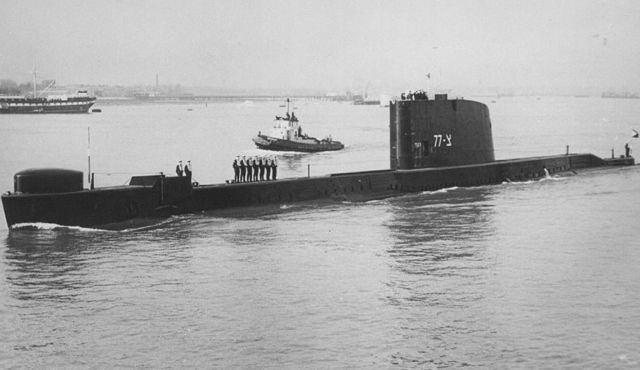
How did Israel’s Dakar submarine sink 45 years ago? – Video Clip

Israel’s archive is allowing the publication of 16 historic documents relating to the submarine’s disappearance and the subsequent search operation, but the answers are not surfacing easily.

The Dakar Submarine 1968

The Dakar Submarine 1968

The State Archives is slated to release a series of secret documents today related to the sinking of the Israel Navy’s Dakar submarine in 1968, which caused the death of 69 Israeli sailors. These documents include an Israel Navy report from 1968 that does not disqualify a “hostile act by the Soviet fleet,” and Foreign Ministry correspondence which notes that Turkey refused to allow Israel to search along its coastline “out of Turkish pride.”

Remnants of the submarine were discovered on the Mediterranean seabed 14 years ago, “but the question as to the circumstances of the sinking remain open to this day,” according to sources at the State Archives.

Now, almost exactly 45 years after the disaster, the archive is allowing the publication of 16 historic documents relating to the submarine’s disappearance and the subsequent search operation. This includes Foreign Ministry cables and the minutes of cabinet meetings beginning on January 26, 1968 − one day after communication was lost with the submarine, which was on a training mission on its way to Haifa.

Even after all these years, there still remain some classified documents that cannot be published in full. These include the classified 87-page report handed over to Dayan by then-navy commander Maj. Gen. Shlomo Harel on March 1, 1968.

That report is on track to be published in its entirety in five years. In the meantime, the State Archives and Israel Defense Forces archives department have cooperated to publish the main findings now.

From the material cleared for publication, it appears that the navy pointed to three possible reasons for the submarine’s sinking. First on the list is “technical fault or human error,” second is “hostile action by the Soviet fleet − a possibility that cannot be fully discarded,” and third is “a collision with another seagoing craft.”

In 45 years, there has been no confirmation that the Soviets were involved in sinking the submarine.

The complete report − of which only a few, secret copies were distributed − is currently stored in the IDF’s archives department. It has not been made available to the public because 50 years have not yet passed since it was drafted.

Other documents released by the State Archives reveal Turkey’s refusal to allow Israel to scour its coastline to search for remnants of the submarine.

On February 2, 1968, Daniel Laor, Israel’s diplomatic representative in Ankara, reported that Israel’s military attache had asked the Turkish chief of staff to allow Israel Navy ships and planes to search along part of Turkey’s southern coastline. The Turks refused, but agreed to conduct their own search operation with Israel’s guidance.

“I expressed disappointment that they raised difficulties,” Laor wrote.

In another cable sent to the Foreign Ministry, Laor offered several explanations for why the Turks refused to allow Israel to search for the submarine. The first was security-related: “It is a sensitive area between Cyprus and Turkey where air, sea and ground forces were gathering prior to an invasion of Cyprus. Turkey is not interested in having foreign ships searching its waters without its supervision,” he wrote.

Cyprus was invaded in 1974, six years later.

Laor noted another possible reason: “Turkish pride, based on the pretense that they could do it better than us.” Eventually, however, Turkey helped facilitate Israel’s extensive search operation. Last week marked the 45th anniversary since then-Defense Minister Moshe Dayan proclaimed that the Dakar and its crew were “missing.” A memorial now stands in the Mount Herzl military cemetery for the Dakar’s 69 crew members who perished.

Source – Haaretz

Suspicious buoy drop highlights Asian submarine tensions

Chinese People’s Liberation Army–Navy (PLA-N) ships earlier this week dropped a number of mysterious buoys around a group of islands in the East China Sea, and although Beijing says they are to monitor ocean conditions, suspicions abound.

The islands are the disputed string called Senkaku by Japan and Diaoyu by China and have for many years been the centre of an increasingly nationalistic tussle between the two powers.

Multiple military planes and ships belligerently traverse the area, inflaming tensions, but submarines have mainly been overlooked.

The buoys may really be for a scientific experiment, as Chinese foreign ministry officials claim, but it is more likely they are part of an expanding system of submarine detectors or sonobuoys China is using to monitor Japanese submarines.

Some were dropped just 300m from Japanese-controlled waters.

While surface tension and conflicts are featured in the news media, beneath the waves submarines are almost forgotten.

Submarines more active

Submarine detection is difficult in the noisy and shallow waters typical of the South China Sea and the East China Sea. Acoustic energy from passive and active sonar technology is more likely to reflect off the seabed than in deeper waters, such as in the Philippine Sea.

Both countries have a number of different classes of submarines but the Chinese diesel-electric vessels are noisier than Japan’s more advanced similarly powered craft.

But the PLA-N’s newest Jin-class nuclear-powered ballistic missile submarines (SSBNs) are a mighty addition to Chinese undersea capabilities. While only two are assumed to be operational, and China is struggling with nuclear power at sea, they add serious firepower to its fleet.

And they may soon be equipped with JL-2 nuclear-tipped ballistic missiles, which, according to initial estimates, can reach the United States, meaning America’s nuclear deterrence strategy would be undermined.

A submarine’s stealth makes it ideally suited for operating in restricted or sensitive waters, making them ideal for the tense waters around the Senkaku/ Diaoyu islands.

The reason for such tension becomes very clear on a map. Geographically, they occupy an extremely strategic position for both Japan and China.

They are a gateway for China into the greater Western Pacific. Controlling them would effectively allow the PLA-N to break out of the claustrophobic South China Sea, a result they desperately desire.

Likewise, keeping them in Tokyo’s hands would help Japan pen China into their territorial waters and put a temporary lid on Beijing’s expansionist dreams.

Beijing’s strategy

China’s development of a world-class submarine fleet is in its infancy, but even now Beijing can quietly project power a significant distance from its shores.

This is why the outcome of the Senkaku/Diaoyu islands dispute is so important for both nations. Controlling them would give Chinese submarines unfettered access to the Western Pacific and increase Beijing’s strategic options in the Eastern Pacific.

It would also open up the rest of the Pacific for exploration by its submarines, possibly sailing with nuclear-tipped ballistic missiles.

Only the US and Russia possess similar capabilities. Adding a third nation to the list will radically alter the strategic nuclear leverage America has enjoyed in the Pacific since the end of the Cold War.

Ultimately, Tokyo will not end its submarine patrols around the disputed islands, despite the Chinese sonobuoy drop. Submarines are an integral part of the monitoring of major sea routes to Japan.

With heightened military movements in the region the chance of an accident increases. And with so much firepower in close proximity should the US become involved – along with widespread and popular nationalism in both Japan and China – the need to tread carefully to avoid escalating hostilities is paramount.

Source – National Business Review

Former submariner to sign copies of his new book in Plymouth

A FORMER Royal Navy submariner will be signing copies of his new book later  this month.

Ian Franklin, from Newton Ferrers, has said proceeds after costs from the  book, Stand By To Surface, will support a submarine museum exhibit.

HMS Alliance, Mr Franklin’s first submarine, is undergoing a £6million refit  at the RN Submarine Museum.

He will be signing copies of his book based on life aboard HMS Orca in the  60s, between 11am and 1.30pm at Waterstones, New George Street, on March  23.

Source – This is Plymouth

US operating five submarines in Persian Gulf

File photo shows USS Springfield.

File photo shows USS Springfield.
The number of US submarines deployed to the Persian Gulf and the Sea of Oman has reached five with the dispatch of the USS Springfield (SSN-761) to the region.

The USS Columbia (SSN-771) is operating west of the Strait of Hormuz, which is a key oil transit route. The US has also stationed eight minesweeping ships in international waters of the Persian Gulf and the Sea of Oman.

The United Kingdom has also deployed HMS Trenchant, a Trafalgar-class nuclear-powered submarine, to the Sea of Oman.
Financial woes in the United States have forced Washington to reduce its military presence in the Persian Gulf.
The news comes after the US administration was forced to sign into effect the spending cuts known as the sequester last Friday, which will take USD85 billion from the US federal budget in 2013.
About half of the cuts, or USD46 billion, will affect the US military sector, the most sensitive of which will be altering plans for the deployment of Pentagon’s naval assets.
While the Pentagon had been previously considering plans to assign two of its 10 aircraft carriers to the Persian Gulf, the giant budgetary cuts have now forced the Department of Defense to deploy only one of those aircraft carriers to the region.
Source – Press TV

Russia, Vietnam agree on submarine fleet deal

cam_ranh_naval_base_concept__si

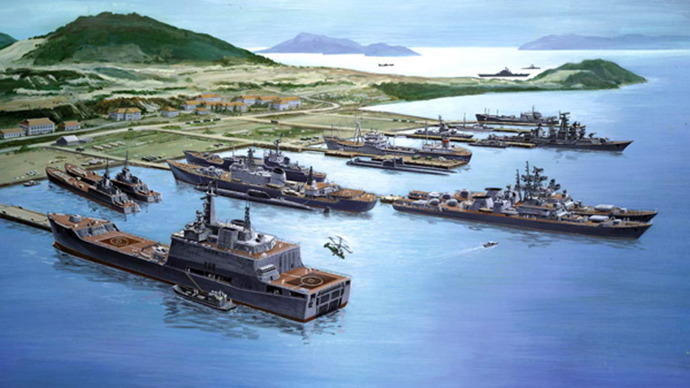
Artist’s concept of ships in port at Cam Ranh Bay, Vietnam.

Vietnam will get its own submarine fleet as soon as this year, said Russia’s defense minister while on a visit to Hanoi.

This year a new page will be opened in the history of the Vietnamese Navy – it will get a fleet of submarines,” Sergey Shoigu told reporters following the meeting with the Vietnamese Defense Minister Phung Quang Thanh.

The Russian minister said that they reached an agreement on synchronization in preparing both the submarines and their crews, and also decided that Russian military schools would train more Vietnamese specialists in the nearest future.

In earlier comments Shoigu called the cooperation with Vietnam one of the priorities of Russia’s foreign policy and promised that Moscow would renew active military cooperation with Hanoi.

In particular, the two sides discussed the possibility for Russian specialists to use the naval base and the military airport in Cam Rahn. All talks were held in secrecy, but Shoigu’s visit to Vietnam started from a trip to Cam Rahn, which was once used by Soviet and then by the Russian Navy, but was abandoned in 2002 due to lack of funds.

Russian experts are divided on the possibility and necessity of putting Russian military bases in Vietnam. Colonel-General Leonid Ivashov, former head of the foreign cooperation department of the Russian Defense Ministry, told the Nezavisimaya Gazeta daily that such a step is simply necessary as it would seriously strengthen Russia’s positions in the South East Asia.

At the same time, the Interfax news agency quoted an unnamed source in the Russian Navy HQ as saying that the return of the Cam Rahn base is not necessary and the issue is not even on the agenda.

News of Russia’s future role in the beefing up of the Vietnamese navy comes on the background of the major international row over the South China Sea and its major oil and gas deposits.

In the latest developments, Vietnam has commenced exploratory drilling on the sea shelf, but China replied with a note demanding it to stop. Soon after that China declared that the oil under the South China Sea was its national asset. Other neighboring countries, such as the Philippines and Malaysia also voiced claims to the resource-rich region.

Source – RT dot Com


UK – Minister insists leak in reactor of nuclear submarine was ‘very small’

A MINISTER has insisted a leak in the reactor compartment of Devonport-based nuclear-powered submarine HMS Tireless was “very small”.

MP Philip Dunne made the statement as campaigners accused the Royal Navy of a “cover-up”, suggesting the leak was more serious than first indicated.

Ian Avent, chairman of the Plymouth residents’ group Community Awareness Nuclear Storage and Radiation, has called on Plymouth Moor View Labour MP Alison Seabeck to press the Ministry of Defence (MoD) for answers about safety concerns.

As previously reported in The Herald, HMS Tireless is undergoing repair in Devonport Dockyard after returning to Faslane Naval Base at the beginning February with the leak.

Mr Avent said: “A leak in the cooling system of a nuclear reactor is a far from trivial occurrence, and some very serious questions need to be asked about just how this incident occurred, what risks it poses, and what steps have been taken to provide protection to the public, dockyard personnel, and submarine crew members.

“We appreciate that submarine operations are a sensitive topic for the Navy, but this has nothing to do with national security and everything to do with safety.  To date the Navy has said nothing to reassure residents about the problems on board the submarine, fuelling fears that a significant incident is being covered up.

“There are very obvious risks in keeping ageing submarines in service beyond their design life, and the MoD must under no circumstances be allowed to relax submarine safety standards to compensate for delays in bringing new Astute class submarines into service”.

Responding, Mr Dunne, Minister for Defence Equipment, Support and Technology, said: “The recent coolant leak onboard HMS Tireless was a very small quantity and was caused by a very small defect in a system within the sealed reactor compartment of the submarine. There was no risk to the public, environment or the crew.”

He said it was too early to confirm the cost or timescale of repairs.

“The impact of this defect on other submarines has been fully considered and, accordingly, it is not deemed necessary to carry out additional maintenance or inspections,” he said.

An MoD spokesman added: “The MoD stresses that there was no and there is no risk to the public, environment or the crew.”

Source – The Plymouth Herald