Monthly Archives: July 2013

Canada – Navy submarine damage severe, internal report says

HMCS Corner Brook hit seafloor off British Columbia in 2011

Slamming into the seafloor at 11 km/h damaged one of Canada’s submarines more severely than the navy originally admitted to the public, new documents obtained by CBC show.

The Royal Canadian Navy’s Damage Assessment and Options Analysis report for HMCS Corner Brook tells a story of a submarine suffering “extensive damage” from “tearing and dents” that left a gaping, two-metre hole in the submarine’s bow.

Seawater was “roiling” in the parts of the submarine and two of its torpedo tube doors had been torn off when it rammed the ocean floor off British Columbia two years ago.

The submarine had 60 people aboard, including some of the most experienced and senior submariners in the navy, when it rammed the rocky seafloor while cruising 45 metres below the surface.

Two sailors were slightly injured during the June 4, 2011 collision.The navy’s official board of inquiry blamed Lt.-Cmdr. Paul Sutherland, the sub’s captain, for the collision.

The inquiry was closed to the public and the navy only released a one-page summary of the hearing.

The navy has publicly called the accident a “fender bender” which resulted in no structural damage. But the navy’s internal report tells a much different story.

The damage report obtained by CBC under Access to Information was completed three days after the grounding and contains photographs detailing the damage to the Corner Brook.

While Vice-Admiral Mark Norman, now commander of the Royal Canadian Navy, assured Canadians the damage was not as bad as it looked, the report says “structural state of sub unk.” Unk is navy shorthand for unknown.

“Location of strike likely to have caused shock stress transmission within forward structure,” states the navy’s early damage report.

Norman had denied the damaged extended beyond what could be seen in several photographs obtained by CBC in February 2012.

The photos showed the submarine after it was hauled from the water with a hole in it the size of a ping-pong table.

Safety questioned

“The navy has not been upfront with Canadians about the degree of damage and just how close we came to a truly serious accident. I think the Canadian navy has to come clean across the board with respect to Canada’s Victoria class submarines,” said Michael Byers, a University of British Columbia defence expert who has been critical of the submarine program in the past.

The report said that there are “strong indications” of damage to the main ballast tank that may extend to the pressure hull of the submarine. The pressure hull is a thick, rolled-steel area of the submarine where sailors live and work.

“This accident came very close to claiming the lives of the entire crew,” said Byers, who co-authored a recent report on Canada’s fleet of four second-hand British-built submarines.

The damage to the HMCS Corner Brook was in the area in which sailors are quartered.

The damage to the HMCS Corner Brook was in the area in which sailors are quartered. 

Byers said if the pressure hull is twisted or damaged, it may be impossible for the navy to fix.

“Please bear in mind that the documents you have from the ATI request were created very soon after HMCS Corner Brook ran aground in 2011,” wrote Department of National Defence spokeswoman Tracy Poirier in an email to CBC.

“While I can say that more work has been done since then to look into what damage the submarine incurred, I have not been able to find out any details as to what was learned during these subsequent surveys.”

The navy has said it intends to repair the 2,400-tonne submarine during its scheduled refit period, which is to begin this year and run until 2016. The navy will replace the British torpedo system and other sensors and communications equipment that came with the four Victoria-class submarines Canada bought in 1998.

A similar refit process was just completed on another submarine from the class — HMCS Windsor — and it took five years instead of the planned two.

The cost of the work on the Windsor totalled $209 million and still only one of the sub’s two generators is operational, limiting the distance the sub can go away from land.

The navy has not said how much more it will cost to attempt to repair the collision damage to the 70-metre-long Corner Brook.

“If it turns out not to have worked after an attempt at repairing the vessel then Canadian taxpayers will have poured close a billion dollars into a bottomless pit trying to recover this submarine,” said Byers.

Source – CBC News

Trident: Does Britain need a submarine-based nuclear missile system that will cost £100 billion?

Ministers argue that having nuclear submarines permanently patrolling our waters has “served us well”

So, the Lib Dems’ long-awaited review of alternatives to Trident is Here.

Having pledged to “say no to the like-for-like replacement” in their election manifesto in 2010, then being forced to cede ground in order to enter into power, the review was always going to represent something of a fudge. Essentially it outlines a slimmed down version of the current system, which would deliver a bit less firepower and very little in the way of savings to the taxpayer.  It’s done little to paper over the cracks in the Coalition with the Defence Secretary condemning the plans as “reckless”, and the Prime Minister flatly rejecting them.

Most importantly the review fails to address the blindingly obvious question of whether Britain, decades after the Cold War and in the grip of austerity, actually needs a submarine-based nuclear missile system that will cost an estimated £100 billion over the next 30 years. I’ll be raising this point in a debate in Parliament today.

In any case, what the Lib Dems think seems to be of little relevance.

The Government, regardless of the views of its coalition partners, Parliament, or the public has been ploughing money into a replacement.

In response to a parliamentary question I tabled in 2010, the MoD revealed it was already spending billions on enriched uranium components and high explosives.

Ministers argue that having nuclear submarines permanently patrolling our waters has “served us well”.  But has our security really been greater than other nations that have chosen not to spend billions on a permanent flotilla of nuclear submarines?  Do we sleep safer in our beds than the Germans or the Japanese?

The fact is that the Liberal Democrats, like the Conservatives and like Labour, refuse to accept the major strategic and economic benefits that non-renewal would offer.  These include improved national security (with flexibility to spend elsewhere on the armed forces) and improved global security.  Britain’s moral authority in global multilateral disarmament initiatives depends on its own behaviour.  How can we dictate to Iran or other nations seeking to join the nuclear club while we remain wedded to Trident?

This is a time when growing numbers of our citizens are relying on food banks. When public sector workers are having their pay frozen.  When vital services that the most vulnerable in our society depend on are being cut daily. And when the armed forces themselves are under strain.

It’s not lefty-pacifist propaganda to ask whether we should be refusing to move on from a past era of warfare. Four former senior military commanders have voiced concerns  that “replacing Trident will be one of the most expensive weapons programmes this country has seen” and highlighted concerns about its impact on  defence equipment budget.

You might reasonably ask, like the former Prime Minister John Major: “In what circumstances, and upon whom, is Trident likely to be used?” The Government’s own National Security Strategy has downgraded the threat of state on state nuclear warfare, while highlighting the emergence of new 21st Century threats – including climate change, pandemics, organised crime and cyber warfare – as well as terrorism, the threat of which is arguably heightened by the kind of posturing that Trident represents.

But instead of facing up to the real threats of the modern world, the Government sadly seems determined to lock the UK into the costly technologies of the past.

Source – The Independent

US -Eugene Wilkinson (1918-2013): Navy Commanding Officer of First Nuclear Submarine


The US Navy gives recognition and all salutes to Vice Admiral Eugene P. Wilkinson, who passed away last July 11 at the age of 94, as reported in NavyTimes.

Wilkinson made history as the first commanding officer to have full command over Nautilus, the Navy’s first nuclear-powered submarine. As the Nautilus made its maiden voyage, Wilkinson issued a message: “Underway on nuclear power”His career in the Navy spanned 34 years, starting from his commissioning in 1940.

His credentials include a Silver Star for his services during World War II, as well as working as the Naval Operations for Submarine Warfare’s deputy chief prior to his retirement in 1974. Wilkinson also powered the Institute of Nuclear Power Operations as its first president and CEO. The organization emphasizes the importance of safety in nuclear power plants. Aside from his command of the historic nuclear sub, he also commandeered the first nuclear-powered cruiser called Long Beach.

Navy Staff director Vice Adm. Richard Hunt expressed his respect for the departed veteran, in behalf of the entire Navy fleet. “He was a pioneering leader, an outstanding shipmate, and he will be sorely missed by his community and the Navy family,” Hunt said. –

Source – US Navy Seasl Blog

Trident submarine base: No 10 disowns MoD’s Faslane sovereignty proposal

Whitehall row and SNP anger ignites over report of plans to make naval base UK territory if Scots vote for independence

Faslane naval base in Scotland which hosts the UK's nuclear submarines

Faslane naval base in Scotland which hosts the UK’s nuclear submarines.

A furious behind-the-scenes row has prompted Downing Street to disown a proposal to designate as sovereign UK territory the Scottish naval base that hosts Britain’s Trident nuclear deterrent, in the event of Scottish independence.

No 10 rushed out a statement saying that it was neither “credible or sensible” to give the Faslane base the same status as the British sovereign military bases in Cyprus, following an argument involving senior members of the cabinet and the former chancellor Alistair Darling.

Amid an angry reaction from the Scottish National party (SNP), which drew parallels with Saddam Hussein’s annexation of Kuwait, a No 10 spokesman said: “This government has not commissioned contingency plans over Faslane. No such ideas have come to the secretary of state or the prime minister. They would not support them if they did. It is not a credible or sensible idea.”

Downing Street swung into action after Darling, who heads the pro-UK Better Together campaign, telephoned No 10 on Thursday morning to warn about the impact of a report in the Guardian about the Faslane base on Gare Loch in Argyll and Bute.

The Guardian reported that Ministry of Defence officials were starting to examine plans to designate the Faslane base as a Sovereign Base Area along the lines of its military bases in Cyprus.

The report dominated the morning lobby briefing in No 10, usually chaired by David Cameron, after the MoD confirmed the report in an email to the BBC late on Wednesday night.

A decision was taken to try to kill the story after the unit in No 10, run by Andy Dunlop who co-ordinates the government’s handling of the independence referendum, issued a stern warning that the sovereign base idea was a gift to the SNP.

One source close to a senior cabinet minister said of the MoD’s interest in the sovereign base idea: “What a ridiculous thing to say. Talk about handing a gift on a plate to the SNP.”

The SNP accused Westminster on Wednesday night of seeking to bullyScotland. Speaking during the weekly session of business questions,Angus MacNeil, the SNP MP for Na h-Eileanan an Iar said: “May we have a debate on the dangers and evils of imperialism and annexation of another country’s territory, whether it be Saddam Hussein in Kuwait or, at the other end of the spectrum, the Westminster government who, as the front page of the Guardian reports, are bullying Scotland as part of ‘project fear? Free peoples across the world will condemn that and stand with Scotland in the name of freedom.”

Darling was understood to be particularly concerned because he feared that the MoD’s proposals for Faslane would undermine the central theme of a major lecture he gave at the University of Glasgow on Thursday on the referendum. The former chancellor he said he wanted Scots to make a positive choice to remain in the UK and “not merely to reject the risks and uncertainties of independence”.

It is understood that a senior official from Darling’s Better Together campaign telephoned the No 10 Scottish referendum unit late on Wednesday night to express deep alarm about the Faslane plan. The group was assured that the No 10 unit was equally appalled that the private thinking of the MoD on such a sensitive matter had entered the public domain.

One source in the Better Together campaign said: “We phoned Downing Street to bluntly ask what was going on. They were already on to it.”

Darling, who called No 10 himself, showed his irritation after his speech in Glasgow. Picking up on the submarine theme, he said: “It was a row that quickly surfaced and equally quickly it was sunk. It was a frankly ridiculous proposal to suggest we could possibly designate part of Scotland as different from the rest. I am glad the UK government has hit it hard on the head – that’s exactly what it deserved.

“Any normal person looking at it for more than 10 seconds would come to the view that this was something that should just go straight into the bucket.”

The Guardian reported on Wednesday night that MoD officials were starting to examine plans to ensure that the Vanguard submarines could remain at the deep-water Faslane base and nuclear warheads could continue to be stored at the nearby Coulport base on Loch Long. The Guardian reported that, ahead of next year’s referendum, the MoD was officially working on only one option for the Faslane base – a defeat for the SNP. An MoD spokesperson told the Guardian: “No contingency plans are being made to move Trident out of Scotland. The scale and cost of any potential relocation away from Faslane would be enormous.”

But a defence source said the idea of designating Faslane as sovereign UK territory in the event of an SNP victory was being taken seriously. The source said: “It would cost a huge amount of money, running into tens of billions of pounds, to decommission Faslane. Those costs would be factored into any negotiations on an independence settlement. The sovereign base area is an option. It is an interesting idea because the costs of moving out of Faslane are eye wateringly high.” A version of this was emailed to the BBC, which ran a story on its website with the headline: “Faslane Trident base could be in UK after Scottish independence”. The MoD emailed the BBC to say: “The sovereign base area is an option. It is an interesting idea.”

Source – The Guardian

Major new submarine museum planned for River Clyde

Two Navy servicemen on a 'Stickleback' submarine in 1954. Picture: Royal Maritime Museum

Two Navy servicemen on a ‘Stickleback’ submarine in 1954. Picture: Royal Maritime Museum

A MULTI-million pound museum to create the biggest ­memorial in the world to more than 5,300 Commonwealth sailors killed in the line of duty, and honour Scotland’s role in the ­development of submarine technology, is planned for the banks of the River Clyde.


Award-winning architect ­Gareth Hoskins, who designed the £47 million National Museum of Scotland redevelopment, the Culloden Battlefield Memorial Centre and the Bridge Arts Centre, has been asked to draw up plans for the new £6m building overlooking the Firth of Clyde at Helensburgh.

Funding for the proposed Scottish Submarine Centre is being sought from a consortium of private and public bodies with organisers claiming to have secured pledges of more than £1m so far.

An application for £240,000 is due to go before the Scottish Regional Armed Forces Community Covenant Awards Board for approval later this month.

The Community Covenant grant scheme was launched by the Ministry of Defence in August last year. It offers funding of £30m over four years to UK projects which strengthen ties between serving and former military personnel with their communities.

The proposed Submarine Centre will be the only one of its kind in Scotland. Already, the Royal Navy Museum has agreed to donate an X51-class submarine as a centrepiece of the state-of-the-art digital museum to act as a memorial to submariners from around the world.

The midget submarine is a direct descendant of the X-class subs whose crews trained in the Firth of Clyde during the ­Second World War to develop the techniques needed to attack enemy shipping in the narrow fjords of Norway. The X51, improved on the wartime midget submarines, was first unveiled in 1954 on the Gareloch in the Firth of Clyde. Capable of carrying a crew of five, the miniature subs were used for a variety of roles. However, the history of submarines and the Clyde is much longer.

It is hoped the new facility will open by the end of 2016 in time for the 100th anniversary of the K13 disaster. Thirty-two people died when the steam-driven submarine failed during sea trials in the Gareloch near Helensburgh on 29 January, 1917 within sight of the location proposed for the new museum and memorial. Brian Keating, a Helensburgh-based businessman who is driving the project, said: “Helensburgh and the Clyde have been associated with the submarine service for more than 100 years. A lot of work was done here to pioneer the technology.

“The Clyde has also played a major role as a home to submarines on active duty. Many of the most famous and daring ­missions carried out during the Second World War either began here or were in some way connected with the Clyde.

“We want to create a world-class museum which celebrates the marine engineering heritage of the Clyde shipbuilders involved in the development of submarines and serves as a memorial to the brave men from all over the Commonwealth who served in the ­‘silent service’.”

Architect Hoskins, a native of Helensburgh, was recently awarded a series of top awards.

Source – Scotsman

TV review – Time Team Special: The Lost Submarine of WWI

It’s hard to look at Sir Tony Robinson without conjuring an image of perennial idiot and Blackadder whipping boy Baldrick, writes  Tim Spiers.

cunning

Sir Tony Robinson with the nuclear powered boat HMS Ambush (Blog editor takes no credit for this obvious inaccuracy!!)

His cunning plans and overwhelming stupidity earned Baldrick and Robinson cult status in the BBC sitcom and launched the actor’s career.

And rather oddly that career has taken a peculiar turn in recent years, with Robinson earning a niche for himself tucked away on Channel 4 on Sunday nights.

Time Team is, in the nicest possible sense, Geek TV, at least in its subject matter.

But as The Lost Submarine of WWI proves, that subject matter can be fascinating, educational and entertaining.

In it we see Robinson explore the story behind the very first submarines of warfare, focusing on the run-up to WWI and an arms race to build the most technologically advanced subs to try to win the war.

Submarines are compared favourably to tanks and machine guns in the way that they changed the face of warfare forever – they’re labelled as the weapon that changed the world, and with good reason.

First off Robinson travels to a secret location off the island of Skye to see firsthand the very latest in submarine technology.

Nuclear-powered sub HMS Ambush weighs 7,400 tonnes, can purify its own air and water, travel around the globe without ever popping above the surface and will never be refuelled in its 25 years of service.

It’s a far cry from the primitive early boats of the early 1900s, but comparisons between then and now are plentiful.

To prove this we’re taken back more than 100 years to discover a submarine which changed warfare forever.

And the Holland 5 was built here in Britain.

All design elements that modern designers take for granted came to life in this sub, which actually began life as an anti-British terrorist weapon.

Irish Republican John Holland designed the early Holland prototypes and was linked with what was effectively the US arm of the IRA.

The plan was to build a submarine capable of sinking a battleship, but Holland’s designs never came to fruition and his business partner came to the UK and duly licensed the Holland 5 for the Royal Navy.

The first incarnation of the series – Holland 1 – was extremely basic but by the time Holland 5 came around, complete with a periscope, a storage tank for water to help keep its balance and a new system for diving gently into the water, the British had designed a submarine fit to take on the Germans.

Perhaps surprisingly submarines were criticised by some – they were labelled as underhand and ‘un-English’, with a strong sense of questioning the morality at being so sneaky, even if it meant the enemy would be defeated.

History buffs will eat this stuff up with a spoon but there’s interest for casual observers too.

And Time Team excels in keeping it simple for the viewer, so that even the most unlikely subject matters become accessible.

As for the Holland 5, it sank in the English Channel and rapid technological advances meant that it soon became outdated and new fleets of submarines – on both sides of the war – were hastily constructed from 1914 onwards. But the groundwork had been done and the British submarines played a substantial role in winning the war, making the Holland 5 a hugely successful invention.

Or as Robinson might put it, a rather good cunning plan.

Source – Shropshire Star

‘HMS Talent’ pays another visit to Gibraltar

HMS-Talent-July-4

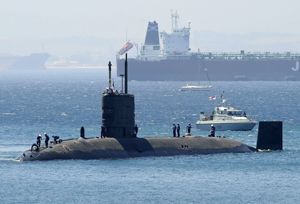
The British nuclear submarine HMS Talent is pictured above as it sailed into the bay of Gibraltar yesterday escorted by a patrol boat from the Royal Navy’s Gibraltar Squadron.

This is the submarine’s second visit to the Rock so far this year.
It called here last May, the first British submarine to stop in Gibraltar in five years.
The Trafalgar-class ‘hunter killer’ submarine arrived yesterday afternoon and it is not known how long it will stay in port.
As is routine in such cases, the Ministry of Defence disclosed no information about the submarine’s visit.
A one-line statement contained the standard line that HMS Talent was visiting Gibraltar “…as part of scheduled operational tasking.”
The visit comes against continued tension in the Bay of Gibraltar over recent incursions by Guardia Civil and Spanish navy vessels.
HMS Talent is described by the Royal navy as a technically advanced, nuclear powered ‘hunter-killer’ submarine, the penultimate in a series of seven Trafalgar Class submarines.
Launched by Princess Anne in Barrow in Furness in 1988, the submarine has conducted operations all around the world.
The principal role of the ‘hunter-killer’ is to attack ships and other submarines.
In this capacity, vessels of this type could support and protect a convoy or taskforce.
HMS Talent can also be used in a surveillance role as it is fitted with cameras and thermal imaging periscopes.
HMS Talent is also fitted with Tomahawk Land Attack Missiles, which gives it a land attack role.

Source – Gibraltar Chronicle

Canada – New $531-million submarine contract protects 200 jobs at Esquimalt

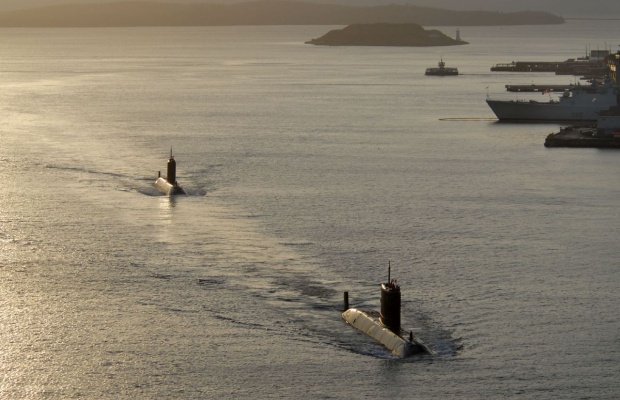
A rare site of two Canadian subs sailing together into homeport for the Christmas holidays. Seen leading the pack is the HMCS Cornerbrook with the HMCS Windsor following. The HMCS Cornerbrook and the HMCS Windsor arrived in the early dawn coming along side in Halifax today in Nova Scotia on the 21st of December 2006

Canada

The Harper government is set to announce a five-year, $531-million contract  extension to repair and upgrade Canada’s fleet of four diesel-electric  submarines

OTTAWA — B.C.’s shipbuilding and repair industry will get a shot of good news  Thursday when the Harper government announces a five-year, $531-million contract  extension to repair and upgrade Canada’s fleet of four diesel-electric  submarines, The Vancouver Sun has learned.

The contract, following a similar agreement struck in 2008, will protect  roughly 200 jobs at the department of national defence’s Fleet Maintenance  Facility in Esquimalt, according to a federal official.

Another 200 jobs will be protected at locations elsewhere in Canada, he  said.

“This significant federal investment will support more than 400 high-quality  jobs, improve the long-term sustainability of B.C.’s shipbuilding industry and  provide the best tools for Canada’s sailors,” he said in a prepared  statement.

The contract was won in a competitive bid by Babcock Canada Inc., a  subsidiary of the British multinational firm Babcock International Group  PLC.

Babcock International won the original contract in 2008 after it teamed up  with Weir Canada Inc. of Mississauga, Ont., to create a consortium called the  Canadian Submarine Management Group.

However, Babcock announced in 2011 that CSMG would be renamed Babcock Canada  Inc. after Weir’s share of the joint venture was transferred to Babcock.

The original contract award caused a political flap because Babcock beat out  Irving Shipbuilding, which wanted to keep the repair work in Halifax.

One of the critics was Green party leader Elizabeth May, who at the time was  planning her run against Defence Minister Peter MacKay in his Nova Scotia  riding.

May, who accused the government of an “anti-Atlantic bias,” is now the MP for  the Vancouver Island riding of Saanich-Gulf Islands.

The original five-year contract in 2008 was worth $370 million over five  years, but if CSMG met performance targets the contract was to be extended over  15 years, for a total value of up to $1.5 billion.

Thursday’s announcement gives a clear indication that Babcock has met those  targets.

The fleet of four Victoria-class diesel-electric submarines has had a rocky  history after the Liberal government made what appeared to be the  bargain-basement purchase of the mothballed subs from the Royal Navy for $750  million in 1998.

It took far longer and was costlier than expected to make the vessels  seaworthy, and in 2004 the HMCS suffered a fire that left one officer dead. In  2011, HMCS Corner Brook ran aground near Vancouver Island during manoeuvres.

There are now two subs, HMCS Victoria and HMCS Windsor, that are fully  operational.

HMCS Chicoutimi is currently being serviced at Esquimalt but is expected to  be ready for sea trials later this year.

The HMCS Corner Brook is also in Esquimalt for both repairs and a refit.

The fleet is “at the highest state of readiness that they’ve ever been,” the  source said.

Source – The Vancouver Sun

UK – AMS wins submarine equipment contract

UK – Stokesley-based firm Analox Military Systems has won a valuable contract to supply submarine equipment to the Norwegian Navy

Analox Military System is to supply the Norwegian Navy with submarine equipment


A manufacturing specialist has won a six-figure contract to supply the Norwegian Navy with submarine equipment.

Analox Military Systems (AMS), which specialises in the design and manufacture of gas analysis equipment, has signed the contract with Norwegian Defense Logistics Organisation (NDLO) to supply the Norwegian Navy with two carbon monoxide monitoring systems for six ULA-class submarines.

Established more than 30 years ago, the Stokesley-based firm already exports to navies around the world including the USA, Brazil, Holland, Australia and Sweden.

It will undertake the development, manufacture, installation and commissioning of the new system, with the first due to be delivered in February.

Analox Ltd divided its operation into two divisions in 2011, launching Analox Military Systems Ltd to help it continue the business growth.

AMS, which also won Exporter of the Year Award at the North East Business Awards 2006, delivers services and products for military customers around the world. It is currently working with Hakon Rygh, its Norwegian distributor, on the installation and commissioning phase.

Vicky Brown, sales and marketing director at AMS, said: “We’re very proud to be supplying the Norwegian Navy with gas analysis equipment.

“Historically, carbon monoxide monitoring has been problematic for submarines owing to the presence of hydrogen.

“AMS’s new system uses an accurate infra-red technique and as a result, is not sensitive to hydrogen, giving the submariners confidence in the accuracy of the monitoring.”

Commander Baard Gjerstad, project manager submarine projects for NDLO, added: “We needed equipment which would not be affected if hydrogen was present, and Analox Military Systems is able to deliver systems which meet this specific need. We are looking forward to working with AMS on this contract.”

The submarine has people living and working within a confined space. It is therefore essential the atmosphere is carefully managed at all times to limit exposure of the crew to potentially harmful substances.

The new CO monitoring system, which is designed specifically for submarines, will be officially launched at DSEi, a major defence and security exhibition in London, from September 10 to 13.

Brown added: “ We are expanding our team and boosting our engineering capability. This contract win, and the growth of our team, is testament to the commitment and hard work of everyone at AMS.”

This contract win, and the growth of our team, is testament to commitment and hard work

Source –  The Journal

Trident: Lib Dems consider end to continuous at-sea nuclear deterrent

Trident nuclear submarine

The future of Britain’s Trident nuclear programme has split the coalition

The Liberal Democrats are considering calling for Britain to give up its permanent at-sea nuclear deterrent within the next few years.

They are expected to use a review of Trident to say some of the UK’s four nuclear submarines should not be replaced after they are decommissioned.

But senior figures are now pushing to end Britain’s continuous at-sea deterrent even earlier, from 2016.

A decision about the future of Trident has to be made by that point.

This would mean that some of the existing Vanguard submarines would be confined to port with skeleton crews and used for spare parts to keep the remaining boats operational.

The hope among Lib Dems is that this would not just save billions of pounds but would also send a signal that it is possible for a nuclear state to reduce its arsenal while keeping some kind of a deterrent.

‘Kept in port’

This was hinted at last week when Lib Dem Treasury chief secretary Danny Alexander said it was time “to move on from the Cold War postures of the past” with a credible deterrent that “can play a role in supporting disarmament in future”.

One senior Lib Dem MP said: “We are looking at ending continuous at-sea deterrent even earlier. We don’t have to wait until the subs need replacing. We could just keep them in port now.”

Another Lib Dem MP said: “If you thought that you could sustain a meaningful deterrent with two boats, then nothing would prevent you using the existing boats on the same principle.

“It would be reckless to scrap them but you could cannibalise them for parts.

The proposal is contained in an internal party policy paper on defence which is said to be at a “pretty late stage of development” and will be put to the Lib Dem conference in September.

Mr Alexander has chaired the government’s review of Trident which is sitting on David Cameron’s and Nick Clegg’s desks and will be published shortly.

It is expected to say that some of the potential alternative ways of delivering nuclear weapons – from land or from air – are either too expensive or too impractical. But the review is expected to consider the option of scaling back the current submarine-launched system.

Most military experts agree that it would be impossible to provide a continuous, around-the-clock nuclear deterrent with less than four Vanguard submarines. With training and repairs, there is frequently only one submarine on duty at sea.

‘Credible’

The Conservatives are committed to a like-for-like replacement of Trident which is estimated to cost as much as £20bn. But many Lib Dems believe that Trident is too expensive and distorts the defence budget.

They hope to argue that it would be better to spend the money on troops and kit.

Last week Mr Alexander told the BBC’s Andrew Marr programme that the review was seeking to answer whether like-for-like replacement was “the only way to protect our country in future”.

“And while the review doesn’t come to any conclusions, I think when we publish the results in a few weeks time people will see that there are choices available to this country, there are alternatives where we can move on from the Cold War postures of the past and try and set out a new future for this country with a deterrent that is credible but where this country can play a role in supporting disarmament in future.”

A Lib Dem spokesman said: “The Cabinet Office-led review into alternatives to Trident has now been submitted to the prime minister and deputy prime minister.

“The review’s findings will now be considered and an unclassified version will be published in due course.”

A senior Conservative source said: “Abandoning our continuous at sea deterrence, which has been the ultimate safeguard of our national security for more than 45 years, would be a reckless gamble.

“And leaving our nuclear-armed submarines rusting in port, and then seeking to deploy them at a time of crisis would not only put Britain’s security at risk, but would also risk escalating global tensions.

“Conservative policy is clear: we will safeguard Britain’s national security and maintain our continuous at sea deterrent.”

John Woodcock, Labour MP for Barrow and Furness, said: “Unilaterally ending the commitment to keeping at least one nuclear submarine operational at all times will make no meaningful contribution to global non-proliferation, in fact it could have the opposite result by unsettling other countries who are currently under NATO’s umbrella of protection.

“The Liberal Democrats are finally admitting there is no alternative mini-deterrent that could save billions, but few will be taken in by their latest fallacy that a part-time deterrent could save lots of money and protect Britain adequately in the event of a threat in future decades.”

Source – BBC News