Tag Archives: Submarine

U36: Another Fuel Cell Submarine for the German Navy

HDW Class 212A submarine

One of the most modern non-nuclear submarines in the world has been named during a ceremony at the shipyard of ThyssenKrupp Marine Systems GmbH, a company of ThyssenKrupp Industrial Solutions AG. This marks another important milestone in the ongoing shipbuilding programme for the German Navy: U36 is the second boat of the second batch of HDW Class 212A submarines destined for operation in the Navy. The German town of Plauen has assumed sponsorship for U36. The ultra-modern submarine was named by Silke Elsner, companion to the Mayor.

The contract to deliver a second batch of two HDW Class 212A submarines was signed on 22nd September 2006 in Koblenz with the German Office for Military Technology and Procurement/BWB (now the German Office for Equipment, Information Technology and Employment of the Bundeswehr/BAAINBW). The submarine building activities are taking place at the shipyards of ThyssenKrupp Marine Systems in Kiel and Emder Werft- und Dockbetriebe in Emden.

The two additional units will be largely identical to their sister ships from the first batch. They are also equipped with the HDW air-independent fuel cell propulsion system which has already given excellent results in operations with the boats of the first batch. The German Navy submarine U32 gave renewed proof of this in April 2013. On the way to participate in naval exercises in the USA the boat produced a new record for non-nuclear submarines with 18 days in submerged transit without snorkelling.

To meet changes in operational scenarios and to take constant technological advances into account, a number of modifications have been made in the second batch:

  • Integration of a communications system for Network Centric Warfare
  • Installation of an integrated Sonar and Command and Weapon Control System
  • Installation of a superficial lateral antenna sonar
  • Replacement of one periscope by an optronics mast
  • Installation of a hoistable mast with towable antenna-bearing buoy to enable communication from the deep submerged submarine
  • Integration of a lock system for Special Operation Forces
  • Tropicalisation to enable world-wide operations.

The Italian Navy has also decided in favour of a second batch of two HDW Class 212A submarines, which are being built under licence by the Italian shipyard Fincantieri. That means that the Italian Navy will soon also have four boats of this class available for operations.


U36 – Technical Data:

General boat data:
Length over all: approx. 57 m
Height including sail: approx. 11.5 m
Maximum hull diameter: approx. 7 m
Displacement: approx. 1,500 t
Crew: 28
Pressure hull built of non-magnetic steel

Propulsion system:
Diesel generator
SIEMENS Permasyn® motor
HDW fuel cell system [SIEMENS PEM fuel cell]
Low-noise skew-back propeller

Source – Fuel Cell Today

Mystery of French submarine disasters can never be unveiled


Mystery of French submarine disasters can never be unveiled. 50107.jpeg


The death, or rather, sudden disappearance of Eridis submarine of the French fleet stirred heated debate in the world. The tragedy occurred early in the morning on March 4, 1970. Despite the fact that the site of the tragedy was found almost immediately, it took specialists almost two months to find the submarine itself. This is not the only mysterious detail about the disaster.

Generally, there is very little information about French submarine Eridis. In contrast, dozens of books have been written and several documentaries have been made about the death of Russia’s Kursk submarine. A well-known documentary on the Kursk disaster was filmed by famous French journalist Jean-Michel Carre. The reason and basis for the film, as the author of the film admits, was the article published on the Pravda.Ru website three years after the death of the Kursk.

During the International Film Festival of marine and adventure films “The Sea is Calling,” which takes place in St. Petersburg, the author of this article had a chance to talk to the former commander of France’s third nuclear submarine, Rear Admiral Jean-Marie Mate. The admiral did not reveal any special secrets about the Eridis other than those that can be found in the open press, albeit in limited quantities. Jean-Marie Mate pointed out that submariners, whatever their nationality might be, always remain heroes. Figuratively speaking, they have only one nationality that is directly connected with their profession that is equally difficult and dangerous in all navies of the world.

But still, why did the death of Eridis submarine receive so little attention in the press, books and movies? The disappearance and death of this submarine in the Mediterranean Sea used to be a worldwide sensation … The secret of secrets. However, we managed to find some information on the subject. We had to resort to the help of translators from French and dig into into the archives of the Russian, or more precisely, Soviet Navy (the Russian military also investigated the disaster). Here’s what we found out.

The Eridis submarine belonged to the Daphne class of diesel-electric submarines. There were eleven submarines of this type built for the French Navy, and all of them were named after mythical goddesses, nymphs and dryads. Submarines of this class were built for the navies as Spain, Portugal, South Africa and Pakistan. The full water displacement of the submarine made up a little more than a thousand tons. It was about 58 meters long and was outfitted with 12 torpedo tubes (which was a bit more than any Russian submarine of the class had).

According to historical information that can be found in Russian sources, the construction of submarine S-644 Eurydice began in July 1958 at Direction des Constructions et Armes Navales shipyard in Cherbourg. The sub was launched on June 19, 1960, and on September 26, 1964 the submarine was passed into service. Its service was common for French submarines: combat training of the crew, patrolling the southern coast of France and North Africa and escorting civilian vessels with important goods. The Eridis has never traveled outside the waters of the Mediterranean Sea.

Early in the morning of March 4, 1970, the Eridis left the base of Saint-Tropez. There were 57 people on board. At sea, the submarine, in cooperation with aviation, was supposed to exercise the search and conventional attack against a submarine of a potential enemy. For this purpose, the Eridis was in touch with the basic patrol plane Atlantic that took off from Nimes-Garon naval air base. The sea seemed to be calm at first. Interestingly, pilots saw the periscope breaker of the Eridis when the sub was about seven miles to the south-east off Cape Camara. Communication was normal. Suddenly, early in the morning, at 7.13 a.m. local time, messages from the Eridis ceased to arrive. The Atlantic aircraft lost the radar contact with the submarine …

In his last radio message, the submarine commander said that he was taking the course in the area of ​​the exercise and was preparing to submerge. Very quickly, almost immediately after the break of connection, naval aircraft and anti-submarine vessels began to look for the lost vessel. The French navy sent everything that was available into the sea: surface ships Surcouf, Dyuper, Picard, Vendée, Alert, Arago, Jean Charcot, six minesweepers, Daphne and Doris submarines, as well as airplanes and helicopters. The Italians and Americans also took part in the search: they sent four minesweepers and the Skylark rescue boat.

The approximate area of ​​the death of Eridis was found quickly. The place, where patrol aircraft Atlantic saw the submarine during the last session, was found as well. A large spot of diesel fuel, pieces of plywood and a punch card with the name “Eridis” were found some time later. The remains of the submarine proved that the submarine had sunk. Experts began to investigate the disappearance of the submarine. They analyzed samples of the diesel fuel that was found on the water surface. The analysis showed that the fuel had a high content of sulfur, which was characteristic of the fuel of the lost submarine.

Four days after the start of the search, the administration of the French Navy announced the Eridis and 57 members of its crew perished. Officers on rescue ships removed their caps, and all ships of the French fleet blared their horns in memory of the victims.

Some time later, after analyzing the data of seismographs of coastal surveying laboratories, it was found that there was an explosion recorded on March 4th, at 7.28 a.m.. The place, where the tragedy occurred, was found quickly. However, it took specialists quite a while to find the submarine itself.

The relatives of the dead sailors demanded the submarine be found at all costs and the cause of its death be established. The French government asked the United States to assist in the search for Eridis. American rescue ship Mizar arrived in Toulon: the vessel successfully demonstrated her abilities during the search for the Thresher submarine. It was only on April 22, more than 1.5 months after the death of the submarine, when the Americans detected and identified several large fragments of Eridis scattered at depths from 600 to 1,100 meters …

It was later found that a large fragment of the stern of the Eridis was resting in the center of a strange crater that was 30 meters in diameter. All metal fragments of the sub were strangely twisted and deformed. European newspapers started guessing. Design flaws? Crew error? The version about alien intervention was especially popular during that time. Some suggested that the Eridis collided with a merchant vessel. Indeed, Tunisian, Argentine and Greek cargo ships traveled across the area, where the accident occurred.

The results of the investigation have never been exposed to the general public. The death of the Eridis caused national shock in France. A few years before, three French submarines sank with their crews near Toulon, one after another. On December 6, 1946, U-2326 submarine tragically sank (France received the submarine after the defeat of Nazi Germany). On September 23, 1952, submarine Sibylle was lost (former British R.229 Sportsman). January 27, 1968 became the day when France lost Minerve sub (of the same type with Eridis).

The reasons of those disasters remain a mystery. Is there a Bermuda Triangle in the Mediterranean Sea?

In Toulon, at one of the main bases of the French Navy, a monument to the dead submariners was erected. The French still go there to honor the memory of the dead submariners.

Source – English Pravda

Singapore and Australia sign submarine rescue arrangement

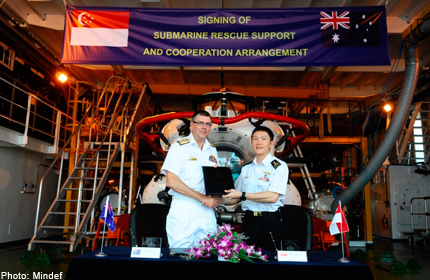
RAN's Chief of Navy Vice-Admiral Ray Griggs (left) and RSN's Chief of Navy Rear-Admiral Ng Chee Peng (right) at the signing the Submarine Rescue Arrangement on board the RSN’s submarine rescue and support vessel, MV Swift Rescue.

RAN’s Chief of Navy Vice-Admiral Ray Griggs (left) and RSN’s Chief of Navy Rear-Admiral Ng Chee Peng (right) at the signing the Submarine Rescue Arrangement on board the RSN’s submarine rescue and support vessel, MV Swift Rescue.

SINGAPORE – The Republic of Singapore Navy (RSN)’s Chief of Navy Rear-Admiral Ng Chee Peng signed the Submarine Rescue Arrangement with Royal Australian Navy (RAN)’s Chief of Navy Vice-Admiral Ray Griggs earlier today.

The agreement was signed on board the RSN’s submarine rescue and support vessel, MV Swift Rescue.

The Submarine Rescue Arrangement establishes a framework between the RSN and RAN in the area of submarine rescue support and cooperation. Under the arrangement, the RSN will make available to the RAN MV Swift Rescue and other resources to render support and assistance in the event of an RAN submarine incident.

The Ministry of Defence said that the Submarine Rescue Arrangement reaffirms the close and long-standing bilateral defence relationship between Singapore and Australia, where both armed forces interact frequently through exercises, visits, professional exchanges and military courses.

Source – Asia One

Japan – Military to respond to submarines entering territorial waters, PM Abe warns

Military to respond to submarines entering territorial waters, PM Abe warns

Prime Minister Shinzo Abe has once again issued a warning against any intrusion into Japan’s territorial waters, this time referring to foreign submarines that will attempt to pass through underwater. This is in response to the Defense Ministry’s report that a foreign submarine was spotted just outside the contiguous zone, south of Kumejima Island in Okinawa Prefecture on Tuesday.

The contiguous zone is a 12 nautical mile strip outside territorial waters so the submarine still did not violate any international laws. Rules state that vessels can pass freely through the waters given that their intentions are peaceful. Submarines are required to surface and display their national flags if they are already navigating in territorial waters. There is still no indication from what country the spotted vessel was but Ministry officials have said that they probably belong to the Chinese Navy.

Abe told the parliament that submarines entering territorial waters is a “serious issue” and would require maritime security action. This indicates that the Ministry could direct Japan’s Self Defense Forces to move if there would be any confirmed intrusion. This incident, while not violating any laws, is too close to reports of three Chinese government ships that were near the disputed Senkaku/Diaoyu islands last Monday. The Japanese Coast Guard says that this is the 43rd incident of Chinese ships entering Japanese waters since September 2012.

While observers do not believe that China would mount any actual attack or military move on the waters, it is just further proof of them boasting their naval and military capabilities. They have been criticized for showing off an aggressive stance against countries that have a territorial dispute with them, particularly Vietnam, the Philippines and Japan.

Foreign submarine  spotted near Japanese territorial waters

Foreign submarine spotted near Japanese territorial watersA foreign submarine was detected in a contiguous zone just outside Japanese territorial waters south of Kumejima Island in Okinawa Prefecture, Japan’s Defense Ministry revealed on Tuesday. Ministry officials did not elaborate on the submarine vessel’s country of origin, but a government source revealed that the sub likely belonged to the Chinese Navy.

“I was prepared to order ‘maritime security operations’ immediately upon getting approval from the Prime Minister (Shinzo Abe), if the submarine entered Japan’s territorial waters,” Defense Minister Itsunori Onodera told reporters on May 13. Under the current Self-Defense Forces Law, Onodera has the authority to order Japan’s Self-Defense Forces (SDF) units to conduct whatever was necessary to protect Japanese lives and property at risk, and to maintain the nation’s security at sea. These circumstances, often termed as “maritime security operations,” allow the SDF to use weapons in lawful self-defense and emergency evacuation of citizens. The last time such an order was made was in November 2004, when a Chinese submarine entered Japan’s territorial waters – the area around the Sakishima island chain in Okinawa Prefecture. The latest case did not involve any incursion into Japanese territorial waters, but Onodera is believed to have mentioned such information as a stern warning to any country that may have been involved.

It is known that international law does not prohibit submarines from entering contiguous zones such as in this incident. It is a calculated tact by Japan’s Defense Ministry to make the latest incident public because of the fact that the passage through the contiguous zone was over a prolonged period of time, which made it very unusual. Tense maritime situations have been par for the course with China and Japan as the territorial dispute over the Senkaku/Diaoyu island chain continues to drag on. On Monday, three Chinese maritime surface ships broke the 12-nautical-mile rule and approached one of the islands, which according to the Japanese Coast Guard was the 43rd incident where Chinese ships in the area entered Japanese territorial waters since September 2012. This incident, including the submarine issue, is causing further tension in an already escalating situation.

Source – JDP

Crew of first Vietnamese submarine to make five 10-days sea voyages

The sea part of the training of the crew of the first Project 636 submarine built for the Vietnamese Navy has begun in the village of Svetly near Kaliningrad, a source in the Russian shipbuilding industry told Interfax-AVN.

“The theoretical, coastal part was followed by the sea part of the training, which includes five 10-days sea voyages,” the source said.

“Since the beginning of the factory trials, which included tests by the customer’s representatives, the first export series submarine has successfully conducted 23 dives,” he said.

In 2013, the shipbuilding enterprise Admiralteiskiye Verfi will provide to the Vietnamese Navy the first two diesel electric Project 6363 Varshanyanka submarines  of the six submarines envisioned by the contract, a source in the Russian defense industry told Interfax earlier.

The contract for the supply of six diesel electric Project 6363 submarines was signed in 2009 during a visit to Moscow by Vietnamese Prime Minister Nguyen Tan Dung.

Besides, submarine construction, the contract envisions the training of Vietnamese crews and the supply of the needed equipment and technical property.

Project 6363 diesel electric submarines are third-generation submarines. These submarines have a good modernization potential that makes it possible to integrate new weapons, including the anti-ship missile system Club, which considerably expands the target area.

A training center is created to train the crews of the Vietnamese submarines in Kamran with assistance from  the ST. Petersburg OAO Concern NPO Avrora.

The enterprise developed and created five systems for these submarines, specifically, the computerized information system Lama and the submarine management system Palladiy.

Source – Russia Beyond the Headlines

Russia boosts its submarine exports to Asia

Two Malaysian Air Force Lady officials take a look at the two submarines from France "La Praya" and Pakistan "Hurmat" at the Langkawi International Maritime and Aerospace (LIMA '97) Exhibition 03 December in Malaysia's resort island Langkawi.
Two Malaysian Air Force Lady officials take a look at the two submarines from France “La Praya” and Pakistan “Hurmat” at the Langkawi International Maritime and Aerospace Exhibition in Malaysia’s resort island Langkawi.


During the Langkawi International Maritime and Aerospace exhibition taking place in Malaysia, Igor Vilnit, the CEO of the Russian developer of submarines Rubin, reported on the progress of a number of development projects aimed at exporting Russian submarines to Asian countries. Vasily Kashin, an expert at the Center for Analysis of Strategies and Technologies, analyzes the situation.

This year Vietnam will receive the first of six Project 636 submarines it has ordered. At present, the first Vietnamese submarine, which was named “Hanoi”, is already undergoing testing. At the beginning of this year the Vietnamese team of the future vessel started its training in Russia. Simultaneously, Russian specialists are building in Vietnam the entire necessary infrastructure for using the submarines and training the submarine personnel.

One cannot exclude the possibility that the transfer to Vietnam of the Project 636 submarines will go more quickly than what was stated by Rubin’s CEO, – suggests expert Vasily Kashin. It is known for a fact that the second submarine of the Vietnamese order has already been launched, while the third one is expected to be launched in August. It is quite possible that this year Vietnam will get two submarines and another one in 2014. All six submarines have to be transferred to Vietnam by the end of 2016.

Thus, 2013 will be used to develop the Vietnamese fleet’s submarine forces. Prior to this Vietnam tried to set up its submarine forces by purchasing two superlight submarines from North Korea, but it failed. North Korea’s light submarines turned out to be too weak in their combat capabilities.

According to Vasily Kashin, an expert at the Center for Analysis of Strategies and Technologies, the acquisition of the Project 636 submarines from Russia satisfies Vietnam’s need to defend its sovereignty at sea and in reality poses no threat to the interests of Russia’s strategic partner China. The limited submarine forces would not give Vietnam any chance of winning the battle against the Chinese fleet, which supersedes it by several times, but would allow it to preserve the status-quo with its own resources. The lack of its own effective naval forces could push Vietnam towards a closer partnership with powers from outside the region, like it happened in the Philippines’ case. Taking all this into account, the real conflict between Vietnam and China has a very low probability as China’s policy towards Vietnam is based on the maximum engagement of the Vietnamese in trade and economic cooperation.

Another promising direction for the export of Russian submarines to Asia is India. The India’s navy is getting ready to announce a tender for the purchasing of 6 non-nuclear submarines. According to Rubin’s CEO Igor Vilnit, Russia is planning to offer the Indians its submarines of the Amur-950 project. Amur-950 is a reduced version of the Amur-1650 submarines, the acquisition of which China is currently negotiating to purchase. Compared to Amur-1650 they have a lower displacement and a lower range, while their armament is just slightly inferior to that of the Amur-1650 submarines.

The specific qualities of the Amur-950 submarines include the vertical launch for 10 ballistic missiles, which if needed could be launched within 2 minutes.

The offer to the Indian Navy includes the vessels equipped with ultrasound ballistic missiles “Brahmos” jointly produced by Russia and India. Russia’s participation in the Brahmos project is considered to give a serious advantage to the Russian proposal for this tender, in which the French submarine producers are participating as well. Obviously, these submarines of a low displacement are meant to be used in the Indian Ocean only.

 At the same time, the negotiations with China are still underway to supply four larger Amur-1650 submarines, of which two are likely to be equipped with the new Russian engines which work without air supply. Due to the extended range of action, the Amur-1650 submarines can be used in the Pacific Ocean at far distances from the bases. Compared to the Project 636 submarines supplied to China earlier, Amur-1650 boats have lower level of perceptibility, which increases their chances of overcoming Japan’s system of submarine defense.

The modern diesel-electric submarines are an effective and relatively inexpensive weapon, which gives the naval forces of Asia’s developing countries a chance to stand up to the large fleets of the developed countries, believes Vasily Kashin, a Russian expert on defense issues. The experience of the Falklands war of 1982 and the subsequent naval military exercises of the NATO countries revealed that with proper management such boats can successfully overcome the anti-submarine defense of aircraft carrier combat groups.

Source – The Voice of Russia

Decision to test the dismantling of nuclear submarines in Rosyth ‘right’

319996463

A proposal to put the dismantling of redundant nuclear submarines to the test at Rosyth in Fife is the “right decision”, the local MP Thomas Docherty has said.

Defence Minister Philip Dunne has announced that redundant nuclear submarine dismantling would be trialled in Rosyth. If the process works, the remainder of the UK’s retired nuclear fleet will be cut up in both Plymouth and Rosyth.

But he announced a further consultation on where intermediate-level nuclear waste would be stored, widening the choice to include commercial and other defence sites.

The consultation will start next year, and the Rosyth pilot will not go ahead until a storage site has been identified.

Seven redundant nuclear submarines are thought to have been stored at Rosyth since the 1990s. Eight submarines are berthed at Devonport, with others due to come out of active service in the future.

Mr Docherty said: “What the MoD is saying – and I think most people in the community would agree – is that the safest most practical way is to dismantle the submarines at the two sites. I don’t think there’s widespread opposition to that. The bit that’s more controversial is what happens to the nuclear materials. The MoD have said nothing will happen until storage has been approved. ”

However, SNP Lochgelly and Cardenden Fife councillor Ian Chisholm said he was concerned Rosyth could be left as a nuclear dump for 20 years.

He said: “It’s the things that are not in the report’s conclusions I worry about not the things that are in it.

“It’s a bit of a fudge in that we are still years away from getting rid of this radiation hazard from Rosyth.

“I had hoped the hulks would be towed complete, down to Devonport where they belong and where they were serviced when Rosyth lost out on the work and kobs. It is now the MoD’s decision to dismantle one sub’s radioactive pressure vessel on site at Rosyth. The only plus point is they have decided the pressure vessel should be removed in one piece but the fly in the ointment is where that piece should be stored.

“The MoD now say that if the pilot is successful the remaining subs will be dismanted at both Rosyth and Devonport but I take that with a pinch of salt. From previous MoD discussions it seems the pressure vessels are too “hot” to go straight to long term storage and would need to cool for 20 years above ground.

“But depressingly the subs will stay exactly as they are until a suitable Intermediate Level Waste site is selected.”

MoD programme manager John Davis said: “Decisions have now been taken, subject to regulatory and other statutory approvals, on where the initial phases of submarine dismantling will take place…

“No radioactive waste will be removed from the submarines, however, without a disposal or storage solution being agreed.”

Source – The Courier

Submariner Day in Russia

09.11.2008 АПЛ подлодка подводная лодка судмарина Акула Нерпа

March 19th marks Submariner Day in Russia. 107 years ago, on March 19th 1906, Emperor Nicholas II issued a decree declaring submarines a separate class of warships and including ten submarines in the Russian Navy.

Russia’s first submarine – the Dolphin – rolled off the Baltic Shipyard in 1904.

At present, submarines make up the backbone of the country’s naval strategic nuclear forces.

Naval mariners, Navy veterans and cadets will lay flowers to the monuments of submariners and shipbuilders who took part in the creation of submarines.

Floral tributes will also be laid to the Kursk Submarine Memorial outside the Central Museum of the Armed Forces in Moscow.

Source – The Voice of Russia

The insane plan to rescue Napoleon from St. Helena by submarine

Back in the early 19th Century, an Irish adventurer and smuggler named Tom Johnson hatched a plot to rescue the exiled Napoleon from his island prison on St. Helena. But to do so he would need to approach the heavily guarded island with extreme caution. That’s when he decided to design his very own submarine — decades before the invention of the first practical underwater vessel.

This remarkable story comes courtesy of Mike Dash, an expert in 19th century European history. And it’s a story that really got started back in 1814 with Napoleon’s first banishment, an exile that saw him re-located to the small Italian island of Elba. But in a regrettable turn of events for his foes, Napoleon escaped and returned to France where he set up the famous Hundred Days campaign.

So, in an effort to really and truly be done with him, the British sent Napoleon to St. Helena in 1815 after his defeat at Waterloo.

But this time they meant business. St. Helena is a small island in the South Atlantic located about 1,200 miles from the nearest land. It’s also an island that features steep cliffs and has no viable landing places for boats. St. Helena was also guarded by the Royal Navy, along with a large garrison consisting of 2,800 men armed with 500 cannon. It was the perfect prison for the deposed Emperor — one intended to keep him there permanently.

The British were right to be worried that he’d escape. According to Dash, there’s enough historical evidence to suggest that this plan was very real. And in fact, Johnson likely devised the scheme after seeing a conceptual submarine design by Robert Fulton from 1806.

Called the Etna, the craft would have been 40 feet long and crewed by 34 men. It would also have been armed with torpedoes — something Johnston had every intention of adding to his version of the underwater machine.

Writing in the Smithsonian, Dash writes about the plot:

The narrative passes silently over the not inconsiderable difficulty of how such small vessels were to make the voyage south to St. Helena, and moves on to their appearance off the island — the Etna so close to the shore that it would need to be “well fortified with cork fenders” to prevent being dashed to pieces on the rocks. The plan then called for Johnson to land, carrying “a mechanical chair, capable of containing one person on the seat, and a standing foot-board at the back,” and equipped with the enormous quantity of 2,500 feet of “patent whale line.” Leaving this equipment on the rocks, the smuggler would scale the cliffs, sink an iron bolt and a block at the summit, and make his way inland to Longwood.

“I should then obtain my introduction to his Imperial Majesty and explain my plan… I proposed that [a] coachman should go into the house at a certain hour… and that His Majesty should be provided with a similar livery, as well as myself, the one in the character of a coachman and the other as groom…. We should then watch our opportunity to avoid the eye of the [naval patrols on] guard, who seldom looked out in the direction of highest point of the island, and upon our arriving at the spot where our blocks, &c., were deposited, I should make fast one end of my ball of twine to the ring, and heave the ball down to my confidential man…and then haul up the mechanical chair to the top. I should then place His Majesty in the chair, while I took my station at the back, and lowered away with a corresponding weight on the other side.”

The escape would be completed at nightfall, Johnson wrote, with the emperor boarding the Etna and then transferring to the larger Eagle. The two submarines would then make sail — they were to be equipped, Johnson’s account notes, with collapsible masts as well as engines. “I calculated,” he finished, “that no hostile ship could impede our progress…as in the event of any attack I should haul our sails, and strike yards and masts (which would only occupy about 40 minutes), and then submerge. Under water we should await the approach of an enemy, and then, with the aid of the little Etna, attaching the torpedo to her bottom, effect her destruction in 15 minutes.”

Unfortunately — or fortunately for Europe’s sake — Johnson’s plot was never realized. But even if he had reached Napoleon, Dash suspects that the deposed Emperor wouldn’t have gone for it:

There is no need to suppose that Napoleon himself had any inkling of a plan to rescue him; the scheme Johnson laid out in 1835 is so woolly it seems likely that he planned simply to try his luck. Such evidence as survives from the French side suggests that the emperor would have refused to go with his rescuer in the unlikely event that Johnson had actually appeared at Longwood; salvation in the form of an organized invasion was one thing, Bonaparte thought; subterfuge and deeds of desperate daring quite another. “From the start,” Ocampo says, Napoleon “made it very clear that he would not entertain any scheme that would require him to disguise himself or require any physical effort. He was very conscious of his own dignity and thought that being captured as a common criminal while escaping would be demeaning.… If he left St. Helena, he would do it ‘with his hat on his head and his sword at his side,’ as befitted his status.”

Indeed, Napoleon spent the rest of his days at St. Helena, dying in 1821.

Source – io9.com

Bangladesh to buy first submarine

Bangladesh is to acquire its first submarines to boost its naval power in the Bay of Bengal, Prime Minister Sheikh Hasina announced Monday, only days after she signed the country’s largest defence deal.

“We have made a decision to add submarines with base facilities to Bangladesh’s navy very soon to make it a deterrent force,” Hasina said, as she commissioned the country’s first domestically produced warship at a base in the southern city of Khulna.

“We will build a modern three-dimensional navy for future generations which will be capable of facing any challenge during a war on our maritime boundary.” The announcement is the latest sign of Hasina’s willingness to spend heavily on defence, coming only nine days after she signed a $1 billion defence deal in Russia for the purchase of training fighters, helicopters and anti-tank missiles.

Analysts have said the deal with Moscow represents the biggest military purchase agreement since impoverished Bangladesh won its independence in 1971.

Hasina did not give details of how many submarines the country would be purchasing and from where, but a senior army general told reporters on Monday that Bangladesh was in negotiations with China on the subject.

Bangladesh, a third of whose 153 million population lives below the poverty line, has been expanding its defence capabilities in recent years, building a new air base close to neighbouring Myanmar and adding new frigates.

A UN tribunal ended a territorial dispute between Bangladesh and Myanmar last March, but the row had brought the two sides close to military conflict in 2008 when Myanmar sent naval ships to support drilling for gas.

Bangladesh has also a long-standing dispute with neighbouring India over their maritime boundary in the resources-rich Bay of Bengal.

Hasina said the amicable settlement of the sea dispute with Myanmar has ensured the country’s sovereignty over 111,631 sq.km (43,100 sq.miles) of maritime area, nearly the size of the country itself.

She added the defence purchase was essential to ensure security of the huge area, in which Dhaka last month invited bidding from international oil companies to drill for new gas and oil reserves.

According to the state-run BSS news agency, the new warship that Hasina officially commissioned on Thursday was made in Khulna Shipyard under the supervision of the Bangladesh Navy.
The “BNS Padma” is armed with four 37-mm and two 20-mm cannons to resist land and air attacks and capable of laying mines.

Source – Times Online