Category Archives: UK Submarines

News, views and stories about UK submarines

Jude Law apes Gibraltar submarine captain for new film Black Sea

ACTOR Jude Law has prepared for his next Hollywood role by joining the crew of an operational Royal Navy nuclear submarine on patrol.

Jude-Law-on-board-submarine-HMS-Talent-in-Gribraltar-for-filmingJude Law on board submarine HMS Talent in Gribraltar for filming

The 40-year-old actor spent several days on HMS Talent learning the life of a submariner, and he remained on board when the vessel left Gibraltar to take part in war games in the Mediterranean.

However, London-based Law, whose film credits include The Talented Mr Ripley and Sherlock Holmes, was not allowed to see the most sensitive operational areas of the hi-tech submarine.

The actor is due to star in the film Black Sea as a British submarine captain who embarks on a hunt for a stolen submarine with gold on board.

He was very down-to-earth, he went around every department and worked out with the Captain

Leading Seaman Anthony Morgan

Crewmen said he immersed himself in the job and made sure he ate with all the officers and sailors. Leading Seaman Anthony Morgan said: “He was very down-to-earth, he went around every department and worked out with the Captain.”

When Law left he was given a “dolphin” badge, which is presented to newly-qualified submariners.

Source – Express

‘Sub should go on show in Greenock’ – HMS Onyx

CALLS for a submarine to be exhibited in Greenock have resurfaced – following news that a new ‘silent service’ museum is to be opened on the other side of the Clyde

HMS Onyx

SAVE SUB: HMS Onyx could be scrapped if no-one comes up with the money to buy the submarine

Source – Greenock Telegraph


The Malpas birthplace of Newport’s submariner hero, Commander John ‘Tubby’ Linton VC, is to get a blue plaque

linton

HONOUR: The Malpas birthplace of Newport’s submariner hero, Commander John ‘Tubby’ Linton VC, is to get a blue plaque

A RENOWNED submarine commander from Newport who was awarded the Victoria Cross will be recognised tomorrow with the unveiling of a plaque on the house where he was born.

John Wallace Linton VC, known as ‘Tubby’, was born in Malpas and went on to command submarines during the Second World War.

He was responsible for sinking around 100,000 tonnes of enemy shipping but died along with his crew, almost certainly due to his submarine, HMS Turbulent, being hit by an Italian depth charge.

The blue plaque will be 18 inches in diameter and will read: “Commander John Wallace Linton VC, distinguished service across the Royal Navy, was born here 15 October 1905. Posthumously awarded the Victoria Cross 25 May 1943 for conspicuous gallantry whilst in command of HM Submarine Turbulent during operations in the Mediterranean Sea.”

It will be mounted on the porch of the house where he was born in the grounds of St Joseph’s Hospital.

This plaque will be the first of a series dedicated to submarine commanders.

Rick Rothwell, secretary of the Submariners’ Association, said: “He was very well thought of by all his crew.

“That goes a long way to a submarine achieving good results, the crew being 100 per cent behind the commander.

“The management committee thought it was a good idea, while there are still living contacts to the submarine VCs, to commemorate them.

“It’s a piece of history that may never be repeated. The submarine service is over 113 years of age and in that very short time it achieved 14 Victoria Crosses.”

The Victoria Cross is the highest military honour for gallantry awarded to British and Commonwealth forces.

Doug Piddington, 81, secretary of the Newport and Cwmbran Royal Naval Association, said: “He (Tubby) was one of the greatest submarine commanders that the country has ever seen.”

A memorial service to Commander Linton is held every year and in 2004 a Wetherspoons pub on Cambrian Road was named after him.

Source – South Wales Argus

WWI submarine graveyard discovered by underwater archaeologists

german u-boat (whatsthatpicture flickr)

A short way off England’s south and east coasts, under less than 50 feet of water, archaeologists have discovered the remains of 41 German and 3 UK submarines sunk during World War I. Der Spiegel reports that the watery graveyard is home to several U-boats that the German Imperial Navy still lists as missing. Now that the vessels have been discovered, the race is on to explore them before they disintegrate entirely.


Nearly half of Germany’s 380 U-boats were lost during the war

The German vessels were an integral part of Germany’s naval strategy at the time, inflicting heavy damages on the British fleet. But when discovered, their slow speed and undeveloped torpedo technology ultimately left them easy prey for warships, and nearly half of Germany’s 380 U-boats were lost during the war.

Since many of the subs were sunk during active duty, the bodies of the crew are expected to still be inside — what are called “disaster samples.” But further examination and preservation of the sites presents some tricky legal hurdles. Firstly, under UK law, the sunken subs are considered “inviolable gravesites.” And secondly, UNESCO doesn’t consider the wrecks to be archaeological artifacts worth protecting since they’re still less than 100 years old.

Source – The Verge

£2m nuclear submarine crane nears completion at Kingswinford firm

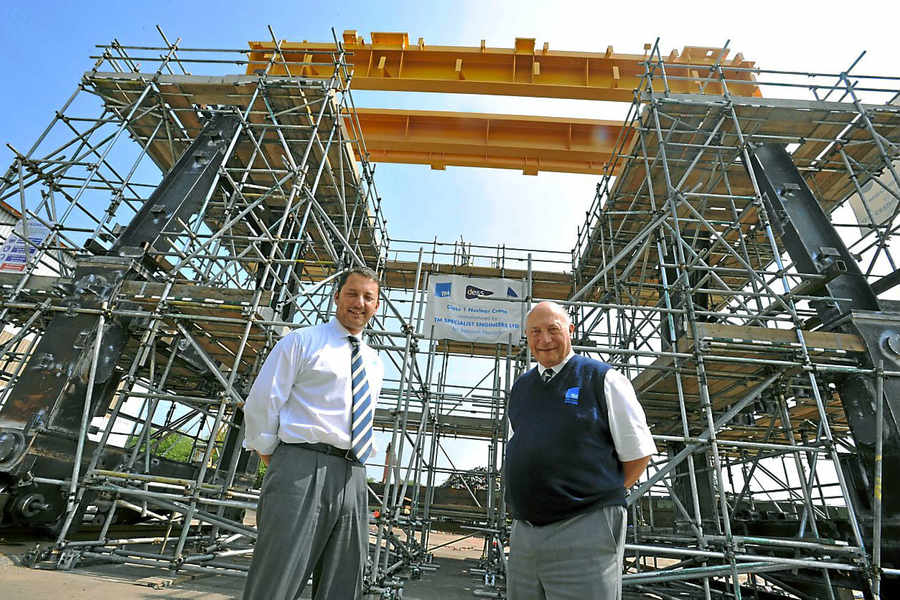
A £2 million defence project to build a colossal crane for the decommissioning of nuclear submarines is nearing completion at a Black Country firm.

30675337
Managing director Robert Holland, right, and sales manager Richard Holland with the colossal crane in Kingswinford

Around 50 workers at Kingswinford’s TM Engineers have been working to create the 40ft high and 60-tonne structure, for the past two years.

Bosses from the company, in Oak Lane, today said the finishing touches were now being added to the crane.

It will be used to remove rods from the nuclear reactors of Trafalgar-class submarines at the end of their service life.

Work is due to be completed on the project within the next few weeks.

It will then be broken down into five separate pieces and transported from the firm’s headquarters during the next month.

The crane will eventually form part of a larger structure installed at the Devonport Royal Dockyard – where the submarines will be stripped down.

It takes around two years to fully strip a submarine and the crane has been designed to withstand natural disasters such as tsunami, hurricanes and earthquakes.

The structure is designed to be in operation for 30 years with designers at the Black Country firm having to anticipate what will be required of it during that period.

Around 8,000 hours of welding has gone into creating the structure.

Sales manager at the company Richard Holland said all of the staff at the firm deserved credit for the successful project.

“You can design something but it is the workers here who have made it a reality. They have worked tremendously hard over the past two years,” he said. “It has been a very difficult project to work on as technology and the demands on the structure change so quickly.

“This has been a highly prestigious contract for us. It has involved all of our staff at various points during the project.”

It is not the first major project to have been completed by the firm. It won a prestigious £750,000 deal to build parts for the famous Large Hadron Collider in Switzerland. The firm developed mechanised parts for the project which helped capture atoms as they are sent careering around the 16-mile underground structure.

The parts, called E-Cal End Plates, were 13ft wide, made from aluminium and sent in two sets to Geneva. They took six months to develop due to the complicated nature of the manufacturing process.

A carbon fibre ‘shroud’ and lead blocks were attached to holes on the plates to catch the atoms.

The firm which employs 55 staff was founded more than 60 years ago. It is one of only 10 firms worldwide to be awarded special gold plaques from Geneva for its work on the Hadron Collider. The firm became involved through Rutherford Appleton Laboratories in Oxfordshire.

Source – Express & Star

UK – Work starts on sixth Astute submarine at Barrow

Agamemnon keel

The keel is the first part of a submarine to be built

A ceremony has been held at a Cumbrian shipyard to mark the start of work on the sixth of a fleet of seven new submarines for the Royal Navy.

The Astute-class vessel – a nuclear-powered attack submarine – is being built at BAE Systems in Barrow.

It has been officially named Agamemnon after the Greek mythological King, though it has not yet been constructed.

A keel laying ceremony took place at Devonshire Dock Hall.

Defence Equipment Minister Philip Dunne attended the ceremony and revealed the Ministry of Defence (MoD) had signed a new contract with BAE Systems.

The Barrow yard has been working on the Astute programme since 2001.

The other submarines are HMS Astute, Ambush, Artful, Audacious and Anson. The seventh will be named HMS Ajax.

Hard to detect

The keel for the first vessel – HMS Astute – was laid in January 2001 and the craft was launched in June 2007.

Mr Dunne said: “The keel-laying of Agamemnon and the handover of HMS Astute and HMS Ambush to the Royal Navy are huge milestones, reflecting significant progress in the programme.

“By ensuring the UK’s submarine programme remains affordable, this new contract will help deliver the Astute Class and secure around 5,000 jobs at BAE Systems and thousands more in over 400 suppliers across the UK submarine supply chain.”

The fleet of submarines will be based at Faslane in Scotland.

The Astute Class of vessels have greater firepower, state-of-the-art communications equipment and advanced stealth technology, making them quiet and harder to detect, according to the MoD.

Source – BBC News

UK – Mourners pack out funeral for ex-submariner – Video clip

THE Armed Forces are sometimes dubbed ‘the biggest family in the world’ and today proved exactly that.

http://www.portsmouth.co.uk/news/defence/mourners-pack-out-funeral-for-ex-submariner-1-5289388

Scores of mourners turned out at Fareham Cemetery, Wickham Road, to see off Rodney ‘Vic’ Silvester, a veteran who served on nuclear submarines for many years.

Vic, 67, died last week at QA Hospital after losing his fight with cancer.

Prior to his death, he had spent a short time at Woodland Court residential care home in Portchester.

Not much had been known about Vic before his death as he had become withdrawn after his friends and family had all died.

His one remaining cousin came forward to organise the funeral, but when Supporting Veterans in Care Facebook group heard that Vic faced a lonely funeral, it put out a plea for mourners.

The British Legion and the Submariners’ Association heard about the funeral and followed suit.

Today, representatives from the groups and people who had read the plea in The News turned out in Fareham.

A service was held where mourners heard about Vic’s career at HMS Dolphin, on HMS Odin and on HMS Dreadnought, before he was laid to rest.

A bugler played the Last Post as his coffin was committed to the ground.

John Harper, from Bognor Regis, is Vic’s second cousin. He said: ‘I think what these guys do is fabulous, absolutely superb. I didn’t expect such a large turn out, it’s brilliant. I would like to say thank you very much for everybody for turning out. Rod would have been chuffed to bits, so would his dad. He would have loved every bit of it.’

Roy Dixon, from Gosport, is part of the Submariners’ Association. He said: ‘We heard that Vic had passed and the information was very scant but one significant factor was that we had heard only one member of family had been in contact. So we decided that we would not let the side down, and do what we would always do and attend the funeral of a fellow submariner. I’m so pleased that the turn out is as good as this, from all walks of navy life, surface ships, bombers, diesel boats, there’s even a green beret here which is really something.’

Lisa Smith and Tamie Pye, staff from Vic’s care home, were at the funeral.

Tamie said: ‘He came out of his shell once he came to us. He was like a new man.’

Lisa said: ‘He kept himself to himself but he did like to have a good chat, especially about his navy days.’

Father Paul Miles-Knight led the service . He said: ‘It is amazing to see. At the start there was only going to be me and three others here but thanks to the wonders of the internet, the veterans got together. He would have been proud.’

Source – The News


Trident: Does Britain need a submarine-based nuclear missile system that will cost £100 billion?

Ministers argue that having nuclear submarines permanently patrolling our waters has “served us well”

So, the Lib Dems’ long-awaited review of alternatives to Trident is Here.

Having pledged to “say no to the like-for-like replacement” in their election manifesto in 2010, then being forced to cede ground in order to enter into power, the review was always going to represent something of a fudge. Essentially it outlines a slimmed down version of the current system, which would deliver a bit less firepower and very little in the way of savings to the taxpayer.  It’s done little to paper over the cracks in the Coalition with the Defence Secretary condemning the plans as “reckless”, and the Prime Minister flatly rejecting them.

Most importantly the review fails to address the blindingly obvious question of whether Britain, decades after the Cold War and in the grip of austerity, actually needs a submarine-based nuclear missile system that will cost an estimated £100 billion over the next 30 years. I’ll be raising this point in a debate in Parliament today.

In any case, what the Lib Dems think seems to be of little relevance.

The Government, regardless of the views of its coalition partners, Parliament, or the public has been ploughing money into a replacement.

In response to a parliamentary question I tabled in 2010, the MoD revealed it was already spending billions on enriched uranium components and high explosives.

Ministers argue that having nuclear submarines permanently patrolling our waters has “served us well”.  But has our security really been greater than other nations that have chosen not to spend billions on a permanent flotilla of nuclear submarines?  Do we sleep safer in our beds than the Germans or the Japanese?

The fact is that the Liberal Democrats, like the Conservatives and like Labour, refuse to accept the major strategic and economic benefits that non-renewal would offer.  These include improved national security (with flexibility to spend elsewhere on the armed forces) and improved global security.  Britain’s moral authority in global multilateral disarmament initiatives depends on its own behaviour.  How can we dictate to Iran or other nations seeking to join the nuclear club while we remain wedded to Trident?

This is a time when growing numbers of our citizens are relying on food banks. When public sector workers are having their pay frozen.  When vital services that the most vulnerable in our society depend on are being cut daily. And when the armed forces themselves are under strain.

It’s not lefty-pacifist propaganda to ask whether we should be refusing to move on from a past era of warfare. Four former senior military commanders have voiced concerns  that “replacing Trident will be one of the most expensive weapons programmes this country has seen” and highlighted concerns about its impact on  defence equipment budget.

You might reasonably ask, like the former Prime Minister John Major: “In what circumstances, and upon whom, is Trident likely to be used?” The Government’s own National Security Strategy has downgraded the threat of state on state nuclear warfare, while highlighting the emergence of new 21st Century threats – including climate change, pandemics, organised crime and cyber warfare – as well as terrorism, the threat of which is arguably heightened by the kind of posturing that Trident represents.

But instead of facing up to the real threats of the modern world, the Government sadly seems determined to lock the UK into the costly technologies of the past.

Source – The Independent

Trident submarine base: No 10 disowns MoD’s Faslane sovereignty proposal

Whitehall row and SNP anger ignites over report of plans to make naval base UK territory if Scots vote for independence

Faslane naval base in Scotland which hosts the UK's nuclear submarines

Faslane naval base in Scotland which hosts the UK’s nuclear submarines.

A furious behind-the-scenes row has prompted Downing Street to disown a proposal to designate as sovereign UK territory the Scottish naval base that hosts Britain’s Trident nuclear deterrent, in the event of Scottish independence.

No 10 rushed out a statement saying that it was neither “credible or sensible” to give the Faslane base the same status as the British sovereign military bases in Cyprus, following an argument involving senior members of the cabinet and the former chancellor Alistair Darling.

Amid an angry reaction from the Scottish National party (SNP), which drew parallels with Saddam Hussein’s annexation of Kuwait, a No 10 spokesman said: “This government has not commissioned contingency plans over Faslane. No such ideas have come to the secretary of state or the prime minister. They would not support them if they did. It is not a credible or sensible idea.”

Downing Street swung into action after Darling, who heads the pro-UK Better Together campaign, telephoned No 10 on Thursday morning to warn about the impact of a report in the Guardian about the Faslane base on Gare Loch in Argyll and Bute.

The Guardian reported that Ministry of Defence officials were starting to examine plans to designate the Faslane base as a Sovereign Base Area along the lines of its military bases in Cyprus.

The report dominated the morning lobby briefing in No 10, usually chaired by David Cameron, after the MoD confirmed the report in an email to the BBC late on Wednesday night.

A decision was taken to try to kill the story after the unit in No 10, run by Andy Dunlop who co-ordinates the government’s handling of the independence referendum, issued a stern warning that the sovereign base idea was a gift to the SNP.

One source close to a senior cabinet minister said of the MoD’s interest in the sovereign base idea: “What a ridiculous thing to say. Talk about handing a gift on a plate to the SNP.”

The SNP accused Westminster on Wednesday night of seeking to bullyScotland. Speaking during the weekly session of business questions,Angus MacNeil, the SNP MP for Na h-Eileanan an Iar said: “May we have a debate on the dangers and evils of imperialism and annexation of another country’s territory, whether it be Saddam Hussein in Kuwait or, at the other end of the spectrum, the Westminster government who, as the front page of the Guardian reports, are bullying Scotland as part of ‘project fear? Free peoples across the world will condemn that and stand with Scotland in the name of freedom.”

Darling was understood to be particularly concerned because he feared that the MoD’s proposals for Faslane would undermine the central theme of a major lecture he gave at the University of Glasgow on Thursday on the referendum. The former chancellor he said he wanted Scots to make a positive choice to remain in the UK and “not merely to reject the risks and uncertainties of independence”.

It is understood that a senior official from Darling’s Better Together campaign telephoned the No 10 Scottish referendum unit late on Wednesday night to express deep alarm about the Faslane plan. The group was assured that the No 10 unit was equally appalled that the private thinking of the MoD on such a sensitive matter had entered the public domain.

One source in the Better Together campaign said: “We phoned Downing Street to bluntly ask what was going on. They were already on to it.”

Darling, who called No 10 himself, showed his irritation after his speech in Glasgow. Picking up on the submarine theme, he said: “It was a row that quickly surfaced and equally quickly it was sunk. It was a frankly ridiculous proposal to suggest we could possibly designate part of Scotland as different from the rest. I am glad the UK government has hit it hard on the head – that’s exactly what it deserved.

“Any normal person looking at it for more than 10 seconds would come to the view that this was something that should just go straight into the bucket.”

The Guardian reported on Wednesday night that MoD officials were starting to examine plans to ensure that the Vanguard submarines could remain at the deep-water Faslane base and nuclear warheads could continue to be stored at the nearby Coulport base on Loch Long. The Guardian reported that, ahead of next year’s referendum, the MoD was officially working on only one option for the Faslane base – a defeat for the SNP. An MoD spokesperson told the Guardian: “No contingency plans are being made to move Trident out of Scotland. The scale and cost of any potential relocation away from Faslane would be enormous.”

But a defence source said the idea of designating Faslane as sovereign UK territory in the event of an SNP victory was being taken seriously. The source said: “It would cost a huge amount of money, running into tens of billions of pounds, to decommission Faslane. Those costs would be factored into any negotiations on an independence settlement. The sovereign base area is an option. It is an interesting idea because the costs of moving out of Faslane are eye wateringly high.” A version of this was emailed to the BBC, which ran a story on its website with the headline: “Faslane Trident base could be in UK after Scottish independence”. The MoD emailed the BBC to say: “The sovereign base area is an option. It is an interesting idea.”

Source – The Guardian

Major new submarine museum planned for River Clyde

Two Navy servicemen on a 'Stickleback' submarine in 1954. Picture: Royal Maritime Museum

Two Navy servicemen on a ‘Stickleback’ submarine in 1954. Picture: Royal Maritime Museum

A MULTI-million pound museum to create the biggest ­memorial in the world to more than 5,300 Commonwealth sailors killed in the line of duty, and honour Scotland’s role in the ­development of submarine technology, is planned for the banks of the River Clyde.


Award-winning architect ­Gareth Hoskins, who designed the £47 million National Museum of Scotland redevelopment, the Culloden Battlefield Memorial Centre and the Bridge Arts Centre, has been asked to draw up plans for the new £6m building overlooking the Firth of Clyde at Helensburgh.

Funding for the proposed Scottish Submarine Centre is being sought from a consortium of private and public bodies with organisers claiming to have secured pledges of more than £1m so far.

An application for £240,000 is due to go before the Scottish Regional Armed Forces Community Covenant Awards Board for approval later this month.

The Community Covenant grant scheme was launched by the Ministry of Defence in August last year. It offers funding of £30m over four years to UK projects which strengthen ties between serving and former military personnel with their communities.

The proposed Submarine Centre will be the only one of its kind in Scotland. Already, the Royal Navy Museum has agreed to donate an X51-class submarine as a centrepiece of the state-of-the-art digital museum to act as a memorial to submariners from around the world.

The midget submarine is a direct descendant of the X-class subs whose crews trained in the Firth of Clyde during the ­Second World War to develop the techniques needed to attack enemy shipping in the narrow fjords of Norway. The X51, improved on the wartime midget submarines, was first unveiled in 1954 on the Gareloch in the Firth of Clyde. Capable of carrying a crew of five, the miniature subs were used for a variety of roles. However, the history of submarines and the Clyde is much longer.

It is hoped the new facility will open by the end of 2016 in time for the 100th anniversary of the K13 disaster. Thirty-two people died when the steam-driven submarine failed during sea trials in the Gareloch near Helensburgh on 29 January, 1917 within sight of the location proposed for the new museum and memorial. Brian Keating, a Helensburgh-based businessman who is driving the project, said: “Helensburgh and the Clyde have been associated with the submarine service for more than 100 years. A lot of work was done here to pioneer the technology.

“The Clyde has also played a major role as a home to submarines on active duty. Many of the most famous and daring ­missions carried out during the Second World War either began here or were in some way connected with the Clyde.

“We want to create a world-class museum which celebrates the marine engineering heritage of the Clyde shipbuilders involved in the development of submarines and serves as a memorial to the brave men from all over the Commonwealth who served in the ­‘silent service’.”

Architect Hoskins, a native of Helensburgh, was recently awarded a series of top awards.

Source – Scotsman