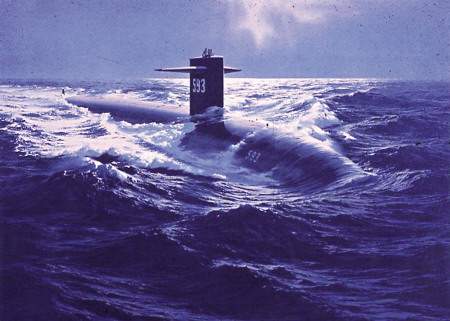
Submarine USS San Francisco leaves on deployment

The 361-foot San Francisco was built at Newport News Shipbuilding in Virginia.

The 361-foot San Francisco was built at Newport News Shipbuilding in Virginia. US Navy

The fast attack submarine San Francisco left Point Loma Tuesday for a six-month deployment to the western Pacific, says the Navy. The boat, commissioned 31 years ago, went to sea with a crew of roughly 140 sailors. The Navy said San Francisco’s mission involves “maritime security, forward presence, sea control, and power projection.”

The San Francisco has been homeported here since 2009. The boat was moved to Point Loma after it underwent a bow replacement that became necessary after the San Francisco slammed into an underwater seamount more than 400 miles southwest of Guam in 2005.

San Francisco is one of six Los Angeles-class nuclear-powered submarines homeported at Point Loma. One of those boats, the Topeka, just arrived at the Portsmouth Naval Shipyard in Kittery, Maine for a three year overhaul. Earlier this year, Topeka completed a 35,000 mile mission in the western Pacific.

Northrop’s X-47B drone shot into air via ground-to-flight catapult

The 361-foot San Francisco was built at Newport News Shipbuilding in Virginia.

The Topeka arrives at the Portsmouth Naval Shipyard in Maine. US Navy

The 361-foot San Francisco was built at Newport News Shipbuilding in Virginia.

The Point Loma-based Jefferson City underway recently. US Navy

Source – UT San Diego

India upgrading submarine fleet

India is constantly upgrading its submarine fleet with modern weapons and sensors, Defence Minister A.K. Antony said Monday.

//

This was done to “ensure that the combat capacity of the country remains at the desire level”, he said in a statement in the Lok Sabha.

“The government has approved the submarine programme to adequately augment (the) submarine fleet of the navy,” he said.
The minister was asked if the government had signed any agreement with foreign countries regarding procurement of submarines with state-of-the-art technologies.

He said the government signed a contract in 2005 with Mazagon Dock Ltd, Mumbai, to construct six Scorpene class submarines under Project-75.
Mazago Dock Ltd was building these submarines after signing an accord with a French company, he said.

Source – IndiaTVnews

General Dynamics Awarded $41 Million for Submarine Maintenance and Modernization

EB_News-landing-page

GROTON, Conn. –General Dynamics Electric Boat has been awarded a U.S. Navy contract worth $41 million to perform non-nuclear submarine modernization and maintenance work. Electric Boat is a wholly owned subsidiary of General Dynamics (NYSE: GD).

Under the contract, Electric Boat will continue operating the New England Maintenance Manpower Initiative at the Naval Submarine Base here, providing a wide range of non-nuclear overhaul, repair and modernization services in support of submarines, floating dry docks, support and service craft and other equipment at the base. About 250 Electric Boat employees will be engaged in the work.

The contract includes four annual options. If these options were exercised, the cumulative value of the contract would be $222.3 million

More information about General Dynamics is available on the Internet at www.generaldynamics.com

Source – General Dynamics Website.

Fast attack submarine arrives in Maine for maintenance

KITTERY — The USS Topeka (SSN 754), a Navy fast attack submarine, and its crew of 120 enlisted personnel and 13 officers arrived Sunday at Portsmouth Naval Shipyard in Kittery.

In this 2009 photo, the USS Topeka departs Naval Base Point Loma in San Diego for a scheduled deployment to the western Pacific Ocean. Topeka was showcased in the movie, “Transformers: Revenge of the Fallen.”

Shipyard spokesperson Danna Eddy said the Topeka, which recently completed a six-month deployment that took the submarine to the western Pacific Ocean, will undergo maintenance and system upgrades during its stay in Maine.

Its tour of duty, which covered more than 35,000 nautical miles, took the submarine to Japan, Singapore and Guam.

Topeka is the third ship of the U.S. Navy named for the city of Topeka. It is a Los Angeles-class nuclear powered submarine featuring a retractable bow plane and a reinforced sail for working under ice. It has Tomahawk cruise missile capability.

Topeka is assigned to the Pacific fleet . Its homeport is San Diego.

Source – Portland Press Herald

Expert: China’s submarines close to world level

When commentating as a guest on People’s Daily Online, naval expert Li Jie said that submarines independently designed by China are close to those of the United States, Russia, Germany and Japan in performance indicators, despite slight gaps from developed countries in terms of power plant and noise.

Li Jie explained that China’s process of designing and building submarines has been actually getting mature and increasingly improved. By virtue of the intelligence and wisdom of Chinese people, China has made significant achievements in submarine design. The submarines independently designed by China have no big problems but some slight gaps in noise, material application and power supply.

Li Jie added China’s submarines are very close to nuclear submarines developed by the U.S. and Russia as well as conventional submarines developed of Japan and Germany in performance indicators, with narrowing gaps with them. Specifically, China has made improvements in mute effect, invisibility, material application, underwater hitting power, while we are also developing long-range, short-range, anti-ship and ballistic missiles. Additionally, we are also making effort to improve AIP submarines, and have made a great progress.

Source – Peoples Daily online

All at sea: Clyde-based Trident sub stranded in US despite £300m overhaul

Trident submarine HMS Vigilant has been forced to limp back to port in the US after its rudder broke, upsetting Britain’s nuclear weapons patrols and undermining the effectiveness of a £300 million

HMS Vigilant suffered damage while heading home to Scotland

HMS Vigilant suffered damage while heading home to Scotland

The Ministry of Defence (MoD) has confirmed that HMS Vigilant, a nuclear-powered submarine capable of carrying nuclear warheads, was disabled while on the way home to the Faslane naval base on the Clyde after test-firing a Trident missile in the Atlantic off the coast of Florida on October 23.

The submarine is understood to have turned around and returned to the US naval base at Kings Bay in Georgia, near Florida, where the damage is now being investigated and repaired. The base is home to the US fleet of Trident submarines.

A submariner on Vigilant revealed that the boat’s planned schedule had been disrupted when he complained on Twitter that he was “stuck in the USA for Christmas”. Vigilant was due to return to Scotland to recommence continuous patrols of the oceans after a three-year overhaul.

The MoD has released few details of what happened because the operations of Trident submarines have the highest security classification. The ministry never usually says where the boats are, or whether they are carrying nuclear weapons.

“While returning to the UK after the successful firing of an unarmed Trident II D5 missile, HMS Vigilant suffered a defect to her rudder,” an MoD spokesman said. “This is not nuclear-related and the crew and boat have safely returned to port where the defect is being assessed.”

A source told the Sunday Herald that damage had been caused by “debris at sea”, but this was not confirmed by the MoD. “There is no evidence that there was a collision at sea,” said the MoD spokesman.

Steven Savage, a sailor currently serving on Vigilant, sent a tweet on December 8 to the BBC in Teesside saying he was missing Middlesbrough Football Club, known as Boro.

“Can we have a shout out to all the Boro fans on HMS Vigilant (submarine). Stuck in the USA for Xmas #missingtheboro,” he said.

Vigilant is one of four Vanguard-class submarines equipped to carry nuclear-tipped Trident missiles. One submarine is meant to be patrolling the seas 24/7 as part of a policy of “continuous at-sea deterrence”.

Last month, Defence Minister Philip Dunne told Parliament that Vigilant had recently completed a major overhaul.

Test-firing the missile was part of a “demonstration and shakedown operation” designed to demonstrate the effectiveness of the UK’s nuclear deterrent before the submarine returned to service.

According to the Royal Navy, the overhaul cost more than £300m, took three years and involved refuelling the submarine’s reactor. More that 200 significant upgrades were made to the submarine’s machinery and operating systems.

Critics questioned how a submarine that had just undergone such an extensive and expensive overhaul could immediately break its rudder. They were also concerned about whether it would be safe to sail with a defective rudder.

“The navy is probably very concerned about this,” said John Large, an independent expert on nuclear submarines. “It may be that the maintenance work caused the problem.”

He suggested that the rudder could have suffered a mechanical failure with its hydraulics or communications systems, or may have snagged on a cable used to tow a sonar array to detect other submarines.

The incident would also have been embarrassing, Large argued. “I would imagine the boat would have to surface, which is a disaster for a stealth submarine because it can be seen,” he said.

He also pointed out that Trident submarines were very dependent on keeping to their programme. “If something goes wrong it completely screws up the schedule,” he added.

John Ainslie, co-ordinator of the Scottish Campaign for Nuclear Disarmament, claimed that sailing a Trident submarine across the Atlantic with a “dodgy” rudder could cause a collision with “catastrophic consequences”.

He also claimed that repairs would delay when Vigilant becomes fully operational. “It will have an impact on the navy’s ability to keep one Trident submarine at sea at all times,” he said.

“Rather than rushing to patch up the rudder, the MoD should follow the Liberal Democrats’ advice and end continuous at-sea deterrence. Then they can take as long as they like to fix this problem.”

Another Trident submarine, HMS Vanguard, famously collided with a nuclear-armed French submarine, Le Triomphant, in February 2009 somewhere in the Atlantic. Both boats had to return home for repairs.

The submarine is understood to have turned around and returned to the US naval base at Kings Bay in Georgia, near Florida, where the damage is now being investigated and repaired. The base is home to the US fleet of Trident submarines.

A submariner on Vigilant revealed that the boat’s planned schedule had been disrupted when he complained on Twitter that he was “stuck in the USA for Christmas”. Vigilant was due to return to Scotland to recommence continuous patrols of the oceans after a three-year overhaul.

HMS Vigilant - one of the Royal Navy`s Trident submarines

The MoD has released few details of what happened because the operations of Trident submarines have the highest security classification. The ministry never usually says where the boats are, or whether they are carrying nuclear weapons.

“While returning to the UK after the successful firing of an unarmed Trident II D5 missile, HMS Vigilant suffered a defect to her rudder,” an MoD spokesman said. “This is not nuclear-related and the crew and boat have safely returned to port where the defect is being assessed.”

A source told the Sunday Herald that damage had been caused by “debris at sea”, but this was not confirmed by the MoD. “There is no evidence that there was a collision at sea,” said the MoD spokesman.

Steven Savage, a sailor currently serving on Vigilant, sent a tweet on December 8 to the BBC in Teesside saying he was missing Middlesbrough Football Club, known as Boro.

“Can we have a shout out to all the Boro fans on HMS Vigilant (submarine). Stuck in the USA for Xmas #missingtheboro,” he said.

Vigilant is one of four Vanguard-class submarines equipped to carry nuclear-tipped Trident missiles. One submarine is meant to be patrolling the seas 24/7 as part of a policy of “continuous at-sea deterrence”.

Last month, Defence Minister Philip Dunne told Parliament that Vigilant had recently completed a major overhaul.

Test-firing the missile was part of a “demonstration and shakedown operation” designed to demonstrate the effectiveness of the UK’s nuclear deterrent before the submarine returned to service.

According to the Royal Navy, the overhaul cost more than £300m, took three years and involved refuelling the submarine’s reactor. More that 200 significant upgrades were made to the submarine’s machinery and operating systems.

Critics questioned how a submarine that had just undergone such an extensive and expensive overhaul could immediately break its rudder. They were also concerned about whether it would be safe to sail with a defective rudder.

“The navy is probably very concerned about this,” said John Large, an independent expert on nuclear submarines. “It may be that the maintenance work caused the problem.”

He suggested that the rudder could have suffered a mechanical failure with its hydraulics or communications systems, or may have snagged on a cable used to tow a sonar array to detect other submarines.

The incident would also have been embarrassing, Large argued. “I would imagine the boat would have to surface, which is a disaster for a stealth submarine because it can be seen,” he said.

He also pointed out that Trident submarines were very dependent on keeping to their programme. “If something goes wrong it completely screws up the schedule,” he added.

John Ainslie, co-ordinator of the Scottish Campaign for Nuclear Disarmament, claimed that sailing a Trident submarine across the Atlantic with a “dodgy” rudder could cause a collision with “catastrophic consequences”.

He also claimed that repairs would delay when Vigilant becomes fully operational. “It will have an impact on the navy’s ability to keep one Trident submarine at sea at all times,” he said.

“Rather than rushing to patch up the rudder, the MoD should follow the Liberal Democrats’ advice and end continuous at-sea deterrence. Then they can take as long as they like to fix this problem.”

Another Trident submarine, HMS Vanguard, famously collided with a nuclear-armed French submarine, Le Triomphant, in February 2009 somewhere in the Atlantic. Both boats had to return home for repairs.

Source – Herald Scotland

Soviet submarine wreck found off Sweden – Video clip

 Sub reck
Video clip can be viewed by clicking the picture “or” the source link at the bottom…..
 

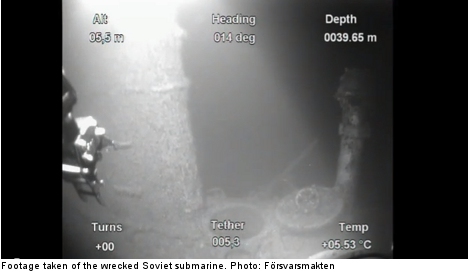
The wreck was discovered earlier this autumn following reports in the Russian media that Swedish civilian divers had found a submarine wreck southeast of Öland, the Swedish Armed Forces (Försvarsmakten) said in a statement.
The wreck was localized by the submarine rescue ship HMS Belos, which also managed to take pictures of the sunken Soviet sub.

According to the Swedish military, the wreck is likely that of S6, a Soviet submarine that went missing in September 1941.
The wreck was found near the Wartburg mine barrier in international waters, but within Sweden’s economic zone.
While it remains unclear exactly what may have caused S6 to go down, an open hatch provides some clues as to what may have happened.
“Boats at the time often sailed on the surface in order to quickly flee and/or to recharge their batteries,” Commander Christian Allerman of the Swedish Navy said in a statement.
The Swedish military theorized that the submarine simply sailed right into the mine barrier and was blown up by a mine.
The wreck consists of two main pieces, with the bow section coming to rest about 20 metres north of the stern section, which was found next to a torpedo-like object.
The images captured by the HMS Belos also show Russian text on the wreck, as well as the Soviet hammer and sickle.

Source – The Local

Brothers perished in Thresher submarine disaster

This portait of USS Thresher by RDML. Tom Eccles was released in April 2008, as part of the 45th anniversary of the submarine disaster.

This portait of USS Thresher by RDML. Tom Eccles was released in April 2008, as part of the 45th anniversary of the submarine disaster.

Scores of families were devastated when the nuclear submarine USS Thresher went down on April 10, 1963, but the blow to the Shafer clan of Connecticut was doubly brutal.

A total of 129 U.S. Navy sailors and civilian workers were lost aboard Thresher in the worst submarine disaster of all time. They were fathers, husbands, sons and brothers. In the case of Benjamin and John Shafer, they were brothers from the same bloodline.

Both were electrician’s mates, and both were career sailors. Benjamin, the oldest of the two, had achieved the rank of master chief petty officer, the highest standard achieved by enlisted men; John was a senior chief, the next highest enlisted rank.

They were also both fathers. When Thresher (SSN 593) was lost during sea trials more than 200 miles off the New England coast, Benjamin left behind three sons and a daughter, while John was survived by four sons.

Michael Shafer, Benjamin’s youngest boy, would grow up to devote 29½ years of his life to the Army, enlisting as a private and retiring as a major in 2005. As a military man, he understands the push to get the world’s most advanced submarine of its day into action. It was, after all, the height of the Cold War with the Soviet Union. As hindsight suggests, however, Thresher may not have been ready for the deep-dive tests it was conducting when it sank.

“They gambled and lost,” Michael said.

Both he and his sister Penny Shafer Craig take pride in the sacrifice their father and uncle made for their country, but acknowledge the heavy toll it took on the family.

According to a 1963 newspaper account that ran in the New London (Connecticut) Day in the wake of the Thresher tragedy, the Shafer brothers’ parents were so distraught they had to be placed under heavy sedation by a physician. Family members gathered in the parents’ home were in a state of shock that day, the report stated; Benjamin’s wife Joyce wept as she disclosed the fatal cruise was to be his last before transferring to another command.

And the Shafers’ mother, according to the newspaper, could be heard wailing repeatedly, “Both my sons! Both my sons!”

“Neither one of them lived long after that,” Clara Main, their only surviving sibling, said of her parents this week. “You can truly die of a broken heart — I believe that.”

Brothers and heroes

Benjamin Nathan Shafer was born in September 1926. He enlisted in the Navy in August 1944, after graduating from Robert E. Fitch High School in Groton, Conn. He then completed basic training in Sampson, N.Y., and served aboard the destroyer USS Doyle (DD 494), during World War II. Benjamin was awarded the Asiatic-Pacific Theater Service Medal, the World War II Victory Medal and other decorations earned prior to his discharge in May 1946.

He worked for a time as a welder at the Electric Boat Division of General Dynamics in Connecticut, then according to Michael, opened an electrical repair shop. After his partner took off with the money from their business, Michael said, Benjamin re-entered the Navy in February 1949. He attended the Navy’s Electrician’s Mate School, and ultimately volunteered for submarine duty

He earned his coveted Silver Dolphins when he qualified as a submariner aboard USS Cobbler (SS 344), and attended the Nuclear Power Training Unit at West Milton, N.Y. He also served aboard the nuclear submarine USS Skipjack (SSN 585) before his assignment to Thresher in February 1961.

John Davis Shafer joined his older brother as a crewmember of Thresher in September of that same year.

“They asked to be on the same submarine,” Clara recalled. “They loved each other; they were brothers. They just wanted to be together.”

John was born in August 1929 in Fort Pierce, Fla. During his school years in Groton, Conn., he received awards in both spelling and history competition. Much of his free time was spent fishing, hunting and bowling.

After graduating from Robert E. Fitch High School in 1947, John enlisted in the Navy and entered basic training at the U.S. Naval Training Center in Great Lakes, Ill. He served aboard the aircraft carrier USS Franklin D. Roosevelt (CVA 42) and the heavy cruiser USS Salem (CA 139) before volunteering for submarines.

He followed his brother to Electrician’s School and proceeded to serve aboard the subs USS Harder (SS 568), Kingfish (SS 234) and Trutta (SS 421), earning his Silver Dolphins aboard Entemedor (SS 340).

A third brother — the oldest, Joe — was also a Navy veteran of World War II, while their father had served in France with the Navy in the First World War.

Michael, the retired Army major, takes solace in knowing the Thresher tragedy directly resulted in the creation of SUBSAFE, the Navy’s enhanced submarine safety program. No vessel has been lost after passing through SUBSAFE in the nearly half-century since Thresher’s loss.

Asked about his thoughts regarding the family’s legacy with the submarine, he cites “The Ballad of the Thresher,” a song by the popular folk band the Kingston Trio. Famous for such 1950s and ’60s hits as “Tom Dooley” and “Where Have All the Flowers Gone,” the band paid tribute to the Thresher’s crew in verse shortly after the disaster. In the ballad’s chorus, the trio sings:

“Every man jack on board was a hero

Every man jack on board there was brave

Every man jack on board was a hero

Each man risked a watery grave”

“If you listen to that song, you’ll know,” Michael explained. “It says it all to me.”

‘I was Daddy’s girl”
In 1969, the 116-man Bachelor Enlisted Quarters at the Atlantic Undersea Test and Evaluation Center on Andros Island in the Bahamas was named Shafer Brothers Hall in honor of Benjamin and John.

“I was very proud that the Navy named this building after my father and uncle,” Penny said. “Even though it’s only a barracks, it’s not very often that they name buildings after servicemen.”

However, the decade was otherwise unrelenting on the family. Penny notes both sets of grandparents died in the 1960s, and just days before Christmas 1969 her oldest brother Steve — a high school senior — died in an auto accident. Their mother was “out of it” for a while after that, Penny said. She would listen to the Glen Campbell tune “My Baby’s Gone” and cry as the country artist sang, “Dry all the raindrops/hold back the sun/the world has ended/my baby’s gone.”

“That one almost did her in,” Penny said of her brother’s death. “Eventually, she came back to us.”

Joyce Shafer went to work at the Navy exchange on the New London Submarine Base in Groton, Conn., and eventually retired as private secretary for the head of research and development there, Penny said. She described her mother as independent, strong and stubborn, but said she rarely talked about the loss of her husband. Joyce never remarried and died of cancer at age 55. Penny was only 5 when her father died, while Michael was 6. They remember very little of their dad.

Penny recalled that he loved the amorous animated skunk Pepe Le Pew, and that a photo of herself at the age 2 or 3 wrapped around her father’s arm was inspired by her mother teasing that Benjamin was “MY daddy!”

“I was Daddy’s girl,” she said.

Michael said his father’s legacy as an honest, responsible family man provided him with a “measuring stick” that he applied as a standard while growing up.

“By all accounts he was a great guy,” Michael said, “but I never got a chance to know him.”

About a dozen members of the Shafer clan, including 79-year-old Clara, plan to attend 50th anniversary Thresher ceremonies in Kittery this April.

Impact on the American psyche

After its commissioning in August 1961, Thresher was considered the fastest, quietest, deepest-diving and most lethal submarine the world had ever known. Its loss was a stunning blow to the nation and the world.

It says something of the Thresher disaster’s impact on the American psyche at the time that in addition to the Kingston Trio’s tribute, legendary folk singer Phil Ochs also dedicated a song to the doomed submarine. “The Thresher” appears on Ochs’ first album, “All the News That’s Fit to Sing,” released in 1964. With haunting lyricism, Ochs captures the early enthusiasm surrounding the submarine’s construction “in Portsmouth town on the eastern shore/Where many a fine ship was born.”

“She was shaped like a tear/She was built like a shark/She was made to run fast and free,” he sings. But eventually a sense of impending doom creeps into his lyrics and the vessel becomes “a death ship all along.” He describes the sub’s final voyage, culminating in a stark final verse that conveys her fate:

“And she’ll never run silent

And she’ll never run deep

For the ocean had no pity

And the waves, they never weep

They never weep.”

LOST AT SEA

For a list of personnel who perished aboard Thresher, visit www.history.navy.mil/danfs/t/thresher1.htm

Source – Sea Coast Online

REVIEW PUBLISHED INTO TRIDENT ALTERNATIVES

Read – Trident Alternatives Review 

THE Nuclear Education Trust has today published its report into the Trident Alternatives Review and the future of Barrow.

The report makes a case for the publication of the Lib Dem-led review into alternatives to “like-for-like” replacement of the Trident nuclear weapons system.

It also concluded that while Barrow is heavily dependent on BAE Systems as an employer, the economic impact of an option other than like-for-like replacement is not ‘a “binary” choice between 6,000 employed or none’.

The report said: “The Nuclear Education Trust heard that diversification for BAE Systems and regeneration of the Barrow economy is extremely difficult. But we also heard that there is evidence of diversification that had been delivered over the past 20 years and that it would be possible in the future. In many respects Barrow, although still dependent on the shipyard, is already transformed from the town it was in the early 1990s.”

The report recommends that the government should ‘take a number of steps now to support a fragile economy’. Reducing Barrow’s dependence on BAE Systems (and thus the need for Trident replacement) could be achieved through a range of investment, regeneration and diversification mechanisms, the report argues.

This could include investment from the Energy Coast Initiative, creation of an Enterprise Zone for Barrow and transitional funding from European Structural Funds, as well as support towards industrial diversification.

The report also suggested an investment of £100m be made in Barrow if there is no like-for-like replacement of the Trident system.

It said: “In the event of a decision to proceed with an option other than a like for like replacement and which means a step down in employment, the government must provide immediate, sustained and considerable support, which should include for instance regeneration funding at the level of £100m for every 1,000 jobs lost to the local economy.”

The Nuclear Education Trust therefore commissioned its research and a survey to examine in detail the alternatives proposed by the Trident Alternatives Review (TAR) and their implications for Barrow.

The project sought to answer the key ‘what if’ question: “What if the UK proceeds with one of the options under consideration by the Trident Alternatives Review and not the full successor programme?”

In its foreword to the report, NET said it was “very aware that the issue of people’s future employment in Barrow is a very sensitive one – “even whispers in the corridors of Whitehall reverberate loudly throughout the town” (TUC). But sensitivity to – or concern about – what happens to people in areas dependent on military contracts is much more widely shared. Hence we hope that our report will resonate with many.”

Barrow and Furness MP John Woodcock said: “There are some valuable recommendations to diversify Barrow’s economy in this report, particular the call for the area to become eligible for energy coast support from which it is currently unfairly excluded.

“But a drive to broaden Barrow’s economic base should be done on the foundation of a thriving shipyard, not as an inadequate replacement for submarine jobs.

“Above all, we should not be distracted by talk of rescue packages when no-one has yet produced any credible evidence that there is a more effective way to provide the nation’s nuclear deterrent than building successor submarines in Barrow shipyard.”

Source – Whitehaven News

BARROW MEMORIAL TRIBUTE FOR SUBMARINE CREWS PLANNED

Ramsden Square, Barrow   in Furness

Ramsden Square, Barrow in Furness

A MEMORIAL is set to be created to remember submariners from Barrow and further afield.

A tribute is set to be sited in Ramsden Square, to mark the coincidental 100th and 50th anniversaries of the Australian Submarine Service and the Barrow Branch of the Submariner’s Association.

Next year will see both organisations celebrate milestone anniversaries and a small tribute is set to be installed to mark those who have served the associations.

Barrow has strong links with Australia with the country’s first two submarines, AE1 and AE2, built at the shipyard before being lost in the Second World War.

An Australian based organisation, AE1 Incorporated, is looking to commemorate the loss of these boats and is attempting to organise memorials in Australia and Barrow.

Barrow Borough Council was approached by the local submariner’s association about sorting the tribute and agreed on Wednesday that the tribute should be sited in Ramsden Square.

Executive director of the council Phil Huck said the memorial’s position would allow a passing salute to be given during the annual Remembrance Day parade.

He said: “There has been some discussions with officers about where the tribute would go. The site that seems to satisfy both officers and the association is in Ramsden Square.”

Councillor Barry Doughty asked if the council had considered placing the memorial in the Coronation Gardens in Abbey Road, near Furness Magistrates’ Court.

He said: “Speaking as an offcomer, I just find that Ramsden Square perhaps doesn’t offer the sensitivity that the memorial should have. I wondered about the Coronation Gardens. Is there any reason why it cannot be put there?”

Mr Huck said both parties wanted the memorial sited in an area where people would visit and that not as many people would see the memorial if it was in the gardens.

Councillor Des Barlow said the memorial would act as a good link between the town and Australia.

The committee agreed to putting the memorial in land at Ramsden Square subject to the design and size of the memorial being agreed.

Source – NW Evening Mail